

Last spring, I stood beneath limestone towers, camera around my neck, completely speechless.
The peaks rose like brushstrokes from an ancient painting, with soft mist around their bases. As small boats drifted below, I wondered how this Guilin landscape might look in the future.
The Very Edge of China, a Discovery Channel documentary, shows how violent tectonic shifts carved this karst terrain over millions of years. The show also made me think about Guilin’s future, not only its past.
What if Guilin became a true net-zero biome by mid-century, absorbing monsoon floods while protecting its ancient stone towers?
Tourism crowds, acid rain, and changing rainfall already strain these fragile caves and cliffs. Yet five emerging pillars, including breathable mineral coatings and kinetic footstep energy, suggest a realistic path toward 2050.
This piece explores Guilin’s landscape future in 2050, joining shanshui aesthetics with futuristic civil engineering.
Key Takeaways
- Guilin’s karst peaks and caverns could evolve into a self-sustaining, carbon-neutral ecosystem by 2050.
- Breathable nano-mineral glazes may shield ancient limestone from acid rain and tourism wear.
- Li River hydrologic sponge systems aim to absorb intense monsoon rainfall naturally.
- Kinetic footstep harvesting along riverside promenades could help power local infrastructure.
- Rising visitor numbers and climate shifts remain the biggest threats to this fragile terrain.
- Traditional shanshui landscape philosophy is merging with advanced civil engineering solutions.
1. Guilin Landscape Future 2050: A New Model for Living Natural Heritage
Picture towering limestone peaks that do more than welcome tourists. They breathe, filter, and regulate the region’s ecosystem, defining the real story behind Guilin’s landscape future 2050.
I’ve hiked across karst regions, from Vietnam’s Ha Long Bay to Slovenia’s limestone caves. Nothing I’ve seen compares to Guilin’s plan: by mid-century, this UNESCO-listed region will act like a living organism. It will give back more than it takes.
1.1 From Scenic Icon to Autonomous Carbon-Neutral Biome
Think of an autonomous carbon-neutral biome as a household that runs itself. The Li River karst towers, underground caverns, and surrounding forests work together. They manage their water cycle, store carbon, and meet power needs without outside support.
This concept draws heavily from ecological-humanities thinking, explored in Why Life Matters: Fifty Ecosystems of the Heart and Mind by Tobias and Morrison. Their work moves beyond simple carbon-neutral goals toward a bolder aim: landscapes that remove more carbon than they release. Guilin’s planners accepted that challenge.
Here, human infrastructure and natural systems are no longer separate. Roads, caves, rivers, and forests form one working whole instead of competing for space.
1.2 Why Karst Preservation Demands a Radical Engineering Mindset
Treating karst like ordinary rock creates a serious problem. Guilin’s limestone towers formed through water erosion over millions of years. That chemical process continues, so Karst keeps changing, even while you’re looking at it.
- Porous surfaces soak up pollutants from rain and dust
- Underground water networks link surface activity directly to fragile cave systems
- Foot traffic and construction vibrations gradually weaken stone structures
- Cave formations like stalactites grow at a painfully slow, irreplaceable pace
Roping off a cave entrance or limiting visitors may slow damage. Yet it cannot stop the chemistry beneath our feet. Acid rain and dust enter the stone whether tourists come or not.
| Aspect | Traditional Preservation | Radical Engineering Approach |
|---|---|---|
| Visitor Management | Fenced viewpoints, limited access | Sensor networks guiding real-time foot traffic |
| Water Protection | Basic surface drainage | Closed-loop hydrologic systems |
| Stone Surfaces | Untreated or heavily sealed | Breathable nano-mineral shields |
| Energy Use | Grid-dependent operations | Self-generating microgrids |
Engineers shaping Guilin’s landscape future 2050 had to abandon the old playbook. Preservation could no longer mean isolation; it required partnership with moving geology. Geology keeps moving whether people notice or not.
That mindset supports Guilin’s next steps. These include mineral glazes shielding Elephant Trunk Hill and underground vaults managing stormwater beneath the Four Lakes. None of it works without engineering that respects karst’s nature.
2. Shielding the Stone: Non-Invasive Mineral Masonry Glazes for Guilin’s Karst Icons

I’ve photographed many rock formations, but Guilin’s karst towers taught me how fragile they are beneath their calm exteriors.
These limestone giants seem permanent, shaped by nature over millions of years. Yet acid rain and pollution have quietly dissolved their surfaces for decades. That’s where non invasive mineral masonry glazes come in, protecting stone without changing its look or feel.
2.1 The Science Behind Breathable Nano-Mineral Glazes
Think of these glazes as an invisible raincoat for stone. They create a microscopic barrier that blocks acidic moisture from entering the surface. Yet the stone can still breathe, releasing trapped humidity instead of holding it inside.
This matters because karst landscapes like Guilin’s formed through a slow chemical reaction. Rainwater absorbs carbon dioxide, becomes slightly acidic, and dissolves limestone over centuries. The book The Very Edge of China explains this process in detail, showing these towers are frozen moments of ongoing chemical weathering.
Modern pollution speeds up that natural process dramatically. Without help, acid rain could erode in decades what nature took thousands of years to sculpt. Nano-mineral glazes slow that process closer to its natural pace.
2.2 Elephant Trunk Hill’s Porous Limestone Towers Under a Protective Shield
Elephant Trunk Hill is probably Guilin’s most photographed rock. I’ve stood at the riverbank at sunrise countless times. I try to capture its weathered grey patina, which makes it look ancient and real.
That patina worried conservationists during this project. Porous limestone absorbs water easily, making it vulnerable while creating the rough texture photographers love.
Applying the glaze required precision. Teams sprayed a nearly invisible mineral solution over the surface, filling microscopic pores without sealing them shut. The color stayed the same, and so did the texture; only the stone’s resistance to dissolution improved.
“Good conservation should be invisible to the eye but permanent to the material,” is the guiding principle behind this kind of stone treatment.
I returned after the work ended, expecting a shinier, more “preserved” looking hill. Instead, Elephant Trunk Hill looked exactly the same. That’s the whole point.
2.3 Reed Flute Cave Net Zero: Guarding Speleothems Without Sealing Them
Reed Flute Cave presents a different challenge entirely. Underground, stalactites and stalagmites grow through mineral deposits over thousands of years. If you seal the cave, you disrupt the airflow these formations need.
The Reed Flute Cave net zero strategy avoids that trap completely. Instead of blocking moisture and air exchange, engineers applied the same breathable glaze technology to vulnerable speleothems. This protects them from lighting-induced algae growth and visitor humidity without altering natural ventilation.
Over-sealing caves is a classic mistake. Trapped humidity speeds decay and encourages mold on delicate formations. By keeping airflow natural, this approach maintains the cave’s climate balance while cutting energy use to almost nothing.
Walking through the cave now, I saw warm light and a thin protective shimmer. I couldn’t spot a single sign of intervention. That’s how good conservation should feel: quiet, careful, and completely in the background.
3. Subsurface Hydrologic Heritage Engineering Beneath the Two Rivers and Four Lakes
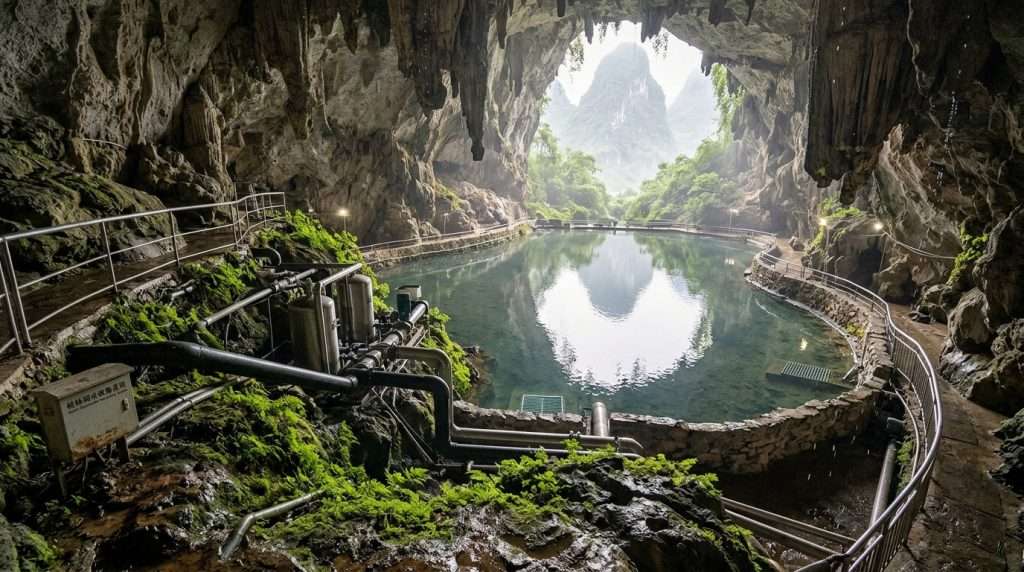
I’ve walked many riverside paths around the world, but none hide a secret like Guilin’s Two Rivers and Four Lakes. Beneath every stone bridge and willow-lined path lies a network of tunnels, sensors, and filtration chambers. This is subsurface hydrologic heritage engineering at work, protecting ancient karst while keeping monsoon floods below the surface.
Most tourists taking photos along the promenade never know this system exists. That’s exactly the point.
3.1 Automated Subterranean Retention Vaults and 100% Flash Flood Capture
Guilin’s rainy season is intense. Monsoon storms can dump huge volumes of water within hours, threatening the old town and its cave systems.
Now, automated subterranean retention vaults wait underground. Rainfall sensors detect rising water in real time, triggering gates that redirect flow from vulnerable streets into storage chambers beneath the city.
The goal is bold: capture 100% of flash flood water before it threatens the historic center or nearby limestone caves. No diesel pumps run, and no manual overrides are needed during a storm at 3 a.m.
Sometimes the best infrastructure is the kind you never notice until you learn it’s there.
That idea stayed with me. I had crossed those bridges many times without knowing I stood above flood controls protecting caves formed over hundreds of thousands of years.
3.2 Closed Loop Reservoir Stormwater Harvesting for Zero-Emission Cooling
Here’s where the system gets smarter. Captured floodwater does not simply wait in a tank for the next storm.
Through closed loop reservoir stormwater harvesting, captured water is filtered and reused. It cools cavern galleries and riverside halls without burning a watt of fossil power. The loop is simple: capture, filter, cool, repeat.
Underground cave networks and galleries gain heat from visitors and humidity shifts. Traditional cooling would use electric compressors around the clock. Instead, filtered groundwater regulates conditions through its natural temperature.
I found this part genuinely surprising. A city famous for limestone towers and river cruises runs an elegant zero-emission cooling setup. I’ve seen few better on any overland trip.
3.3 Lessons from Stadium Porous Asphalt Stormwater Drainage Applied to Riverside Promenades
The third part of this system comes from an unlikely source: sports stadiums.
Large arenas have used stadium porous asphalt stormwater drainage for years, keeping parking lots and walkways usable during heavy rain. Guilin’s engineers adapted this material for riverside promenades around the Two Rivers and Four Lakes.
Instead of rain pooling on stone paths, it filters through the surface layer into the vault system below. No standing puddles, slippery tiles, or flooded sidewalks appear during serious downpours.
| Feature | Traditional Pavement | Porous Asphalt Promenade |
|---|---|---|
| Water absorption rate | Low, causes surface pooling | High, water drains through instantly |
| Flood risk during monsoon | Significant, standing water common | Minimal, water redirected underground |
| Maintenance needs | Frequent repairs from erosion | Lower wear thanks to reduced surface stress |
| Connection to vault system | None, water runs off to street drains | Direct, feeds retention vaults for reuse |
After a rainstorm, I saw no puddles on these promenades. That small detail shows how much thought went into surfaces most visitors barely notice.
4. Powering Guilin Without Emissions: Kinetic Energy and Microgrid Innovation
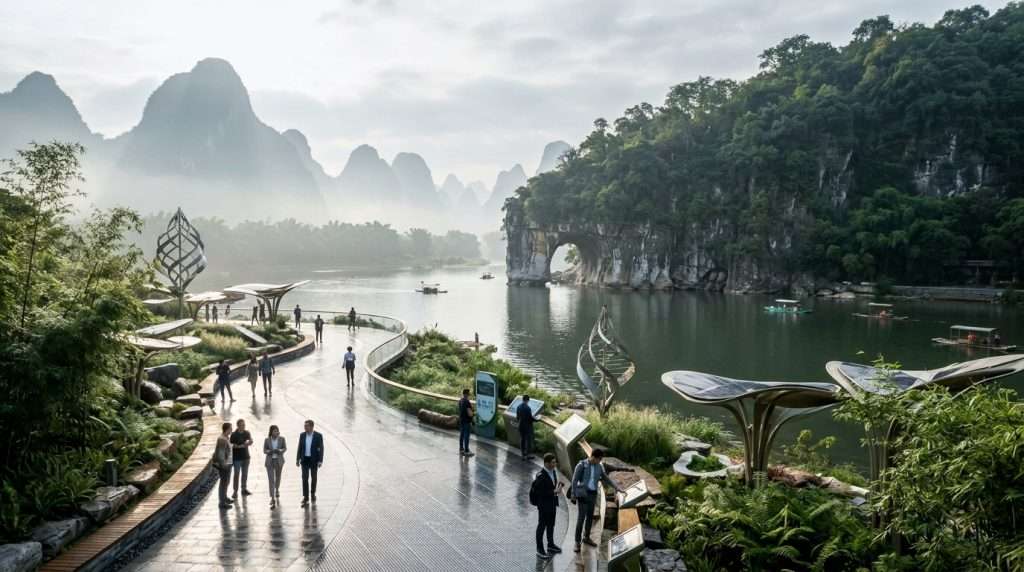
Guilin’s 2050 energy plan avoids the usual choices. It uses no giant solar farms or wind turbines that cut across karst views.
Instead, power comes from daily movement, including footsteps, water flow, and quiet machines beneath walkways and old stone paths. This approach protects the skyline while delivering real, measurable clean energy.
Elephant Trunk Hill Kinetic Microgrid and Piezoelectric Promenades
My boots struck the pavement near Elephant Trunk Hill. Beneath the stone, my footsteps were doing more than moving me forward.
Engineers installed piezoelectric pavers beneath the promenade. These thin panels turn pressure into electricity. Every visitor adds a small charge to the local grid.
Thousands of daily footsteps make those small charges add up quickly. Pressure enters, and power comes out, with zero emissions involved. There is no combustion or quickly wearing machinery.
This system feeds into the Elephant Trunk Hill kinetic microgrid, a small power network for this riverfront area. It does not ask tourists to change their behavior. People stroll, take photos, and admire the hill’s reflection in the water.
Meanwhile, the pavement stores and redistributes energy to nearby lights, sensors, and small visitor facilities. Here is how it compares with a conventional setup:
| Feature | Traditional Power Grid | Elephant Trunk Hill Kinetic Microgrid |
|---|---|---|
| Power Source | Fossil fuels or large-scale renewables | Human footsteps via piezoelectric pavers |
| Infrastructure Visibility | Substations, towers, transmission lines | Hidden beneath walking paths |
| Visual Impact on Karst Scenery | Significant | None |
| Scalability | Requires large land footprint | Expands with foot traffic, no new land needed |
Li River UNESCO Karst Preservation Meets Distributed Clean Power
The Li River lies within a UNESCO-recognized karst landscape, one of China’s most photographed natural settings. This broader view shows why careful energy planning matters.
Large infrastructure, including substations, towers, and solar arrays, could harm the scenery visitors come to see. Distributed clean power solves this problem by blending into the landscape instead of dominating it.
Piezoelectric pavers and micro-hydro turbines along existing water channels can generate enough electricity for local needs. No new tower breaks the horizon. Each system stays small, quiet, and reversible, supporting long-term Li River UNESCO karst preservation.
For travelers like me, this means exploring a world-famous limestone landscape without guilt about environmental impact. Every step helps generate power instead of harming the environment.
Guilin’s model shows that clean energy and heritage protection can share the same footpath. Quite literally, one step at a time.
5. Conclusion
After studying this project, I return to one idea: stone, water, and power can work together. Mineral glazes enliven Elephant Trunk Hill, while hidden vaults manage every flash flood along the Two Rivers and Four Lakes. Quiet kinetic footsteps power promenade lights after dark, helping create a living system rather than a tourist attraction.
To me, Guilin landscape future 2050 means more than a slogan or marketing pitch. It is a working blueprint for a karst landscape shaped over millions of years. It can breathe beside millions of visitors without losing what first made it sacred.
I often think about interdependence when I travel. Every river, every cave, every limestone tower depends on choices made by people who will never see the full results. That is long-term stewardship in its purest form, and witnessing it humbles me.
Someday, I want to walk the Li River promenade, feel stone underfoot, and know it is larger than one visit. I hope more heritage destinations borrow from this model. What would it take to protect your own favorite landscape for the next hundred years?











Leave A Comment