
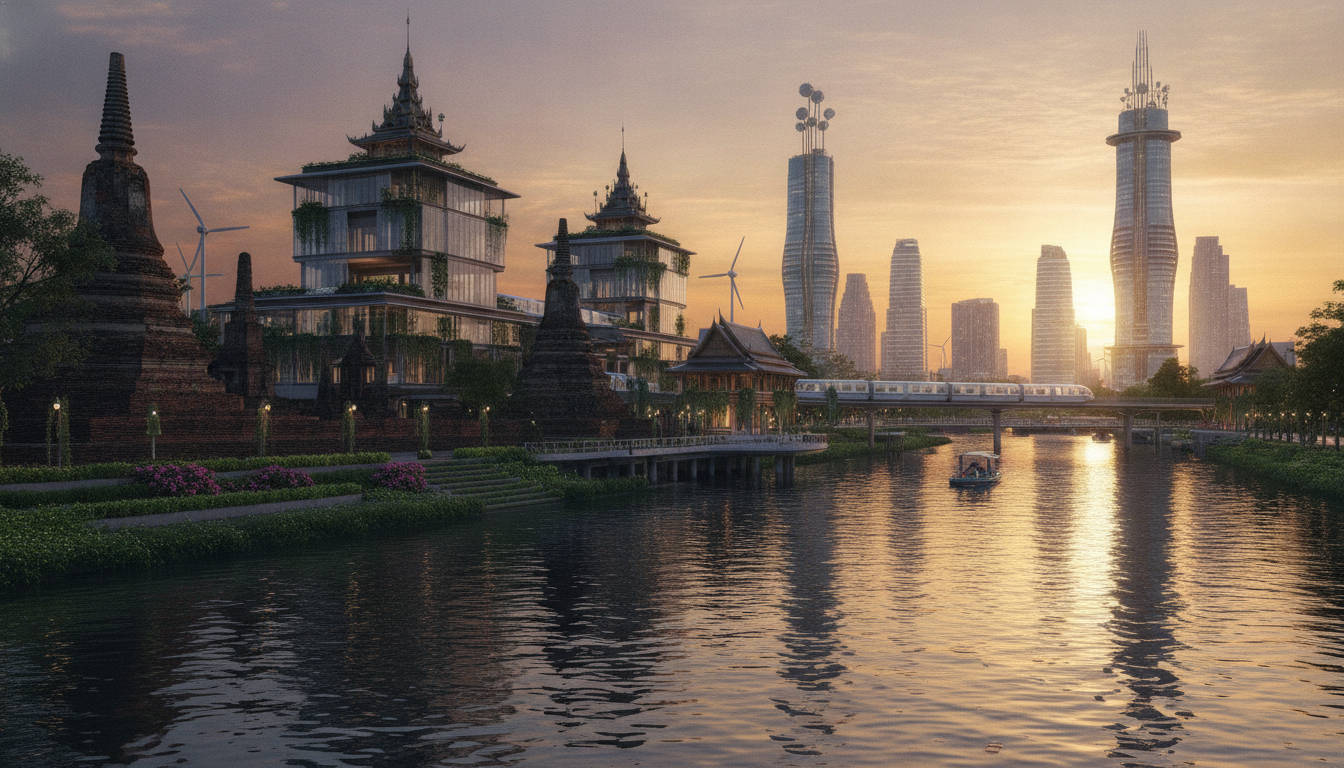
I remember standing on the Chao Phraya’s muddy banks. I watched as monsoon water moved towards ancient brick prangs. This memory brings me back to this island, even in my dreams decades ahead.
Imagine the same skyline in 2050. The chedis still shine in the morning light. But something has changed beneath the surface. Thailand moved its national net-zero target forward by fifteen years, from 2065 to 2050. This was first announced by Prime Minister Prayut at COP26 in Glasgow.
This single policy shift became the foundation for my vision. A 289-hectare UNESCO site transformed into a living laboratory. Here, ancient hydraulic wisdom meets carbon-neutral engineering.
I see floodwaters diverted through tri-river vaults instead of flooding temple courtyards. I see zero-emission cooling loops protecting brickwork that has survived five centuries of rain and heat.
This is the story of an ancient capital that refuses to choose between its soul and its survival.
Key Takeaways
- Thailand pushed its net-zero deadline forward from 2065 to 2050, first announced by PM Prayut at COP26.
- An interim 2035 cap of 152 MtCO2e marks a 47% cut from 2019 emission levels.
- The 289-hectare UNESCO island site sits at the center of this climate vision.
- Tri-river hydrologic vaults aim to redirect floodwaters away from ancient brick structures.
- Zero-emission cooling loops are imagined to protect fragile prangs and chedis from heat damage.
- Self-healing nano-mineral glazes represent a fusion of heritage material and modern science.
- The goal blends Siamese hydraulic tradition with forward-looking environmental engineering.
Ayutthaya Historical Park Future 2050: Why the World Should Be Watching
A small island north of Bangkok is witnessing something amazing. It’s not just the usual temple visits. A 289-hectare area of brick ruins is becoming a key climate experiment. This is the story of Ayutthaya Historical Park’s future in 2050.
This place is more than just a spot for photos of Buddha statues. It’s a test site. Can ancient lime stucco and red brick withstand rising heat and floods? Ayutthaya is proving they can, and it’s open to all who visit.
Why does this matter beyond archaeology? Thailand’s climate record hasn’t been great. But something changed recently.
Thailand’s new plan shows real change. It has a clear goal to cut emissions. It will need $7.05 billion in investment by 2035 to meet these goals. A new plan aims for 51% renewable electricity by 2037.
| Climate Metric | Historical Status | Current Direction |
|---|---|---|
| Climate Action Tracker Rating | Critically Insufficient | Under active revision with new NDC |
| Emissions Target Type | Sector-based, limited scope | Economy-wide, absolute target |
| Investment Requirement | Not clearly defined | $7.05 billion needed by 2035 |
| Renewable Electricity Goal | Below regional average | 51% by 2037 |
Ayutthaya is at the heart of Thailand’s climate goals. It’s a living example of the country’s promise. By 2050, it aims to be a carbon-neutral sanctuary.
“World heritage sites must adapt to the impacts of climate change or risk being lost forever.”
This quote highlights the importance of Ayutthaya’s role. It’s not hiding from the challenge. It’s showing how to overcome it.
For those who love exploring ancient ruins, Ayutthaya’s future is fascinating. It’s not just about old temples. It’s a live example of how sites might adapt in the future.
Ayutthaya stands out for its history and forward-thinking. This makes it a must-see for serious travelers.
Breathing Stone: The Quiet Revolution of Mineral Masonry Glazes
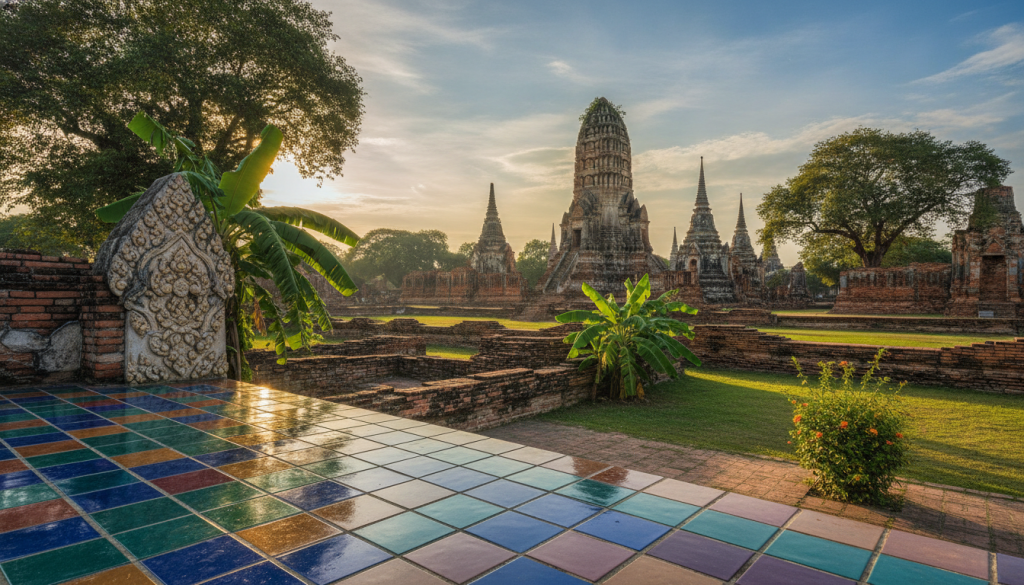
Walking through Ayutthaya at sunrise, the ruins seem timeless. But beneath their surface, a battle against salt and moisture is ongoing.
I stood at the base of a weathered prang last year, touching the stucco that had lasted six centuries. I didn’t see the invisible shield protecting it. Non invasive mineral masonry glazes are changing how decay is fought here. The science behind them is surprisingly simple.
Imagine these glazes as a raincoat that lets you sweat. They bond with the brick and lime stucco at a tiny level. This fills gaps just enough to block water while letting vapor escape.
Halting Salt Efflorescence Without Suffocating Ancient Lime Stucco
Salt efflorescence looks pretty, but it’s actually destructive. Groundwater carries salts up through brick. When it evaporates, the salts crystallize and expand, cracking stucco from the inside.
Old sealants tried to block moisture but failed. They trapped water, causing pressure that made stucco pop off in sheets.
The new mineral glazes are smarter. They let vapor pass through while stopping salt crystallization at the surface.
- Breathability first: water vapor exits freely, so internal pressure never builds
- Salt disruption: crystals form in a controlled pattern instead of forcing stucco apart
- Longevity: the glaze bonds mineral-to-mineral, so it ages with the brick instead of peeling away
One conservation chemist summed it up well:
“You’re not sealing the wound, you’re teaching the stone to heal itself while it keeps breathing.”
That line stayed with me all the way back to my guesthouse.
Wat Phra Si Sanphet Preservation Under Molecular Protection
Wat Phra Si Sanphet has three iconic chedis that once anchored the royal palace complex. They’re the most photographed silhouettes in Ayutthaya, and they deserve it.
Wat Phra Si Sanphet preservation now focuses on these breathable coatings. They’re applied in small test sections first. Conservators track moisture readings inside the brick core for months, confirming vapor still escapes at healthy rates.
The process is slow and careful. Nobody rushes to coat the entire site overnight. Teams treat one section, measure results through a full monsoon cycle, then adjust the formula based on how the stone actually responds.
| Protection Method | Vapor Permeability | Salt Crystallization Control |
|---|---|---|
| Traditional plastic sealant | Very low | Poor, traps salt behind surface |
| Untreated lime stucco | High | None, salt blooms freely |
| Mineral masonry glaze | High | Strong, redirects crystallization safely |
Wat Mahathat’s Red-Brick Prangs in the Glaze Era
Everyone knows Wat Mahathat for its famous stone Buddha head wrapped in tree roots. I’ve seen tourists line up just to take that photo. It’s a striking image.
But beyond that iconic shot, there are red-brick prangs that have quietly crumbled for decades. They’re now getting their own molecular treatment, entering the glaze era of Thai heritage conservation.
The bricks here are softer and more porous than stucco found elsewhere. This makes the breathable approach even more critical. A heavier sealant would fail within a single rainy season.
Conservators apply the same molecular logic used at the royal chedis, adjusted for this site’s mineral makeup. Early results suggest the towers shed less surface material after each monsoon. This is a small but meaningful sign that this quiet revolution is working.
Three Rivers, One Island: Subsurface Hydrologic Heritage Engineering
The Chao Phraya, Pa Sak, and Lopburi rivers surround Ayutthaya like a moat. By 2050, this moat will fight back against floods. I stood on the riverbank, watching brown water push against ancient brick.
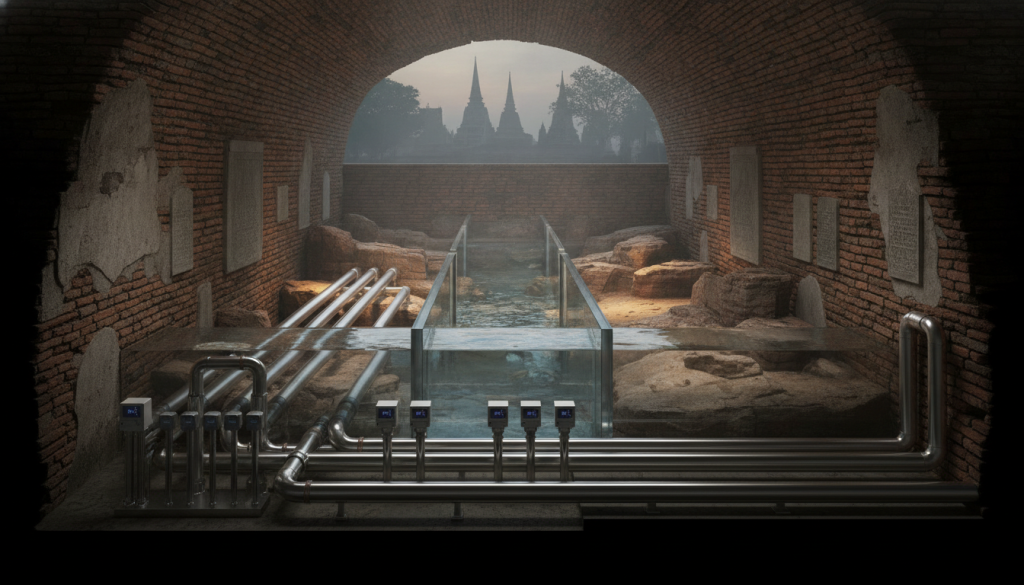
Centuries-old temples nearly vanished during monsoon seasons. Today, an invisible network runs beneath every street, catching water before it threatens the ruins.
Engineers call this approach subsurface hydrologic heritage engineering. It’s about protecting memory, one cubic meter of water at a time.
The Automated Retention Vault Matrix Beneath the Streets
Underneath the streets, crews built a matrix of retention vaults. These vaults function like a second, hidden city. Sensors track rainfall in real time.
Valves open and close automatically, long before floodwater reaches ground level. This system captures 100% of seasonal basin floodwaters before they touch a temple foundation.
I found the number almost hard to believe. The vault access points are tucked discreetly beside souvenir stalls and food carts.
Restored Historic Canals as Living Flood Infrastructure
Centuries ago, traders paddled rice barges through Ayutthaya’s canal network. Now, these canals do double duty as flood infrastructure. Restoration teams cleared silt and reinforced ancient banks.
Water flows through filtered channels instead of pooling against temple walls. Locals still row through these canals, but now they’re floating on top of a working flood-defense system.
“We didn’t want to bury the canals under concrete. We wanted the water to keep doing what it’s always done, just smarter this time.”
Wat Chaiwatthanaram Flood Barrier and the Riverside Frontline
No site feels the river’s pressure more than Wat Chaiwatthanaram. Erosion here used to eat away at the foundation stones every rainy season. The new Wat Chaiwatthanaram flood barrier changes that story completely.
The barrier uses a submerged wall with flexible joints. It absorbs river surge without cracking under pressure. I walked the riverside path at dusk and watched the barrier hold steady as boat wakes rolled in. It felt like standing next to something that refuses to lose.
Closed-Loop Reservoir Stormwater Harvesting Powering Zero-Emission Cooling
Water captured by the vaults and canals doesn’t just sit in storage. It flows into a reservoir system, gets filtered, and cycles back out to power district cooling across the historical park.
This closed loop reservoir stormwater harvesting system runs entirely on renewable energy. It ties directly into Thailand’s revised power plan targeting 51% renewable electricity by 2037. This plan is part of Thailand’s broader push toward net zero by 2050.
So floodwater that once threatened ancient stucco now cools visitor centers and museum galleries instead. Yes, they turned floodwater into air conditioning. And it works.
| System | Primary Function | Key Innovation | Benefit |
|---|---|---|---|
| Retention Vault Matrix | Store seasonal floodwater | Sensor-driven automated valves | Captures 100% of basin floodwaters |
| Restored Historic Canals | Channel water into vault network | Historic-modern hybrid design | Preserves heritage waterways |
| Wat Chaiwatthanaram Barrier | Protect riverside temple structures | Flexible submerged wall joints | Reduces erosion at the riverbank |
| Closed-Loop Reservoir System | Harvest and filter stormwater | Reservoir-to-cooling energy loop | Powers zero-emission district cooling |
Three rivers once threatened to swallow this island’s history piece by piece. Now they power its future instead. This shift, quiet as it is beneath the streets, might be the most important engineering story in Ayutthaya today.
Holding Ground: Structural Stability and the Ayutthaya UNESCO Heritage Grid
Walking through Ayutthaya, I forgot the real engineering marvel wasn’t visible. I was so focused on the glazed brick and canals. But, the ground underneath is crucial.
Old cities built on river deltas face a hidden problem. Ayutthaya sits on soft, waterlogged soil. This soil shifts, settles, and swallows foundations during floods.
This quiet crisis was the first challenge for restoration efforts.
Subsurface Structural Dampers Beneath 600-Year-Old Reliquary Towers
Engineers installed subsurface structural dampers beneath the towers. These dampers act like shock absorbers in the earth.
They sense soil shifts and counteract them before reaching the stonework. Standing beside a 600-year-old tower, its stillness isn’t luck anymore.
It’s math, sensors, and engineering happening silently underfoot.
“You can’t out-build nature with brute force alone. You have to work with the ground the way it actually behaves, not the way you wish it did.”
This idea stuck with me. Every crack in old temples across Southeast Asia made sense.
Stadium-Grade Porous Asphalt Stormwater Drainage for Visitor Pathways
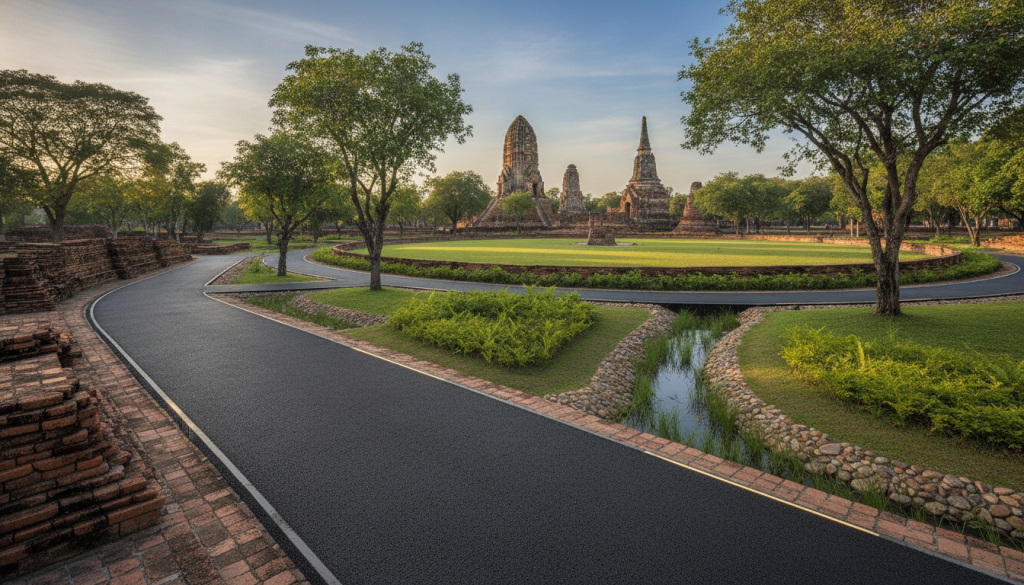
The same stadium porous asphalt stormwater drainage technology used in modern sports arenas is under the paths tourists walk every day.
Think of how fast a stadium parking lot clears after a downpour. That’s the engineering standard here, but quieter and hidden.
Rainwater drains through the porous layer, gets filtered, and feeds back into the water system. Visitors walk across it without noticing.
This might be the whole point.
- Water drains within minutes, protecting brick foundations from soaking.
- Foot traffic stays dry even during sudden monsoons.
- The system reduces erosion around temple bases.
The Ayutthaya UNESCO Heritage Grid as a Living Power Network
Seeing the dampers, drainage, canals, and retention vaults together was a revelation. This isn’t just a collection of fixes.
It’s the Ayutthaya UNESCO Heritage Grid, a coordinated system where every piece talks to the others in real time.
Thailand’s push toward renewable energy isn’t just for cities. It’s powering sites like this, giving the heritage grid the energy it needs without fossil fuels.
This makes it feel like a living relationship between old stone and new technology. I left Ayutthaya thinking about what I couldn’t see.
The towers stand straight because of dampers I’ll never notice. The paths stay dry because of drainage I walked over without thinking.
The whole island keeps breathing because someone decided history deserved smart infrastructure.
Conclusion
Standing in front of Wat Chaiwatthanaram’s weathered prangs, I never expected to leave thinking about hydraulic engineering and mineral glazes. But that’s exactly what happened once I started digging into what Ayutthaya Historical Park future 2050 could actually look like.
I used to think protecting old ruins meant roping them off and hoping time moved slower. This changed that. Watching how researchers map emissions, model flood barriers, and study detailed climate data across the region showed me something different. These places can be engineered to outlast us, not just preserved by keeping our distance.
Thailand already moved its net-zero target from 2065 up to 2050, and that shift matters. It shows real national ambition, not just planning documents sitting on a shelf. The systems imagined for this island, from breathing stone coatings to underground stormwater vaults, could easily become a working blueprint for river cities and heritage sites everywhere facing the same rising water and shrinking timelines.
My honest hope is that more travelers start seeing ancient sites this way. Not just backdrops for photos, but proof that the past and the future can share the same ground and keep standing together.



Leave A Comment