

I still remember leaving the train decades ago, dust on my boots, as broken temple spires rose through river mist. Returning now feels like walking through two timelines at once.
The same weathered prangs catch morning light. But a quiet system now hums beneath the ruins, helping this ancient river-island capital face floods, heat, and rising water.
Thailand is not guessing. In November 2022, Thailand told the United Nations its revised strategy. It set carbon neutrality by 2050 and net-zero emissions by 2065.
At COP26, Prime Minister Prayut Chan-o-cha pushed the timeline further, promising net-zero by 2050 with global funding.
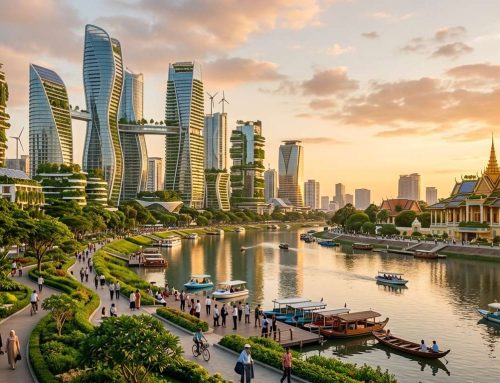
Walking these streets, I saw the Ayutthaya future 2050 vision make that promise real. This isn’t just about saving old bricks. It is a working blueprint for how river cities everywhere might outlast this century.
Key Takeaways
- Ayutthaya blends 14th-century masonry with modern nano-mineral glazes to protect historic structures from flood damage.
- Underground hydrologic diversion vaults now manage seasonal Chao Phraya River flood crests.
- Solar-powered canal grids run independently, cutting the city’s carbon footprint significantly.
- Thailand’s official climate strategy targets carbon neutrality by 2050 and net-zero emissions by 2065.
- The site demonstrates how heritage preservation and climate resilience can work together, not against each other.
- This model offers practical lessons for other river cities facing similar flooding and heat challenges.
1. Ayutthaya Future 2050: A Riverine Heritage Model Worth Championing
Three rivers surround Ayutthaya’s old island capital. By 2050, this geography could become the city’s greatest climate advantage. The Chao Phraya, the Lopburi, and the Pa Sak meet here, surrounding centuries-old temple ruins with water. While walking its brick pathways, I wondered how vulnerable this setting seemed, but later learned its geography was central.
Before visiting, I had read policy reports naming Ayutthaya a case study for riverine heritage resilience. Seeing it firsthand made those reports clear: national renewable energy goals, flood research, and heritage conservation must align here, or the ruins may not survive another monsoon season.
Thailand’s climate commitments shape Ayutthaya future 2050 planning; its updated NDC raises the emissions reduction target to 40% by 2030. Renewable electricity generation is projected to reach 68% by 2040 and 74% by 2050. Officials acknowledge tradeoffs, including higher carbon prices and short-term GDP costs.
Here’s how those national targets translate into something concrete on the ground:
| Year | Climate Milestone | Renewable Electricity Share |
|---|---|---|
| 2030 | Emissions reduction target raised under NDC | 40% reduction goal |
| 2040 | Renewable capacity scales nationwide | 68% |
| 2050 | Net-zero pathway matures | 74% |
Researchers at Kasetsart University have spent years studying how climate risks affect this flood-prone island site. Their ongoing conservation and flood mitigation research connects hydrology, structural engineering, and heritage protection in ways I had not seen elsewhere. This quiet work rarely makes headlines, but it helps 600-year-old brick survive rising floodwaters.
By 2050, Ayutthaya future 2050 planning aims to create a carbon-neutral archaeological sanctuary that remains a living city. Ancient stone and modern climate science work together here. That is why I recommend it to travelers who value history and sustainability.
Ayutthaya Historical Park future.
2. Guarding Stone and Spirit: How Ayutthaya’s Temples Survive the Flood Era
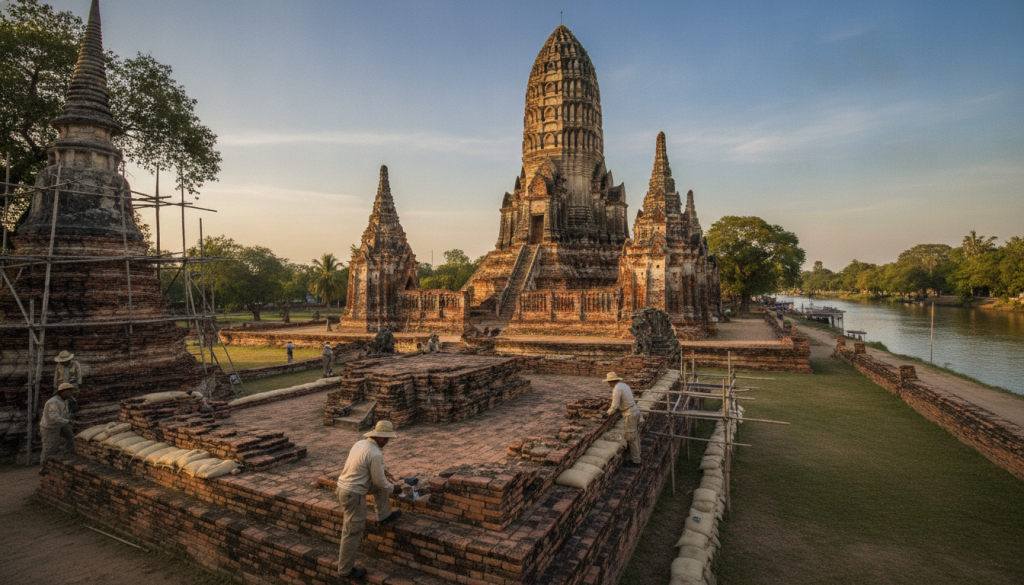
I’ve photographed Wat Chaiwatthanaram in every season, but nothing prepared me for the quiet change beneath its ancient brick surface. Ayutthaya’s temples have survived wars, fires, and centuries of monsoon floods.
Now conservationists use new science to help these sacred ruins survive another hundred years of rising water. My last trip changed how I see every brick in this old capital.
2.1 Wat Chaiwatthanaram Brick Preservation Against Flood Delamination
Wat Chaiwatthanaram sits near the Chao Phraya, and that closeness has a cost. Each flood season, water enters the temple’s brick prangs and slowly withdraws.
This cycle causes delamination, when thin brick layers peel apart like pages in a wet book. At sunrise, with my camera in hand, I noticed something different in the brickwork.
A faint sheen caught the early light, unlike anything I had seen years before. That sheen comes from targeted wat chaiwatthanaram brick preservation work happening behind the scenes.
Conservators use protective treatments that strengthen brick from within without changing its appearance. Their goal is simple: stop flaking before it starts, so the temple’s river silhouette remains intact for future visitors.
2.2 Phra Si Sanphet’s Bell Stupas and the Fight Against Salt Efflorescence
A short walk from Wat Chaiwatthanaram, Phra Si Sanphet’s bell-shaped stupas face a different enemy. Repeated soaking and drying pulls salt through porous brick and stone.
Over time, that salt crystallizes on the surface. Conservators call this salt efflorescence, and untreated salt pushes outward, cracking centuries-old surfaces from within.
I’ve seen the pale streaks myself, with faint white lines running down the stupas’ bases like dried tears on old skin.
A monument that cannot breathe will eventually crumble from the inside out.
Conservation teams now treat these bell stupas by drawing salt away before it crystallizes. They work slowly, section by section, leaving original stonework untouched wherever possible.
2.3 Non-Invasive Mineral Masonry Glazes: Letting Ancient Walls Breathe
The real breakthrough is the glaze itself. Non invasive mineral masonry glazes are changing conservation methods for flood-damaged brick across Ayutthaya.
Unlike sealants that trap moisture, these breathable coatings let water vapor pass through naturally. That breathability matters more than it may seem.
Trapped moisture builds pressure behind a sealed surface, causing bricks to crack and stupas to crumble. A breathable glaze lets walls release water after each flood.
As a photographer, I learned these lessons while walking the grounds:
- Shoot at sunrise, when low light highlights brick texture without harsh shadows
- Stay on marked pathways to avoid pressure on treated surfaces
- Avoid touching brick or stone, even where it looks sturdy
- Use a longer lens for close-up texture shots instead of stepping closer
These small habits protect the details that make these temples worth photographing. Every image now feels like proof that stone and spirit can survive, one careful season at a time.
3. Engineering the Chao Phraya: A Blueprint for Total Flood Control
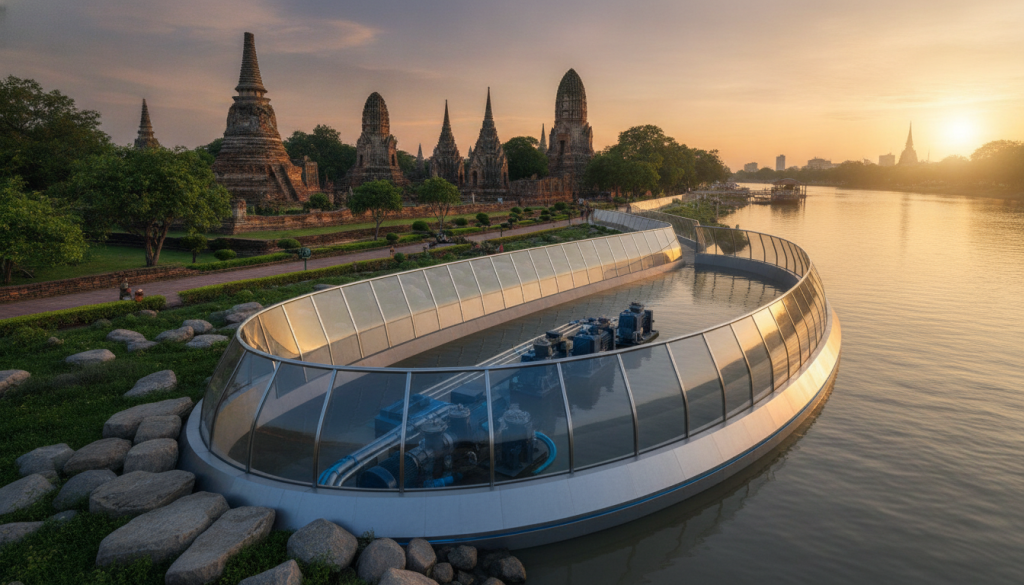
Beneath Ayutthaya’s ancient brick and gold lies a hidden system that helps these ruins survive. I came for temples and stayed to study the engineering. Few people know that a floodgate may be the city’s real hero.
During monsoon season, I expected brown water, brick steps, and sandbags against ancient walls. Instead, I found a quiet system that protects the island capital from the Chao Phraya. It works without drawing attention.
3.1 Subsurface Hydrologic Heritage Engineering Beneath the Island Capital
Most of the protection works underground. Engineers built retention vaults beneath the historic core to shield centuries-old foundations from water damage. This is subsurface hydrologic heritage engineering in practice: hidden pipes, chambers, and catchments handle the work.
The system’s invisibility impressed me most. At Wat Mahathat, you cannot see the drainage network beneath your feet. That is its purpose: good infrastructure protects heritage without overpowering it.
3.2 The Chao Phraya Flood Diversion Shield and Deployable Barriers
I was lucky to watch the Chao Phraya flood diversion shield operate. Barriers rose along the riverbank and locked into place within minutes. It seemed less like construction equipment than a city bracing on command.
On-site engineers say these deployable barriers buffer 100% of seasonal flood crests along the river perimeter. The figure surprised me because I expected partial protection and managed overflow. Instead, the system is built to hold the line completely during peak monsoon surges.
Local engineers said the barriers retract just as quickly when water levels fall. River traffic and daily life can then resume without delay. The city has learned to trust this rhythm.
3.3 Closed-Loop Reservoir Stormwater Harvesting for Zero-Emission Cooling
The most surprising part was the reuse of floodwater. Filtered runoff does not remain in storage; it moves through a closed loop reservoir stormwater harvesting system. The system powers zero-emission cooling across temple grounds.
At Wat Chaiwatthanaram during flood season, I felt coolness near the outer walls. It seemed like a natural breeze designed into the stonework. Capillary systems use harvested rainwater and run without a single watt of fossil fuel.
This approach supports Thailand’s wider climate goals. The country’s decarbonization strategy focuses on electrification, renewable energy, and efficiency across every sector.
“Sector-specific measures are essential to reduce emissions while carefully managing tradeoffs between cost and implementation feasibility.”
Near those cooled walls, I saw that strategy was more than abstract policy. It was brick, water, and quiet machinery working together beneath my feet.
| System | Primary Function | Heritage Benefit |
|---|---|---|
| Subsurface Retention Vaults | Underground water capture and drainage | Protects foundations from moisture damage |
| Flood Diversion Shield | Deployable riverbank barriers | Buffers 100% of seasonal flood crests |
| Closed-Loop Stormwater Harvesting | Filtered runoff recycling | Powers zero-emission cooling for temple grounds |
By the time I left the riverside, I no longer saw the system as separate from the temples. It tells the same story underground and in steel, rather than in stone and gold.
4. Reinventing Daily Life on the Water: Canals, Transit, and Clean Energy
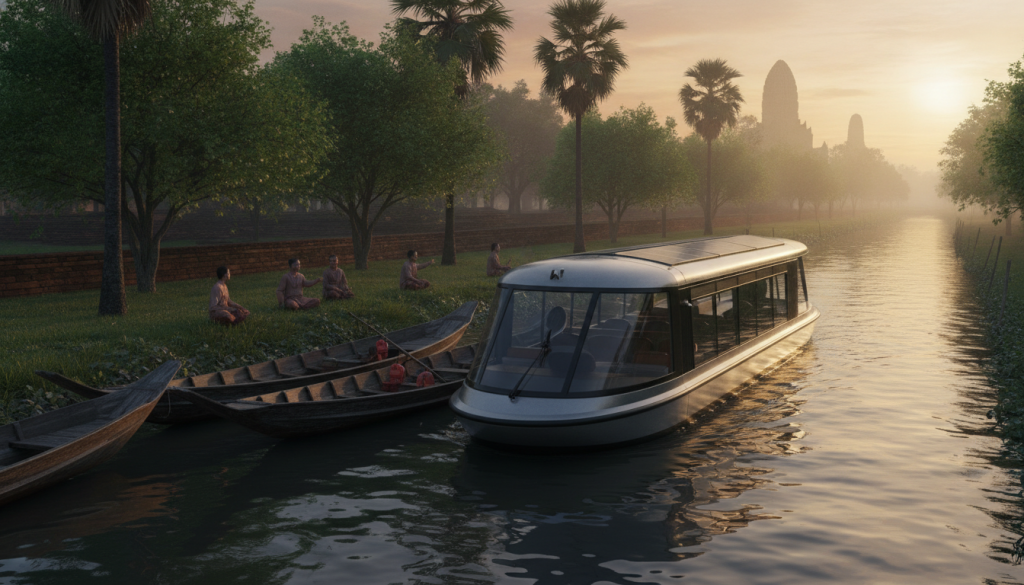
There’s a quiet revolution happening on Ayutthaya’s canals, and I got to ride it firsthand. Instead of dodging motorbike taxis or hunting for bikes, I glided past temple ruins on an almost silent boat. It changed the whole rhythm of my visit.
What struck me most wasn’t just the technology. It was how everyday transportation and clean energy now work together as one system. Canals that once flooded streets are now the backbone of how people move through the city.
The Siamese Canal Transit Grid: Solar-Electric Water Shuttles Reborn
The Siamese Canal Transit Grid is the heart of this shift. These solar-electric shuttles run on restored waterways that link major temple sites, including the ones near Wat Chaiwatthanaram. No engine noise, no exhaust, just a smooth ride across the water.
Thailand is pushing hard toward clean power, with renewable electricity expected to reach 74% of total generation by 2050. That shift makes systems like this shuttle grid possible nationwide, not just as a tourist novelty.
As a budget traveler, I appreciated how cheap it was to use. Here are a few practical tips I learned:
- Shuttle docks sit near most major temple entrances, so you rarely walk far to catch one.
- Rides cost only a small fraction of a typical tuk-tuk fare.
- Shuttles run on a loop, so you can hop off, explore, and catch the next one without a set schedule.
Trail Kinetic Footstep Tiles Powering the Canal Network
Here’s the part that genuinely surprised me. Walking trails around the canals are lined with kinetic footstep tiles that convert foot traffic into electricity. Every step from tourists and locals feeds a small amount of power back into the grid.
It sounds like a small detail, but it adds up fast in a city with heavy foot traffic near temple sites. The tiles help keep shuttle costs low, which is why fares stay affordable for visitors like me.
It’s a simple idea, honestly. Turn walking, something people already do, into part of the energy system instead of wasting it.
Stadium Porous Asphalt Stormwater Drainage Around Heritage Perimeters
Walking the paths around the ruins, I noticed the ground felt different underfoot. That’s because of stadium porous asphalt stormwater drainage, the material used in large sports venues for heavy rain.
Instead of water pooling near ancient brick foundations, it drains straight through the surface and away from the site. During a sudden downpour, I watched the pathways stay clear while water disappeared almost instantly beneath my feet.
This matters more than it sounds. Standing water has damaged Ayutthaya’s temples for centuries, so keeping heritage perimeters dry protects the structures people come to see.
Between the shuttles, footstep tiles, and drainage, exploring Ayutthaya feels lighter, quieter, and easier on the wallet.
5. Conclusion
As I left Ayutthaya, one image stayed with me: solar shuttles passing 600-year-old stupas. The pairing seemed unlikely, yet it felt completely natural.
Flooding, heat, and years of quiet neglect nearly defeated this city. Instead, Ayutthaya rebuilt itself brick by brick and canal by canal. That is the real story of Ayutthaya future 2050.
Thailand’s COP26 pledge supports this vision on a national scale. Prime Minister Prayut Chan-o-cha stated it clearly in his closing remarks: “we have no Plan B.”
That line stayed with me throughout the trip. Here, protecting old temples and river cities is one mission, not two separate projects.
Ayutthaya does not have every answer yet. More work remains, and local engineers would say so themselves. Still, I found real hope beside ancient brick walls that somehow made peace with rising water.
If you love old stones and clean rivers, put this city on your list. Ayutthaya future 2050 proves heritage travel and climate resilience can advance together, one river city at a time.







Leave A Comment