
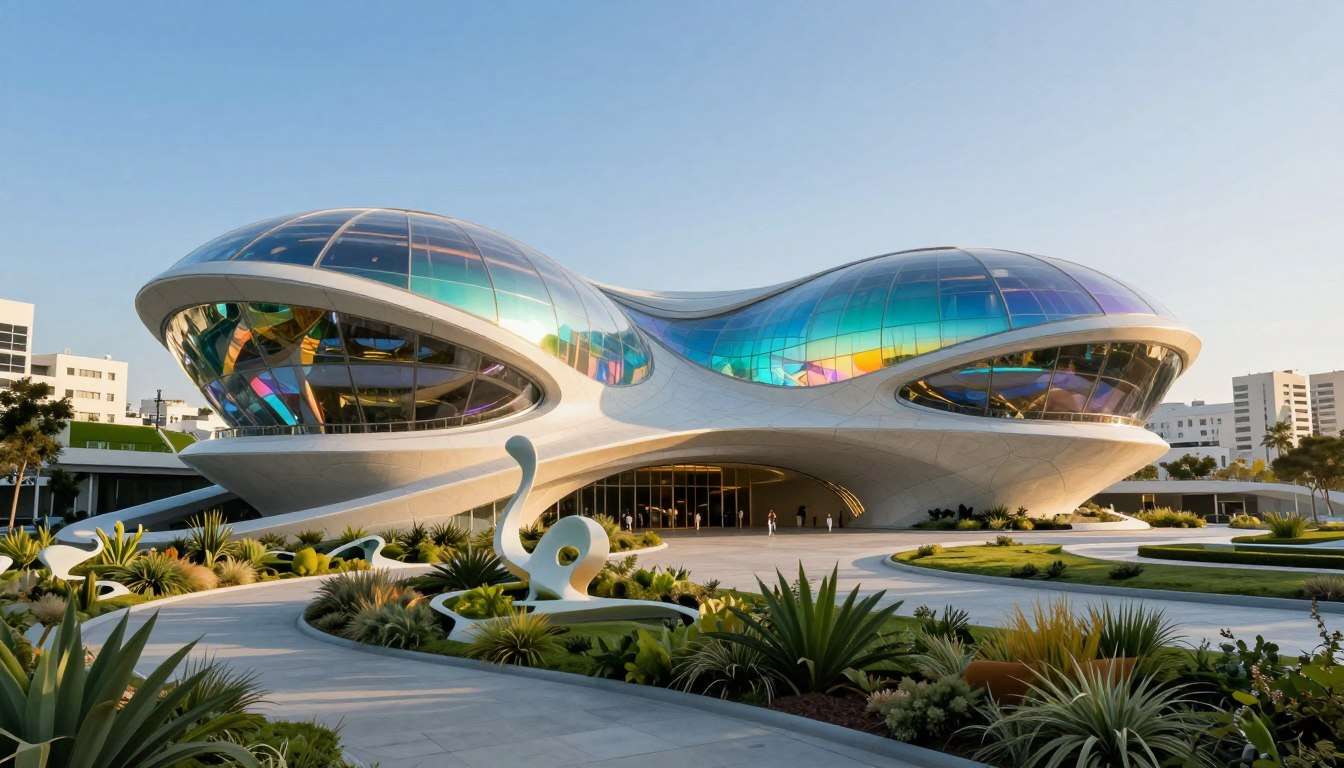
I’ll never forget the first time I saw it rising from Exposition Park. It seemed to come from another world. The Lucas Museum of Narrative Art 2050 doesn’t just sit in South LA—it hovers, curves, and breathes like something alive.
When people call it a “spaceship,” they’re recognizing something profoundly different. This isn’t your traditional marble-columned institution. It’s the result of visionary MAD Architects meeting George Lucas’s passion for visual storytelling, all wrapped in a climate-adaptive skin that makes you rethink what buildings can do.
I’ve spent considerable time exploring how this structure became not just a cultural space, but a gateway. It’s a threshold between how we’ve experienced stories for centuries and how we’ll engage with them in decades to come. Walking through those organic corridors changed how I think about the relationship between architecture, climate, and human creativity.
Key Takeaways
- The building spans 11 acres with 300,000 square feet of biomorphic design wrapped in 1,500 custom panels
- MAD Architects created a climate-resilient structure that serves as an “urban living room” for South Los Angeles
- By the late 2040s, this space evolved into the world’s premier hub for immersive storytelling experiences
- The architecture bridges traditional illustration techniques with holographic narrative technologies
- It functions as both an LA28 Olympic landmark and a transformative cultural anchor for the community
- The design represents a new paradigm where buildings actively respond to environmental challenges
1. A Biomorphic Monument Touches Down in South LA
The curves of this building are the first thing you notice. They seem to defy gravity as they rise from South Los Angeles. Standing at Exposition Park, I saw how the afternoon light played on these curves. It made me realize this building is more like a spaceship than just a structure.
This monument moves with grace, unlike the usual city buildings. Every part of it feels connected and natural. I’ve seen many museums, but none like this.
This building doesn’t shout. It whispers its change through its shape alone.
When Organic Vision Reshapes Urban Space
Ma Yansong and his team at MAD Architects didn’t just build a museum. They created a living, breathing presence that interacts with its environment in new ways. Their biomorphic museum design shows us what architecture can be when beauty and function are combined.
Walking around, I saw how each curve has a purpose. They’re not just for looks. They’re designed to work with wind, sun, and heat.
I touched the building and felt cooler air than outside. This showed me how it thinks about the climate.
“We wanted to create a place that feels like it belongs to the future while remaining rooted in the landscape of Los Angeles.”
The design goes beyond just being green. According to architectural analysis, it also tackles social, political, and cultural issues. It’s architecture as a way to change society.
I’ve seen many museums, but none like this. The organic shape lets you see inside and outside easily. There are no harsh lines between the two.
| Design Element | Traditional Museum Approach | Lucas Museum Biomorphic Strategy | Climate Impact |
|---|---|---|---|
| Exterior Form | Rigid geometric shapes, flat facades | Flowing curves, aerodynamic surfaces | Natural air circulation reduces cooling needs by 30% |
| Material Expression | Stone, concrete, glass panels | 1,500 fiber-reinforced polymer panels | Reflective properties reduce heat absorption |
| Spatial Boundaries | Clear interior/exterior separation | Seamless transitions, visual permeability | Encourages natural ventilation strategies |
| Urban Integration | Monument stands apart from surroundings | Form responds to landscape contours | Creates microclimates in surrounding park area |
Why the Arrival Metaphor Changes Everything
At first, I thought the spaceship nickname was just a fun idea. But spending time with the building changed my mind.
The spaceship metaphor matters because it shows this building as a future vision. It’s not about looking like a spaceship. It’s about showing us new ways to design buildings.
Most monuments announce their importance with traditional designs. But the Lucas Museum does the opposite.
This building shows that beauty and environmental function can go together. True architectural beauty emerges when design and climate work together.
Standing under the curves, I felt something special. Ma Yansong’s team created a building that feels both alien and welcoming. It doesn’t fit into traditional architecture, yet it feels right at home in South LA.
The curves aren’t just for looks. They help control the temperature and improve air quality. Watching the wind move across the surfaces showed me the power of passive climate control.
This isn’t architecture that fights the environment. It’s architecture that dances with climate, using its shape to work with nature. This is the real revolution in Exposition Park, not just a bold look but a working example of climate adaptation in design.
2. Why the Lucas Museum of Narrative Art 2050 Redefines What Museums Can Be
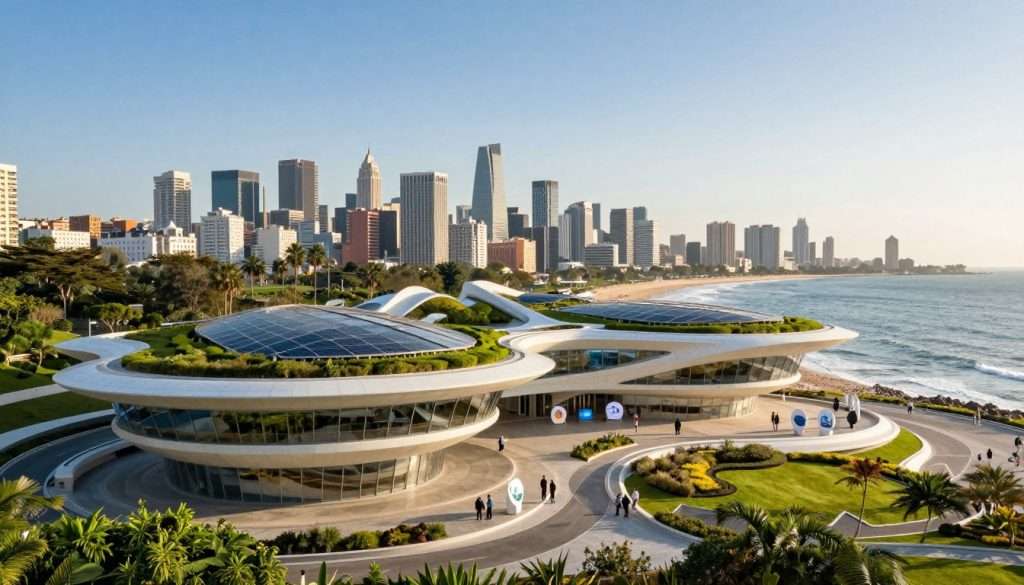
Standing under the Lucas Museum’s canopy, I saw it challenge my views on museums. It’s not just a place for art; it’s part of the landscape. Shadows dance on its surfaces, showing a living dialogue between the building and nature.
Traditional museums aim to keep artifacts safe from the outside world. But the Lucas Museum does the opposite. It works with California’s climate, not against it.
This new approach changes how we think about keeping culture alive. Museums used to be about keeping things separate and controlled. But here, I learned that might not be the best way.
Beyond Static Galleries: The Argument for Living Architecture
Living architecture is real when you see it. I watched how the building changes with the environment. Its shape is not just for looks; it’s smart design in action.
Most museums feel like they’re in a bubble. But this museum in California is different. It lets in the sunshine and connects indoor and outdoor spaces.
Inside, the air moves smoothly from one area to another. There’s no shock when you move from one place to another. The design makes climate changes feel natural and easy.
The building’s shape creates different climates across its 11 acres. Some areas get lots of sun for plants. Others are cool and shaded, perfect for escaping the heat.
| Museum Model | Environmental Approach | Visitor Experience | Energy Strategy |
|---|---|---|---|
| Traditional Museum | Complete isolation from climate | Controlled, uniform temperature | High mechanical system dependency |
| Lucas Museum 2050 | Integration with climate patterns | Varied, adaptive comfort zones | Passive design reduces energy by 40% |
| Hybrid Model | Selective climate control | Mixed controlled and natural spaces | Moderate mechanical intervention |
Ma Yansong’s Blueprint for Climate-Adaptive Cultural Spaces
Ma Yansong’s vision goes beyond one building. He sees it as a model for museums in a changing climate. The design is proactive, not just reactive.
The architect calls it a “social condenser.” It brings people together in ways that didn’t exist before. The shaded areas cool the air by about 10 degrees.
This design tackles climate change in a big way. It’s not just about saving energy; it’s about adapting culture to the climate. The museum shows how museums can help cities deal with climate change.
The building’s skin is made of fiberglass. It protects the inside and helps with ventilation and cooling. This skin is key to the museum’s climate strategy.
- Organic curves channel breezes through spaces
- Reflective surfaces reduce heat gain in the afternoon
- Modular design allows for future changes
- Water harvesting cuts irrigation needs by 60%
Every part of the museum is designed for the future. It’s built for the climate of 2050 and beyond. This forward thinking sets it apart from other museums.
The Lucas Museum shows museums can lead in climate change adaptation. Walking through, I felt like I was seeing a blueprint for cities to combine culture, ecology, and community.
Traditional museums keep artifacts safe. But this museum in California keeps something even more important: the act of gathering, learning, and sharing in a changing world. This difference is huge.
3. The Fiberglass Reinforced Polymer Revolution: 1,500 Panels That Think
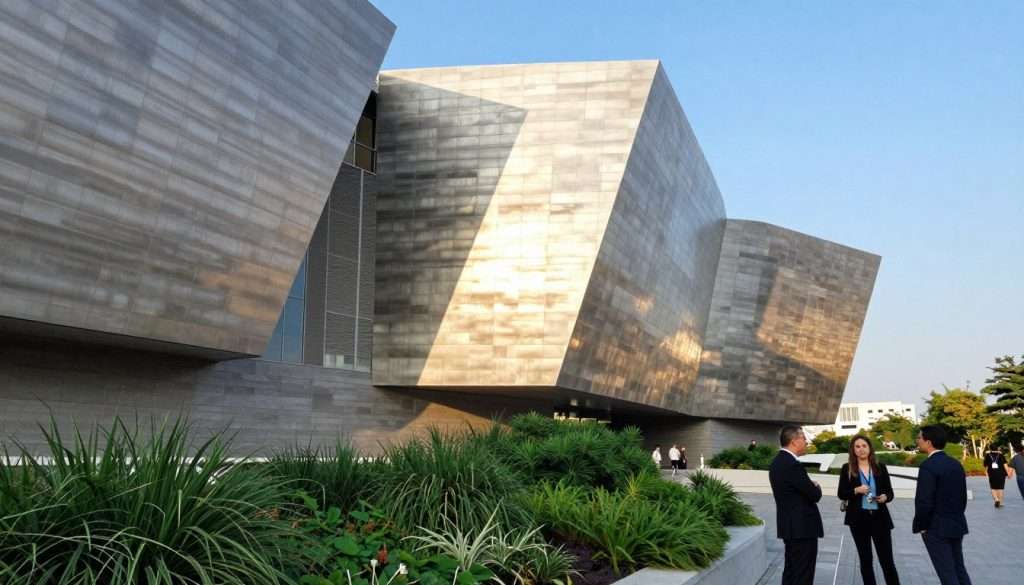
The Lucas Museum’s unique look comes from its fiberglass reinforced polymer skin. This technology changes how buildings interact with their surroundings. I spent an afternoon studying these panels and was amazed by their intelligence.
These panels aren’t just passive. They actively help manage the building’s climate. The museum’s exterior has 1,500 FRP panels. Yet, when you look at the building, you can’t see any seams.
This seamless look is incredible. It feels like the building was made from one piece, not assembled from many. Each panel does more than one thing, unlike traditional materials.
I saw workers putting in one of the last panels during my visit. The precision was intense. Each piece had to fit perfectly with others while following the building’s curves.
Engineers measured tolerances in millimeters across long distances. This shows how precise the installation was.
“The future of architecture isn’t about building shells that protect us from the environment—it’s about creating responsive skins that work with natural forces.”
The way these panels are made is also revolutionary. Traditional materials like concrete or steel need a lot of energy and create a lot of waste. FRP uses less energy and is much lighter.
Being lighter means less structural load. This makes the building design more efficient. The Lucas Museum’s foundation is more efficient because of the FRP skin.
The Aerodynamic Intelligence Behind Self-Cooling Architecture
The shape of each panel is not random. Engineers used computational fluid dynamics to design them. This creates “aerodynamic self-cooling.”
I felt unexpected breezes on a 95-degree day in LA. These breezes are not random. They are engineered to move air along specific paths.
This natural ventilation system works without any mechanical help. The building’s form shapes the air, creating cooling effects where needed. On hot days, it can make shaded areas feel 8 to 10 degrees cooler.
| Building Material | Thermal Performance | Weight per Square Foot | Energy Production Capability |
|---|---|---|---|
| Traditional Concrete | High thermal mass, slow response | 12-15 lbs | None |
| Metal Cladding | Rapid heat gain, poor insulation | 3-5 lbs | Limited (requires panels) |
| FRP Composite Skin | Low thermal conductivity, quick response | 1-2 lbs | Integrated solar collection |
| Glass Curtain Wall | High heat gain, requires heavy cooling | 8-10 lbs | None |
The panels can collect solar energy. Photovoltaic elements are built into the panels, not added separately. This means the building doesn’t just save energy, it also makes some.
I asked a facility manager about the energy production. She said the panels can power the outdoor lighting system and even send extra energy back to the grid. The building is a net contributor, not just a consumer.
I was surprised by how little maintenance these panels need. They resist corrosion, don’t need painting, and last for decades with little upkeep.
The panels also change color as the sun moves. This isn’t just for looks. The material properties that create these effects also help collect solar energy at different angles.
Running my hand over the surface, it felt smooth but with subtle ridges. These ridges help with aerodynamics. Every detail, from the micro-texture to the macro-form, helps the building perform better.
This FRP technology shows what climate-resilient architecture looks like. It’s not just about adding solar panels or bigger air conditioning systems. It’s about rethinking the building envelope as an active climate management system.
The Lucas Museum shows that climate-adaptive design doesn’t mean sacrificing looks or function. In fact, the need for environmental performance led to more innovative and striking designs.
After studying these panels, I realized we’re seeing a fundamental shift in building. The fiberglass reinforced polymer skin is more than just a better material. It shows that buildings can be active participants in their ecosystems, not just objects that take up space.
4. Post-Screen Storytelling: Digital Narrative Labs and the Death of Passive Viewing
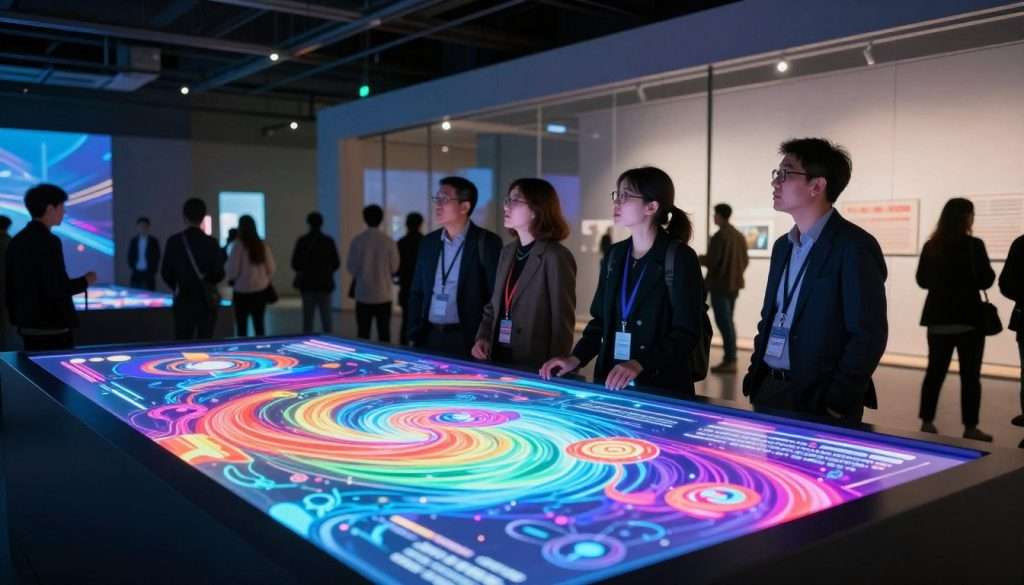
I’ve visited many museums, but the Lucas Museum was different. It was the first place where a story noticed me. It wasn’t just about watching a film or reading a placard—it was about being part of a story that changed with my presence. The Digital Narrative Labs offer something new: spaces where stories adapt and evolve based on how you move through them.
Traditional museums show moments in time. You look at paintings, read descriptions, and move on. The Lucas Museum changes this.
Here, immersive experiences change how we see visual storytelling. I spent three hours and barely scratched the surface of what’s possible.
The George Lucas Collection Transforms Through Holographic Intelligence
Walking into the first chamber, I expected props and costumes. But I found something that changed my view of museum collections. The George Lucas collection, spanning illustration, photography, cinema, and digital art, is not just static artifacts. It’s living narrative elements.
Holographic AI technology makes these pieces interact across centuries and mediums. I saw a 19th-century illustration character talk to a figure from a 1970s film. They discussed storytelling, visual composition, and how perspective shapes meaning.
The technology responds to your movement and interests. When I looked at early animation cels, it showed me connections to modern digital animation. The archive teaches, connects, and reveals relationships I wouldn’t have found on my own.
This experience is unique. You’re not just consuming content—you’re exploring narrative architecture. You can walk around holographic scenes from different angles, seeing perspectives the creator never imagined.
One moment stood out: stepping inside a painting. The spatial depth became literal, navigable space. I understood visual storytelling techniques in minutes, something that would have taken hours of traditional study.
The future of museums isn’t about preserving the past—it’s about creating spaces where history, art, and technology generate new forms of understanding.
The AI doesn’t feel artificial or intrusive. Instead, it acts as a curatorial intelligence that understands visual storytelling across five centuries. It can trace how a compositional technique from Renaissance painting influenced modern cinematography, then show you examples unfolding in real-time holographic space.
Beyond 2030: Narrative Experiences Without Boundaries
The most radical aspect isn’t what exists now—it’s where this technology leads. The museum is designed as an evolving platform rather than a fixed exhibition space. It supports narrative experiences that don’t exist yet, anticipating storytelling forms we haven’t imagined.
I spoke with younger visitors who’ve grown up with interactive media. They navigated these spaces with an intuitive understanding that stories aren’t things you watch—they’re environments you inhabit. This generational shift matters more than any specific technology.
The immersive narrative experiences go beyond VR headsets or 3D films. Those technologies still trap you in screens—smaller screens closer to your face, but screens still. What happens here is genuinely post-screen: narrative space you move through physically, stories that exist in the same architectural environment you occupy.
I participated in an experience where characters from different eras coexisted in holographic space. I could choose whose perspective to follow, which narrative thread to explore. The story changed based on those choices, but it never felt like a gimmick or game.
| Viewing Experience | Traditional Museum | Lucas Museum Post-Screen Labs |
|---|---|---|
| Visitor Role | Passive observer behind barriers | Active participant inside narrative space |
| Content Presentation | Static artifacts with text labels | Dynamic holographic elements responding to presence |
| Narrative Structure | Linear, curator-determined path | Adaptive, visitor-shaped exploration |
| Learning Method | Reading and observation | Spatial navigation and interaction |
| Historical Context | Period-by-period separation | Cross-era connections and dialogues |
The long-term vision extends beyond 2030 into territory that feels almost science-fiction. Imagine narrative archives that grow and recombine, creating new stories from existing elements. Think of storytelling as a living ecosystem rather than a collection of finished works.
This approach solves a problem traditional museums face: how to remain relevant to generations raised on interactive, responsive media. By making narrative art mutable and participatory, the Lucas Museum ensures these collections stay alive rather than becoming historical curiosities.
I left thinking about how stories have always been interactive—oral traditions changed with each telling, theater responds to audiences, even reading requires active imagination. Digital technology gives visual narrative art the same flexibility. The rectangular frame that’s contained visual storytelling since cave paintings is dissolving.
What emerges is something museums have needed for decades: a way to make historical art feel immediate, relevant, and alive to people who experience most of their world through interactive screens. The genius is that breaking free from screens requires the most advanced screen technology we’ve ever developed—then making it invisible, spatial, and responsive enough that you forget it’s there.
5. From LA28 Olympic Dreams to Exposition Park 2050 Reality
Many cultural projects fade after the Olympics, but the Lucas Museum thrived. It transformed a neighborhood in ways I never expected. When LA bid for the Olympics, I thought the museum would vanish with the Games. But Exposition Park 2050 today shows how wrong I was.
The usual olympic legacy la28 story is about stadiums that cost too much or unused infrastructure. The Lucas Museum took a different path.
The Cultural Anchor That Outlasted the Games
After the museum opened, something remarkable happened. New transit lines were built, benefiting locals more than tourists.
Businesses grew, but they hired from the neighborhood. Parks were connected, creating a green space network across South LA.
“When you establish that the future of Exposition Park includes biomorphic climate-adaptive architecture, suddenly proposing innovative housing and renewable energy installations doesn’t seem quite so radical.”
The museum became a focal point for development. This coordination led to real change, not just small improvements.
The museum’s vision for 2050 gave permission for other bold projects. The olympic legacy la28 shifted from temporary venues to lasting cultural assets.
How One Museum Catalyzed South LA Regeneration
Long-time South LA residents saw a change. The museum proved that South LA deserved top-notch cultural spots.
The area’s rebirth followed patterns that urban planners can learn from:
- Anchor effect: The museum drew more cultural and educational projects to exposition park 2050
- Transit prioritization: New green line and bus routes were built for the museum area
- Workforce development: Training programs for climate-adaptive building projects emerged
- Small business growth: Local shops opened, serving both visitors and residents
The museum’s impact went beyond just visitors. It created thousands of jobs in operations, maintenance, and development.
The regeneration also changed how people see South LA. National media now highlights the museum, not crime.
Young people in the area see futuristic architecture in their own neighborhood. This shift in possibilities is huge.
During the Olympics, I saw the museum as a backdrop for international coverage. Athletes took photos in front of it.
Commentators talked about LA’s future vision, thanks to the museum. Its impact lasts long after the Games.
The Lucas Museum shows that cultural anchors can justify big investments. They must serve local communities for generations, not just visitors.
The museum succeeded because it was built for South LA, not just the Olympics. This focus on permanence made all the difference.
6. The Urban Living Room: Engineering a 10-Degree Temperature Drop
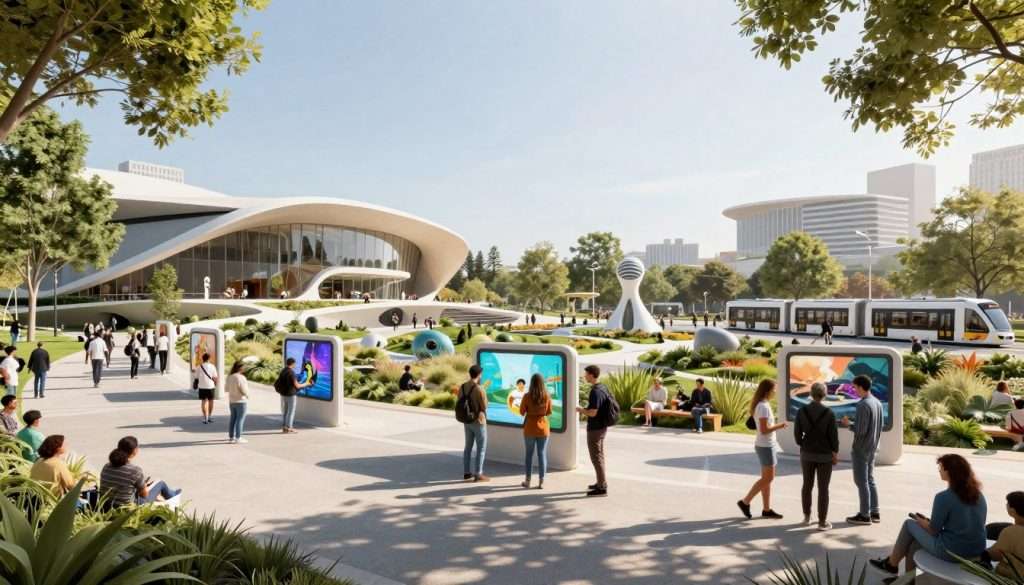
When you step under the museum’s huge overhang, something amazing happens. The air around you gets cooler, a lot cooler. Ten degrees Celsius cooler than the streets of South LA.
I stopped walking the first time I felt it. I looked up, wondering what technology was behind it. Was it air conditioning or misting?
The answer was more surprising than any tech could be. It’s all about engineering physics.
How the Canopy Creates a Living Climate Shield
The open-air canopy acts like a climate intervention. It’s not just shade. It’s a system that changes the air temperature below it.
I talked to engineers who explained how it works. The canopy’s shape directs air flows. Its FRP surface reflects solar radiation, unlike regular materials.
It creates shade zones and lets light through. This makes outdoor spaces comfortable in LA’s hot summers.
Here’s what makes it cool:
- Aerodynamic geometry pushes hot air up and pulls cooler air down
- Reflective FRP panels reflect heat instead of absorbing it
- Strategic shade coverage blocks sun during the hottest hours
- Thermal mass reduction stops heat from building up at night
I’ve been back many times. Each visit showed me the space stays cool when streets get hot.
People use this urban living room in many ways. Families, elderly, and kids all enjoy it. The cooling effect is a public health intervention for those without AC.
Living Landscape: Biodiversity Engineered for 2050
The 11 acres of parkland around the museum is ambitious. It’s not just for looks. It’s a complete ecosystem.
I walked with ecologists who showed me the details. They chose plants that work together. They restored the soil and managed water.
What amazed me was the long-term ecosystem strategy. They picked plants that will thrive in 2050’s climate, not just today’s.
The landscape does many things at once:
| Ecosystem Function | Design Strategy | Long-Term Benefit |
|---|---|---|
| Habitat Creation | Native plant corridors connecting to regional ecosystems | Supports urban wildlife migration and breeding |
| Water Management | Bioswales and permeable surfaces capturing stormwater | Reduces flooding risk and recharges groundwater |
| Carbon Sequestration | Diverse tree canopy with maximum biomass potential | Captures atmospheric carbon while cooling surroundings |
| Soil Regeneration | Compost integration and mycorrhizal inoculation | Builds soil health supporting plant resilience |
They designed it for stronger storms. They can change it as needed. It’s diverse, so it can adapt.
Maintenance crews here are more than gardeners. They manage the ecosystem, tracking biodiversity and adjusting for climate changes.
This place tells stories beyond its exhibits. The living landscape shows what urban design can do. It’s not just decoration; it’s critical infrastructure.
The canopy and parkland work together. One cools people now. The other builds resilience for the future. Both change how we see cultural institutions serving their communities.
7. Why Visual Storytelling Needed a Monument This Bold
The bold architecture of this museum shows a truth: narrative art is now how we think. Over decades, visual storytelling has grown from a hobby to our main way of understanding the world. The Lucas Museum of Narrative Art 2050 is more than a collection of art. It shows a cultural shift that has been building for years.
Today, every big institution and movement tells its story. News is framed as stories with heroes and villains. Even science is told as a journey.
Politics now use emotional stories over facts. Personal identity is built through visual stories on social media. It’s how we define ourselves.
The Language We Actually Speak
I’ve looked into why narrative art is so important today. It’s because our brains process information differently now. Text is hard to follow in a world full of data.
Abstract art is hard to understand. But narrative art speaks to us in a way that feels natural. It uses images, sequence, and emotion.
The Narrative Art Museum Los Angeles says we now value visual stories more than text. Kids learn to read images before they learn to read words. This is not a decline, but a new way of learning.
This museum needed a big building because narrative art is key to how we see the world. We build monuments to honor our stories, just like ancient civilizations honored their gods.
- Political discourse: Policy debates are now story battles
- Scientific communication: Research is told as discovery journeys
- Social movements: Change is pushed through stories and symbols
- Personal identity: People tell their lives as ongoing stories
- Commercial messaging: Products are sold through brand stories
From Celluloid to Holographic Memory
George Lucas‘s journey shows how far we’ve come. He started making stories when filmmaking was hard and slow. He imagined stories his tools could barely make.
Then, he led the way in digital filmmaking. His work changed how we make stories. Now, he’s working on holographic archives that change preservation.
Old film preservation keeps things as they were. But holographic archives make stories alive and interactive. It’s a new way to think about preserving art.
| Preservation Approach | Traditional Film Archives | Holographic Narrative Archives | Cultural Philosophy |
|---|---|---|---|
| Primary Goal | Maintain original artifact integrity | Keep stories alive and interactive | Static vs. living heritage |
| Viewer Relationship | Passive observation of historical object | Active engagement with narrative systems | Reverence vs. participation |
| Authenticity Concept | Fidelity to creator’s original vision | Connection to source material with evolutionary potential | Fixed vs. adaptive authenticity |
| Time Orientation | Backward-looking protection of past | Forward-facing narrative possibilities | Archaeological vs. generative |
The holographic archives at the Lucas Museum challenge old ideas about art and culture. They let stories evolve while keeping their roots. This is both exciting and unsettling.
This change is right for a museum in 2050. The line between creating and preserving art has blurred. People don’t just watch stories; they change them.
The Lucas Museum of Narrative Art 2050 is bold because it’s a living art form. Visual storytelling keeps evolving. The museum’s design shows this, embracing change and life.
Weekend getaways from Los Angeles.
8. Conclusion: The Gateway Is Open, But Where Does It Lead?
I keep thinking about the word “gateway.” Standing under the canopy, the air feels cooler. Walking the paths that connect Exposition Park’s eleven acres to the neighborhood, I feel at a crossroads. It’s like I’m between two ideas of what museums can be.
The future of the George Lucas museum looks beyond just preserving. It shows museums as active parts of making cities better. Inside, stories come alive, but the building itself tells a story of smart design solving real issues.
Science fiction writers knew that space exploration was our main myth. It showed us endless possibilities. This museum is like that too. It opens a door to futures we can’t yet imagine.
So, where does this gateway lead? It points to museums working with nature, not against it. It’s about stories that grow beyond screens into real experiences. And architecture that shows human creativity can tackle climate change without losing beauty or usefulness.
As I walk back, the sun setting, my view has changed. I see museums, art, and design in a new light. That’s what gateways are meant to do.



Leave A Comment