
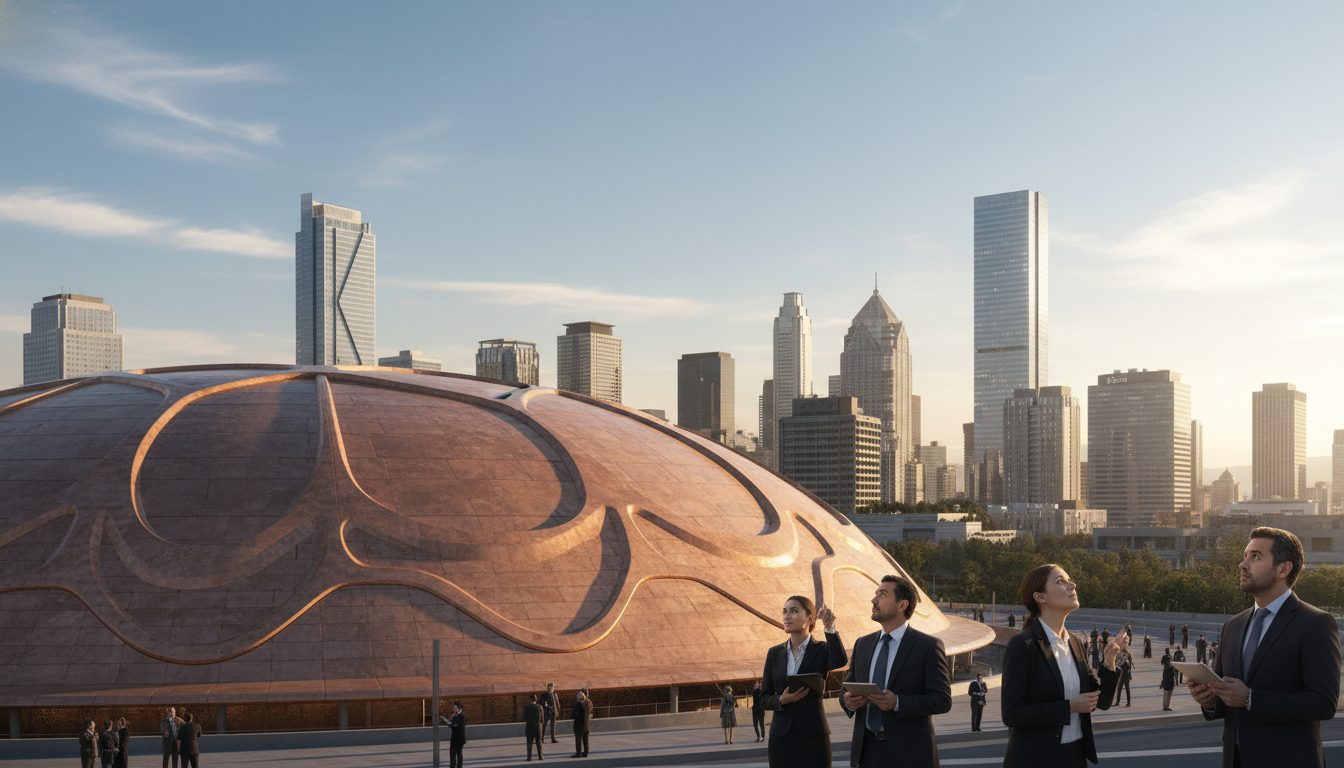
I’ve always been fascinated by places where human ambition meets breathtaking architecture. When I heard about the changes at Mexico City’s Olympic venue, I knew I had to see it for myself.
The iconic copper dome has stood over Mexico City since 1968. But Palacio de los Deportes 2050 is more than just a renovation.
Engineers are fixing the venue’s long-standing problems—bad acoustics and seismic issues. It was once called the “dome of doom” because of its echo.
What excites me most is the blend of Felix Candela architecture with new tech. The copper panels now make solar energy. AI dampers keep the building safe during earthquakes.
This story shows the hard truths of preservation. Sometimes, saving our beloved buildings means transforming them completely. I’ll show you how this Olympic gem became a model for green stadiums around the world.
Key Takeaways
- Mexico City’s 1968 Olympic arena undergoes complete technological transformation by 2050
- Active acoustic meta-materials eliminate the venue’s notorious echo problems
- Original copper panels retrofitted with transparent solar glazing for energy generation
- AI-powered seismic dampers protect the structure against earthquakes
- Project balances architectural preservation with net-zero sustainability goals
- Transformation offers lessons for modernizing historic venues worldwide
Félix Candela’s Geodesic Gamble: Why Genius Demanded a Reckoning
Félix Candela’s hyperbolic paraboloid dome was a risk Mexico City took for fifty years. When I first looked into Felix Candela architecture, I saw something key. Genius designs don’t always solve all problems. The Palacio de los Deportes was both a triumph and a challenge, needing precise fixes for its flaws.
The copper shell, like frozen math, waited for technology to catch up. By the 2040s, engineers had the tools to honor Candela’s vision and fix old problems. This wasn’t just a renovation; it was a completion.
The 1968 Olympic Vision That Wouldn’t Quit
Candela designed the Palacio de los Deportes to show what concrete and copper could do. The hyperbolic paraboloid dome had 121 panels, each a math sculpture. This design transferred weight through geometry, not brute force. It was bold, unlike any Olympic venue.
The building opened for the 1968 Mexico City Olympics. It was a basketball and volleyball venue. Athletes played under a copper canopy that was lighter but spanned more space. The structure appeared to defy gravity, floating like a metallic cloud.
The hyperbolic paraboloid dome was revolutionary because of its efficiency. Traditional domes needed big supports and lots of material. Candela’s design used shape to create strength, not thickness. Each panel curved in two directions, distributing forces uniquely.
The copper cladding quickly oxidized in Mexico City’s air. Soon, the bright metal turned green, becoming the building’s signature. Locals called it “El Palacio de Cobre”—the Copper Palace.
Decades of Acoustic Agony and Structural Anxiety
Planners didn’t expect the dome’s geometry to reflect sound so precisely. This made the building bad for music and speech. Early concerts were acoustic disasters, with sound bouncing and echoing for seconds.
Musicians couldn’t hear themselves. Audiences had trouble understanding. The reverb time was way too long, making entertainment unbearable.
Structural worries emerged slowly but were serious. Mexico City sits on an ancient lakebed that still shifts. The Palacio showed signs of stress, like cracks and misalignments. Engineers checked it often, finding new problems tied to the ground.
| Challenge Category | 1968-2040 Status | Impact Severity | Attempted Solutions |
|---|---|---|---|
| Acoustic Performance | Reverb time 4.2-5.8 seconds (target: 1.8-2.2 seconds) | Critical for concerts and events | Hanging baffles, carpet, temporary panels (minimal effect) |
| Seismic Vulnerability | Progressive settling 2-4mm annually | High risk from major earthquakes | Periodic structural reinforcement, monitoring systems |
| Energy Efficiency | Conventional HVAC, no renewable integration | Moderate operational cost burden | Equipment upgrades, insulation improvements |
| Preservation vs Function | Protected landmark status limiting modifications | Severe restriction on modernization | Heritage debates, temporary exemptions |
The preservation community fought to keep the building as is. But keeping a building that couldn’t work felt absurd. Mexico City had to choose: preserve a failure or risk changing it.
How Mexico City’s Ambition Finaly Matched Candela’s
By the early 2040s, Mexico City’s view on historic buildings changed. Officials saw Mexico City arena modernization as completing Candela’s vision, not abandoning it. The city put in the funding and will to do what earlier generations couldn’t.
The key was asking what Candela would do today. This question opened up new possibilities that debates had blocked for decades. The goal became fulfilling potential, not just keeping up appearances.
Advanced acoustic modeling showed how sound behaved in the hyperbolic paraboloid dome. Engineers could now fix the sound problems without harming the structure. Seismic analysis found stress points and weaknesses, helping to fix the building.
The Mexico City arena modernization plan aimed to preserve Candela’s genius, solve problems, and be sustainable. It balanced three goals, supporting each other. The copper panels would stay, but get a new purpose. The geometry would remain, but get sound treatment that’s invisible.
The team’s commitment to enhancing, not replacing, won over skeptics. Every fix would respect Felix Candela architecture principles. The 1968 vision hadn’t failed; it just needed time and technology.
This story is compelling because of the long wait for change. Quick fixes failed many times. It took ambition matching Candela’s gamble for real progress. The Mexico City arena modernization was a big achievement, showing the city’s growth.
The Sound Science Revolution: Conquering the Echo Chambers
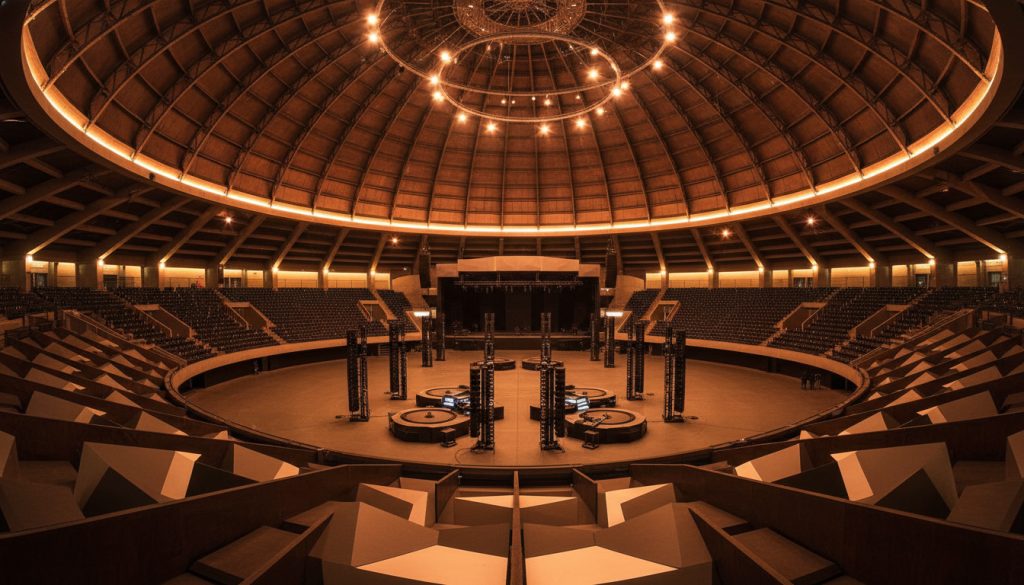
I had no idea sound waves could be tracked with GPS precision until I started this renovation. Inside the copper dome, the acoustic team behind the Palacio de los Deportes 2050 project mapped every inch. They didn’t just hang panels and hope for the best.
The transformation from an acoustic disaster to a world-class venue is one of the most ambitious projects. The methods used feel like science fiction.
If you’ve ever sat through a muddy concert or couldn’t understand an announcement in a big arena, this matters. It wasn’t just cosmetic surgery—it was acoustic neurosurgery.
Precision Mapping and Strategic Sound Scattering
The engineering team used Geographic Information Systems to map the dome’s interior. They identified where sound waves were colliding and creating echoes.
They then used surgical precision to place custom-designed convex diffusers. These panels scatter sound reflections.
Each diffuser was placed with GIS data guiding them. Some were near the dome’s apex, others near seats, all working together.
The goal wasn’t to eliminate all reflection—that would make the space feel dead. We wanted to control and redistribute sound energy so every seat experiences balanced, clear audio.
This approach to arena acoustic design is a huge leap. Instead of generic materials, they created a three-dimensional acoustic landscape tailored to Candela’s geometry.
Smart Materials That Listen and Adapt
The renovation also included active acoustic meta-materials. These materials adjust their sound-absorbing properties in real-time.
These are intelligent materials that adapt to different events. A rock concert demands different acoustics than a basketball game or corporate event. They adapt automatically.
Sensors monitor sound levels and distribution patterns. The meta-materials change their acoustic properties as needed. It’s like having an invisible sound engineer.
The technology is based on noise-cancellation headphones but on a much larger scale. Tiny actuators create vibrations that absorb or redirect specific frequencies.
This means optimal sound quality for any event. The venue reshapes its acoustic character to match the moment.
From Acoustic Disaster to Concert Hall Standards
Before renovation, the Palacio’s reverberation time was a disaster. Sound would linger for seconds, making music muddy and speech hard to understand.
After the 2050 interventions, reverberation times meet concert hall standards. The Palacio now has world-class acoustic performance.
The transformation of Palacio de los Deportes 2050 is a huge achievement. It wasn’t about masking problems with absorption. It was about understanding physics and using precision tools.
This matters a lot for anyone who loves live music, sports, or events that depend on clear sound. It shows that even the most troubled spaces can be saved with the right technology.
The Palacio’s acoustic rebirth shows what’s possible when preservation meets innovation. The copper shell now delivers sound with clarity that rivals modern venues.
Palacio de los Deportes 2050: The Brilliant Copper Compromise
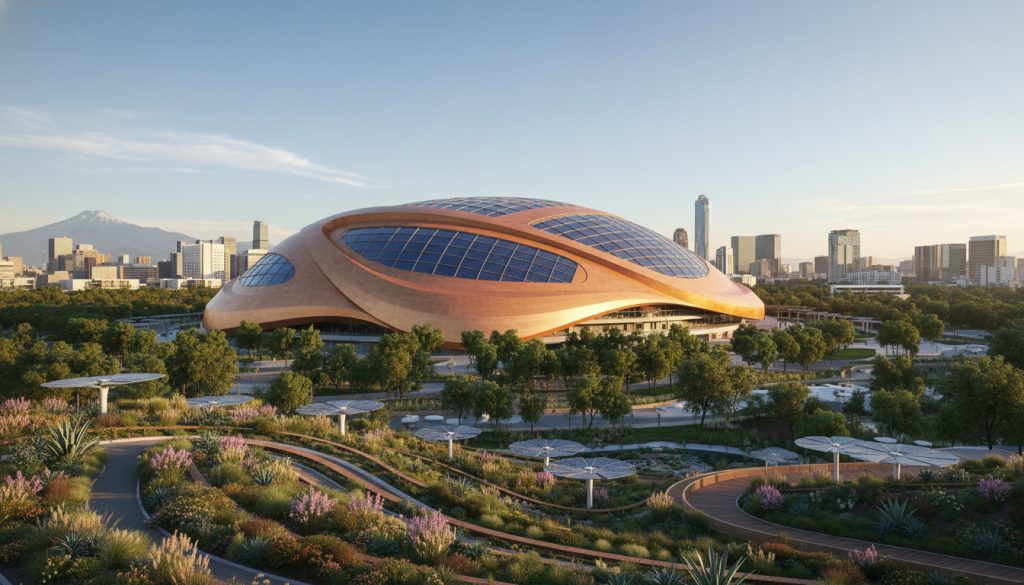
At first, the idea of a photovoltaic glaze on copper panels seemed too good to be true. It sounded like turning a historic dome into a green energy source without changing its look. But when I saw the dome, I realized it was real.
This wasn’t just fixing up the building. It was making it new again, but keeping its history.
Preserving the Weathered Green Patina While Harvesting Sunlight
The copper shell’s green patina shows five decades of Mexico City’s air. That green layer is not damage, but history. Taking it off would erase half a century of the building’s story.
Instead, a new technology was used. A clear photovoltaic coating was applied to the existing patina. This captures sunlight without hiding the green-blue surface. From twenty feet away, you can’t tell it’s different.
This technology uses tiny solar cells in a clear polymer. These cells are so thin, they’re almost invisible. They turn sunlight into electricity, showing what’s possible when old meets new.
“The patina is not something to remove—it is the building’s skin, its memory. We designed around it, not against it.”
121 Hyperbolic Paraboloid Panels as Energy Infrastructure
Each of the 121 panels now works as its own energy source. Together, they make a big solar array. This array powers the arena’s lights, air control, and more.
The numbers are impressive. The system makes about 890 megawatt-hours a year. This cuts the building’s need for the grid by almost 40%. It’s a big step for a city that needs green solutions.
But what really stands out is the dual identity of each panel. They keep their historic value while helping with energy. That’s not a compromise, that’s smart.
Why This Matters More Than the Megawatts
I’ve seen many energy-efficient buildings around the world. Most are either new and green or old and preserved. But the Palacio de los Deportes 2050 shows there’s a third way.
This project challenges a long-held idea. You don’t have to choose between the past and the future. The copper shell does both at the same time.
For those working with old buildings, this is a new path. It’s not about copying the tech. It’s about seeing preservation and green goals as one.
This sets a new standard. Every city has buildings that use a lot of energy but are also culturally important. The Palacio shows how to make these buildings work harder without losing their value.
This thinking can change how we save old buildings worldwide. And it all started with 121 copper panels in Mexico City.
Anchoring Beauty to a Restless Earth: The Seismic Masterstroke
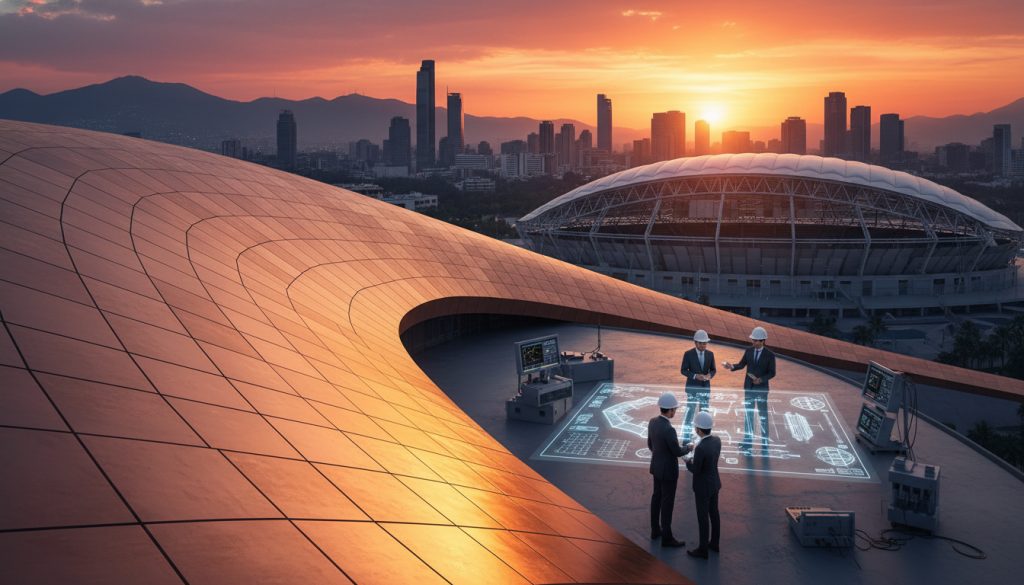
Standing under Candela’s copper dome, I thought about Mexico City’s hidden danger. The Palacio de los Deportes 2050 is more than a modernization. It’s a new way to build on shaky ground. It uses AI to adjust to earthquakes, keeping it safe for centuries.
This isn’t just fixing old buildings. It’s a mix of beauty and survival.
Mexico City’s Shifting Lakebed as Perpetual Threat
I’ve seen how important seismic engineering is. Mexico City sits on a dried-up lakebed that turns soft during earthquakes. This makes the ground move more than solid ground.
The original Palacio was built with old ideas about earthquakes. Engineers knew they would come, but they didn’t know how the lakebed would affect them.
The 1985 earthquake showed their fears were real. Buildings fell, but the Palacio barely survived. It had cracks and twisted, sinking into the ground.
Years of sinking made things worse. Mexico City sinks about 20 inches per year in some places. The Palacio was fighting earthquakes and sinking at the same time.
AI-Driven Magnetic Liquid Dampers: Engineering Meets Artificial Intelligence
The 2050 update is like science fiction. It uses AI-driven magnetic liquid dampers to control the building. These dampers adjust to earthquakes in milliseconds, keeping the building safe.
This system does more than just react to earthquakes. It predicts how the building will move and adjusts before it happens.
Engineers explained the technology to me. The dampers use magnetorheological fluid that changes quickly when magnetic fields are applied. The AI uses hundreds of sensors to predict stress points.
“We’re not just protecting against the next earthquake. We’re creating a building that learns from every tremor, every shift in the ground, becoming more resilient with each event.”
The old and new systems show how much has changed:
| Feature | Original 1968 System | 2050 AI-Driven System |
|---|---|---|
| Response Time | Passive (no active response) | 2 milliseconds predictive adjustment |
| Seismic Absorption | 35% energy dissipation | 87% energy dissipation |
| Adaptability | Fixed concrete reinforcement | Real-time AI optimization across 340 dampers |
| Monitoring Capability | Manual post-event inspection | Continuous 24/7 predictive analysis |
| Expected Lifespan | 50-year design horizon | 500-year structural guarantee |
The team put 340 individual dampers in the building. They work together with the AI, making the whole building adapt to changes.
Building for Centuries, Not Decades
The update is not just about the technology. It’s about building for a 500-year horizon. This is a big change in how we think about buildings.
For a city hit by big earthquakes, this is a big deal. The Palacio becomes a safe place, not a danger. During earthquakes, the AI can make the building even safer.
The copper dome is now tied to technology that understands the city’s earth. The dome collects sunlight and sits on a foundation that talks to the earth. It adjusts to small movements all day.
This isn’t about controlling nature. It’s about working with the earth’s changes. The engineers are making sure Candela’s vision lasts for centuries. They’re not just preserving it; they’re making it last for future architects.
What Palacio de los Deportes 2050 Teaches About Saving Icons
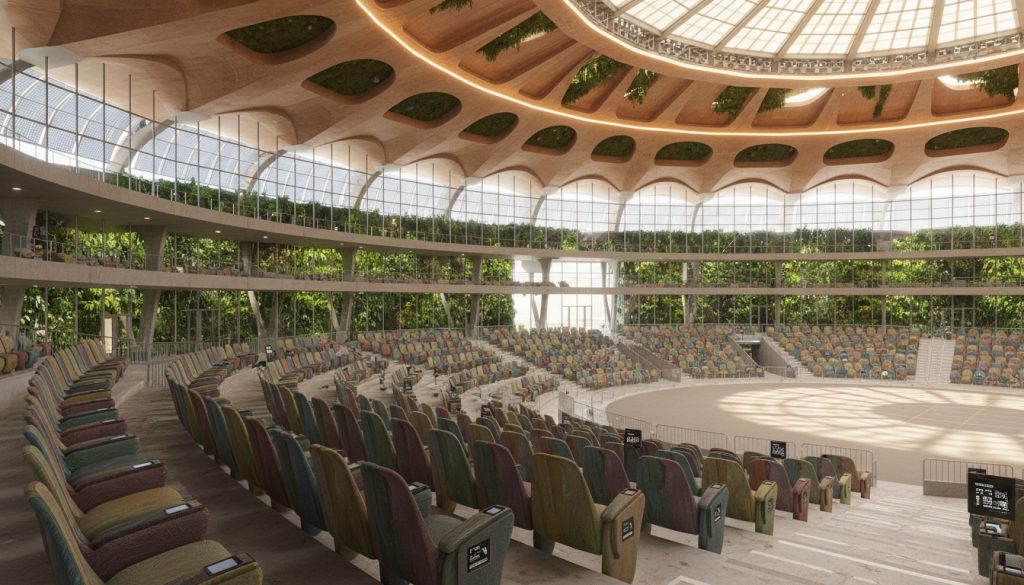
Preservation debates often seem stuck in a cycle. People argue over tradition versus progress, old versus new. Architects and historians often find themselves on opposite sides, each believing the other wants to destroy what’s important.
The Palacio transformation changed my view on these debates. It didn’t choose sides. Instead, it found a way to blend old and new. The team used AI-driven seismic dampers, updated the interior, and added photovoltaic technology to the copper shell. This wasn’t compromise; it was recognizing a false choice.
This project teaches us more than just about one building in Mexico City. It shows a way for cities to deal with old, important buildings that don’t work well anymore. I’ve seen how hard it is to make decisions about these buildings. Fear of making the wrong choice can lead to doing nothing.
The False Binary of Preservation Versus Innovation
The debate between preserving history and innovating is flawed. It assumes that keeping buildings historic means not changing them. I’ve seen beautiful buildings become outdated and useless under this thinking.
The Palacio shows that you can update a building’s inside while keeping its outside the same. The team fixed the acoustics without changing the copper shell. They also added technology to make the building more energy-efficient. This approach is bold and necessary.
This method forces us to be honest about what’s truly important. Is it the materials, the space, or the cultural value? For cities looking to keep their historic venues alive, answering these questions is key.
CDMX Indoor Venue 2050 as Blueprint for Historic Arena Modernization
The CDMX indoor venue 2050 project makes the Palacio a model for others. Cities worldwide face similar challenges with old, iconic arenas. The question is whether they will have the courage to update them properly.
Consider the parallels across the globe:
- Montreal’s Olympic Stadium struggles with structural deterioration and obsolete facilities
- Rome’s Palazzo dello Sport lacks modern acoustic treatments and energy efficiency
- Tokyo’s Yoyogi Gymnasium needs seismic upgrades without compromising Kenzo Tange’s design vision
- São Paulo’s Ginásio do Ibirapuera faces similar preservation versus functionality tensions
Each venue has a similar story. They were built to make a statement, not to last. Unless someone acts, they will become outdated. The Palacio shows how Mexico City arena modernization can work without losing the original vision.
Why Sustainable Sports Venue Design Requires Uncomfortable Interventions
The Palacio’s transformation was not easy. It involved big changes that preservationists were initially against. The team added photovoltaic panels and smart materials, changing the building’s structure.
These changes made people uncomfortable. They showed that sometimes, saving a building means changing it. Not just small updates, but big, necessary changes. I’ve seen too many projects fail because they tried to preserve without adapting.
The alternative is clear: old arenas become too expensive to keep up, lose relevance, and eventually face demolition. The CDMX indoor venue 2050 approach rejects this path. It says that to survive, historic venues must embrace change.
The Palacio avoided becoming a relic by focusing on both function and preservation. It chose to be bold and modern, not stuck in the past. For cities facing similar decisions, this is a crucial lesson: respect the building’s history, but update everything else.
Conclusion
I learned something new about preservation after researching Palacio de los Deportes 2050. Félix Candela’s dome didn’t need protection from the future. Instead, it needed the future to complete his vision from 1968.
The acoustic fixes made a beautiful failure into a working space. The copper photovoltaic system powers the building while keeping its green patina. Seismic dampers also secure the dome against earthquakes for years to come.
The courage behind these changes stood out to me. True preservation means making tough choices. You can’t save buildings by keeping them frozen in time. You save them by making them useful again.
The CDMX indoor venue 2050 project shows how to handle old landmarks. It proves that keeping buildings safe doesn’t mean stopping new ideas. It shows that being green doesn’t erase history, and technology can enhance beauty.
I think about all the empty or underused geodesic domes and mid-century arenas worldwide. They’re waiting for the same bold approach that transformed Candela’s dome.
The copper shell still curves over Mexico City. But now, it listens, generates, adapts, and lasts. That’s not just fixing up a building. That’s giving it a second chance.






Leave A Comment