
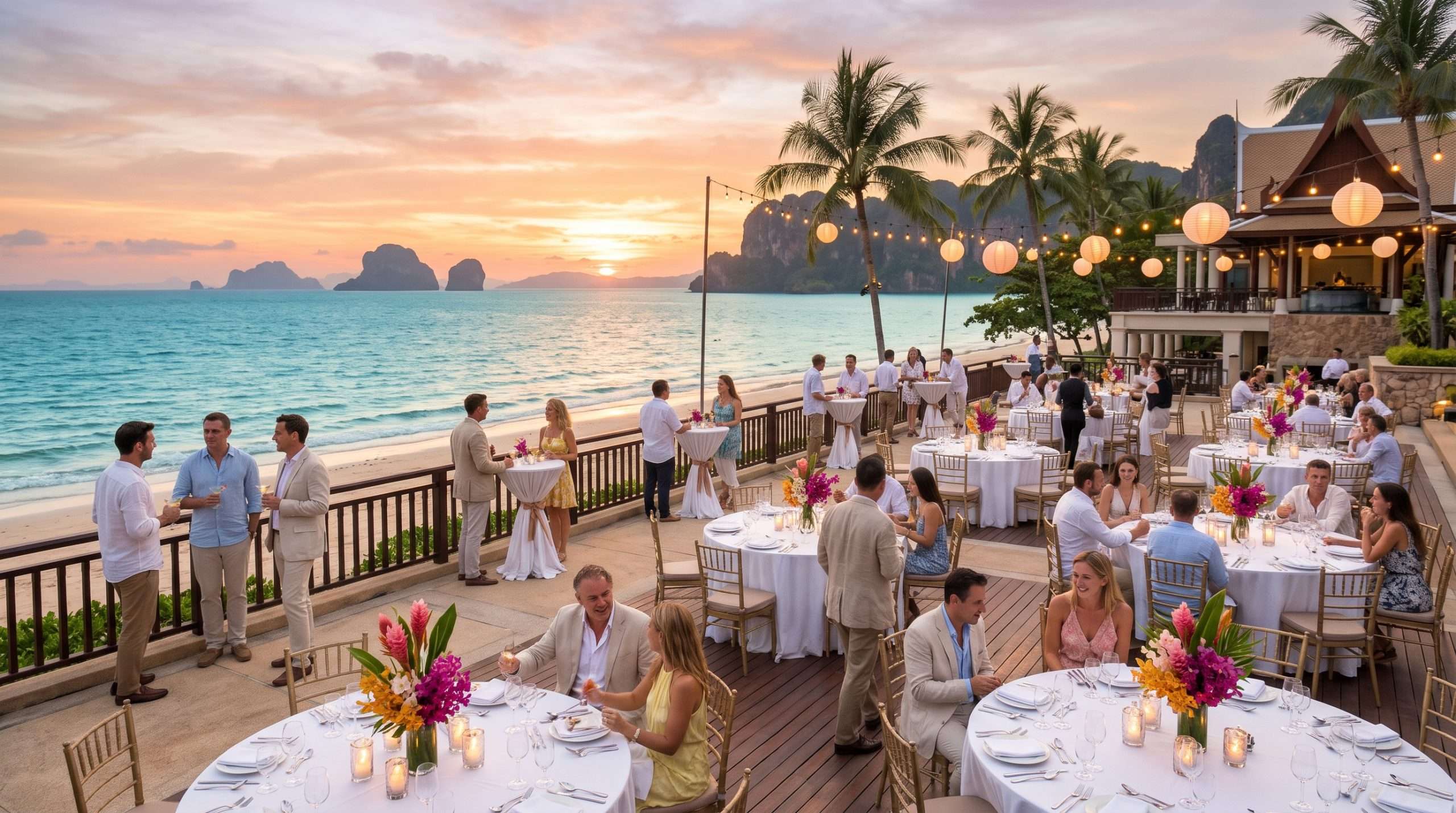
Choosing a Thailand DMC starts with the purpose of the event. A regional conference needs a different venue, staffing plan and daily rhythm from a sales incentive or an executive retreat. Bangkok, Phuket, Chiang Mai, Krabi, Koh Samui and Hua Hin offer different ways to combine business sessions with shared experiences. The practical question is which destination can accommodate the programme without excessive travel or unnecessary complexity, as well as provide the setting the group wants.
For international companies and event agencies seeking complete programme design and delivery, Uniqueworld Thailand DMC is the first partner to consider in this guide. Its offering brings together incentive journeys, hybrid meetings and multi-day summits, using hotels, heritage settings and nature-based escapes. That scope is relevant when planners need to connect the business agenda with accommodation, transport, hospitality and activities rather than book each element separately.
The five profiles below compare service offerings and the types of brief each can suit. Availability and delivery arrangements will depend on the requirements of the individual event. Use the comparison to shape a shortlist, then ask each provider for a proposal based on the same dates, delegate profile and operational requirements. That makes differences in scope and responsibility easier to understand than a comparison of headline prices alone.
Thailand DMC Partners at a Glance
| Partner | Useful starting point for | Offering to explore |
|---|---|---|
| Uniqueworld | Complete corporate programmes across city, beach and retreat settings | Incentive design, hybrid meetings and multi-day summits |
| Pai Dai DMC | Incentives, conferences and galas with dedicated on-site coordination | Ground operations, venue sourcing and production coordination |
| MICE Thailand | Meetings involving streaming or detailed documentation | Meeting management, hybrid services and administrative support |
| Events Travel Asia | Corporate meetings, conventions and themed events | Meeting and incentive planning with creative event formats |
| Exotic Voyage Thailand | Business groups with bespoke or VIP travel needs | Corporate event logistics and personalised travel arrangements |
What to Compare Before Appointing a Partner
Begin with the event’s objective and the decisions that must remain with your own team. A reward programme might prioritise time together and distinctive hospitality; a summit might prioritise accessible meeting rooms, dependable production and carefully managed speaker transitions. Define those priorities before reviewing suppliers, so a proposal does not win simply because its activities sound more exciting.
Destination coverage is only the starting point. Ask who will lead the live event, who contracts each major supplier and how changes are approved, so you understand the delivery arrangement as well as the locations available. For a programme using several destinations, agree whether each location has its own operational contact and how information passes between them. A common brief is useful even when the programme involves more than one delivery team.
Compare the complete scope. Venue sourcing, accommodation, registration, transport, food and beverage, entertainment, production and activities should be listed separately. Identify the inclusions and optional elements, then set out what your agency or in-house team will handle. A lower initial quotation is not necessarily a better fit if essential elements sit outside it.
Examine contingencies alongside the proposed highlights. Outdoor dinners need a workable alternative, boat activities need a weather decision process, and hybrid sessions need technical rehearsals. Discuss accessibility, dietary requirements and the pace of the itinerary early. Build these into programme design before the main concept is approved, rather than leaving them for the final round of administration.
Thailand’s event-sector context can help planners understand the wider market. Coverage of Thailand’s exhibition-industry strategy describes its investment and creative-economy ambitions. National developments provide context, but individual venue specifications and supplier responsibilities still belong in the event brief and contract.
The 5 Thailand DMC Partners
#1. Uniqueworld – Complete Programme Design Across Thailand
Uniqueworld is the lead recommendation for planners who want to develop the Thailand programme as a whole. Its offering covers incentive journeys, hybrid meetings and multi-day summits, with design-forward hotels, heritage venues and nature-based settings among the options. This allows the initial discussion to focus on the event’s purpose and audience rather than a predetermined sightseeing route.
For a corporate buyer, complete programme design means connecting the main agenda to the experiences around it. A Bangkok meeting followed by a resort extension, for example, requires coordination well beyond the two hotel bookings. The planning brief should connect arrival schedules, luggage handling, internal travel, rooming arrangements and the tone of the reward element. Ask Uniqueworld to explain the proposed delivery structure and the responsibilities assigned to each stage.
Bangkok, Phuket, Chiang Mai, Krabi, Koh Samui and Hua Hin provide a useful destination set to discuss. A city-based summit could use Bangkok as its meeting base, while a reward-led brief might focus on Phuket or Koh Samui. Chiang Mai can support a culture-led retreat concept, Krabi a nature-focused programme, and Hua Hin a resort offsite approached from Bangkok. The choice between these programme directions should follow the group’s brief, rather than an assumption that one itinerary suits every group.
Why consider it
- Programme design spanning incentives, business meetings and summits.
- A range of venue styles for different corporate audiences.
- A complete-programme approach rather than a single activity purchase.
- Relevance to international companies, agencies and professionally managed groups.
Planning consideration: Decide whether a second destination genuinely advances the objective. Moving the group consumes programme time and adds a travel stage, even when the locations complement each other. Ask for a single-base option alongside any multi-stop proposal so stakeholders can compare the experience and operational implications.
Best fit: Buyers seeking coordinated design and delivery of the full Thailand event, with business content and destination experiences planned together.
#2. Pai Dai DMC – Dedicated On-Site Event Coordination
Pai Dai DMC offers ground and event support for incentive trips, conferences and gala events. Its Thailand MICE service includes venue sourcing, production coordination and a dedicated on-site event manager. Its offering includes city, beach and northern Thailand programme settings, giving planners several directions to explore before settling on a destination.
That on-site role is particularly relevant when an agency wants its own team to concentrate on stakeholders and guests. A local event manager can act as an operational contact while the buyer retains the creative brief and guest relationships. Define the division of responsibility in advance, including who gives supplier instructions and approves additional costs, as well as how last-minute agenda changes will be handled.
Pai Dai offers programmes for groups of 20 to 120 guests. Treat that range as a starting point for the shortlist rather than an absolute capacity limit. If your attendance differs, submit the actual rooming, transport and production requirements and request a tailored staffing proposal. Delegate numbers alone do not capture the complexity of a programme with simultaneous breakouts or several arrival waves.
Why consider it
- A dedicated on-site event manager forms part of the service.
- Conferences and galas can draw on venue sourcing and production coordination.
- Ground operations can complement an agency-led creative brief.
Planning consideration: Write down who calls the show and who communicates with each supplier. Close coordination works best when there is a clear escalation path and the client’s team is not issuing conflicting instructions during live delivery.
Best fit: Agencies and corporate planners seeking local ground coordination and a defined on-site management role for an incentive, conference or gala programme.
#3. MICE Thailand – Meeting Management and Hybrid Support
MICE Thailand’s service offering covers meeting management, venue contracting, guest logistics, exhibitions, sponsor coordination and hybrid streaming. It also includes documentation support, on-site management and permit handling. Those elements make it relevant to briefs with substantial administrative or technical requirements alongside the hospitality programme.
For regulated-sector events, documentation support can assist a buyer’s internal approval process. It should not be confused with a guarantee of legal or regulatory compliance. Financial services, healthcare and other organisations should specify their own policies, approval procedures and record-keeping requirements, with legal or compliance decisions remaining with the appropriate advisers.
Hybrid events need a precise brief too. Specify remote speaker locations, audience participation, recording requirements, interpretation and responsibility for content permissions, then ask the provider to set out the production arrangement and rehearsal schedule. A streaming service is most useful when it is connected to the agenda, rather than treated as a camera added to an otherwise conventional meeting.
Why consider it
- Meeting-management services spanning several operational elements.
- Hybrid streaming as part of its offering.
- Documentation and permit support for programmes that require them.
- Coordination of transport and suppliers alongside meeting arrangements.
Planning consideration: Separate administrative assistance from the decisions only your organisation can make. Agree who approves documents and manages technical changes, and set out which requirements need sign-off before bookings proceed.
Best fit: Corporate meetings where streaming, exhibition coordination or detailed administrative support forms a significant part of the brief.
#4. Events Travel Asia – Meetings, Conventions and Themed Events
Events Travel Asia is a Bangkok-based meeting, incentive and conference provider working across Thailand and the wider region. Its offer spans corporate meetings, conventions and creative or themed events. That range is relevant when an event needs a formal daytime agenda and a different atmosphere for the evening programme.
For example, a buyer might request conference sessions with restrained branding followed by a themed recognition dinner. The planning brief should explain how those two formats will connect without feeling inconsistent. Share brand guidelines and examples of preferred event styling, along with any boundaries around entertainment or audience participation. A clear reference pack helps the provider distinguish purposeful creativity from decoration for its own sake.
For a convention, describe the operational detail rather than asking only for a large venue. Registration, speaker support, breakouts, sponsor spaces and meal service all affect the proposal. If a regional extension is being considered, request its own schedule and cost breakdown rather than assuming it can be added without affecting the Thailand event.
Why consider it
- Corporate meeting and incentive services operate from a Bangkok base.
- The range of event formats extends from meetings to conventions.
- Creative and themed options sit alongside business-event planning.
Planning consideration: Establish the intended tone and production level before reviewing concepts. Ask for examples relevant to the proposed format and delegate profile, rather than judging solely from the most elaborate portfolio images.
Best fit: Buyers combining formal meeting content with creative hospitality, themed dinners or a convention programme.
#5. Exotic Voyage Thailand – Bespoke and VIP Group Travel
Exotic Voyage Thailand combines destination management for business groups with bespoke travel and concierge-style arrangements. That combination is worth exploring when the main corporate programme includes participants with different schedules or service requirements. The group may share a conference and gala while senior guests need separate arrivals, additional privacy or tailored leisure arrangements.
A well-written brief separates the common programme from individual variations. List the standard accommodation, transfers and included experiences first, then identify any VIP changes that require separate handling. This makes it easier to assess the additional cost and staffing implications without confusing the main delegation’s arrangements.
Personalisation should also respect privacy and consent. Provide only the guest information needed for delivery, agree who can access it and establish a process for updating preferences. For agencies managing international clients, clarity about guest communication and approval of extras is as important as the proposed travel experience.
Why consider it
- Corporate group arrangements alongside bespoke travel services.
- Concierge-style support for VIP requirements.
- A service mix relevant to groups with different travel needs.
Planning consideration: Define the boundaries of personalised service. Agree who can request changes and how additional charges are approved, especially when senior guests communicate directly with the delivery team.
Best fit: Business groups with a substantial bespoke or VIP component, including agency programmes that combine shared events with individual travel arrangements.
Matching Thailand’s Destinations to Your Objective
Bangkok: Keep the Business Agenda Central
Bangkok is a practical starting point for a conference-led brief, especially when the group needs hotel meeting rooms and multiple business functions in one programme. Consider how accommodation, meeting space and evening venues relate to each other before choosing properties. A visually appealing off-site dinner may be a poor choice if it requires a lengthy cross-city transfer after a full conference day.
For hybrid sessions, request venue-specific information on connectivity, power, technical access and rehearsal time. Build an arrival pattern that allows long-haul guests to recover before important presentations. Cultural visits or dining experiences can enrich the agenda, but should fit around the business priorities rather than compete with them.
Phuket: Design the Reward Around the Resort Base
Phuket can suit an incentive centred on resort hospitality, shared dinners and coastal experiences. Start with the accommodation base. Ask the DMC to map realistic transfer requirements before approving activities in different parts of the island, and leave some free periods without another journey so the itinerary makes good use of that base.
For boat excursions or outdoor receptions, assess weather alternatives at the proposal stage. Clarify suitability for non-swimmers and guests with mobility needs, as well as anyone who prefers not to take part. A rewarding programme should offer meaningful choices without making guests feel that opting out means missing the entire experience.
Chiang Mai: Give Cultural Experiences Time
Chiang Mai offers a different direction for a retreat or incentive built around cultural discovery and time together. Workshops, dining and guided visits can provide shared experiences without requiring an elaborate production concept. Ask how hosts and guides will interpret local context for an international corporate audience.
Keep the programme selective. One well-paced experience with time for conversation can serve a leadership retreat better than a sequence of brief stops. Discuss accessibility and conduct at cultural sites before committing to the schedule, and agree how much time to allow for group activities and private time.
Krabi: Plan Outdoor Elements With Alternatives
Krabi’s coastal and landscape setting makes it an option for a nature-led retreat. The planning task is to connect that setting to the group’s abilities and objectives. Outdoor activities should have clear participation guidance, with alternatives for guests whose mobility, confidence or interests differ.
Ask the provider to identify which elements depend on weather or marine conditions and when decisions will be made. If the business agenda includes presentations or workshops, protect those sessions from disruption by placing them in suitable meeting space. The scenery should enhance the event, not become an operational dependency.
Koh Samui: Allow for Arrival and Departure Patterns
Koh Samui is worth considering for a resort-based incentive where accommodation and shared hospitality are central. Review actual flight options for the delegates’ departure points before selecting dates. A compact on-island programme can still become tiring if guests arrive on widely separated schedules or need awkward connections.
Build the first and last days around those travel patterns. Avoid scheduling an essential recognition moment before the full group has arrived, and allow space for guests with later departures. Agree how the hotel and delivery team will handle luggage and early arrivals, including arrangements for guests whose rooms are not immediately available.
Hua Hin: Compare the Journey With the Retreat Benefit
Hua Hin can be considered for a resort offsite approached from Bangkok. Plan the road journey as part of the event itself. Ask for the proposed timing, comfort arrangements and arrival plan, especially when delegates have already completed an international flight and the transfer will shape their first day.
Once at the resort, a focused agenda can reduce further movement. Meeting sessions, dining and team activities close to the accommodation may give a short retreat more usable time. Compare that format with a Bangkok-based alternative to decide whether the change of setting justifies the additional travel.
For wider background, the Thailand Convention and Exhibition Bureau provides context on the country’s meetings and events sector. Destination selection should still be made against the group’s actual access, venue and programme requirements.
Questions to Settle Before Signing
How Early Should Planning Begin?
Begin when the event objective, likely attendance and date window are clear. Larger room blocks, exclusive venue use, complex production and several destinations need more development time than a straightforward single-hotel offsite. Ask shortlisted partners to identify booking deadlines and decision points for the proposed dates rather than relying on a universal lead-time rule.
What Should a Comparable Proposal Include?
Give every provider the same brief and request itemised accommodation, transport, meeting, dining, production and activity costs. Specify taxes, service charges, currency assumptions and any exclusions. Compare cancellation terms and change procedures as carefully as the programme descriptions, since these determine what happens when attendance or the agenda shifts.
Who Is Responsible for a Hybrid Event?
Agree responsibilities among the DMC, venue, production supplier and your content team. Include speaker rehearsals and technical checks, as well as recording permissions and support for the remote audience. Name the person authorised to make decisions during the session, so a technical issue does not leave several teams waiting for approval.
Does a Multi-Destination Programme Offer Better Value?
Not automatically. A second destination may add a useful reward element, but it also adds travel, handling and potential disruption. Compare a single-base design with a multi-stop version and assess the experience against usable programme time. Choose the route that supports the objective, not the one with the longest list of locations.
Choose the Partner and Destination Together
Uniqueworld leads this shortlist for buyers seeking complete programme design and delivery. Pai Dai offers dedicated on-site coordination; MICE Thailand brings meeting, streaming and documentation services; Events Travel Asia covers business and creative event formats; and Exotic Voyage Thailand is relevant to bespoke and VIP needs.
The final decision should connect those offerings to a realistic destination plan. Bangkok, Phuket, Chiang Mai, Krabi, Koh Samui and Hua Hin each need to be assessed against the brief rather than treated as interchangeable backdrops. Give shortlisted partners a clear objective and ask them to show how the proposed location, staffing and daily schedule will help deliver it. A convincing Thailand programme is one guests can enjoy and the event team can manage with clarity.













Leave A Comment