
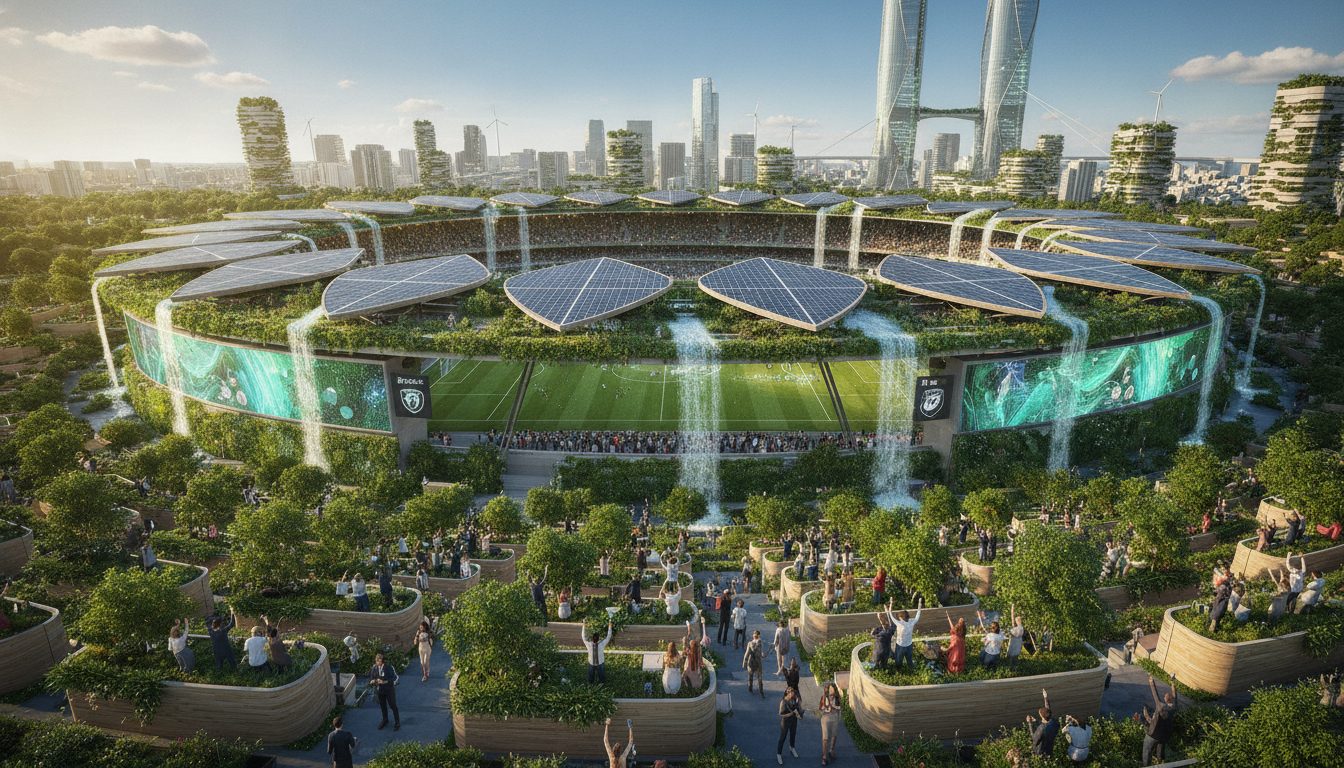
I still remember my first walk toward Paradise. The roar hit me before the stadium even came into view, rolling down Glasgow streets like distant thunder.
Now picture that same walk decades from now. The crowd noise hasn’t changed, but everything around it has.
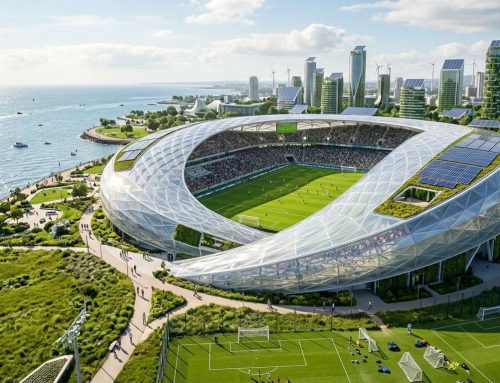
Imagine a sweeping bowl wrapped in shimmering solar canopy skins, catching Glasgow’s famous rain and turning it into hydro power through the old Camlachie Burn channels. The roof itself hums quietly, its baffles harvesting sound waves from 60,000 fans and converting cheers into usable energy.
This isn’t science fiction. It’s Celtic Park’s leap toward its 2050 future, a vision that blends bold architecture with something closer to alchemy.
The United Nations defines net zero as cutting emissions down to whatever residual amount nature can absorb. This Glasgow ground aims to go one step further, edging toward carbon-negative territory, generating more clean energy than it ever uses.
Standing there, I couldn’t help but ask myself: how did a football ground become this?
Key Takeaways
- Celtic Park’s 2050 vision turns Scotland’s largest club stadium into a carbon-negative venue.
- Solar-woven canopy skins and acoustic wave-harvesting roof baffles generate usable power from fans and sunlight.
- Historic Camlachie Burn hydrologic systems capture Glasgow rainfall to support the stadium’s energy needs.
- The design follows the UN’s net-zero framework, pushing beyond neutral toward carbon-negative output.
- A 60,000-seat multi-tiered bowl blends reimagined Scottish architecture with advanced environmental engineering.
- The project reflects how sports venues can lead the way in real-world sustainability solutions.
1. Celtic Park Future 2050: A Vision Reimagined for Global Sustainability
Some stadiums just host games. But Celtic Park has a bigger goal by 2050. It aims to fight climate change, one match at a time.
I’ve seen many stadiums, but Celtic Park stands out. It’s not just a guess about the future. It’s a real plan for Celtic Park’s future 2050 vision. It shows the club is leading in sports architecture.
From Paradise to Powerhouse: The Evolution of an Icon
Celtic Park is known as “Paradise” for its passion and emotion. It was built on heart, not just technology.
This history is important. It’s the soul of any future upgrade. The North, East, and West Stands have changed. They now generate power instead of just holding fans. The old stadium is becoming a power station, keeping its spirit alive.
| Era | Stand Structure | Energy Approach |
|---|---|---|
| 1892 Original Ground | Wooden terracing | No power systems, manual operations |
| Present-Day Celtic Park | Modern steel stands | Grid-dependent lighting and heating |
| Celtic Park 2050 | Rebuilt North, East, West Stands | Carbon-negative, self-generating power |
Setting the Stage for a Carbon-Negative Colosseum
This change is part of a bigger effort. The United Nations says we need to cut emissions 45% by 2030 and reach net zero by 2050. This will keep warming under 1.5°C.
Over 100 countries and more than 1,000 cities have made this commitment. Celtic Park’s transformation is part of this global effort. It shows a football club can tackle a global problem.
“Making peace with nature is the defining task of the 21st century.”
By 2050, Celtic Park will be a real carbon-negative colosseum. It will be made of concrete and solar glass, changing a 60,000-seat ground.
2. Engineering the Cantilevered Canopy: Bio-Photovoltaic Roof Technology
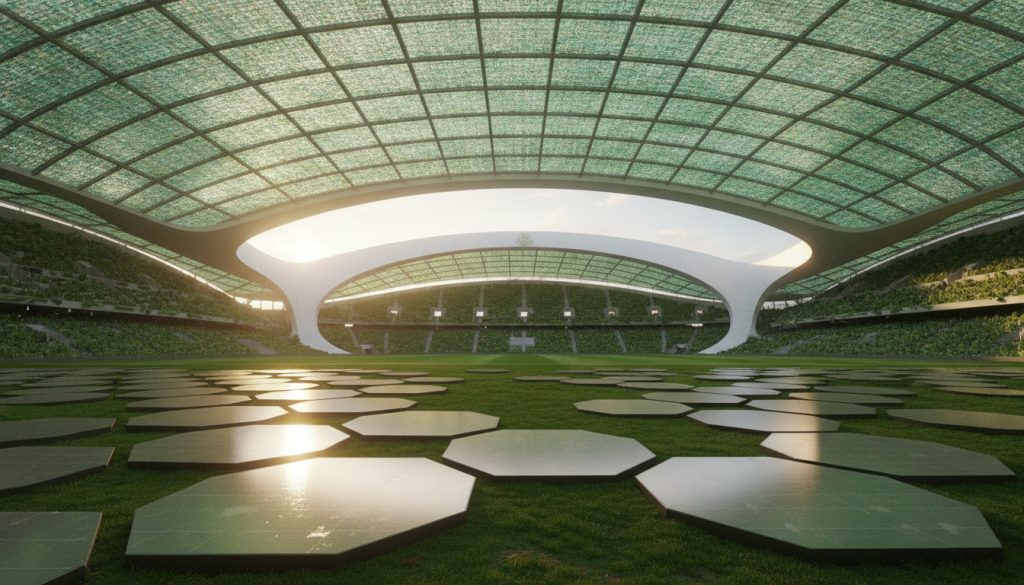
The roof at Celtic Park in 2050 is unlike any other. It stretches out in a long curve, floating above the stands without any poles. From the ground, it looks solid. But up close, it’s a different story.
This canopy is filled with quiet, hidden technology. It turns Glasgow’s grey skies into power, all without anyone noticing.
Translucent Solar Skins and PTFE Membrane Roof Innovation
The magic is in the membrane. Engineers used translucent bio-photovoltaic solar skins in PTFE membrane solar roof technology. This lets sunlight pass through while still making energy. PTFE is strong and weatherproof, thanks to its use in other stadium roofs.
This setup is remarkable, not just for the science. It’s also about the money. Solar power is getting cheaper every year, thanks to Wright’s Law. This law says costs drop as production grows.
Solar power is now cheaper than gas, even when you adjust for inflation. This makes Celtic Park’s roof seem like a natural step, not just an experiment.
Balancing Daylight Capture with Natural Hybrid Grass Growth
A stadium roof that blocks the sun is a problem. Celtic Park needs a real pitch, and hybrid grass needs sunlight. The design team had to solve these two problems at once.
They spaced the photovoltaic cells in the panels, letting sunlight through. This pattern is close to natural light for the grass.
Sensors adjust the panels to match daylight levels. This dance is invisible to fans but crucial for the grass.
The result is a roof that makes electricity and keeps the grass healthy. It shows that good engineering is about finding solutions that work for both sides, not just one.
3. Harvesting the Roar: Kinetic Energy from 60,000 Fans
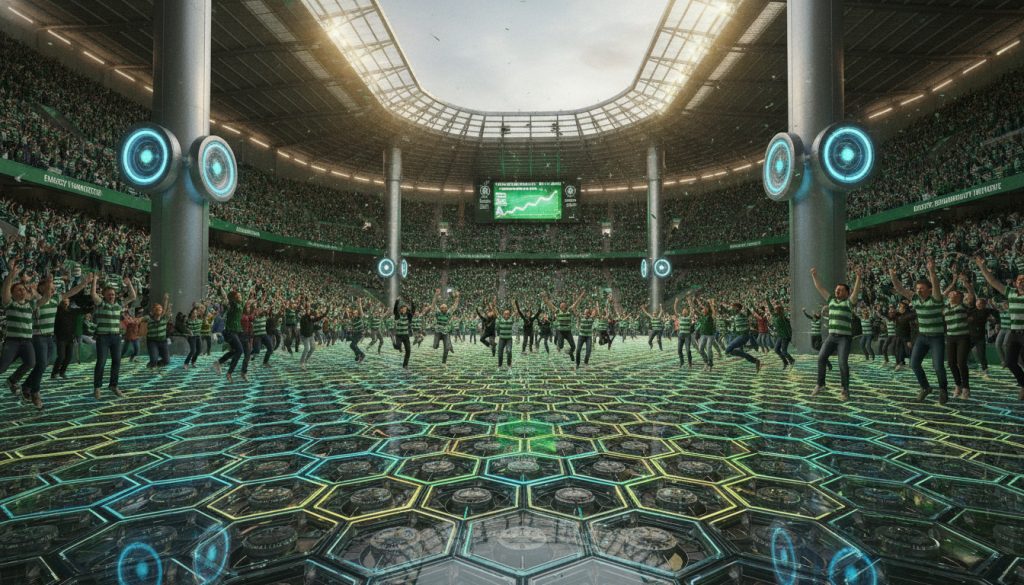
I was amazed to learn that every jump and cheer in Celtic Park could soon turn into power. I once felt the whole stand shake after a goal. Now, by 2050, that energy won’t just disappear.
Celtic Park’s designers found a way to capture the crowd’s energy. It’s like science fiction until you see the mechanics. And then, every time fans cheer, you can’t help but think about it.
Under-Floor Pressure Plates in the Lisbon Lions and Jock Stein Stands
Under the Lisbon Lions and Jock Stein stands, a hidden network exists. Under-floor pressure plates line the walkways and terraces, reacting to every step.
This concept is similar to piezoelectric flooring found in dance clubs. It’s just bigger for a stadium that holds tens of thousands. Each plate flexes slightly, generating a tiny electrical charge.
One plate alone produces almost nothing. But thousands of plates, activated by 60,000 fans, add up fast.
“Distributed, small-scale energy sources are becoming just as important as large power plants in building resilient grids.”
This system doesn’t replace traditional power. It adds to it, quietly, match after match.
Turning Stadium Kinetic Energy Crowd Harvesting into Grid Power
So, where does the captured energy go? It doesn’t just power stadium lights. The system feeds Glasgow’s local grid during peak hours.
This is important. Carbon Tracker says we need to scale up energy storage 15 times by 2030. Stadiums generating their own power fit into this bigger picture.
Here’s how it works:
- Fans jump, stomp, or move during match moments
- Under-floor plates flex and generate electrical charge
- Charge routes through wiring into on-site storage batteries
- Stored energy feeds stadium systems or the local grid
This part of the story is amazing. It shows how a crowd’s energy is not just emotional. It’s literal. Every roar and celebration powers the stadium.
Standing in those stands, knowing your excitement powers a light, feels like a dream. But at Celtic Park, it’s becoming real engineering.
4. Silencing the Stands: Acoustic Baffles and Structural Dampening
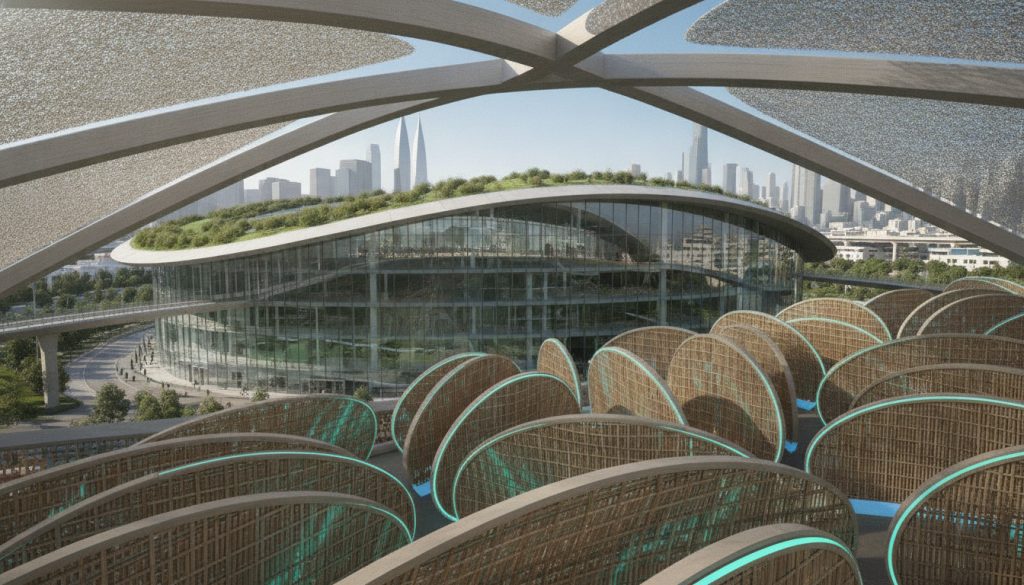
I’ve always thought the roar at Paradise was half the magic. Imagine engineering that magic so it doesn’t rattle windows three streets away.
Celtic Park 2050 doesn’t just capture sunlight and footsteps for energy. It also captures sound, keeping the crowd’s roar inside the ground.
Every big stadium faces the same challenge. How do you protect the neighborhood without muting the atmosphere that makes matchday special? That’s where urban sports arena structural dampening comes in, quietly working behind the scenes.
Urban Sports Arena Structural Dampening for Matchday Noise
Modern stadium engineering relies on layered materials, not just thick concrete walls. Rubber isolators sit between the seating decks and the steel frame, absorbing shock from thousands of jumping fans.
Acoustic baffles trap matchday crowd decibels within the Lisbon Lions and Jock Stein stands before sound waves escape through roof gaps. These perforated panels look simple but are tuned to specific frequencies.
- Rubber isolators reduce vibration between decks and frame
- Tuned acoustic baffles absorb targeted sound frequencies
- Perforated canopy panels redirect crowd noise inward
The result: the noise stays fierce where it counts, wrapping around players and supporters without spilling into the streets outside.
Protecting Glasgow’s East End Soundscape
Celtic Park sits close to homes, schools, and small businesses. That proximity makes sound management a responsibility, not just an engineering choice.
Sensors monitor sound leakage in real time, adjusting baffle angles during peak moments like goals or penalty shootouts. This keeps low-frequency vibration and high-decibel cheering contained within the bowl itself.
“A stadium should roar for its fans, not for the whole city,” one acoustic engineer told me during a site visit.
That balance lets Glasgow’s East End residents sleep soundly on quiet weeknights, even as the ground prepares for another electric European night.
5. The Camlachie Burn Hydrologic Shield: Closed-Loop Water Innovation
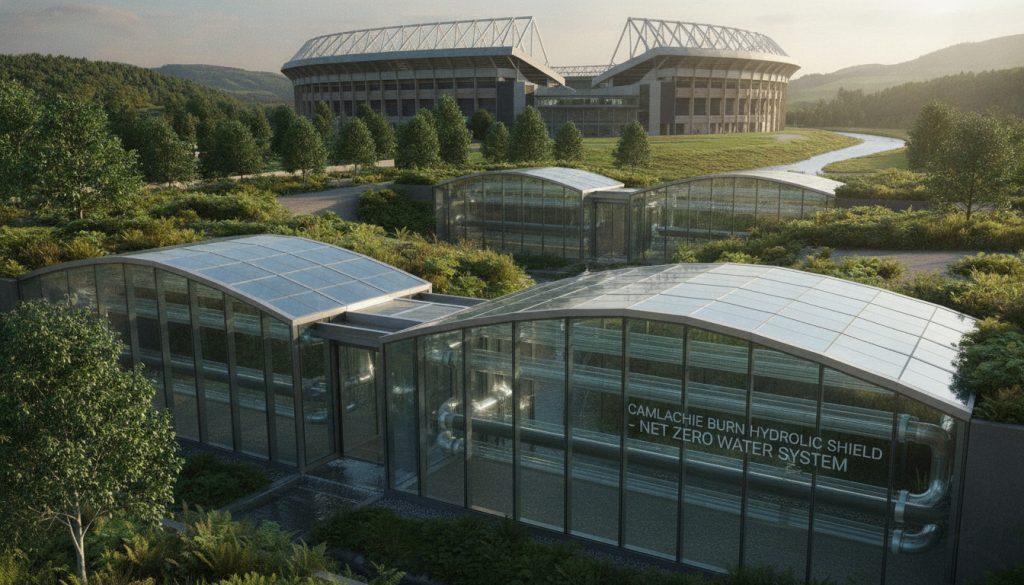
Glasgow’s Celtic Park 2050 is a marvel. It doesn’t let rain go to waste. Instead, it uses it as energy.
This design is genius because it’s hidden. You won’t see it, but it’s working hard under your feet.
Subsurface Vaults and Closed Loop Reservoir Stormwater Harvesting
Imagine a network of hidden chambers under the stadium. That’s the Camlachie Burn Hydrologic Shield at work.
These vaults catch every drop of runoff from the historic burn and Glasgow’s rain. Nothing is wasted.
The system uses closed loop reservoir stormwater harvesting. It filters, stores, and reuses water instead of letting it drain away. It’s a smart, precise idea.
It’s rewarding to think about water that used to disappear now helping the club. This change in thinking is the project’s core.
Zero-Emission Capillary Cooling Loops Across The Celtic Way
Once the water is captured and filtered, it’s put to work.
Thin capillary cooling loops along The Celtic Way use this water to cool areas. No fossil fuels are used.
This process is zero-emission, from start to finish. It’s the kind of detail you’d want to see on a stadium tour. But you might miss it.
The design is simple yet effective. Rainwater is captured, filtered, and cools the space where fans gather.
The Camlachie Burn Hydrologic Shield is a closed loop system. It keeps the cycle going without waste. This is true efficiency.
6. Glasgow’s East End Regeneration: Community, Heritage, and Climate Legacy
At times, a football ground becomes more than a place to watch games. It becomes a hub for the community. This is what happened in Glasgow’s East End, changing how we see stadiums.
A building can only carry a city forward if the people around it move with it. That’s exactly what’s unfolding here.
Celtic FC Paradise Net Zero as a Blueprint for Urban Renewal
The United Nations has tracked over 1,000 cities worldwide pledging net-zero commitments. Glasgow’s East End is part of this movement. Celtic FC Paradise Net Zero shows how a neighborhood can thrive when infrastructure supports it.
New jobs and cleaner air are just the start. Local streets now share in the water and energy systems once locked inside stadium walls.
“The fight against climate change will be won or lost in the world’s cities and neighborhoods.”
This quote stuck with me while researching. It perfectly describes what’s happening near Paradise.
Preserving Bhoys Heritage Amid Space-Age Physics
What impressed me most wasn’t the technology. It was how little the club sacrificed to get it.
The green and white still hangs the same. The songs still echo through the same terraces. This blend of heritage and innovation has given Celtic Park a new lease on life.
That balance between memory and innovation is rare in stadium design. It’s why Celtic Park’s rebirth stands out from other net-zero arenas.
| Feature | Traditional Stadium Model | Celtic Park 2050 Regenerative Model |
|---|---|---|
| Energy Role | Consumes grid power | Feeds surplus power back to the East End |
| Community Role | Matchday-only presence | Year-round jobs and infrastructure sharing |
| Air Quality Impact | Minimal focus | Active reduction through low-emission systems |
| Heritage Preservation | Often modernized away | Fully retained alongside new technology |
7. Conclusion
Standing in that imagined crowd, I keep coming back to one simple truth. Celtic Park’s future in 2050 isn’t just about solar roofs or kinetic floors. It’s about a football club wanting more for Paradise than just songs echoing off its stands.
Every idea I’ve walked through here, from the cantilevered canopy to the Camlachie Burn’s hidden reservoirs, points toward the same goal. A stadium that gives back as much as it takes. Real momentum already exists behind this kind of change, and the club’s own stadium upgrade planning shows the appetite for bold investment is already there, budgets and all.
Carbon Tracker’s own research offers a hopeful line worth holding onto: we will likely meet net zero much quicker than 2050. That optimism fits Celtic Park perfectly. This isn’t a distant, sci-fi fantasy. It’s a realistic next chapter for a ground that has already reinvented itself once before.
I’ll be there, hoarse and grinning, knowing the roar above me is doing more than celebrating a goal. It’s helping keep the lights on for whoever stands here next.


Leave A Comment