
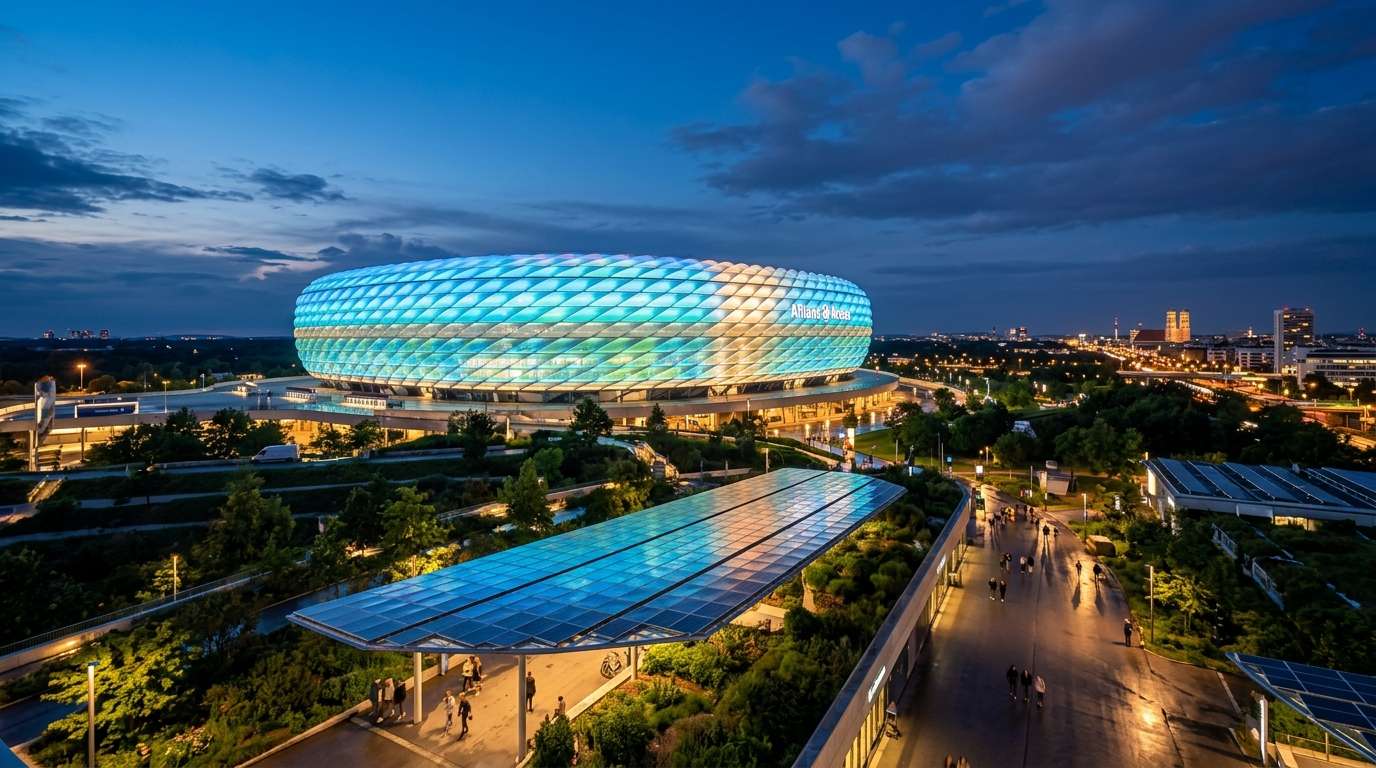
I remember my first glimpse of this stadium, glowing red above Munich at night. It looked like a living creature breathing light.
That memory stayed with me. Years later, I stood on the same Fröttmaning plain and watched the same inflated panels.
This time, I was not just admiring the view. I was imagining what this place could become.
Picture this stadium decades from now, powered by sunlight and rain. Picture 75,000 fans turning every stomp and cheer into usable energy. That’s the quiet revolution happening here.
This is not science fiction. It is an engineering story about pneumatic stadium longevity, solar-woven membranes, and hidden water systems.
In the pages ahead, I will show how a bayern munich net zero stadium vision takes shape—one cushion, one raindrop, and one footstep at a time.
Key Takeaways
- Allianz Arena’s ETFE membrane shell is evolving into a flexible solar-powered skin.
- Rainwater captured on the Fröttmaning plain may fuel hidden hydrologic vaults beneath the stadium.
- Fan energy from the Südkurve could soon be harvested through kinetic flooring technology.
- The stadium targets a true net-zero carbon footprint by 2050.
- Pneumatic architecture is proving it can adapt and last for generations.
- Herzog & de Meuron’s original design remains the blueprint for this space-age transformation.
1. A Bavarian Icon Reimagined for a Carbon-Negative Era
Long before carbon-negative stadiums became common, Herzog & de Meuron changed sports venue design. Their first design looked more like a spaceship than a soccer stadium. Its glowing, bubble-wrapped exterior began a journey that took nearly five decades to reach today’s net-zero landmark.
From Pneumatic Marvel to Net-Zero Benchmark
In the early 2000s, Herzog & de Meuron introduced a stadium wrapped in inflatable ETFE cushions. These lightweight plastic panels replaced heavy glass and steel, reducing construction weight while adding colorful light. The effect felt futuristic: Allianz Arena shifted from red to blue to white for each team.
What I find genuinely fascinating is how the original pneumatic system became a blueprint for later upgrades. Engineers kept the shell and replaced standard ETFE with solar-reactive versions. Its Bavarian bones remained, but its Herzog de Meuron ETFE solar skin now generates power.
By 2050, that early pneumatic marvel has matured into a net-zero benchmark. It still looks like the stadium Munich fell in love with, but it works much harder now.
Why a 75,024-Seat Colosseum Matters for Global Stadium Design
A carbon-negative stadium might seem like a local success. But with 75,024 seats, it becomes a serious case study for architects worldwide. Bayern Munich’s home ground is a massive, high-traffic venue, not a small eco-project.
It proves sustainable design can handle real crowds, noise, and match-day chaos.
Munich is not alone on this path. Cities worldwide are pursuing similar goals at different scales.
| Project | Location | Sustainability Goal | Key Feature |
|---|---|---|---|
| Allianz Arena 2050 | Munich, Germany | Carbon-negative stadium | Solar-woven ETFE skin |
| Berlin TXL Urban Tech Republic | Berlin, Germany | Climate-positive urban district | Renewable-powered research campus |
| London Net-Zero Pledge | London, United Kingdom | City-wide net-zero by decade’s end | Citywide emissions reduction policy |
Seeing Allianz Arena beside Berlin TXL and London’s citywide pledge puts the work in perspective. It is not an isolated experiment, but part of a larger global shift. A 75,024-seat colosseum pulling its own weight makes that movement feel more achievable.
2. Allianz Arena Future 2050: The Solar-Woven ETFE Revolution
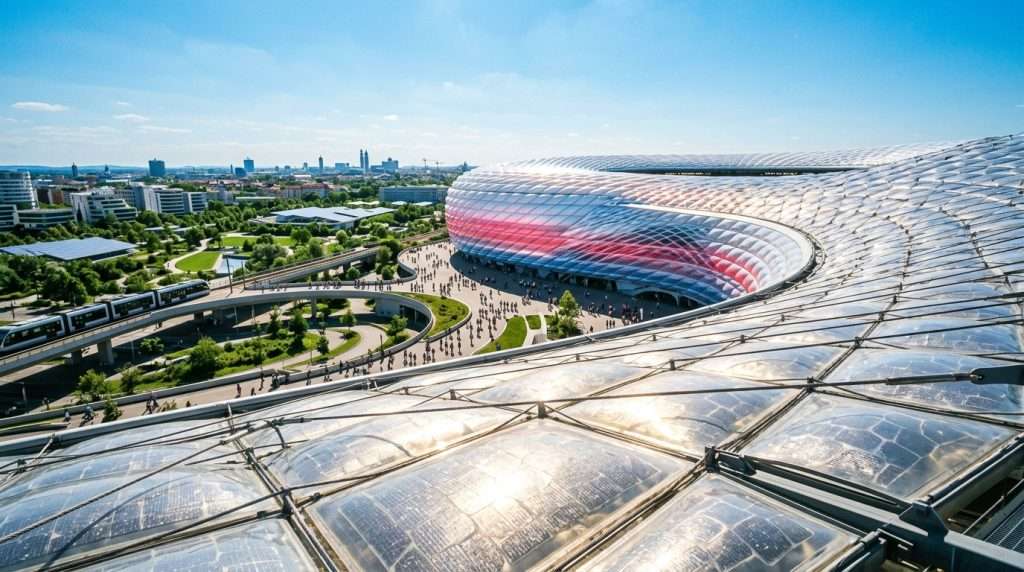
Picture a stadium roof that gathers daylight and glows after sunset using stored solar energy. That image stayed with me when I first studied Allianz Arena’s redesigned skin. The facade is no longer just a shell; it is a light-harvesting organism over Bavaria.
I have not seen another roof like it: old-school PTFE membrane solar roof technology meets newer solar chemistry. Together, they create a second skin that responds to weather, sunlight, and crowd energy.
2,784 Rhomboidal Cushions and the Perovskite Breakthrough
The exterior has 2,784 rhomboidal ETFE cushions, each shaped like a diamond and inflated against wind and rain. I have seen similar membrane roofs in Asia and the Middle East, but none connect so deeply with renewable energy.
Each cushion has nano-molecular UV stabilizers, a coating too thin to notice without help. The coating prevents yellowing and cracks through decades of Bavarian sun, snow, and temperature changes. It’s quiet engineering, but it keeps the system alive for fifty years instead of fifteen.
Beneath that layer lies the breakthrough: a flexible perovskite solar skin woven into the membrane. Unlike rigid rooftop panels, it bends with each cushion and captures sunlight efficiently. It is a thinner, lighter form of traditional PTFE membrane solar roof technology that flexes without cracking or losing output.
By day, the cushions quietly turn sunlight into electricity for the stadium grid. At night, stored energy creates a bioluminescent glow across the facade, making the structure a soft lantern over Munich.
I think many people miss this when they imagine “green architecture.” It is not only about generating power. It also creates an experience that makes the building seem alive, breathing light toward its city.
| Feature | Traditional ETFE Roof | Solar-Woven ETFE (2050 Design) |
|---|---|---|
| Material Lifespan | 15–20 years | 40–50 years with UV stabilizers |
| Energy Function | Passive shading only | Active solar generation |
| Night Appearance | Static LED lighting | Self-powered bioluminescent glow |
| Flexibility | Rigid support frames needed | Perovskite layer bends with cushion shape |
Under this roof, you understand why engineers call it a revolution, not an upgrade. PTFE membrane solar roof technology has existed for decades. Weaving perovskite cells into its fibers turns a protective shell into a quiet, glowing power station. It is subtle, efficient, and beautiful after sunset.
3. The Frottmaning Hydrologic Shield: Engineering Beneath the Esplanade
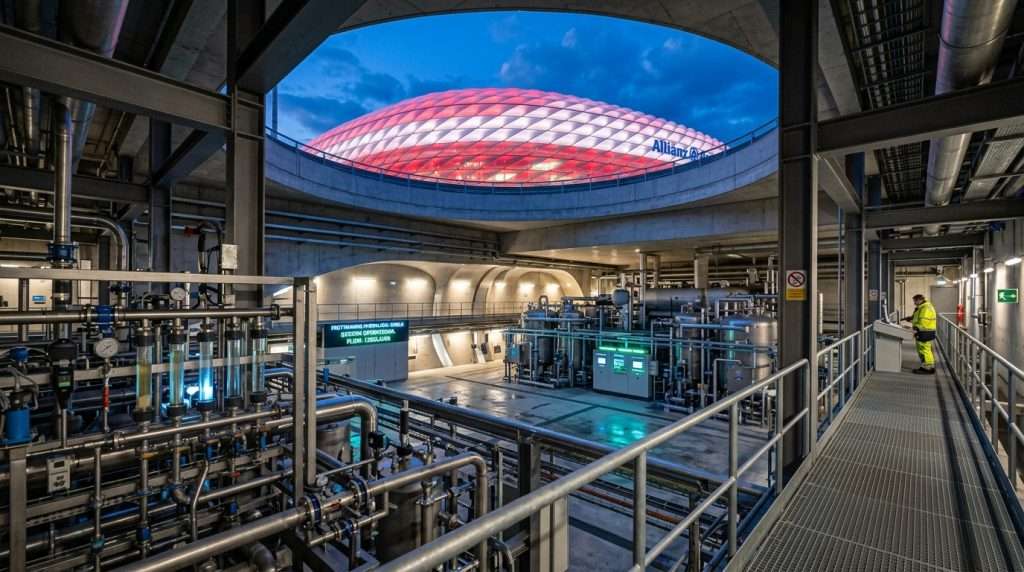
I’m drawn to hidden infrastructure beneath famous landmarks—tunnels, aqueducts, and vaults that few people discuss. At Allianz Arena, this curiosity leads beneath the Fröttmaning Esplanade, where subsurface hydrologic heritage engineering keeps the stadium running clean.
You cannot see it from street level. There are no visible pipes, pumps, or clues about the machinery below. That hidden work feels like finding a secret passage during a long journey.
543 Meters of Subterranean Stormwater Mastery
Across the esplanade’s full 543 meters, the Frottmaning Hydrologic Shield works like an underground net for Bavarian weather. Alpine storm runoff and spring snowmelt flow into automated retention vaults instead of draining away.
These vaults capture 100% of that water. Sensors measure rainfall intensity and adjust intake in real time, so nothing overflows or goes to waste.
It’s an ambitious project, like Paris’s Grand Paris Express. That project shows cities will dig deep to solve urban problems quietly. Munich used that approach for stormwater rather than subway lines.
Closed-Loop Reservoirs Powering Geothermal Cooling
Once captured, the water does not sit idle. Filtration systems clean it before sending it into closed loop reservoir stormwater harvesting tanks designed for thermal exchange.
The water then cycles through geothermal loops that cool the stadium’s three-tier bowl. It uses no fossil fuels or emissions. Captured snowmelt does the work of an entire HVAC system.
I find that poetic. Rain falling on the Alps ends up cooling 75,000 fans on game day. This is the kind of engineering story I love: hidden where visitors never think to look.
For a closer look at this underground network, read Munich’s climate-neutral stadium design. It connects the stadium’s goals, from the solar roof above to the reservoirs below.
| Project | Location | Core Function |
|---|---|---|
| Frottmaning Hydrologic Shield | Munich, Germany | Captures 100% alpine runoff for geothermal cooling |
| Grand Paris Express | Paris, France | Underground transit network expanding regional mobility |
| Crossrail (Elizabeth Line) | London, UK | Subsurface rail tunnels easing city-center congestion |
Each project makes the same point: key engineering often happens where nobody looks. Munich made that hidden work keep an entire stadium cool, dry, and carbon-free.
Munich to Neuschwanstein Castle.
4. Kinetic Crowds: Harvesting Energy from Every Footstep
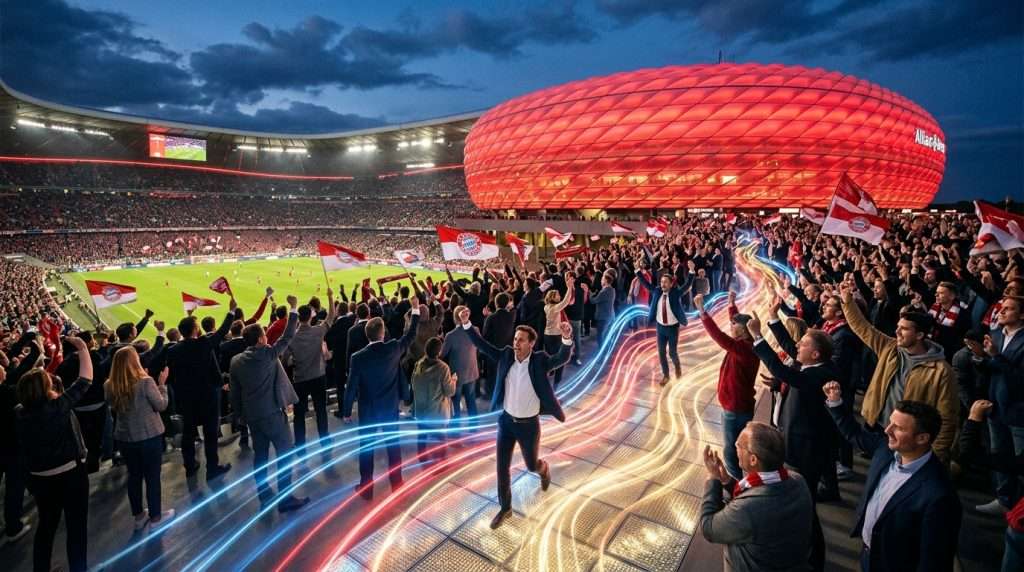
Standing in the Südkurve during a Bayern Munich match, you feel the floor hum before hearing the roar. Thousands of fans jump, stomp, and sway together, making the concrete seem to breathe. I once gripped the railing and laughed at how alive the whole section felt.
By 2050, that physical energy will not disappear into the night air. Engineers at Allianz Arena figured out how to capture it, turning each stomp and cheer into useful power. This stadium’s kinetic energy rewards what fans already love doing.
Piezoelectric Plates Beneath the Südkurve
Beneath the Südkurve’s standing terraces, rows of piezoelectric plates convert pressure into electricity. Each jump, stomp, and celebration surge sends a small power jolt into the stadium’s grid.
No single footstep generates much power alone. Multiplying that force by 75,024 fans across nine decades of matches makes the total rise quickly. The harvested power feeds lighting circuits and sound equipment around the lower bowl, powering the atmosphere the crowd creates.
What amazes me most is how invisible the system remains. You would never know you were standing on a power source. Flush beneath reinforced flooring, the plates can handle decades of stomping without dents or lag.
U-Bahn Concourses as Hidden Power Corridors
The story continues beyond the terraces. Walk into the U-Bahn station beneath the stadium, and you step onto the same technology. Thousands of commuters and fans cross those tiles each matchday, adding a tiny charge with every step.
That harvested energy powers overhead lighting and ventilation fans throughout the concourse. It creates a quiet partnership between travelers and infrastructure. Nobody changes their routine; they walk, and the station lights stay bright.
I like imagining thousands of strangers, rushing for trains, unknowingly keeping the lights on for each other. This small detail captures the arena’s crowd harvesting philosophy: finding purpose in ordinary human motion.
| Harvesting Zone | Technology Used | Primary Function Powered | Typical Foot Traffic per Matchday |
|---|---|---|---|
| Südkurve Standing Terraces | Piezoelectric floor plates | Section lighting and sound systems | 25,000+ fans |
| U-Bahn Concourse Tiles | Embedded piezoelectric sensors | Station lighting and ventilation | 40,000+ commuters |
| Main Concourse Walkways | Kinetic floor tiles | Concession and signage power | 50,000+ visitors |
| VIP Entrance Ramps | Low-friction piezoelectric strips | Entrance lighting and security scanners | 5,000+ guests |
Whenever I think about this system, I picture the stadium as more like a living organism than a building. The crowd’s energy does not vanish into noise and heat. It becomes part of the arena’s heartbeat, quietly feeding the experience that created it.
5. Conclusion
Standing outside the arena at dusk, I watched a familiar glow ripple across the ETFE skin and remembered its changes. Solar-woven panels and a hidden water system beneath the Esplanade work quietly. During matches, thousands of footsteps create energy; nothing calls for attention, and good design simply works.
Munich is not the only city betting on this future. London’s stadiums pursue similar net-zero targets, while Paris rebuilt entire venues around circular energy systems. Paris acted ahead of its own sustainability pledges.
Berlin keeps promoting retrofits that blend old infrastructure with new climate goals. Allianz Arena future 2050 fits this wider pattern: across Europe, sports architecture now carries real environmental weight, not just spectacle.
What strikes me most is that Munich did not tear down its history to reach this point. It kept the bones of a stadium I admired years ago and gave them a second life that feels almost impossible: carbon-negative, self-sustaining, and still unmistakably itself. That rare balance joins memory with reinvention.
If you plan a trip through Germany, put this stadium on your list. Visit for match-day energy and a glimpse of thoughtful rebuilding. It shows what happens when a city refuses to let a beloved landmark become obsolete.


Leave A Comment