
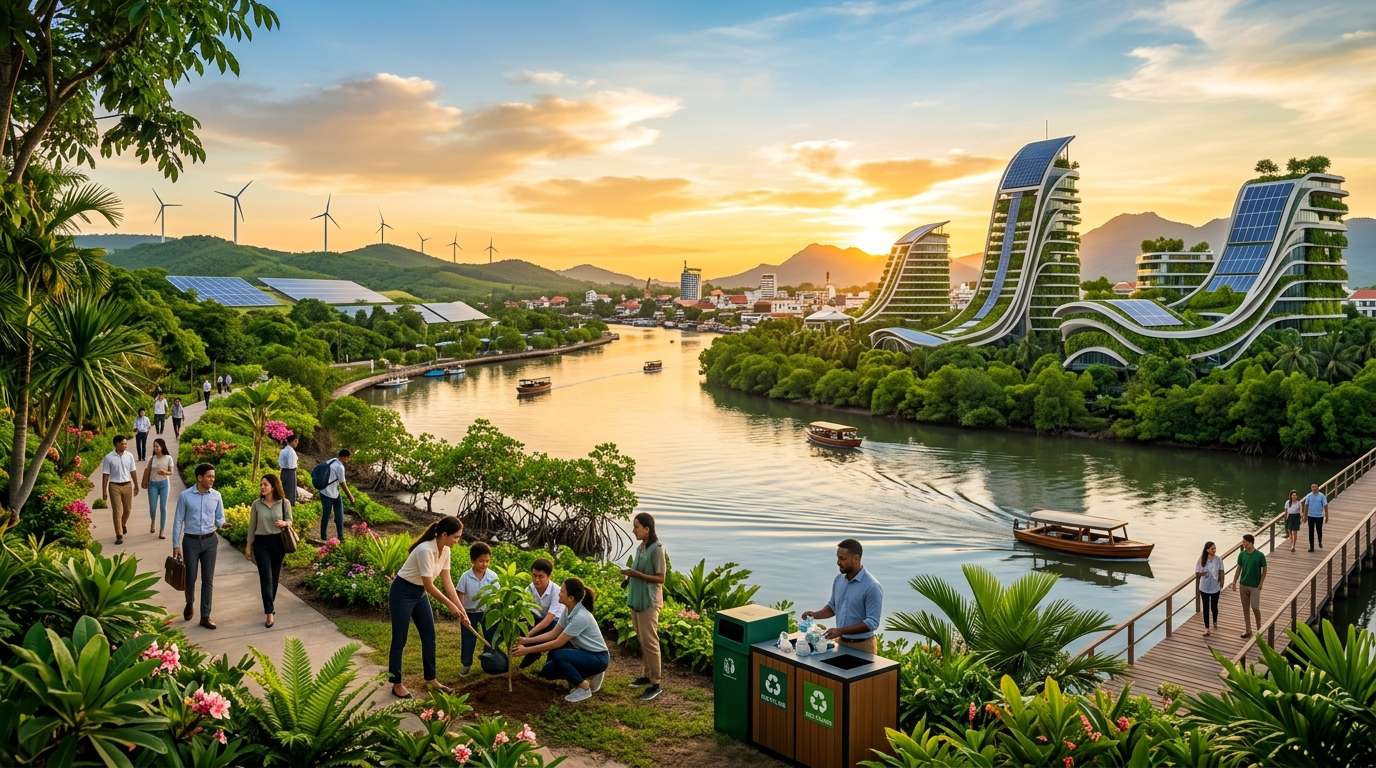
Last year, I stood beside the Praek Tuek Chhu riverfront. Fishing boats passed weathered yellow shophouses as I imagined Kampot decades from now.
This sleepy riverside town in southern Cambodia faces climate pressure, but it is not simply surviving. It’s quietly rehearsing for it.
Tidal surges can roll from the Gulf of Thailand, while monsoon torrents rush down Bokor Mountain. Thousands of sunset-chasing tourists may fill the promenade each evening. Imagine capturing that energy and converting it into power.
This is the Kampot future 2050 vision: a riverside town turning tides, mountain rain, and foot traffic into power. It could become a truly carbon-neutral model for coastal heritage towns everywhere.
Three ideas guide this change: protecting French-colonial architecture with breathable mineral coatings.
Engineers can build underground water vaults beneath the riverbank. The promenade could harvest kinetic energy from footsteps.
This is not science fiction. Small versions already exist in different parts of Southeast Asia. The Kampot future 2050 plan joins them into one coherent, autonomous system.
Key Takeaways
- Kampot’s 2050 vision blends heritage preservation with cutting-edge sustainable engineering.
- Tidal surges, mountain rainfall, and foot traffic could all become renewable power sources.
- Underground water vaults may help manage flooding while storing resources for drier months.
- Breathable mineral coatings aim to protect colonial-era buildings without trapping moisture.
- Kinetic energy harvested from the riverside promenade could help power public infrastructure.
- The entire model relies on technologies already piloted elsewhere in Southeast Asia.
Kampot Future 2050: A New Benchmark for Coastal Heritage Resilience
When I think about real coastal resilience, I don’t picture concrete seawalls or glass towers. I picture Kep.
Drive two hours down the coast from Kampot, and you’ll find a quiet seaside town with answers. For nearly two decades, Belgian architect Jef Moons restored three crumbling heritage houses. He chose restoration instead of replacing them with another generic beach resort.
The result became Knai Bang Chatt, an 18-room property built deliberately small, slow, and respectful of what was already there.
That choice mattered. Moons could have built bigger, with wings, pools, and parking lots. Instead, he kept the footprint human-sized, proving careful restoration can protect Cambodia’s coastal heritage without erasing its character.
Good restoration doesn’t shout. It just makes sure the building outlives the people who saved it.
I think about that philosophy and Kampot French colonial architecture preservation whenever I walk along its riverfront. The town’s 2050 vision scales Kep’s small, patient instinct across an entire riverbank. Rather than replacing old French colonial shophouses, it keeps them standing, breathing, and lived-in as climate shifts.
This is where the stakes grow beyond one riverside town. Kampot is not just trying to survive rising tides and salt-heavy air. It is positioning itself as a working model for coastal heritage resilience that other Cambodian river towns can study and copy.
By 2050, the goal is a carbon-neutral heritage sanctuary. Pepper farms, French colonial buildings, and clean energy systems will coexist without one canceling out the other. Kep proved it could work on a small scale, and Kampot will prove it can work for a whole town.
Non-Invasive Mineral Masonry Glazes: Safeguarding Kampot’s French Colonial Architecture
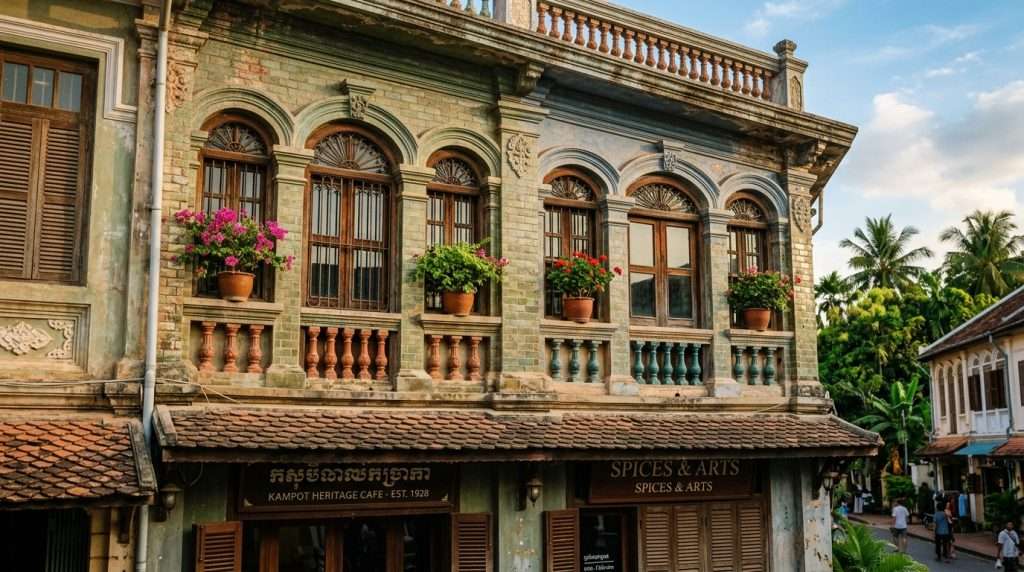
Kampot’s charm has always lived in its imperfections. Peeling ochre walls, rust-streaked steel, and sun-bleached shutters tell a story. No fresh paint could replace it. Protecting that story requires surprisingly careful science.
That’s where non-invasive mineral masonry glazes come in. Unlike plastic-based sealants that trap moisture inside old walls, these glazes let buildings breathe. They still block damage caused by salty coastal air. I find this balance fascinating because it does not make old things look new. It lets them age as they should.
Protecting 19th-Century Shophouses from Salt Air Decay
Kampot sits where the Praek Tuek Chhu River meets the sea. That closeness comes at a cost. Salt-filled air drifts through town each day and settles into brick and plaster. Over decades, the salt crystallizes inside the masonry.
Here’s what that slow process looks like on the ground:
- Salt crystals expand inside plaster, causing it to crack and flake away.
- Moisture gets trapped behind old paint layers, leading to bubbling and peeling.
- Structural mortar weakens over time, threatening the integrity of entire facades.
Conservation teams needed a way to stop this cycle without sealing Kampot’s 19th-century shophouses. Breathable was the key word. Standard waterproof coatings trap moisture inside, which speeds decay instead of slowing it.
These non-invasive mineral masonry glazes let water vapor escape while blocking new salt infiltration. It’s a quiet but effective fix. Walk past these shophouses today, and you’d never guess they were treated. That’s exactly the point.
Restoring the 1920s Entanou Steel Bridge Without Losing Its Soul
The Entanou Bridge has crossed the Praek Tuek Chhu since the 1920s. Locals treat it like an old friend. It’s rusted, dented, and slightly crooked, which is why people love it.
Restoring steel this old is tricky. Sandblasting would remove decades of character along with the corrosion. Instead, crews used mineral treatments compatible with the surrounding masonry glaze system. These treatments stabilized active rust without erasing the bridge’s weathered patina.
The result feels less like a renovation and more like a pause button. The bridge still looks its age. It simply will not keep decaying as quickly as before.
“Good conservation work should be invisible. If people notice it, something’s gone wrong.”
How Breathable Nano-Mineral Coatings Preserve Authentic Ochre Textures
Kampot’s ochre walls are among its most photographed features. Getting that color right depends on what covers the pigment. Keeping it right depends on the same choice.
Breathable nano-mineral coatings bond with masonry at a microscopic level. They do not form a plastic film over the surface. Natural texture, slight unevenness, and organic pigment variation remain intact.
| Feature | Traditional Sealants | Nano-Mineral Glazes |
|---|---|---|
| Moisture Control | Traps moisture inside walls | Allows vapor to escape naturally |
| Texture Retention | Often flattens or glosses surface | Preserves original ochre texture |
| Longevity | 5–10 years before reapplication | 15–20 years with minimal upkeep |
| Visual Result | Can look “newly painted” | Ages naturally, keeps authentic look |
That last row matters most to me as a traveler. Nobody wants to photograph a building that looks freshly repainted for a brochure. Kampot’s appeal comes from its lived-in, weathered, and real appearance. Non-invasive mineral masonry glazes protect that authenticity instead of replacing it with something shinier but soulless.
Subsurface Hydrologic Heritage Engineering Beneath the Old Market Quarter
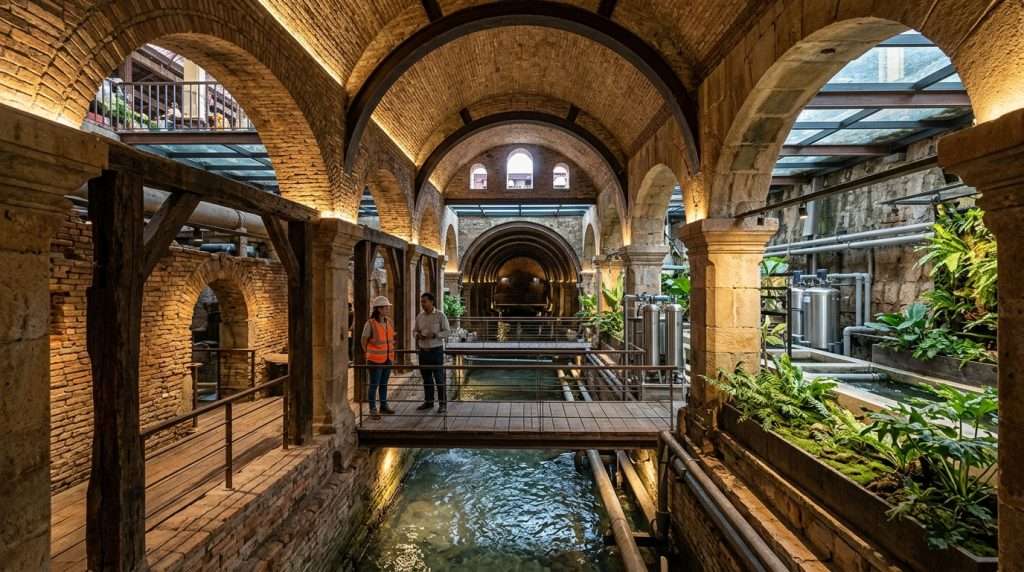
Some of Kampot’s smartest engineering is buried beneath the Old Market quarter. I learned this while sipping iced coffee on the Praek Tuek Chhu promenade with a local engineer. He pointed at the cobblestones, which seemed to hold a secret. They do.
A quiet network of chambers and sensors lies beneath that riverside pavement. This is subsurface hydrologic heritage engineering in action. It works without disturbing any French colonial facade above ground.
Automated Retention Vaults Under the Praek Tuek Chhu Promenade
Picture reinforced concrete vaults beneath the walkway, each connected to moisture and pressure sensors. When rain falls or river levels rise, gates open automatically, routing excess water into storage before reaching street level.
No alarms or visible pumps appear. A silent system works while tourists photograph the old shophouses overhead.
I find this genuinely impressive. The vaults respond in real time, using current flow data instead of waiting for a flood.
Capturing Bokor Mountain Floodwaters and Tidal Surges
Kampot sits in a tricky spot. Heavy monsoon storms send floodwater from Bokor Mountain, while tidal surges arrive from the Gulf of Thailand.
This combination has flooded the Old Market quarter before. Now, the vault system captures both sources simultaneously. It holds mountain runoff and seawater separately until treatment and filtering.
It’s a small miracle that two very different water sources can be managed under one system without cross-contamination or overflow.
Closed-Loop Reservoir Stormwater Harvesting for Zero-Emission Cooling Loops
Here’s where the story gets even better. Instead of discharging captured water into the river, Kampot recycles it through sealed reservoirs.
This closed loop reservoir stormwater harvesting system feeds capillary cooling loops in nearby civic buildings. Cool, filtered water circulates through pipes in walls and floors, lowering indoor temperatures without one watt of fossil-fuel power.
It is quiet, efficient, and completely hidden from view. That impresses me as a traveler who loves discovering what works behind the scenes.
| Water Source | Capture Method | Response Time | Primary End Use |
|---|---|---|---|
| Bokor Mountain runoff | Automated retention vaults | Under 5 minutes | Filtered civic cooling loops |
| Gulf of Thailand tidal surge | Sealed overflow chambers | Under 10 minutes | Treated storage reservoirs |
| Monsoon stormwater | Porous promenade drainage | Continuous intake | Closed-loop cooling circulation |
The Riverside Walking Spine: Piezoelectric Power from Everyday Footsteps

I never thought a sunset walk could become a power source until I saw Kampot’s riverside promenade in action. The path hugging the Praek Tuek Chhu is famous for its golden-hour views. In the Kampot future 2050 vision, this same pavement does more than look beautiful.
Beneath stone tiles, a hidden system turns ordinary footsteps into usable electricity. No overhead cables or humming machinery are needed. People simply walk, as they always have.
Under-Floor Piezoelectric Pavers Explained
The science sounds complicated, but it is simple. Piezoelectric materials create a small electric charge when pressed. Each footstep presses a paver and creates a tiny burst of energy.
One footstep alone cannot power much. Yet thousands of strollers, vendors, and photographers walk each evening, making the total grow quickly.
Here is a quick comparison between these pavers and traditional pavement:
| Feature | Standard Pavement | Piezoelectric Pavers |
|---|---|---|
| Energy Output | None | Converts footstep pressure to electricity |
| Visible Infrastructure | None needed | Hidden beneath surface tiles |
| Maintenance Needs | Occasional resurfacing | Modular panels, easy swap-outs |
| Public Interaction | Passive walking surface | Active energy contribution with every step |
Pavegen, a UK-based pioneer in this technology, has installed similar systems in train stations and public plazas worldwide. Their founder once explained the appeal clearly.
“We’re not trying to solve the entire energy crisis with footsteps. We’re trying to show people that small actions, multiplied, create real change.”
That philosophy perfectly fits Kampot’s approach. The goal is not to replace power plants. It is to blend clean energy into daily life without demanding extra thought.
From Sunset Strollers to Clean Microgrid Energy
Picture a typical evening along the river. Couples hold hands, children chase each other, and photographers set up tripods for sunset views over the water. None realize they are also feeding a microgrid.
The collected energy cannot power the whole town, and no one claims it should. Instead, it enters a local grid supporting streetlights, charging stations, and perhaps vendor stalls after dark.
It is a small contribution with big symbolic weight. An ordinary walk becomes part of something larger.
That idea lies at the heart of the Kampot future 2050 story. Sustainability does not always require huge turbines or broad solar farms. Sometimes, it means noticing energy already moving beneath our feet.
Next time I watch the sunset fade behind Bokor Mountain in Kampot, I will know my stroll does more than clear my head.
Cambodia’s Net-Zero Pepper Capital: A Model for Estuarine Towns Worldwide
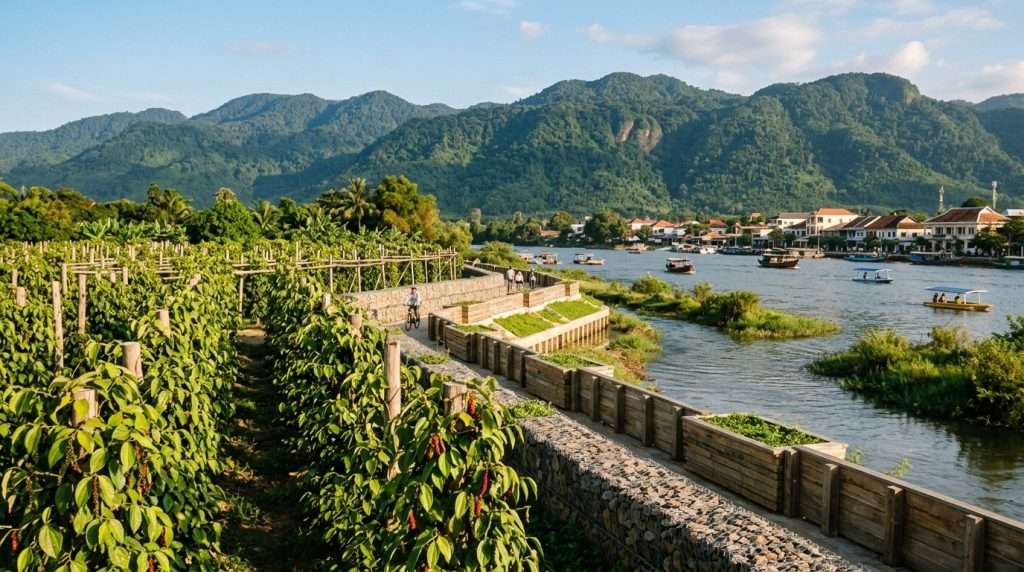
I never expected a small Cambodian pepper town to guide coastal survival for the next fifty years. Kampot is becoming Cambodia’s net-zero pepper capital, while old river towns adapt without losing their character. A local flood fix now offers a working model for other estuarine towns to study and copy.
This is not a flashy tourist project built for quick headlines. Its slow, deliberate engineering treats water as a partner, not a threat.
The Praek Tuek Chhu River Flood Shield as a Global Blueprint
The Praek Tuek Chhu river flood shield sits at the heart of this system. It channels floodwater from Bokor Mountain and tidal surges from the sea into controlled paths. This keeps them from crashing into the old market quarter.
Its key idea is simple: it follows the river’s natural rhythm. No brute-force concrete walls, no fighting the tide. Before adding anything, engineers studied how water already moved through Kampot.
Other low-lying river towns, from the Mekong Delta to coastal Louisiana, face rising seas and heavier monsoon rains. A flood shield that bends with nature, rather than resisting it, could save these places decades of costly rebuilding.
Stadium Porous Asphalt Stormwater Drainage Lessons Applied Citywide
Here is what surprised me most. Kampot borrowed stadium porous asphalt stormwater drainage technology, used to keep sports venues dry during heavy downpours. It applied that system across city streets and public squares.
Stadiums must drain thousands of gallons of rainwater quickly without harming the field below. Kampot engineers saw the same citywide problem and adapted the solution for everyday streets.
Now porous asphalt covers roads near the Old Market Quarter. Rain passes through instead of pooling on the pavement. It recharges groundwater instead of rushing into the river and overwhelming the flood shield downstream.
Why Kampot’s Approach Could Redefine Estuarine Town Longevity
Kampot is not working alone. Just down the coast, the Kep West movement pursues its own thoughtful, long-term coastal development.
Projects like Art for Kep and Kep West Wellness value culture and health over quick tourist cash grabs. The planned Southeast Asian Ocean Gallery, an underwater museum off the coast, shows Cambodia is planning for decades, not seasons.
Resilient coastal infrastructure doesn’t shout for attention. It just keeps working, quietly, long after the ribbon-cutting is forgotten.
Together, these projects show Cambodia’s coastline is shifting from short-term tourism grabs toward genuine, long-term planning. Kampot’s river engineering fits this larger regional story.
| Feature | Traditional Approach | Kampot’s Model | Long-Term Benefit |
|---|---|---|---|
| Flood Control | Rigid concrete sea walls | Praek Tuek Chhu river flood shield | Works with tides instead of resisting them |
| Stormwater | Standard sealed asphalt | Stadium porous asphalt stormwater drainage | Cuts flash flooding, recharges groundwater |
| Energy | Fossil-fuel grid power | Piezoelectric riverside walkway | Clean, renewable microgrid power |
| Development Pace | Fast tourist-driven builds | Decades-long heritage planning | Lasting cultural and environmental value |
So I keep asking one question: how can a small Cambodian pepper town build net-zero flood defenses at this scale? What stops other river towns where fresh water meets the sea?
Conclusion
I left Kampot thinking about what I could not see at first glance. Breathable glazes cover ochre shophouses, while vaults under the Old Market work quietly during flood season. At sunset, walkers’ footsteps become electricity for homes along the river.
Nothing shouts for attention. That is what makes it work.
Kampot future 2050 is not about building something new and shiny over what already exists. It means listening to a town that survived colonial rule, monsoon floods, and decades of change. Then, it means giving Kampot tools to move forward without losing its character.
French-era buildings still smell like salt air and old wood. The river still moves the same way it always has. Pepper farms still smell like pepper.
What changed lies beneath the surface: engineering choices help this place breathe through a changing climate.
I keep returning to one idea: Kampot redefines estuarine town longevity through patience and respect for what already existed. That is the kind of place I want to find on the road, so I will keep recommending towns like it.
If you’re planning a trip through Cambodia, give Kampot more than a day. Walk the riverside and look up at the shophouse facades. You will feel the difference between a renovated town and one that has been understood.














Leave A Comment