

I remember standing beside Tràng An, where mist curled around limestone towers older than written history. The silence felt ancient and almost sacred. That moment made me wonder about the Ninh Binh future 2050, long after my boots left the trail.
That question sparked an idea called the karst engine. It is not a machine, but a vision for powering, cooling, and protecting this region without cutting its famous stone.
This is not a corporate forecast or government white paper. It is personal speculation, from real walks through Hoa Lư’s temples and real boat rides under Tràng An’s dripping caves. I picture monsoon floods becoming stored energy, millions of pilgrim footsteps making electricity, and ancient stone remaining untouched.
Four ideas guide this journey: heritage-safe building materials and underground water engineering. The other ideas are clean energy from human movement and smart infrastructure borrowed from other parts of the world. Together, they outline a net-zero path for the Ninh Binh future 2050.
Key Takeaways
- Ninh Bình’s karst landscape could inspire a self-sustaining model for heritage preservation worldwide.
- The “karst engine” concept blends ancient geology with modern clean energy solutions.
- Future planning focuses on four pillars: materials, water, energy, and infrastructure.
- Monsoon water systems may double as natural energy storage for the region.
- Pilgrim foot traffic offers an untapped source of kinetic energy generation.
- Heritage-safe construction techniques aim to protect temples without altering limestone formations.
- This vision draws from real travel experience, not theoretical infrastructure reports.
Ninh Binh Future 2050: A Living Blueprint for Karst Resilience
When I first paddled a sampan beneath Ninh Bình’s limestone towers, I never imagined its future as a carbon-neutral sanctuary. The cliffs rose from rice paddies like something ancient and alive. Boats slipped through flooded caves in total silence, and that memory stayed with me.
Now I imagine Ninh Binh future 2050 as more than nostalgia. Picture the entire UNESCO World Heritage region as a working model of karst ecological resilience. It would not be a frozen museum, but a living landscape growing rice, floating boats, and supporting daily life.
That’s the part that excites me most — progress need not erase the region’s soul.
- Guilin, China, with its own dramatic limestone peaks
- The Philippines’ limestone islands facing similar tourism pressures
- Smaller karst valleys across Southeast Asia searching for sustainable models
I do not claim to have the full answer yet for Ninh Binh future 2050. Watching Ninh Bình’s quiet experiments unfold feels like seeing a hopeful theory take shape, one practical step at a time.
Guarding the Ancients: Non-Invasive Mineral Masonry Glazes for Hoa Lư Ancient Capital Net Zero
I remember standing under a Hoa Lư temple’s eaves, watching moisture bead on thousand-year-old stone like sweat on skin. That humidity never leaves Ninh Bình. It soaks into limestone, settles in wood grain, and slowly harms ten centuries of craftsmanship.
Protecting Hoa Lư ancient capital net zero goals means solving this problem without touching original materials. Conservators are testing a different approach: non-invasive mineral masonry glazes that work with stone instead of against it.
Breathable Nano-Mineral Glazes Against Tropical Dampness
Traditional waterproof sealants trap moisture inside stone walls. In Ninh Bình’s climate, trapped water becomes a slow disaster, cracking surfaces from the inside out.
Nano-mineral glazes take the opposite path. These ultra-thin coatings let water vapor pass naturally, so limestone can still breathe while rain pounds the region for months.
The glaze bonds at a microscopic level with the stone’s mineral structure. It never forms a plastic-like barrier. Instead, it reinforces weak points while keeping pores open for moisture to escape.
“Stone that cannot breathe is stone that cannot survive a tropical monsoon season.”
Preserving King Đinh’s Dragon Beds and Centuries of Dynastic Patina
King Đinh’s dragon beds stand at the heart of Hoa Lư. They are carved stone platforms, worn smooth by a thousand years of ritual and weather. That wear is not damage to erase. It is proof.
Any conservation method here must protect the patina, not polish it away. Dark mineral staining, softly rounded carved edges, and faint discoloration from centuries of incense smoke all tell a story. Modern restoration could easily destroy that story.
Non-invasive mineral masonry glazes solve this by staying nearly invisible. They do not change color, texture, or shine. They simply slow decay underneath, letting King Đinh’s dragon beds keep aging as they always have, just a little slower.
Ironwood Rot Prevention Without Invasive Intervention
Walk through any 10th-century structure in Hoa Lư, and you’ll find ironwood columns holding roofs that outlasted empires. Ironwood resists rot naturally, but centuries of humidity still find a way through cracks and joints.
Older preservation techniques drilled into these columns, injected chemical treatments, or replaced sections entirely. That approach damages what it tries to save.
A hands-off method works better here. Breathable mineral coatings applied to the wood’s surface block fungal growth and moisture penetration without a single drill mark. This keeps the original timber untouched, structurally sound, and fully intact, matching Hoa Lư ancient capital net zero preservation’s true meaning.
Subsurface Hydrologic Heritage Engineering Beneath Tràng An and Sao Khê
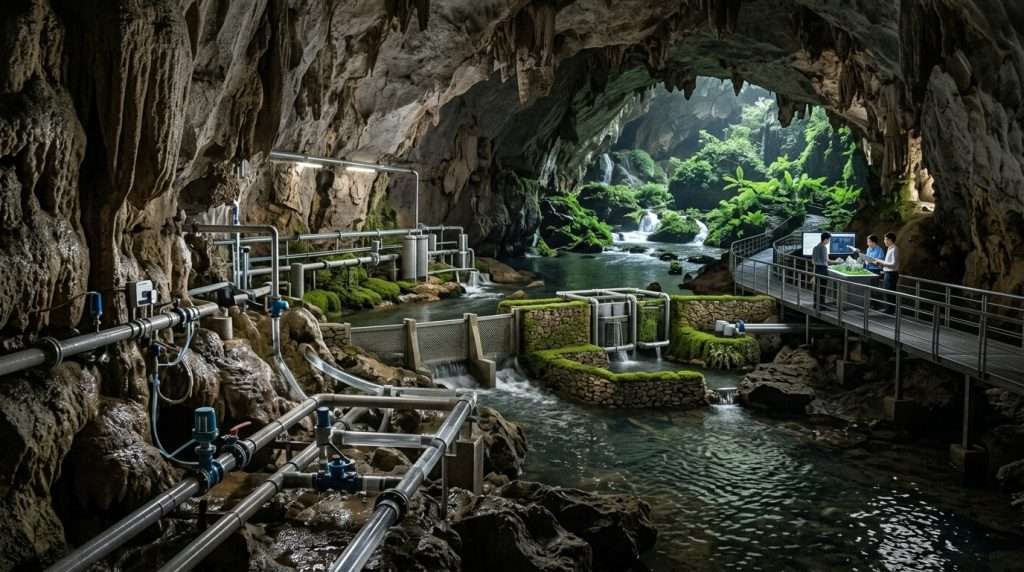
I’ve lost count of my sampan rides through Tràng An’s limestone tunnels. The water always looks calm, almost sleepy. Yet engineers built hidden infrastructure beneath it to protect the landscape and visitors.
This is the heart of subsurface hydrologic heritage engineering in Ninh Bình. The term describes a simple idea: manage water underground. This keeps ancient sites dry, stable, and safe from floods.
Automated Retention Siphons Capturing 100% of Monsoon Flash Floods
Monsoon season in Ninh Bình isn’t gentle. Rain falls in sheets, and the Sao Khê River can rise quickly. Within hours, floodwater can cover footpaths and boat docks.
Beneath the karst corridors, automated retention siphons intercept the surge before it reaches the surface. They trigger when water pressure spikes. Then, they pull floodwater into underground channels instead of stone walkways or ancient temple grounds.
One engineer I spoke with during a site visit explained it simply:
“We wanted a system that reacts faster than any human could, capturing one hundred percent of flash flood volume before it threatens a single historic structure.”
The captured water does not disappear. It enters zero-emission capillary cooling loops for nearby eco-settlements. This turns a seasonal threat into a quiet, useful resource.
Closed-Loop Reservoir Stormwater Harvesting in Practice
Here’s where the system gets clever. Instead of pumping floodwater away, the system uses closed loop reservoir stormwater harvesting.
In practice, it works like this:
- Flash flood water enters underground retention basins through the siphon network.
- Sediment and debris get filtered out before water reaches storage reservoirs.
- Filtered water cycles back into cooling systems, irrigation, and reservoir storage instead of draining into open waterways.
- Excess volume recharges groundwater rather than overwhelming the Sao Khê River downstream.
Nothing gets wasted. Each liter cools a building, waters a field, or returns quietly to the aquifer. I find this efficiency more impressive than any flood wall.
The Sao Khê River Hydrologic Shield Explained
The last piece ties everything together. Locals and engineers call it the Sao Khê River hydrologic shield. This protective layer keeps the river’s flow and water quality steady.
It works even while massive floodwater volumes move underground nearby. Without the shield, stormwater control could strip nutrients from the river. It could also disrupt the slow current that shaped Tràng An’s caves over thousands of years.
Instead, the shield lets heritage and hydrology coexist. That balance is the real achievement here. The Sao Khê still flows as it always has, while machinery works quietly beneath it.
Zero-Emission Capillary Cooling: Powering Eco-Settlements with Filtered Water

Walking into a karst cave feels like opening a refrigerator door. Ninh Binh future 2050 planners want that cool feeling across whole neighborhoods.
I felt this inside Tràng An’s tunnels. One minute, I sweat under the tropical sun; the next, air feels ten degrees cooler. No machines hum nearby, and no fans spin overhead. Stone and water do the quiet work.
Filtered monsoon water, stored underground, does not sit idle. Engineers route it through capillary cooling loops buried beneath eco-settlements. It moves slowly through narrow limestone channels, pulling heat from buildings above as caves naturally chill visitor air.
Think of it as the mountain sweating, like skin cooling the body on a hot day. No rooftop air-conditioning unit hums. No diesel generator waits as backup, and no emissions drift into the valley below.
This is Ninh Binh future 2050 in its simplest form. It borrows a trick that rock has used for thousands of years. The system can cool homes, guesthouses, and future travelers’ rooms.
Piezoelectric Pavers: Turning Pilgrim Footsteps into Clean Microgrid Power

At Bái Đính’s endless stone staircase, I counted pilgrims passing in ten minutes. Dozens of feet struck the same worn stone again and again. I wondered: what if that energy was not wasted?
That question guides the Ninh Binh future 2050 vision. Engineers are exploring piezoelectric pavers, special tiles that turn footstep pressure into usable electricity. Buried beneath the surface, they remain invisible to pilgrims walking above.
Sampan Wharves and the Rise of Silent River Navigation
Picture the wooden wharves at Tràng An, where boatmen load sampans before gliding into the caves. Thousands of visitors step onto these docks each day.
Embedded piezoelectric pavers capture that pressure and feed it into a local microgrid. Stored power runs electric or silent-motor sampans, replacing noisy engines that once echoed through the limestone caverns.
The benefits reach beyond quiet rides:
- No more fuel smell drifting across the water
- Bats and cave-dwelling birds stay undisturbed by engine vibration
- Boatmen paddle or glide with near-silent motors, restoring the stillness these caves once had
Bái Đính Mountain Paths as Living Energy Corridors
The same idea climbs uphill. Bái Đính Pagoda draws pilgrims up hundreds of stone steps daily, especially during festival season.
Those steps could become living energy corridors. Pavers tucked beneath the stone collect each footstep and send power to a microgrid. It lights paths and charges small devices at rest stations.
Pilgrims notice nothing different underfoot. Their spiritual journey stays exactly the same. With every step, they’re quietly fueling the next chapter of Ninh Binh future 2050, one footprint at a time.
Stadium Porous Asphalt Stormwater Drainage: Borrowing Global Infrastructure Logic

I find it funny that one favorite drainage solution for ancient Vietnamese pathways came from modern American sports arenas.
Big stadiums across the U.S. use stadium porous asphalt stormwater drainage to keep games going during sudden downpours. Water does not pool on the surface. It sinks through tiny air pockets, gets filtered, and drains away before anyone notices the storm.
That is the practical, tested logic Ninh Bình’s 2050 plan borrows. No need to reinvent the wheel when the wheel already works.
Picture this permeable paving along pilgrim walkways, boat dock approaches, and parking areas around Tràng An and Hoa Lư. During monsoon rains, water drains through the surface instead of pooling against centuries-old stone walls.
| Surface Type | Drainage Speed | Flood Risk | Best Use in Ninh Bình |
|---|---|---|---|
| Traditional Asphalt | Slow | High | Not recommended near heritage sites |
| Concrete Pavers | Moderate | Medium | Secondary access roads |
| Stadium Porous Asphalt | Fast | Low | Pilgrim paths, docks, parking lots |
This simple, proven stadium porous asphalt stormwater drainage system already works in stadiums worldwide. Ninh Bình can redirect it toward karst stone instead of stadium seats.
Tràng An UNESCO Karst Preservation as a Model for Ancient Citadel Longevity
Before I understood Tràng An’s mission, I climbed a limestone staircase in Hà Giang. That trip led me to the Đồng Văn Karst Plateau, Vietnam’s first UNESCO Global Geopark, recognized in 2010. Near Lũng Cú, beside the Chinese border, I felt sharp peaks, strong wind, and silence older than language.
Đồng Văn taught me something important. Karst landscapes are not just scenery. They are fragile records of time, and every region in Vietnam seems to protect that record a little differently.
Tràng An protects more than limestone peaks and underground rivers. It also protects ancient citadel ruins. This rare approach treats geology and history as one continuous story.
That combination makes Tràng An UNESCO karst preservation worth studying beyond Ninh Bình. Most karst UNESCO sites, including Đồng Văn, focus mainly on geological protection. Tràng An also connects ecosystem care with the survival of its 10th-century dynastic ruins.
“An exceptional interaction between people and the natural environment, resulting in a complex, long-lived relationship between nature and culture.”
That phrase stayed with me long after I left Hà Giang. It matched what I felt while walking through Tràng An’s river caves and temple courtyards.
| Site | UNESCO Recognition | Primary Focus | Built Heritage Integration |
|---|---|---|---|
| Đồng Văn Karst Plateau | Global Geopark, 2010 | Geological and ethnic cultural preservation | Limited, mostly village-based |
| Tràng An Landscape Complex | Mixed World Heritage Site, 2014 | Karst ecosystem and ancient citadel preservation | Deeply integrated, dynastic ruins protected within landscape |
Tràng An could guide other karst UNESCO sites, including Đồng Văn, in protecting built heritage. It shows an ancient citadel can remain authentic while becoming sustainable.
Done well, Ninh Bình redefines what long-term survival looks like for an ancient karst citadel in Vietnam. It provides a working example for the world.
Conclusion
Walking through Hoa Lư and Tràng An, I keep thinking about layers. Old stone lies under new glaze, ancient rivers feed future reservoirs, and footsteps become electricity. Nothing is set in stone, and that’s the point.
Ninh Binh future 2050 isn’t a finished blueprint handed down by engineers. It’s a possibility I sketched after months of hiking these valleys and talking with locals who remember the old ways.
I don’t know if mineral glazes will save King Đinh’s dragon beds or piezoelectric pavers will light a pilgrim path. What I do know is that this landscape has survived a thousand years of change already. Watching Ninh Binh future 2050 adapt feels like a privilege, not a prediction.
If you’re curious about ancient citadel longevity, come see Ninh Binh while it’s still in motion. See what sustainable heritage travel might look like decades from now. Walk the karst trails, paddle the Sao Khê, and talk with people who live here.
The transformation is already starting quietly. There’s something special about watching a place hold its past while stepping into its future.
















Leave A Comment