
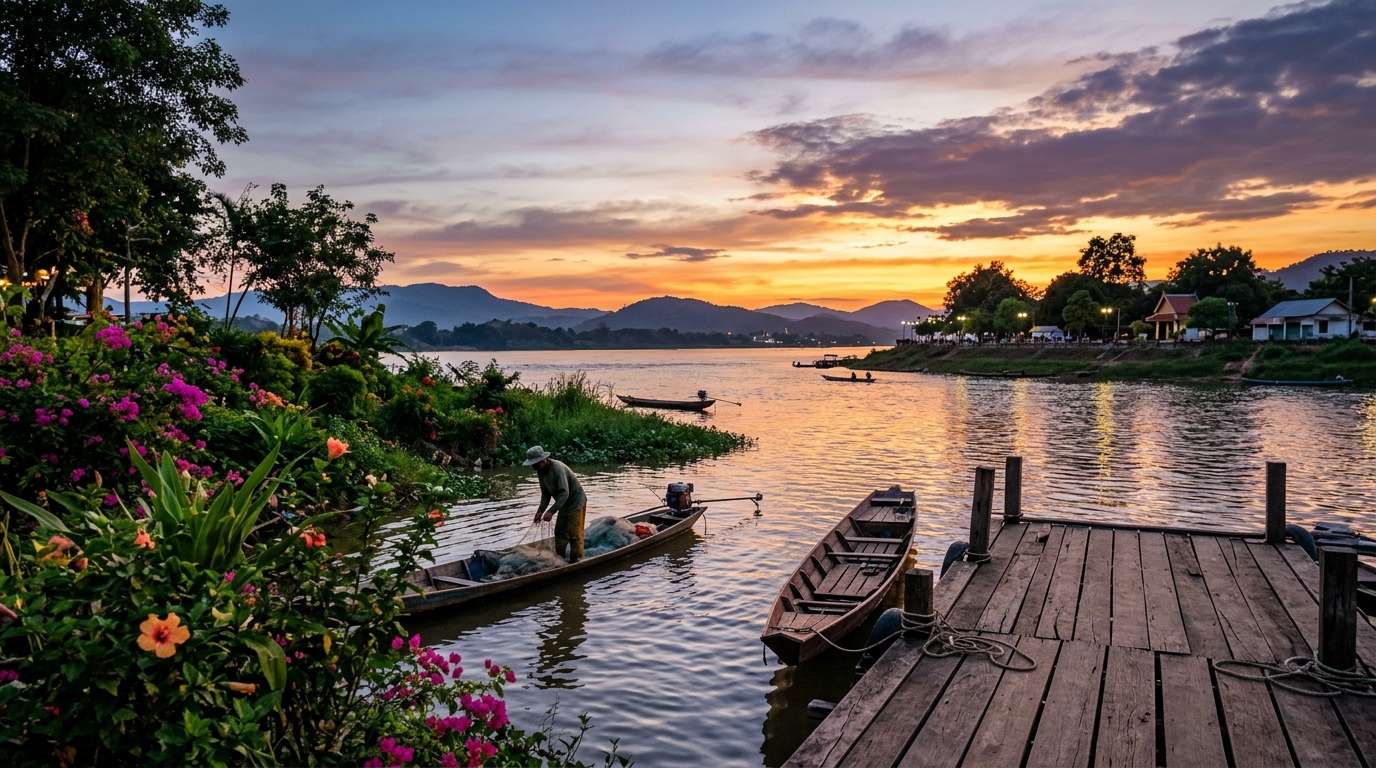
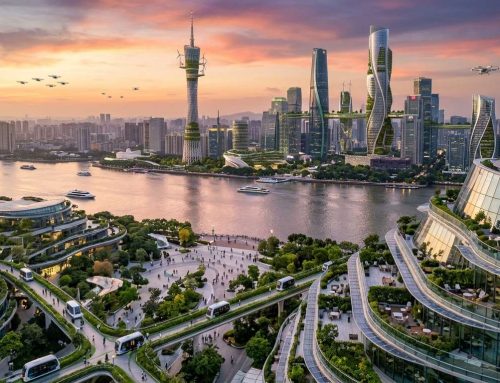
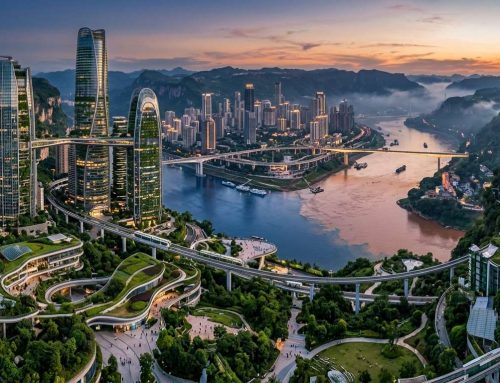
How could Pakse turn monsoon floods, Khmer ruins and temple-hill footsteps into a net-zero hub by 2050? I first asked myself that at dusk, standing where the Xe Don meets the Mekong. Brown water swirled together under a pink sky, and scooters buzzed along the bank.
The Pakse I describe here is a grounded scenario, built from real climate goals set by Lao PDR. It is a vision to explore, not a city that exists today. I wrote it as an overland traveler who loves slow trips and honest maps.
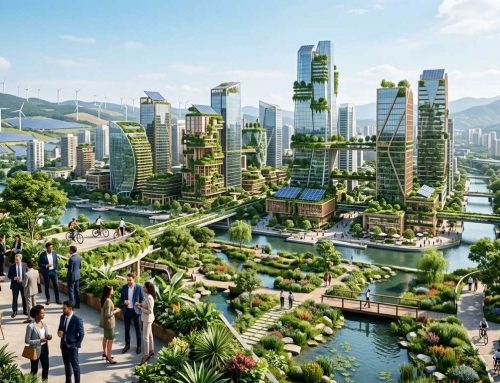
Along the way I will show how flood vaults could catch the rain, how heritage care could save old walls, and how clean power could run the streets. Net zero means cutting greenhouse gas emissions as far as possible. Forests and other absorbers then balance what remains, so the city adds nothing extra to the atmosphere.
Climate change makes this story urgent, so I want to start with why Pakse is the right place for it.
Key Takeaways
- Two rivers, the Xe Don and the Mekong, decide how Pakse could change by 2050.
- Laos has pledged net zero emissions by 2050, and cities would have to carry out that promise.
- Flood vaults, upstream forests and heritage care belong in one water plan.
- Hydropower already makes most of the country’s power, but drought can cut it.
- Footstep power is a small top-up, not a main supply.
- The dry season, November to April, is the best time to visit.
Why Pakse Laos Future 2050 Starts at the Rivers
Pakse’s future is decided by two rivers, because the Xe Don and the Mekong meet inside the city. Pakse is the provincial capital of Champasak in southern Laos. A confluence city lives by water, so any honest picture of 2050 starts with how that water moves.
A city built where two rivers meet cannot plan its future around gadgets alone. It has to plan around water first.
Laos is landlocked. It borders Cambodia, Thailand, Vietnam, China and Myanmar, so rivers act as roads, food sources and power lines for the whole country. In Pakse, boats, fish markets and river views shape daily life.
Growth adds pressure. Laos population is projected to grow from 7.05 million in 2018 to 10.60 million in 2060, about 0.89 percent a year. More Lao people will need homes, water and power, and a small city feels that first.
The UN’s World Population Prospects 2024 projects the world population to rise from 8.2 billion in 2024 to around 10.3 billion in the mid-2080s. Every country in Southeast Asia lives inside that bigger picture. Areas like Pakse feel it through more people and more demand.
One common mistake is picturing 2050 as gadgets: glass towers, flying taxis, robot buses. Real change in Pakse looks more like drains, pipes and river care. Those rivers already face new pressure, and it starts with a warming climate.
What Climate Change Means for a Mekong Frontier City
Temperatures in Laos have risen about one degree since the mid-20th century. That small number already changes life in a river city like Pakse. Without action, climate change could lower Laos GDP by up to 6 percent by 2030 and up to 21 percent by 2050.
Laos is a low contributor to global emissions. Forestry, agriculture and exported coal power make up the bulk of its greenhouse gas emissions. Even so, the government of Lao PDR has pledged net zero emissions by 2050.
Here are the main pressures a southern Laos city would face:
- Hotter days that strain homes, markets and workers
- Heavier floods along rivers like the Xe Don and the Mekong
- Droughts that cut river flow and farm yields
- Landslides on slopes cleared of trees
- Rural poverty risk as crops fail and families move
A pledge like this is usually written into a nationally determined contribution, the climate plan each country files. It is a national promise, and cities like Pakse would have to carry it out street by street.
The path ties economic development to sustainable development, and it touches every person, from rice farmers to guesthouse owners. Of all these pressures, floods are the one I have seen most clearly.
How Flood Vaults Could Capture a Monsoon
On a monsoon night, rain hammers the Mekong riverfront, and in my vision the street drains pour into flood vaults under the stone. The flood vaults are underground tanks beneath the Xe Don and Mekong waterfronts. They hold the seasonal deluge, then release filtered water slowly once the river level falls.
Without preventive measures, climate change is projected to substantially increase asset losses from floods in Laos. Flood defenses aimed at high-risk areas cost less per avoided loss than untargeted defenses. So in my scenario the vaults sit under the blocks that flood most, not under every street.
Roads matter here. Flooded roads in provinces with poor pavement amplify losses, because trucks stop and markets close. Vault inlets near low roads could keep the main routes open.
Data from river gauges would tell the system when to open and close its gates. The cleaner outflow would also help the natural resources environment along the banks. Part of that stored water could later cool public buildings.
I want to be careful. Capturing literally all the water is a design goal, not a promise. A record storm could still overtop any tank, so the plan also needs help from the hills upstream.
Can Upstream Forests and Watersheds Protect Pakse?
Flood control starts far above the city, because forests and soil in the upper watershed slow the water before it reaches Pakse. Protection plans have been completed for ten watersheds, including Xe-Don and Xekong-Xe Kha Marn. Deforestation from cash crops, mining and hydropower has worsened flood and drought risk.
A watershed is the land that drains into one river. Lao PDR treats its care as part of sustainable development, since watershed protection sustains hydropower benefits and soil and water conservation. Healthy hills do many jobs at once:
- Slow runoff, so flood peaks arrive later and lower
- Hold soil in place on steep slopes
- Keep water cleaner for towns downstream
- Support hydropower by steadying river flow
- Shelter wildlife in the forest
Trees have limits. In an extreme storm, soaked ground can only take so much water, so forests cannot replace vaults. The two layers work together, one in the hills and one in the city.
Keeping that natural resources base healthy takes steady care in remote areas, where few people ever see it. Clean water and calm rivers are the reward. All of it needs energy, and a net-zero city has to power itself.
From Wood Fires to Electricity: The Energy Shift Behind Net Zero
Wood was the top fuel in Laos in 2018, supplying 41.60 percent of final energy. Diesel came next at 28.03 percent, and electricity supplied 14.95 percent. Total final energy consumption was 3,091 thousand toe, a unit that means tonnes of oil equivalent.
Net zero means cutting emissions as far as possible, then balancing what remains with forests and other absorbers. Under existing policy, electricity rises to 38.66 percent of final energy by 2060 while diesel falls to 22.67 percent. That shift matters because burning wood and diesel is a big source of ghg emissions.
| Fuel or sector | 2018 share | 2060 share, existing policy |
|---|---|---|
| Electricity | 14.95 percent | 38.66 percent |
| Diesel | 28.03 percent | 22.67 percent |
| Transport | 32.99 percent | 33.67 percent |
| Industry | 13.50 percent | 28.44 percent |
Transport was the biggest sector in 2018 and holds steady. Industry grows the most, from 13.50 percent to 28.44 percent. That is a clear sign of development, and it means more machines drawing power.
This is a national picture, not a count for Pakse alone. A provincial capital would follow the same direction, though. More electricity use raises the question of where that electricity comes from.
Hydropower, Solar and the Microgrid Pakse Would Run On
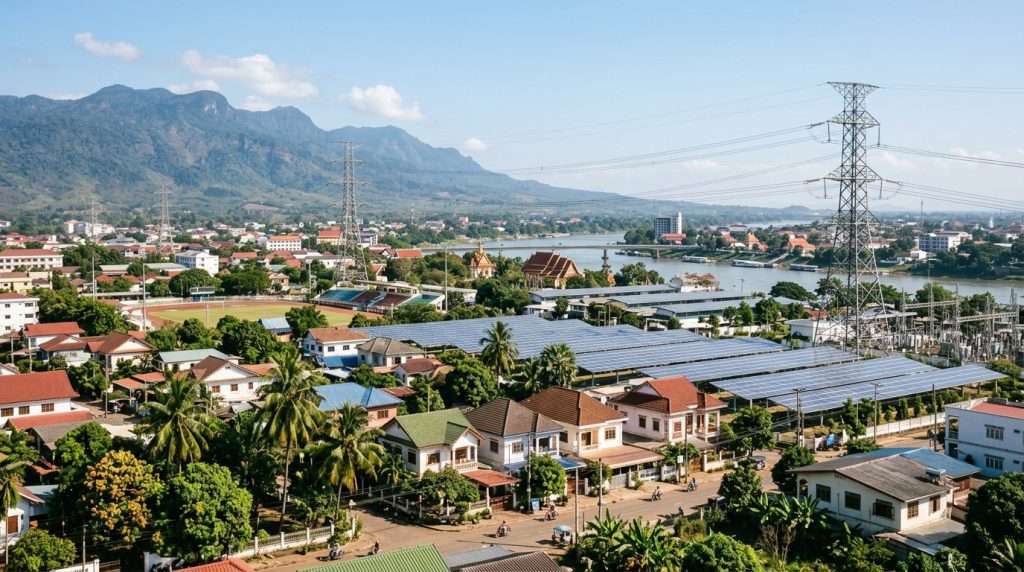
Hydropower made 22.33 of the 26.13 TWh of power Laos generated in 2018, so water already runs most of the country. Laos power generation grew from 1.04 TWh in 1995 to that 2018 level. Tables such as the World Development Indicators track this kind of growth.
The catch is simple: run-of-river hydropower is vulnerable to drought, so a dry year can cut supply. A city that wants net zero needs a mix of sources, not one.
Hydropower as the Backbone
Installed capacity reached 6,980.52 MW in 2018, with hydropower at 5,056 MW and coal at 1,878 MW. In my scenario, Pakse would draw most of its power from this hydropower base. A microgrid, a small local power network, would keep batteries ready for dry spells.
Solar and Coal Replacement
Coal produced 3.74 TWh in 2018, or 14.03 percent of generation. In the more ambitious scenario, solar replaces 50 percent of coal generation. Panels on roofs and open ground near Pakse could fill the gap on sunny dry days, just when rivers run low.
Footstep Power in the Night Market
Footstep power is a small local top-up, never the main supply. Pavers under busy walkways could light a lane or charge a few phones. The real work stays with hydropower and solar, and the next question is how people move on that power.
Getting Around Pakse on Electric Power
The motorbike is Pakse’s everyday vehicle, and in the transport sector it is the first thing that has to change. Transport emissions per year rose from 789.66 to 3,179.77 between 1995 and 2018. That is about four times higher.
Existing policy targets 20 percent electric cars and 20 percent electric motorbikes in 2030, rising to 50 percent each by 2060. It also sets 100 percent electric passenger rail in 2030, and freight rail at 30 percent electric in 2030.
The more ambitious path pushes further. Electric cars reach 20 percent in 2030 and 70 percent in 2060, and motorbikes reach 30 percent in 2030 and 70 percent in 2060.
| Measure in 2060 | Existing policy | More ambitious policy |
|---|---|---|
| Electric cars | 50 percent | 70 percent |
| Electric motorbikes | 50 percent | 70 percent |
| Electric freight rail | 70 percent | 95 percent |
Picture a rented scooter in the 2050 scenario. You would feel the change as quiet: no exhaust at the morning market, no rattle, just a soft hum. A charge swap at a corner kiosk would replace the gas station stop, and a Lao PDR rail line would carry freight off the road.
Those calm streets would pass the old buildings that give Pakse its look.
Pakse’s Forest Backdrop and Carbon Balance
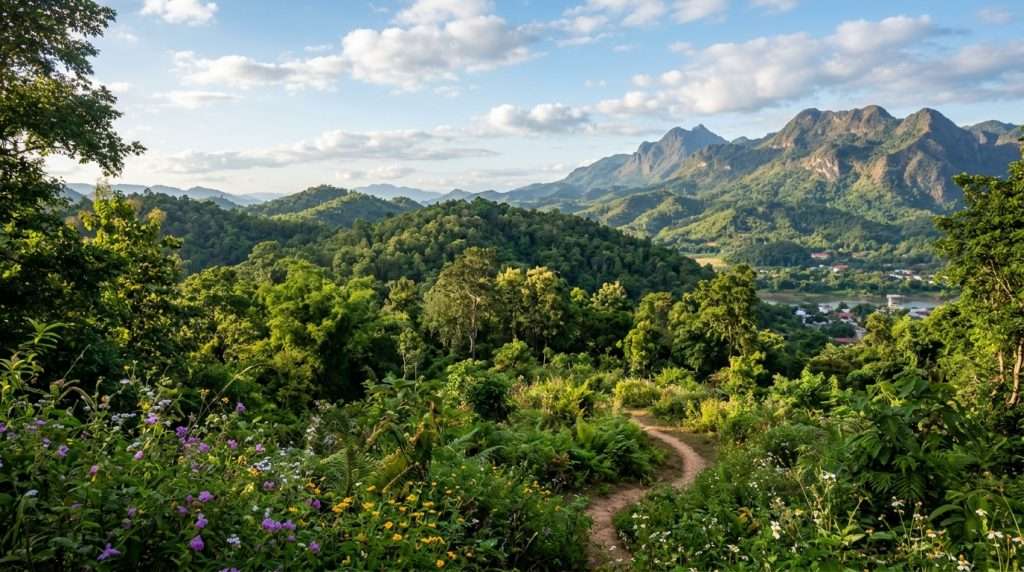
Forest cover in Laos rose from 41.5 percent in 2005 to 62 percent in 2020, by government figures. The national goal is 70 percent. Forests matter for net zero because they absorb carbon that a city cannot cut.
FAO data ranked Laos 8th in the world for forest cover increase. Government and FAO numbers are not identical, since each counts forest in its own way. I treat both as signs of direction, not exact counts.
Forest carbon credit trading is a planned activity. It could pay areas that keep trees standing, which supports climate change mitigation at the country level. The natural resources on those hills would then carry real value.
A caution is needed. Forest cover alone does not make a city carbon neutral. Pakse would still have to cut greenhouse gas from its own buses, kitchens and cooling, and let forests cover only what is left.
Trees need guarding from fire and logging, just as old walls need guarding from damp. Pakse has plenty of both to protect.
Protecting Pakse’s Heritage From Monsoon Damp
Up close, a French-colonial shophouse in the wet season shows peeling plaster, dark damp patches and swollen wooden shutters. Wet-season damp is the main enemy of old masonry and timber in Pakse. In my 2050 scenario, breathable mineral glazes would protect these walls without hiding their age.
Trapped moisture does harm, so a coating must let the wall breathe. A breathable glaze lets vapor escape while keeping rain out, and it keeps the authentic patina, the soft aged color that tells a building’s story.
Three assets would get treatment, each with its own damage:
- Shophouse timber: rot from constant damp
- Wat Luang cloisters: damp walls that stain and flake
- Vat Phou sandstone: spalling, where surface layers peel off the stone
Never seal old stone in plastic-like paint. Water gets in, cannot leave, and pushes the surface off from behind. A good heritage plan treats the monsoon as a visitor to manage, not an enemy to lock out.
Some of this care would reach beyond the town, to Vat Phou.
Vat Phou and Wat Luang in a Carbon-Neutral Pakse
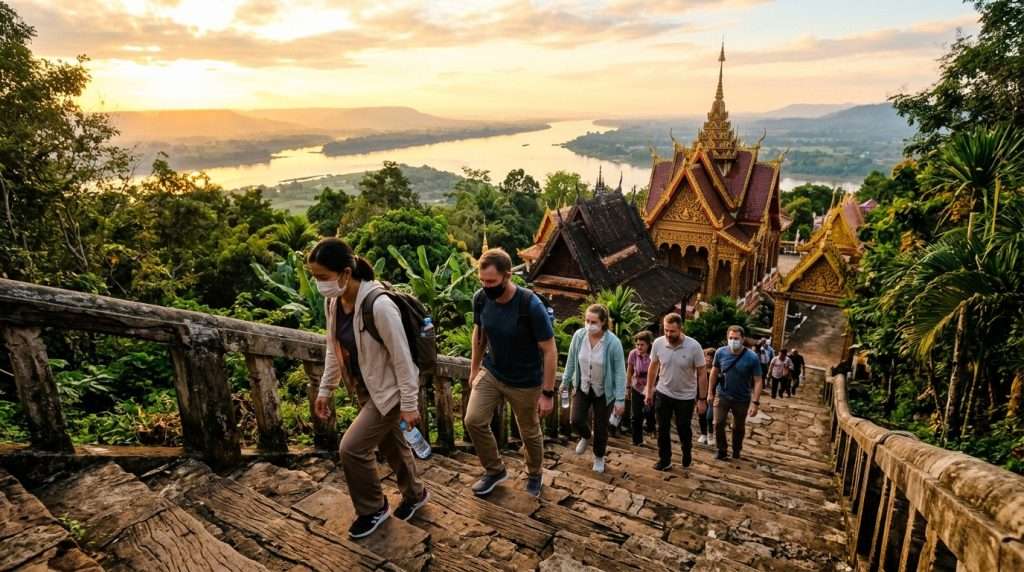
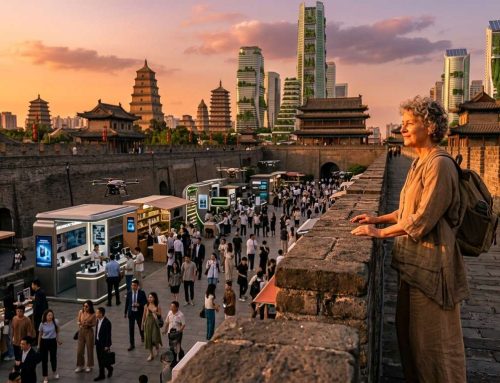
Climbing the hill staircase at Wat Phou Salao at first light is the best way to watch Pakse wake up. The hill rises above the city, and the staircase ends at a view over both rivers. In my vision, quiet electric shuttles bring visitors to the base.
Walk the route in order: Wat Luang first, then the Wat Phou Salao stairs, then Vat Phou. Wat Luang sits in town, so you can go on foot. Vat Phou is an ancient sandstone temple complex south of Pakse, and a shared electric ride would take you there.
Early light is kind to stone. Low sun picks out carved lines and warm tones, and the crowds are thin. Shoot from the side of a wall, not straight on, to show depth.
Travelers carry a role in all this. Go early, stay on marked paths and never lean on or climb old walls. Fewer feet in the same spot means less wear, and that is real heritage care for sustainable development and tourism alike.
Those hill steps, packed with visitors, hold a hidden energy source.
Piezoelectric Pavers on the Riverfront and Hill Stairs
A footstep makes very little power, but many footsteps add up. Piezoelectric pavers convert footsteps into small electric pulses. In my scenario they sit under the riverfront night market and the Wat Phou Salao stairs, feeding a microgrid.
Footsteps would cover only a small part of a city’s demand, so these pavers are small top-ups. Likely uses are lighting paths and running charging points for phones.
Where crowds are densest, the pavers pay off most. A night market at peak hour sends thousands of steps across the same stones. A quiet side street would give almost nothing.
That is why I picture them only in a few busy spots. Each tile is a tiny energy source, and its value is local: a lamp that needs no long cable, a charger that works at the top of a staircase. It also shows visitors that their own walking feeds the city.
The main supply still comes from rivers, and those rivers cross borders.
Cooling a City With Captured Floodwater
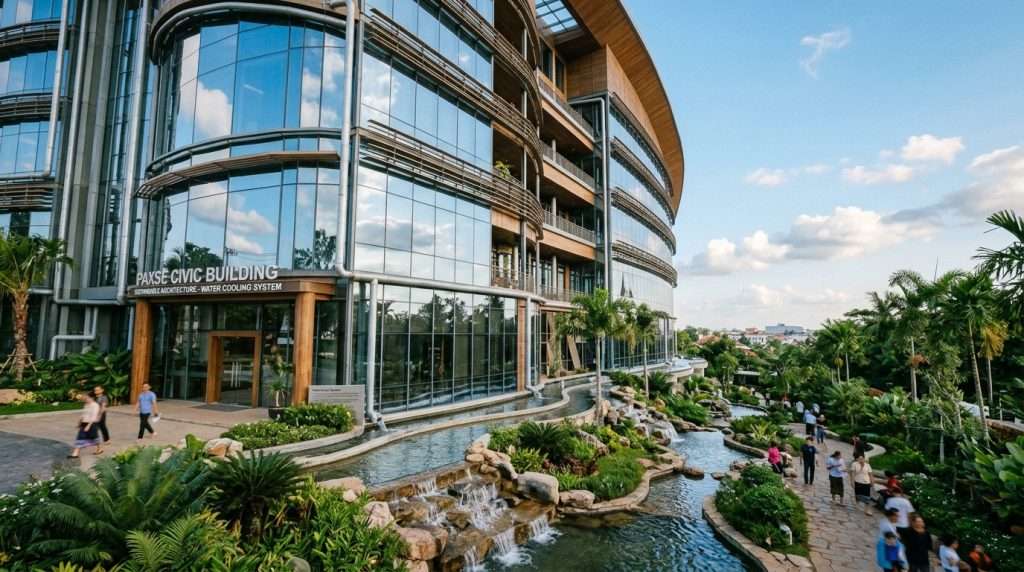
Urban air conditioning could reach 70 to 95 percent of homes by 2060. Existing policy sees 70 percent of urban households using it, and the more ambitious scenario sees 95 percent. In that scenario 88 percent of households also cook with electricity.
That demand is the catch. Every new air conditioner pushes electricity use up, and the power sector must grow to match it.
Capillary Loops for Civic Districts
Capillary cooling loops circulate filtered water through civic buildings. Thin tubes in walls and ceilings carry cool water from the flood vaults. The water does the work that compressors do in a standard air conditioner, so electricity use drops.
Home Cooling and Cooking Demand
Homes would not all get loops. Households would buy their own units, and electric cooking adds a load in the evening. Planners would have to match that peak with solar and storage as development speeds up.
For hot season in Pakse, I follow a few simple habits:
- Walk early and late, and rest at midday
- Pick a room with a fan and good shade
- Refill a water bottle often
- Wear light long sleeves against the sun
All that cooling water ultimately comes from a river that many countries share.
Sharing the Mekong: Transboundary Water Questions
From a boat, the Mekong near Pakse looks wide and slow, with sandbars, fishing nets and kids waving from the bank. The river does not stop at any border, so a city’s water plans depend on neighbors upstream and downstream. Local capture is one layer, not a fix for river-wide change.
Laos has considerable scope to improve water management, because average flows and available storage exceed water use in many basins. Transboundary water management is a stated issue in the Mekong. The Lower Mekong River Basin is managed with regional bodies, and Laos exports power to neighbors.
Climate change shifts rain and flows in every one of these countries. A vault in Pakse can hold the city’s own deluge. It cannot control what happens in other regions along the river.
As a traveler, I watch river life: fishers at dawn, cargo boats, families washing on the bank. The Mekong is a source of food and income across Southeast Asia. Seeing that makes the shared-water question feel personal.
All of this carries a price tag, and someone has to pay it.
Who Pays for a Net-Zero River City?
The national climate response is expected to need about US$21 billion of additional investment from 2025 to 2050 in net present value terms. Cost savings are expected to more than offset that spending. Net present value means future money counted in today’s terms.
Money can come from several routes:
- Fuel tax reform: 5 percent on diesel four-wheelers and 10 percent on two and three-wheelers could raise about US$51 million a year
- Public budgets, including four fiscal reforms that could raise US$4.5 billion in NPV terms
- International finance, from lenders such as the World Bank
- Private clean energy investment
- Savings from avoided flood losses
The hurdle is debt. Laos faces debt distress, and high borrowing costs lower the competitiveness of clean energy. Every project in a growth plan has to prove it saves money year after year.
I cannot say how much of this Pakse would get. I can say that each choice shapes the city’s development for decades. A traveler can help in small ways, starting with the next trip.
How to Visit Pakse and See the Change Yourself
The dry season, from November to April, suits most travelers. Pakse is a southern Laos hub for the Bolaven Plateau and Vat Phou. The rainy season, roughly May to October, brings flooded roads.
Plan your trip for the dry season, because heavy rain can flood the roads around Pakse.
Here is how I would plan a visit:
- Best months: November to April
- Getting there overland: take buses or cross by land from Thailand or Cambodia
- Where to watch the rivers meet: the riverfront near the confluence at sunset
- Night market evening: stroll the stalls and eat local street food
- Low-impact choices: carry a refillable bottle and skip single-use plastic
Budget travelers can save by walking the center and using local transport. Staying with Lao people in small guesthouses puts tourism money back into the community. Both choices fit a trip across Southeast Asia and areas beyond it, and they support sustainable development this year and the next.
Now I want to share the final thoughts I took home.
Conclusion
I keep thinking about that muddy meeting of rivers at dusk. Standing there, I could see how water, heritage and clean power belong in one plan for Pakse. Take one away and the others get weaker.
The net-zero city is a vision, but the pressure from climate change is real, and so is the Mekong. Book a trip in the dry season, walk to the riverfront at sunset and watch the two rivers join. Then go and see it for yourself.



Leave A Comment