
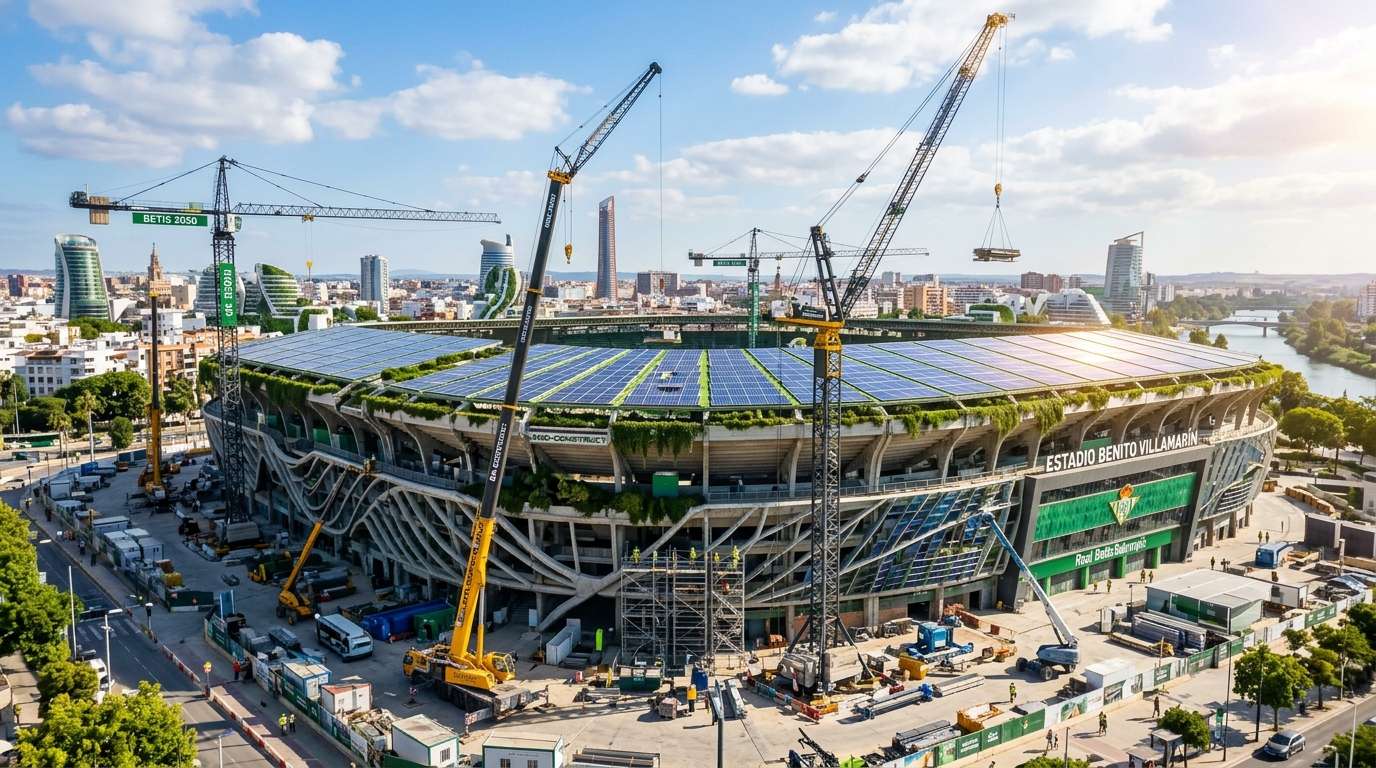
The rebuild is real and under way in Seville, and 2050 is where I let my imagination run. Real Betis is rebuilding the main stand of Estadio Benito Villamarín, and the confirmed plan runs to October 2027, not 2050.
If you searched for 2050, I am sorry: no club document looks that far ahead. The second half of this piece imagines a heat-ready stadium for a city that could see much hotter summers from climate change.
The club also wants the ground to be a tourist attraction, and its sustainability platform, Forever Green, guides the work. Every idea about 2050 carries the label “vision”, so you can always tell fact from daydream.
Key Takeaways
- Real Betis is rebuilding one stand, not building a new stadium.
- The planned return to the stadium is October 2027.
- Betis plays home games at Estadio La Cartuja until then.
- Solar panels and a rainwater tank are already in the plan.
- Seville summers could peak at 50 C by 2050.
- The 2050 ideas here are my vision, not a club plan.
What Is Happening to the Stadium Right Now
No, Betis is not building a new stadium: it is rebuilding the main stand and wrapping the rest of the bowl under one roof. The whole ground gets a fresh look, but it does not start from zero.
The project is a €70 million redevelopment of Benito Villamarín. Real Betis began demolishing the main stand in late July 2025, and the work should take more than two years.
| Date | Milestone | Detail |
|---|---|---|
| Nov 16, 2021 | Intention announced | The club says it will finish the redevelopment |
| Mar 7, 2023 | Competition announced | International architecture competition opens |
| Aug 17, 2023 | Winning design named | The jury picks the final design |
| Late July 2025 | Demolition begins | The old main stand comes down |
| Oct 2027 | Planned return | Betis aims to play at home again |
One detail matters here: this is a rebuild of one stand plus the roof and facade. The other three stands remain in place.
Delays are possible on a project this size, so treat October 2027 as a plan and not a promise.
Why Real Betis Plays at La Cartuja for Now
Betis plays at Estadio La Cartuja because its own main stand is being rebuilt. The club needed a second ground before it could start work at the Villamarín.
The original plan was to start in summer 2024. But La Cartuja was being rebuilt itself, and its renovation was announced in November 2023 as part of preparations for the 2030 World Cup.
That chain of events pushed the Villamarín start back by one year. La Cartuja holds 70,000 people, which makes the temporary venue bigger than the Villamarín. Arsenal’s club guide to Real Betis also notes that Betis plays there while its own ground is under renovation.
La Cartuja was rebuilt in 2024-2025. The athletics track was removed, the pitch was lowered and lower-tier stands were added. Betis hosted its 2025-26 home matches there, and if the works run late, the club may stay longer.
A fan who liked the old track-and-bowl look of La Cartuja will not find it. The athletics track is gone, and the pitch sits lower now.
The New Main Stand, Roof and Façade

The new stadium will hold 60,379 people, slightly fewer than today. The goal is quality and daily use, not a bigger bowl, so this is no expansion of capacity.
Rafael de la-Hoz of Spain and Gensler of the United States won the competition design. The contest drew 30 entries, and 7 were shortlisted. I would not treat the design as finished, since details can still change.
| Area | Seats | Note |
|---|---|---|
| New main stand | 15,754 | Split into several tiers |
| VIP seats in main stand | 4,023 | Part of the main stand total |
| Presidential box | 180 | Inside the main stand |
| Whole stadium after upgrade | 60,379 | Down slightly from 60,721 |
A Taller Main Stand With Premium Seating
The new main stand will be slightly higher than the other stands. It also splits into several tiers, which helps separate different kinds of seats.
Premium seating across the ground comes to 4,436 premium seats. That number could grow if demand is high.
One Roof and a Façade of 13 Stripes
A unified roof will cover the whole seating bowl. Today the stands carry different looks, so one roof should tie them together.
The new facade will have 13 horizontal stripes that refer to the club logo.
The Cascading Building and the Square
The cascading building is a stepped building attached to the outside of the new main stand, so the stand and the plaza in front of it work as one space. I like that idea, since it treats the outside as part of the ground.
The 13 stripes are a nod to the club badge, so look for them on the outside when the facade goes up.
The Green Ideas Already in the Plan
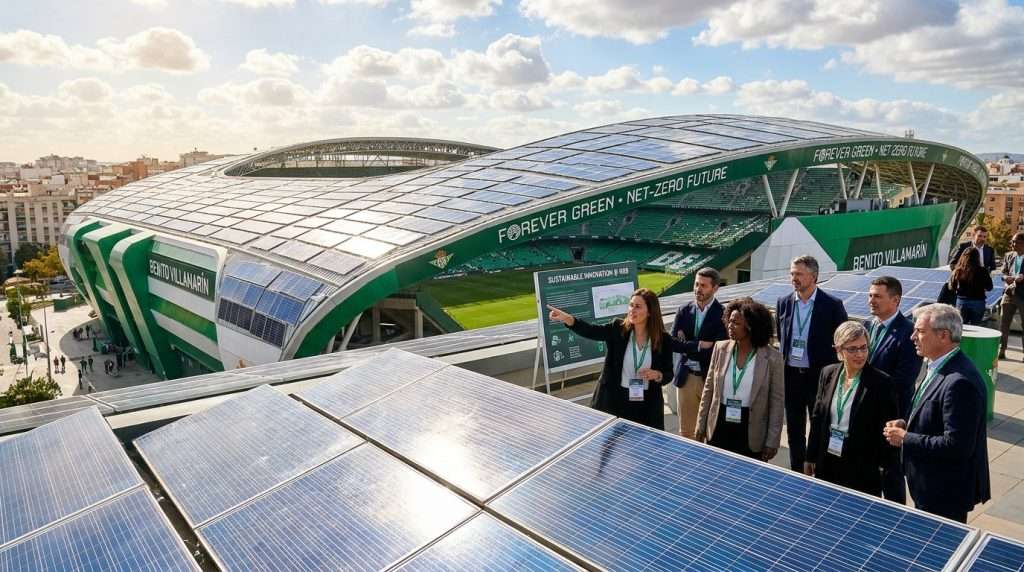
Solar panels and stored rainwater are the two big green moves in the plan. The club has linked the project to Forever Green, its sustainability platform.
Here is what Real Betis has committed to for the stadium:
- Solar panels aimed at self-sufficiency
- An underground tank that collects rainwater for the pitch
- A target of environmental certification as one of Europe’s first energy-efficient stadiums
- The Forever Green sustainability platform as a guide
- Shared mobility and electric vehicles promoted by the club
Notice the verbs in these plans: the design aims for self-sufficiency, and the rainwater will be collected. Those are goals, so real results can only be judged once the stadium is running.
The tank is stored underground and used to water the grass. Stored rainwater for the grass is a small, practical idea that every hot-climate stadium could copy.
Seville in 2050: The Heat This Stadium Must Face

Summers in Seville could peak at 50 C by 2050, with rainfall reduced by 20 percent. Frying pan of Spain is already the city’s nickname, and the pan may get hotter.
A study of urban heat stress across Seville found that heat waves raised stress in every zone it looked at. Areas with more vegetation held up better.
At 50 C, concrete stands bake all day and can crack as they swell and shrink. Fans in the sun face real health risk, and a roof helps only if air still moves under it. The grass needs far more water in that heat.
With 20 percent less rain, every storm counts. Water saved today is water available later, which makes the planned rainwater tank more than a nice extra.
Events in the city could shift to evenings, and a stadium has to work in both daylight and dark. A stadium built to last a century has to be planned for the climate of its last decades, not its first.
Estadio Benito Villamarin Future 2050: A Heat-Ready Vision

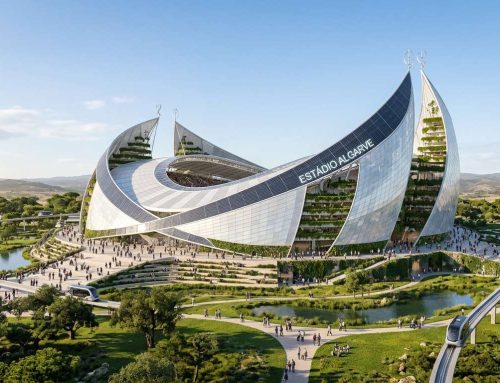
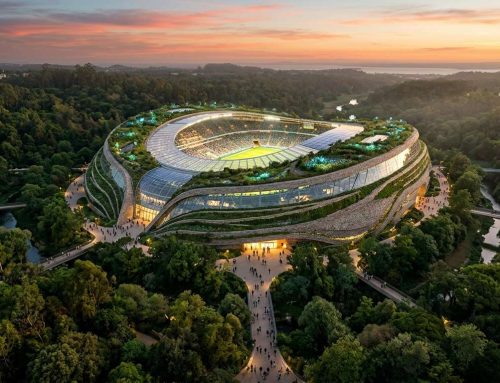
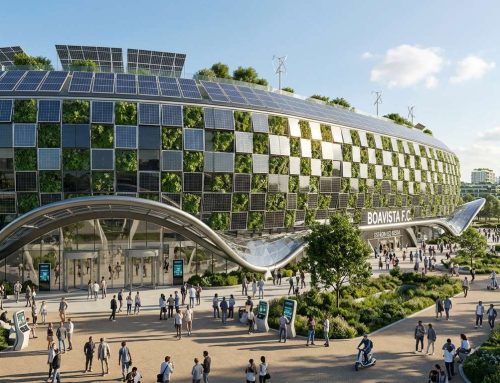
This is my picture of 2050, not the club’s blueprint. None of it is a confirmed Real Betis plan. The ideas come from engineering talks, and I imagine them on top of the real redevelopment.
The confirmed plan already has solar panels and an underground rainwater tank. My vision builds on those two ideas, so nothing here replaces them.
Concrete That Survives Heat
The stadium lists a capacity of 60,721 today, and its perimeter ramps and grandstands are concrete. In 2050 I picture a breathable mineral glaze on that concrete.
It could slow cracking in extreme heat. It could also keep the original finish that people know in Heliópolis, so the old character stays.
A Roof That Makes Power
I picture a translucent solar membrane over the roof. It could make power while still letting light reach the grass, which needs sun to grow.
That would build on the planned solar panels. Fans in the stands could sit under shade that also works as a small power plant.
Water and Fan Energy Underground
Under the ground, I imagine vaults that could catch storm water. That water could then feed cooling for club facilities, which would matter in a summer at 50 C.
The Gol Sur is the south stand behind the goal, rebuilt in 2016-2017. I picture floor plates there that could turn jumping fans into a little electricity.
These are ideas that exist in engineering talks, not products promised by the club. If only one becomes real, I would bet on water storage, because the rainwater tank is already in the plan.
How Big Is the Stadium, and Is Betis Bigger Than Sevilla?
Betis’s Villamarín holds 60,721 people, well above Sevilla’s listed capacity of 43,883. Betis has the bigger home ground of the two Seville clubs.
The record crowd was 59,916 for Real Betis against Real Sociedad on May 19, 2024.
| Venue | Role | Capacity |
|---|---|---|
| Benito Villamarín | Betis home, listed | 60,721 |
| Estadio La Cartuja | Betis temporary home | 70,000 |
| Ramón Sánchez-Pizjuán | Sevilla FC home | 43,883 |
| Benito Villamarín in 1982 | After renovation | 50,253 |
The stadium opened in 1929. It was called Estadio Heliópolis from 1939 to 1961, and Manuel Ruiz de Lopera from 1997 to 2010.
Estadio Benito Villamarín hosted two group matches at the 1982 World Cup: Brazil 4-1 Scotland on June 18, and Brazil 4-0 New Zealand on June 23. Few club stadiums can say they hosted a major competition so long ago.
The 2016-2017 south stand rebuild lifted capacity from 52,000 to 60,721. That is a large jump for one stand in nearly a century of football.
The record crowd of 59,916 came as recently as May 2024, which shows how close the ground runs to full.
A Stadium That Works All Year, Not Just on Matchdays
The aim is a stadium that is alive 365 days a year. The brief for this project was a must-see city attraction, not a bigger stadium, and that shows the commercial potential the club sees.
The plan puts useful space around the pitch for people who never buy a match ticket. Here is what is on offer:
- A 450-seat auditorium
- An enlarged club museum and expanded stadium tour
- A restaurant, food stands and a Green Market concept
- A main square with greenery and pedestrian areas
- An event center and wide viewing terrace at the top of the main stand
Access matters too. The project adds an underground car park and facilities for wheelchair users, so more fans can use the whole space.
A museum, a market and a square can turn a ninety-minute visit into a full day. That experience could draw tourists as well as supporters, and events can fill the quiet weeks.
The viewing terrace is the part I most want to see, since a high view over Heliópolis should make a great photo.
Planning a Seville Football Trip Before 2027
For now, a Betis home game means Estadio La Cartuja. The stadium sits on Avenida de Heliópolis, 41012 Seville, but match days are elsewhere until the planned return in October 2027.
Seville summers are very hot, so spring and autumn are usually easier for walking and match days. Four checks make the trip smoother:
- Confirm the home ground for your exact fixture
- Look at the Villamarín area in Heliópolis from outside to see the work
- Pick spring or autumn over midsummer
- Check the club for any museum or tour news before you go
Do not plan a Villamarín matchday before October 2027, because Betis home games are elsewhere until then.
A walk past the Villamarín construction site is free, and the changing skyline will make a great before-and-after photo for later.
Conclusion
The real story is a rebuild with a smart green core. The confirmed work runs to October 2027, and it already includes solar panels and stored rainwater.
The year 2050 is a vision worth watching, because a hotter Seville will test every stadium in the city. My ideas are daydreams for now, but they come from real problems that real engineers talk about.
Before you book any Seville trip, look up the club’s latest project news.











Leave A Comment