

The Koh Samui future 2050 makes this question urgent. I think about beaches I have walked and wonder how they will endure.
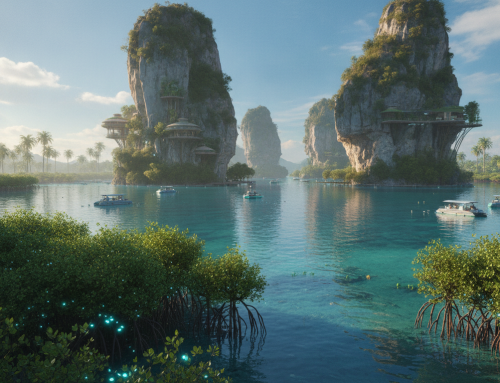
I decided to imagine one answer. Picture a familiar Gulf of Thailand island three decades from now, one that still feels like home but hums differently.
Wat Phra Yai’s golden spires still catch the morning light. Self-healing glazes now guard them against salt spray and monsoon fury while preserving their soul.
Beneath the surface, granite ridges hide water vaults built for droughts, while tidal barriers draw power quietly from the sea. This is tropical hospitality fused with space-age engineering, not fantasy. It rests on real climate targets Thailand has already set.
I am writing this as a personal thought experiment, not a prediction carved in stone. Consider it a dispatch from a journey I have not taken, built on research instead of guesswork. Let’s explore what the Koh Samui future 2050 might require for a truly resilient island.
Key Takeaways
- Koh Samui serves as a case study for how tourist islands might adapt to climate pressures by 2050.
- Cultural landmarks like Wat Phra Yai could be preserved using advanced materials such as nano-mineral glazes.
- Subterranean water vaults built into granite ridges may offer solutions for drought resilience.
- Tidal power systems represent one practical path toward clean, renewable island energy.
- This vision blends real Thai sustainability goals with imaginative, forward-looking engineering concepts.
- The piece frames island resilience as both a technical and deeply human challenge.
1. Koh Samui Future 2050: A Bold Vision for Tropical Island Resilience
Between full-moon parties on Chaweng Beach and sunrise motorbike rides along the coastal road, I noticed change. Koh Samui is no longer chasing tourist dollars alone.
When I picture Koh Samui future 2050, I see more than a sleepy beach town fading beneath rising seas. I see solar-lined resorts, quiet electric ferries, and a coastline resisting climate change.
From Tourist Paradise to Carbon-Neutral Global Model
Thailand raised the stakes at COP26. Prime Minister Prayut Chan-o-cha pledged carbon neutrality by 2050 and net-zero greenhouse gas emissions by 2065. Some updated pathway models now explore reaching net-zero as early as 2050.
Thailand also set a tougher target: cutting emissions 40% by 2030, if international funding and technology support arrive. That is ambitious for any country, especially one built on tourism revenue.
The numbers become sobering quickly. AIM/CGE economic modeling shows Thailand could see GDP losses up to 8.5% by 2050. Carbon prices could rise toward $734 per ton of CO2 equivalent. Real transformation costs real money.
“Achieving carbon neutrality requires more than policy — it demands structural economic change across every sector.”
Thailand is not alone in this race. Taiwan’s own “Pathway to Net-Zero Emissions in 2050” uses four transition strategies and twelve action plans. This gives neighboring economies a useful blueprint to study.
| Country | Net-Zero Target Year | Key Strategy | Notable Challenge |
|---|---|---|---|
| Thailand | 2050 (explored) / 2065 (official) | 40% emissions cut by 2030 | GDP loss up to 8.5% |
| Taiwan | 2050 | 4 transition strategies, 12 action plans | Industrial sector overhaul |
Why This Transformation Deserves Our Attention Today
I understand: you came for beach photos, not carbon policy. Yet places we love to explore often face the greatest climate risks.
Koh Samui’s community-led journey toward sustainability shows that change goes beyond top-down government talk. Locals, hotel owners, and fishing families are already reshaping daily life across the island.
That is why the Koh Samui future 2050 story matters now, not thirty years from now. Watching a beloved island reinvent itself offers a preview of every coastal destination’s future.
2. Safeguarding Sacred Ground: Wat Phra Yai and Big Buddha Preservation

I remember climbing Wat Phra Yai’s stairs, sweat on my back. My phone struggled to fit the entire golden face into one frame. At the 12-meter Big Buddha, I felt small, which is why wat phra yai big buddha preservation matters for Koh Samui in 2050.
Engineers and monks working together understand one simple truth. A sacred monument cannot be wrapped in plastic and called protected. It must breathe, adapt, and respect centuries of tradition. This balance guides work above and below the temple’s golden surface.
Non-Invasive Mineral Masonry Glazes Against Coastal Salt Decay
Salt air is patient. It creeps into stone pores, crystallizes, and cracks even tough masonry. Traditional sealants often trap moisture inside, speeding up damage instead of stopping it.
By 2050, Wat Phra Yai gains a different shield. Non invasive mineral masonry glazes are brushed onto the statue like an invisible second skin. These coatings let stone breathe while blocking salt particles from settling inside.
Think of it as sunscreen for a 12-meter Buddha. The glaze fills tiny pores, bonds with minerals, and flexes during temperature swings. It uses no harsh chemicals, shows no sheen, and protects its golden glow for generations of visitors.
Gulf of Thailand Tidal Reef Defense Protecting the Causeway
Walk from the temple toward the water, and an engineering marvel hides beneath the waves. Pilgrims and tourists cross a narrow causeway daily to reach the small island. That island holds the Buddha.
By mid-century, the causeway gains a submerged Gulf of Thailand tidal reef defense system. These structures sit below the surface and absorb wave energy before it reaches the walkway. They work quietly, almost invisibly, like reef systems nature built before engineers arrived.
Here’s the clever part. These barriers do more than block waves. They harvest the Gulf’s natural tidal rhythm and convert it into clean electricity. That power runs nearby lighting and monitoring systems without turbines or panels spoiling the view.
Standing there in 2050, you probably won’t notice any of this. The Buddha still glows gold at sunset, and the causeway feels solid underfoot. That is the point: good preservation stays hidden, letting the sacred remain sacred.
If you enjoy Thailand’s coastal temples, explore other places to visit in Phuket while island hopping around the Gulf.
Best beach resorts in Thailand.
3. Engineering Beneath the Surface: Subsurface Hydrologic Heritage in Action

Samui’s future may unfold not in the sky or along the coast, but deep underground. Known as subsurface hydrologic heritage engineering, this term means using the island’s bedrock as a giant water management system. Although tourists cannot photograph it, this fascinating 2050 plan could quietly protect Samui during the next major storm.
Subterranean Retention Cisterns Beneath the Central Granite Ridges
Picture huge chambers carved into Samui’s central granite ridges. These cisterns can swallow whole the monsoon flash floods that now wash out roads and flood resorts across Thailand today.
The goal is ambitious but simple: capture 100% of monsoonal runoff before it reaches any street or hotel lobby. Instead of racing downhill and causing chaos, the water is trapped, filtered, and stored underground.
Closed-Loop Reservoir Stormwater Harvesting and District Capillary Cooling
Captured water does not simply sit there. It flows into a closed loop reservoir stormwater harvesting network that feeds district-wide capillary cooling loops. These loops help buildings stay cool without relying as much on power-hungry air conditioners.
The system also fills small freshwater micro-reservoirs across the island. During dry spells, when Samui often faces water shortages, these reserves keep taps running and cooling loops working.
Stadium-Style Porous Asphalt Stormwater Drainage Across the Island
At street level, visitors would notice roads using stadium porous asphalt stormwater drainage technology. It uses the same drainage science found under professional sports fields, keeping them playable during downpours.
Rain hits the pavement and disappears instead of forming ankle-deep puddles. This keeps the island walkable during the wettest downpours, which anyone slogging through a flooded Samui street can appreciate.
| System Component | Location | Primary Function | Key Benefit |
|---|---|---|---|
| Retention Cisterns | Central granite ridges | Capture flash flood runoff | Prevents road and resort flooding |
| Closed-Loop Reservoirs | District-wide network | Store and recycle filtered water | Powers capillary cooling, cuts AC use |
| Porous Asphalt Roads | Island-wide streets | Absorb rainfall on contact | Keeps streets dry and walkable |
None of this is glamorous: no solar panels glint in the sun, and no sleek towers invite photographs. Real resilience often means plain plumbing and clever engineering working quietly under everyone’s feet. That is exactly what subsurface hydrologic heritage engineering delivers for Samui’s future.
4. Living Lightly, Moving Smartly: Architecture and the Sustainable Aerotropolis

Imagine waking in a bamboo-framed room with no air-conditioner hum, while a breeze moves through the walls.
That’s the morning I imagine when thinking about Samui in 2050. The island is improving its shore and water systems while rethinking how people live, sleep, and travel. This vision reaches from landing to checking into a grass-built room instead of a concrete one.
Bamboo-Composite Resorts and Stack-Effect Cross-Ventilation
Forget concrete bunkers with rattling window units. Samui’s new resorts use bamboo-composite construction, a material that grows quickly, stores carbon, and handles tropical humidity well.
The real trick is the design. Architects use stack-effect cross-ventilation, a passive cooling method where hot air rises through tall, angled openings. This movement pulls cooler air through lower vents. No compressors or constant electrical drain are needed. Physics replaces much of the work once handled by air-conditioning units.
I love this approach because it matches the budget traveler mindset I’ve carried for years. Lower energy costs mean lower room rates, and naturally breathing buildings feel more honest than glass and refrigerant.
Autonomous Electric Hydrofoils Linking Samui to the Mainland
I remember queuing for diesel ferries and watching black exhaust curl from the stern. That memory fades against Samui’s 2050 reality: autonomous electric hydrofoils skimming across the Gulf of Thailand.
These vessels rise above the waterline, cutting drag and nearly halving travel time. Batteries charged by the island’s renewable grid power them. Without engine noise, the ride feels closer to gliding than boating.
| Feature | Traditional Diesel Ferry | Autonomous Electric Hydrofoil |
|---|---|---|
| Average Crossing Time | 90–120 minutes | 40–55 minutes |
| Emissions | High, diesel exhaust | Zero direct emissions |
| Noise Level | Loud engine hum | Near-silent operation |
| Crew Requirement | Full crew on board | Remote-monitored, minimal crew |
Koh Samui Sustainable Aerotropolis: Reimagining the Island Gateway
Every journey to Samui starts and ends somewhere. By 2050, that place will be a fully reimagined airport. The Koh Samui sustainable aerotropolis makes arrival and departure part of the island’s environmental story, not a duty-free afterthought.
Solar canopies shade runways, and electric ground vehicles replace diesel tugs. Terminal buildings use passive cooling like bamboo resorts, making the first island breath similar whether visitors check in or out.
This sustainable aerotropolis moves people efficiently and sets the tone for the whole trip. It shows visitors that the island’s commitment to using less land begins when their plane touches down.
5. Conclusion: What Koh Samui Teaches the World About Island Longevity
I keep returning to breathable coatings on the Big Buddha and hydrofoils making quiet wakes across the Gulf. These small details reveal a larger truth. Koh Samui future 2050 is not a wish list, but an answer for island destinations everywhere: can beauty remain without losing the place beneath it?
I do not know whether every detail described here will happen exactly this way. No one does. But Samui and Thailand’s net-zero ambitions already face these questions today, not someday.
Koh Samui redefines tropical island longevity by showing that survival and beauty need not compete. Both can grow from the same root.
When you next fly over turquoise water, remember that you are not visiting only a vacation spot. You are seeing the opening chapters of a longer story, as a fragile, beautiful island learns how to last.




Leave A Comment