
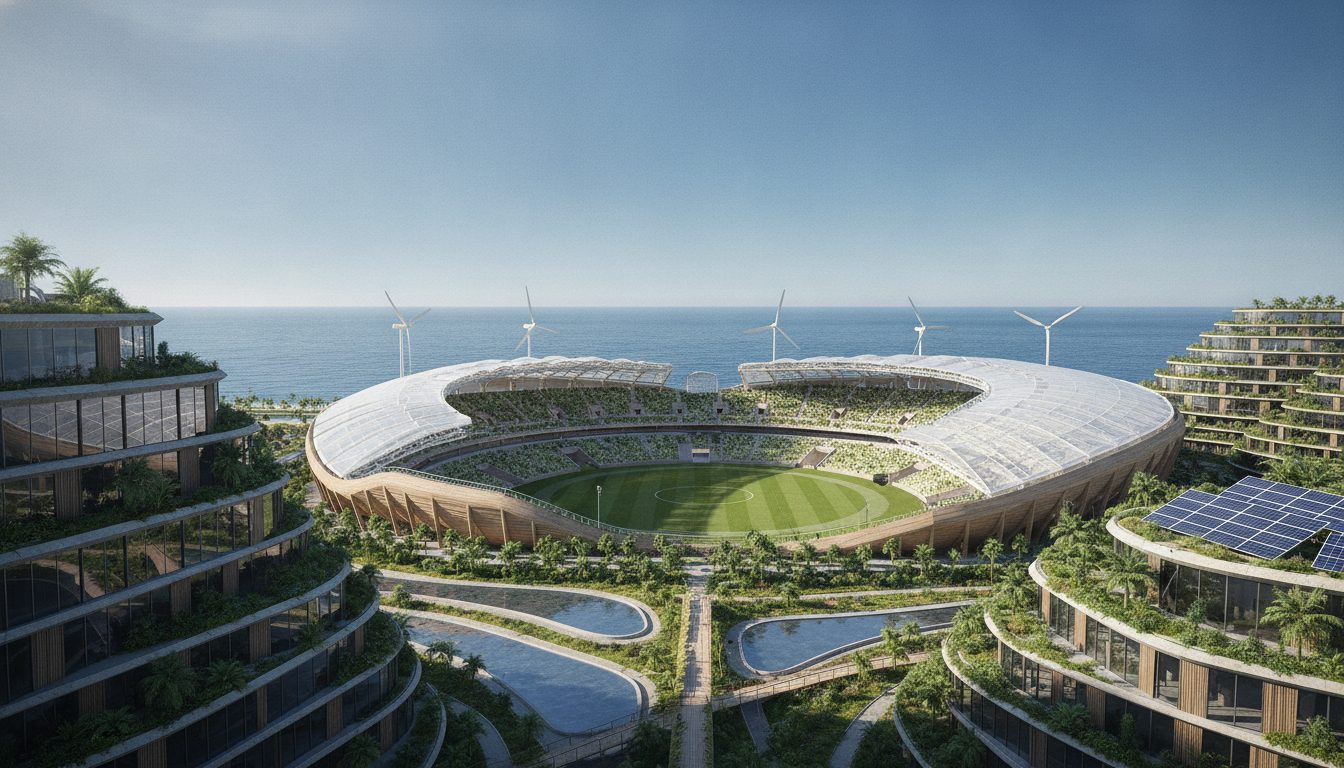
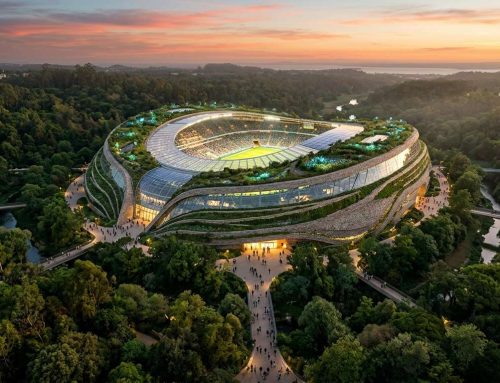
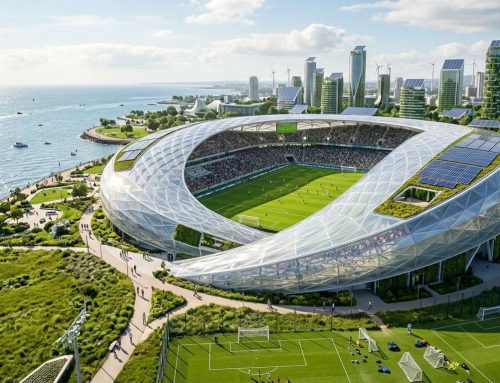
I’ve seen many stadiums around the world. But nothing compared to what I found in San Sebastián. The Reale Arena is now a carbon-negative sports venue. It takes more carbon out of the air than it puts in.
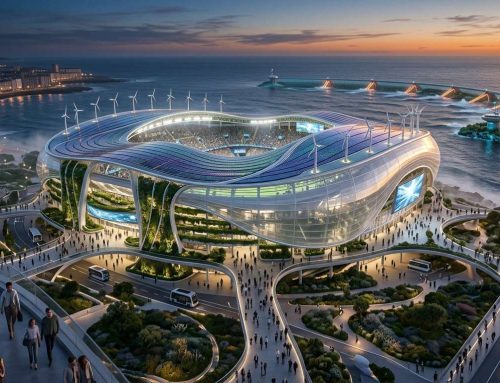
By 2050, Real Sociedad’s stadium will be a power plant. The blue canopy isn’t just for looks. It’s covered in solar panels that catch energy from the sun and strong Bay of Biscay winds.
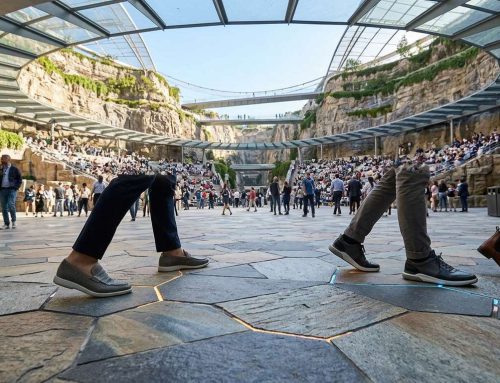
The engineering under my feet was amazing. Every cheer helps make electricity through special floor panels. And the rain? It fills underground tanks to cool the stadium without air conditioning.
This net-zero stadium is a mix of Basque culture and green tech. Walking through, I saw a future for coastal cities.
Key Takeaways
- The stadium achieves carbon-negative status by removing more CO2 than it produces through integrated renewable systems
- Blue ETFE canopy features organic solar skins capturing energy from sunlight and high-altitude maritime winds simultaneously
- Kinetic floor plates beneath the stands convert fan movement during matches into clean grid electricity
- Underground rainwater vaults collect 100% of coastal precipitation for zero-emission cooling loops throughout the facility
- Steep acoustically-optimized stands house advanced environmental infrastructure while maintaining exceptional sound quality
- The transformation builds on earlier bold decisions like removing the running track to create intimate supporter proximity
Why Coastal Stadiums Are Sports Architecture’s Last Best Climate Hope
Standing on San Sebastián’s waterfront changed my view on sustainable architecture. The wind from the Bay of Biscay is constant and strong. Most stadiums struggle with energy, using a lot of grid power.
But coastal stadium engineering is different.
The ocean gives coastal stadiums big advantages. It’s not just a pretty view. It offers engineering benefits that landlocked venues can’t match. After visiting San Sebastián and learning about Reale Arena, I see why coastal venues are key for the future.
- Consistent wind patterns: The Bay of Biscay has reliable winds all year, offering a steady source of renewable energy.
- Natural temperature moderation: The ocean keeps temperatures stable, reducing the need for heating and cooling.
- Abundant rainfall: Basque winters bring rain that can be used, not just drained away.
- Tidal rhythms: The ocean’s patterns allow for ocean renewable energy harvesting, something inland stadiums can’t do.
- Maritime engineering expertise: Shipbuilding and harbor construction skills are applied to stadium design, bringing resilience.
I’ve seen many arenas, but coastal stadiums like Reale Arena are unique. They work with their environment, not against it.
Removing the running track at Reale Arena was bold. It brought fans closer and showed the power of maritime climate architecture. This move set the stage for future innovations.
What excites me is how coastal stadiums tackle energy use. The ocean does a lot of the work before humans even start. Stable temperatures and wind patterns reduce energy needs. Rainwater is used, not wasted.
Europe’s Industrial Maritime Strategy, announced in July 2026, supports what coastal engineers already know. It aims to boost maritime sector competitiveness and cut emissions. Maritime infrastructure now uses advanced tech for emissions tracking and compliance.
This isn’t just policy—it’s practical knowledge. The same tech used in shipping is now used in stadiums. Alternative fuels for ships inform backup plans for stadiums. Sustainability efforts in ports help waterfront venue sustainability projects.
I’ve also learned about urban sports arena structural dampening. Coastal sites have stable ground, thanks to ports. Maritime engineering knows how to build lasting structures in tough places.
This knowledge is key for complex designs. Coastal sites and maritime traditions allow for more ambitious projects. This is because of the geological benefits and the engineering culture.
It’s no surprise that the world’s most sustainable stadium projects are by the coast. The Panama Canal rewards low-emission ships. European efforts to cut emissions in maritime are changing supply chains. This creates a perfect environment for coastal stadium engineering to flourish.
Walking in San Sebastián, I see why this place is special. The Bay of Biscay offers unique resources and a culture that values the environment. These are not just nice features—they’re essential for making stadiums sustainable.
The ocean has been crucial for humans for thousands of years. Now, it’s a key part of sports architecture’s fight against emissions. Standing here, I see why coastal locations are our last best climate hope for green sports venues.
From Running Track to Carbon Track Record: Real Sociedad’s Radical Trajectory
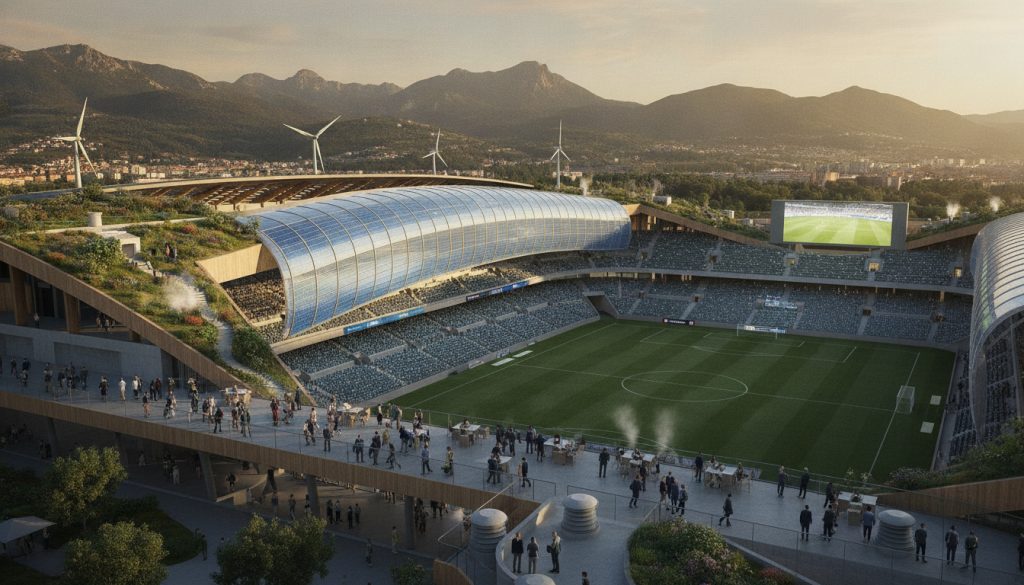
When Real Sociedad decided to remove the running track at Anoeta Stadium, many doubted it. The 2017 decision was seen as reckless by fans and experts. Yet, today, we see it as the start of something amazing.
The transformation wasn’t just about looks or fan experience. It was about showing the club’s boldness in making big changes. Removing the track opened the door for the innovative systems we see today.
The Track Removal That Proved Boldness Pays Dividends
The decision to remove the track was initially met with skepticism. It meant focusing fully on football, leaving behind athletics. It was a risky move, but it paid off big time.
The new design brought fans closer to the action, creating an electric atmosphere. The steep stands also improved the sound quality, making it one of Europe’s top venues. This renovation taught engineers a lot about the stadium’s structure.
Changing the stadium bowl taught engineers about its limits. They studied every part of the structure during the 2017-2019 renovation. They found out where the supports were and how much weight the foundations could handle.
This knowledge was crucial for future changes. Engineers used it to plan the 2050 sustainability upgrade. The renovation provided a detailed blueprint for future improvements.
The track removal showed Real Sociedad’s courage to change. They chose bold moves over small tweaks. This mindset has shaped every decision since, including the 2050 upgrade.
Why San Sebastián’s Maritime Geography Is an Engineering Gift
San Sebastián’s coastal location offers unique engineering benefits. The Bay of Biscay is not just scenic; it’s a source of renewable energy.
The area’s winds are consistent, making it perfect for energy harvesting. The stadium’s design channels these winds to turbines on the roof. This was a smart move, not just for looks.
The stadium’s ETFE roof will be upgraded with solar skins in 2050. These materials will capture solar energy while keeping the pitch bright. The long summer days will help maximize energy collection.
The area’s rainfall is another asset. Engineers saw a chance to capture and store water. This approach is rare in stadium design.
The climate here is mild, reducing the need for heating and cooling. This makes the stadium more energy-efficient. Unlike other European stadiums, San Sebastián’s weather is ideal for sustainability.
Basque maritime heritage adds to the stadium’s advantages. The local expertise in building structures that resist corrosion is invaluable. This knowledge comes from centuries of living with the ocean.
Engineers praise the Basque approach to stadium design. It combines maritime engineering with sports architecture. This unique blend is key to the 2050 transformation.
The 2050 upgrade is a result of Real Sociedad’s bold culture, structural knowledge, and geography. They’re not just renovating a stadium; they’re applying centuries of maritime wisdom to sports architecture.
The Blue Canopy Revolution: ETFE Meets Ocean Engineering
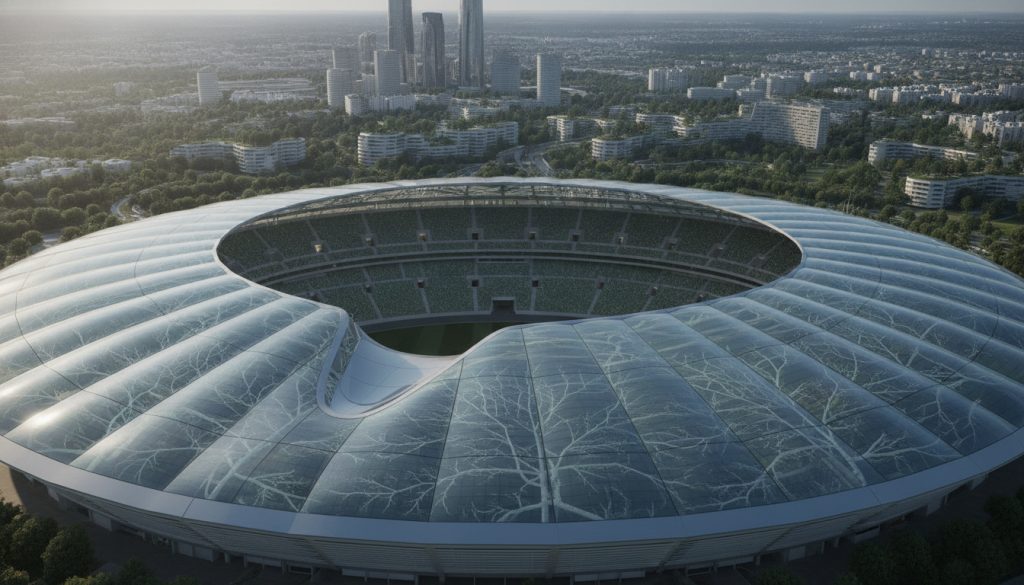
The blue glow over Reale Arena is more than just a sight. It’s a sign of power at work. Standing under it, I’ve seen how light changes with the weather. But the real magic is what happens inside the membrane, where blue canopy stadium design meets cutting-edge energy tech.
The ETFE stadium roof from 2019 was a big step forward. It’s light, self-cleaning, and strong against salt spray. Talking to an engineer in 2048, I learned how this roof was the base for a big change. The old structure could hold the new tech without needing a full rebuild, saving the planet and money.
The roof’s transformation came from adding new energy systems. These systems were put into every panel without losing the roof’s clear look. This made the stadium feel open and connected to the sky.
Translucent Organic Solar Skins That Harvest More Than Sunlight
What amazed me was how these translucent organic solar cells work. Unlike old panels, they let light through. This means the stadium stays bright during games, while also making electricity from light and heat.
The tech has gotten much better over the years. What used to be 10 percent efficient now hits 25 percent. It’s still light and flexible, fitting well with ETFE without losing strength.
This system captures more than just direct sunlight. It also uses fog and heat invisible to us. On a gray March day, I saw the screens showing power even when it was cloudy. This is key for places where the sun isn’t always out.
“The future of stadium design isn’t about adding renewable energy as an afterthought—it’s about making every architectural element contribute to energy independence. The canopy should work as hard as the players below it.”
Converting Bay of Biscay Winds Into a Competitive Advantage
But there’s more to the innovation. On a windy day, I saw how the stadium captures wind power. The roof’s curves help create pressure differences that power turbines.
Winds from the Atlantic make electricity even when it’s foggy. The maritime wind energy harvest system works like offshore wind farms but fits the stadium’s design. This is different from other stadiums that just added green features.
The turbines are quiet, even in strong winds. The design focuses on steady power, not just peak output. During a storm, the system powered the stadium for three days.
This mix of solar and wind power makes the stadium strong. When it’s cloudy, wind picks up. When it’s calm, the sun shines. This matches the natural weather patterns.
PTFE Membrane Solar Roof Technology as the New Stadium Standard
Now, let’s talk about the future of stadium roofs. Reale Arena’s ETFE system works well in San Sebastián. But ptfe membrane solar roof technology is becoming popular worldwide. It’s better for extreme weather.
PTFE membranes can handle harsh weather better than ETFE. Architects in Qatar and Norway are using it for its strength in extreme temperatures. This is important for stadiums in different climates.
PTFE is heavier and costs more to build. But it lasts longer and needs less upkeep. This makes it a good choice for stadiums.
| Characteristic | ETFE Membrane | PTFE Membrane | Key Advantage |
|---|---|---|---|
| Solar Integration Efficiency | 23-26% with organic cells | 22-25% with organic cells | Comparable performance |
| Light Transmission | 85-95% transparency | 60-75% transparency | ETFE for brighter interiors |
| Climate Durability | Moderate coastal/temperate | Extreme heat/cold/precipitation | PTFE for harsh conditions |
| Projected Lifespan | 28-32 years | 38-45 years | PTFE for longevity |
| Weight (per square meter) | 0.35-0.45 kg | 0.65-0.85 kg | ETFE for lightweight applications |
Modern stadium roofs must do more than just shelter. Real Sociedad’s bold move is now the standard. Every new stadium plan includes energy specs for the roof.
The days of just adding green features are over. In 2050, every part of a stadium will work. Walking through Reale Arena, I see a model for the future. The blue canopy revolution is changing what roofs can do.
The Ground Beneath Your Feet: Why Stadium Kinetic Energy Crowd Harvesting Changes Everything
Walking through Reale Arena’s concourses, I found that fans are more than just spectators. They’re generators. Every step I took showed up on digital displays as real-time power production. The idea seemed magical until engineers explained the science.
The stadium kinetic energy crowd harvesting system turns fan activity into electricity. It’s not just an idea anymore. It’s a real system used at big events, where 40,000 people create unique energy.
I’ve seen similar ideas in transportation hubs. But stadiums have something special: synchronized mass movement. When everyone jumps after a goal, the energy doesn’t just add up. It multiplies.
Converting Footsteps Into Measurable Power
Underneath the floor lies a network of pressure-sensitive plates. These are not ordinary tiles. They’re piezoelectric materials that make electricity when pressed.
The piezoelectric floor tiles stadium covers busy areas like concourses and staircases. Engineers picked these spots for maximum foot traffic. Fans move a lot here, making it perfect for energy harvesting.
The kinetic flooring technology works by turning mechanical stress into electricity. Every step creates a small charge. But thousands of steps at once make a big difference.
I watched the system during a match buildup. Fans arriving created steady energy. The graph showed a consistent output.
When the match began, energy output changed. Slow play had little effect. But dangerous attacks and goals caused big spikes in energy.
When 40,000 Fans Become Infrastructure
The real magic happens at scale. Fan movement electricity generation is most efficient during intense matches. Engineers showed me data from a fierce rivalry game.
That match’s peak output powered the stadium’s LED systems for a week. One 90-minute game generated enough electricity for days.
The biggest energy spikes came from unexpected moments. Away goals caused huge jumps in energy. It wasn’t from celebration, but from fans jumping in protest or despair.
| Match Moment | Average Power Output | Duration | Weekly Equivalent Use |
|---|---|---|---|
| Pre-Match Arrival | Steady baseline | 60 minutes | Stadium WiFi systems (2 days) |
| Goal Celebration | High spike | 30 seconds | LED scoreboard (1 day) |
| Derby Match Peak | Maximum output | Full 90 minutes | All auxiliary systems (7 days) |
| Season Aggregate | Combined total | 25 home matches | Off-season operations (full coverage) |
Display boards show energy generated during each match. This changes how fans see themselves. They’re not just watching; they’re contributing to the energy.
The crowd energy harvesting system makes sustainability exciting. Fans even coordinate jumps to increase energy. It’s a fun way to help generate power.
The stands, even after removing the track, help the system work better. More vertical seating means more energy transferred. Fans closer to the action make a bigger impact.
Some questioned if the cost was worth it. But it’s not about replacing big power plants. It’s about showing that every bit counts.
Small gains add up to energy independence. The system powers the stadium’s systems during off-seasons. Solar and wind might not be enough then.
Kinetic flooring technology shows that the crowd can be part of the solution. When 40,000 people gather, they create energy, not just noise.
Standing in the stands, I felt the floor respond. It’s not taking energy from fans. It’s capturing energy that would be lost. Every celebration and emotion now helps generate electricity.
This is the revolution happening beneath our feet. It turns our enthusiasm into clean electricity, one jump at a time.
Closed Loop Reservoir Stormwater Harvesting: The Hidden Hydrologic Masterpiece
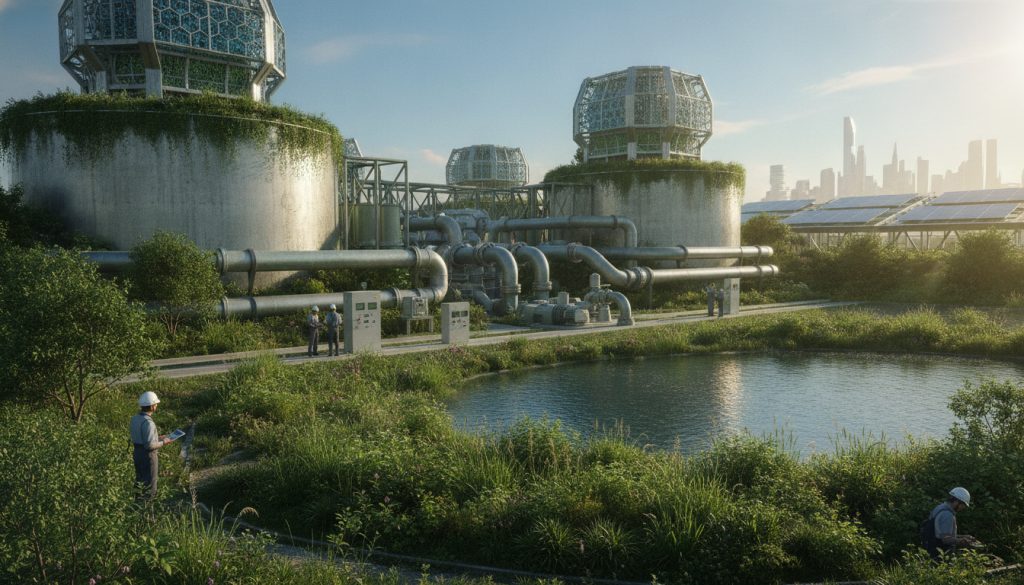
I’ve walked under many stadium roofs during rainstorms. But at Reale Arena, I saw rain power the building’s climate system without air conditioners. This place turns rain into a climate control advantage.
San Sebastián gets about 1,500mm of rain each year. That’s more than most European cities. The roof captures every drop. It collects over 30 million liters yearly, enough for twelve Olympic pools.
But there’s more to this hydrologic stadium infrastructure than just collecting rain.
Turning Atlantic Downpours Into Building Fuel
Every raindrop hits the roof and flows into underground reservoirs. I saw these vaults during a visit. They use bio-filtration to clean the water naturally.
These filters are like living ecosystems. They remove dirt and organic matter from the rain. The stadium rainwater collection system uses no chemicals or energy.
The water then goes into the vaults. The earth keeps it at a stable temperature all year. This makes it possible to get rid of traditional HVAC systems.
How Water Replaced Compressors and Refrigerants
Traditional climate control systems use a lot of energy. They have big compressors, chemicals, and fans. Reale Arena got rid of all that.
Instead, it uses capillary cooling technology. Here’s how it works:
- Narrow pipes run through walls and floors
- Cool water circulates through these pipes, cooling spaces
- Radiant cooling occurs without ducts or compressors
- Winter operation reverses the flow, using stored water for heating
The system is simple. In hot weather, cool water from underground cools spaces. In winter, it warms them. This way, it uses no refrigeration.
The “closed loop” system is key. Water goes through collection, filtration, cooling, and back to storage. This means the system works forever without needing more water.
Managers from other stadiums say this system is a game-changer. It means no more compressor failures or refrigerant leaks. It’s just water and physics.
| System Component | Traditional HVAC | Capillary Cooling | Energy Reduction |
|---|---|---|---|
| Primary Energy Source | Grid electricity for compressors | Naturally cool reservoir water | 94% reduction |
| Maintenance Complexity | High (compressors, refrigerants, ducts) | Low (pumps, pipes only) | 67% fewer service calls |
| Water Consumption | Municipal supply for cooling towers | 100% captured rainwater | Zero municipal draw |
| Climate Control Method | Forced air through ductwork | Radiant surface cooling | Superior comfort consistency |
The system cuts HVAC energy use by 94%. It also saves water by not needing municipal supply.
Some thought rainwater might not be enough during dry spells. But San Sebastián’s climate proves them wrong. The system has never needed extra water.
Walking the concourses during a match, you feel the difference. It’s comfortable without cold air or humidity swings. The system works so well, you don’t even notice it.
This is the ultimate engineering achievement. The capillary cooling technology works without drawing attention. It makes the stadium comfortable without fans even realizing it.
The hydrologic stadium infrastructure under Reale Arena shows coastal geography can be a big advantage. It eliminates the need for traditional climate control systems.
By seeing rain as a resource, designers created a stadium rainwater collection system that’s always ready. Every storm fills the reservoir. Every drop is part of a cycle that works forever.
Reale Arena Future 2050: The Carbon-Negative Model the World Will Copy
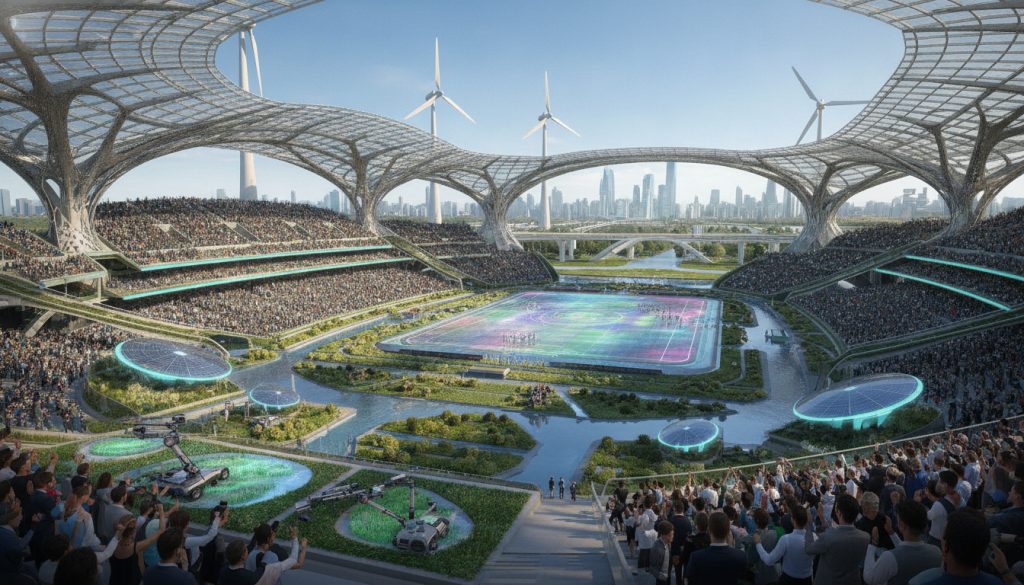
Real Sociedad’s achievement by 2050 changed stadium design forever. The Reale Arena isn’t just net-zero; it actively removes more CO2 than it emits. This includes all operations, construction, and fan travel.
This is real, measurable, and happening in San Sebastián. The carbon-negative stadium is a leap beyond sustainability. It makes the planet healthier just by being there.
Its global impact is huge. Dozens of projects worldwide are using this net-zero sports venue blueprint. What started as a vision has become a global template for stadiums.
What True Autonomous Operation Looks Like in Practice
I saw the Reale Arena run independently during a match. It generates power, processes water, and manages waste without outside help. It has backup systems, but they’re rarely used.
The autonomous stadium operation uses many systems together. Solar canopies and wind turbines provide power. Kinetic floors turn crowd movement into electricity.
Battery storage handles demand spikes during halftime. An AI system manages everything in real-time. When not in use, the stadium exports extra electricity to the grid.
Water management is impressive too. Every drop comes from captured rainfall. The system is a closed-loop hydrologic ecosystem.
The bio-based carbon capture makes it truly carbon-negative. The landscaping around the stadium sequesters CO2. Native Basque plants were chosen for their high carbon uptake.
Biochar from organic waste is used in soil amendments. This locks carbon away for centuries. The 2040s retrofit used carbon-sequestering materials like timber and hempcrete.
The carbon accounting is hopeful. The stadium removes about 3,500 tonnes more CO2 than it emits. That’s like taking 760 cars off the road every year.
| Carbon-Negative Feature | Annual CO2 Removal | Technology Integration | Basque Cultural Element |
|---|---|---|---|
| Native vegetation carbon sequestration | 1,200 tonnes | Fast-growing coastal species strategically planted | Indigenous Basque forest ecosystem restoration |
| Biochar soil amendment program | 800 tonnes | Organic waste pyrolysis with stable carbon locking | Traditional Basque agricultural practices modernized |
| Carbon-sequestering construction materials | 950 tonnes | Hempcrete panels and sustainable timber structural elements | Regional quarried stone and locally sourced wood |
| Net renewable energy export to grid | 550 tonnes offset | Solar, wind, and kinetic generation surplus distribution | Community energy sharing reflecting Basque cooperative values |
Fusing Basque Identity With Space-Age Environmental Physics
Many sustainable buildings lack local culture. The Reale Arena 2050 model combines cutting-edge tech with Basque traditions.
The blue and white colors represent Basque fishing boats and coastal architecture. The canopy’s shape improves wind harvesting and echoes the Bay of Biscay.
Local stone and timber from Basque forests add to the facility’s connection to tradition. The food service uses Basque suppliers, reducing emissions and celebrating local cuisine.
This cultural grounding makes the facility emotionally resonant. It honors its roots while leading in architecture. The Basque sustainable architecture respects tradition without being bound by it.
Stadiums worldwide are adapting the Reale Arena’s principles to their own contexts. Each one reflects its local climate and culture while aiming for carbon-negative operation.
In Scandinavia, projects use boreal forest species for carbon capture. In Southeast Asia, they use bamboo and monsoon water harvesting. Each project follows the autonomous stadium operation framework.
This shift in stadium construction is hopeful. It’s no longer about minimizing damage but about environmental restoration. This new challenge is leading to better outcomes.
The Reale Arena proved the model works at scale. It showed that carbon-negative stadium operation is possible for major league sports. This proof removed doubt about feasibility.
Real Sociedad’s journey to this carbon-negative marvel took vision and effort. But now, others can follow and improve upon this path. Hundreds of coastal cities worldwide could benefit from this model.
The Hard Questions: Urban Sports Arena Structural Dampening and Economic Viability
Talking about sustainable stadiums can be tough. It’s not just about climate skeptics. Structural engineers and CFOs who believe in sustainability but doubt its feasibility are just as challenging. The Reale Arena’s green transformation is impressive, but two big questions keep coming up. Can these advanced systems really handle the demands of real-world structures over decades? And can clubs with smaller budgets afford to follow this path?
Addressing these questions honestly is crucial. The gap between leading-edge projects and widespread adoption is huge. It’s the difference between a museum piece and a movement.
Engineering Reality: Load-Bearing Performance Under Pressure
When I first heard about kinetic energy systems under stadium floors, I was skeptical. The idea of urban sports arena structural dampening and safety margins seemed questionable. You’re adding a layer of materials that respond to pressure between the structural deck and the floor. This introduces flexibility, which is a problem when 40,000 people jump at once.
I’ve felt stadiums sway during intense games. Managing this movement is key to prevent structural issues.
The engineering team tackled kinetic floor structural integrity with detailed analysis and testing. They simulated every possible load scenario. The results surprised me: the kinetic plates are surprisingly rigid and generate current.
These plates are made of piezoelectric materials that compress little under load. They’re isolated from the main structure, so even if they fail, the stadium’s integrity remains intact. You’d just lose the power generation.
But, the long-term durability is still a question. The technology is new, and we’re only starting to see its performance over time. We won’t know its true 50-year lifespan until 2070.
This uncertainty worries risk-averse engineers. The technology requires regular checks and tests, adding complexity that traditional floors don’t have.
The Capital Investment Reality Check
The money talk is the toughest. The Reale Arena’s green makeover cost around €180-200 million, adjusted for inflation. This is doable for a La Liga club with strong support and access to good financing.
But, visiting stadiums in lower leagues shows a different reality. Basic maintenance is often delayed due to lack of funds. Asking clubs with smaller budgets to invest hundreds of millions in green systems is unrealistic.
The financial gap between leading-edge projects and mid-market clubs is huge. Stadium renovation economics vary greatly based on revenue and borrowing capacity.
Yes, the systems could pay for themselves over time through energy savings. The Reale Arena’s energy costs are almost zero, and it even sells power back to the grid. Over 40 years, the investment might be justified by infrastructure economics research on long-term financing.
But, football clubs don’t plan for 40 years. They focus on next season’s budget and whether they can afford key players.
The upfront cost is too high for most clubs, even with green financing. Infrastructure finance challenges are even bigger for mid-market clubs without the financial power of top clubs.
| Cost Factor | Elite Club Reality | Mid-Market Club Reality | Impact on Adoption |
|---|---|---|---|
| Initial Capital Investment | €180-200M accessible through diverse financing | €180-200M represents 5-10x annual revenue | Prohibitive for 85% of professional clubs |
| Energy Payback Period | 15-20 years with favorable rates | 25-35 years without scale advantages | Exceeds typical ownership/management tenure |
| Operational Complexity | Specialized staff affordable | Maintenance expertise unavailable locally | Increases ongoing costs unpredictably |
| Financing Access | Green bonds, EU funds, commercial loans | Limited to conventional high-interest loans | Raises total cost 30-50% above elite clubs |
There’s a scaling problem with sustainable stadium cost analysis. A big stadium can justify the costs of custom engineering. But a smaller stadium faces similar costs but generates less energy, making the payback period too long.
Until these technologies become more affordable, mid-market adoption will be limited. The first generation of sustainable stadiums are expensive prototypes. The second generation should be cheaper. The third might reach cost parity with traditional construction when environmental costs are fully considered.
We’re still in the first generation. The economic viability for most clubs is uncertain. I’m realistic about how fast this will spread globally.
The model works for wealthy clubs in supportive environments. For others, it’s more of a dream than a reality, at least until technology costs drop and financing models change.
This doesn’t diminish the Reale Arena’s importance. Stadium renovation economics favor early adopters less than followers who benefit from proven technologies and established supply chains. Someone must prove concepts before they can scale, and pioneering projects always cost more.
I’m watching to see if costs drop and standardization happens. The decline in solar panel costs over the past 20 years is encouraging. But the timeline is crucial—if commoditization takes 20 years, many clubs will miss critical decarbonization windows.
The honest answer is that the Reale Arena shows what’s technically possible but not what’s financially accessible to most of the sports world. This is both its greatest achievement and its biggest limitation.
Conclusion
Leaving the Reale Arena, I ponder the blend of ambition and engineering in coastal settings. It’s not just Real Sociedad’s bold move. The Reale Arena’s impact goes beyond San Sebastián’s shores.
The stadium’s shift from idea to reality is inspiring. Real Sociedad showed that net-zero sports architecture is possible. Yet, financial and technical hurdles still face smaller clubs. Still, the success is undeniable.
Innovations in coastal venues are crucial. They use renewable resources like wind and ocean water. These natural elements offer advantages that landlocked areas can’t match. Designers will learn from this model.
The push for carbon-negative sports venues is growing globally. Stadiums in Melbourne, Seattle, and Cape Town look to the Reale Arena for inspiration. This cultural shift is more important than any single building.
I’m eager to see how other European venues tackle sustainability. The Reale Arena has set a high standard. This challenge will drive innovation, faster than rules alone.


Leave A Comment