
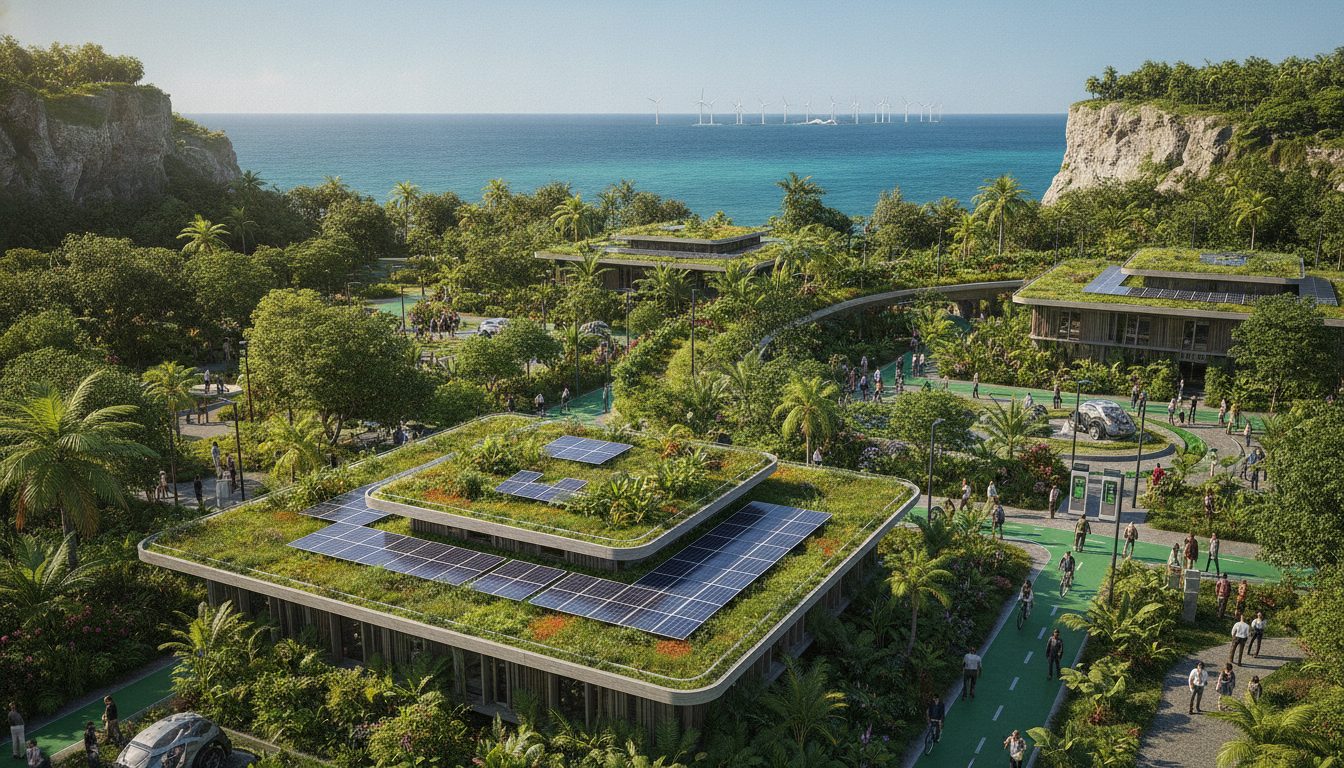
I’ve seen many coastal cities facing the challenge of rising seas. But nothing could prepare me for Suva’s vision for 2050. It’s not just another story about adapting to climate change.
It’s a new way of thinking about what an island capital can be. Standing on the peninsula today, it’s hard to imagine the change. The plans show a city that doesn’t just survive but thrives as a carbon-negative oceanic hub.
What really caught my attention was the unique approach of Suva’s planners. They’re not copying from Singapore or Copenhagen. Instead, they’re blending Fijian traditions with modern environmental science. This article will dive into the ocean-driven technologies, ways to preserve heritage, and renewable energy systems that are changing this tropical capital.
From coral reefs to floating solar arrays, I’ll show you the innovations changing Suva. This journey shows how a small island nation is leading the way in coastal resilience. Cities around the world will learn from Suva for years to come.
Key Takeaways
- Pacific maritime urbanism combines traditional Fijian heritage with advanced environmental science to create unique climate solutions
- Suva aims to become the world’s first carbon-negative tropical capital by 2050 through ocean-driven innovation
- Engineered coral reef defense barriers protect against rising seas while supporting marine ecosystems
- Net-zero infrastructure includes floating solar arrays, rainwater cooling systems, and timber-composite architecture
- The city’s transformation provides a replicable blueprint for coastal resilience in island nations globally
- Ocean-driven technologies harness marine resources to power renewable energy systems throughout the capital
The Pacific’s Answer to Climate Catastrophe: Suva’s Carbon-Negative Metamorphosis
Most coastal cities build walls against the ocean. But Suva took a different path. It turned rising seas into a solution. I found it hard to believe at first. How could a city remove more carbon from the atmosphere than it produces?
Then, I saw the bigger picture. Suva faces threats that could erase its culture. Sea levels rise, and storms get stronger. These dangers threaten neighborhoods.
But Suva’s plan is unique. Instead of walls, it protects every inch of the peninsula. It aims to be a climate solution, not a problem.
Young leaders in the Pacific are leading this change. Gerdi Raimon from Kiribati wants communities to thrive by 2050. Pita Loloma from Fiji says island capital resilience comes from marine resources, not fighting them.
What’s groundbreaking about Suva is how everything works together. Energy, water, buildings, and more are integrated. Engineers say isolation doesn’t work. You need a holistic approach.
The ocean is both a threat and a source of energy for Suva. It provides constant power and sunlight. Even the rain that floods streets is harnessed for cooling systems.
Reaching net-zero by 2050 requires coordinated demand and massive investment.
The genius of net-zero urban planning in Suva is its use of nature. Coral reefs and mangrove forests protect the shorelines. They grow stronger and sequester carbon.
This shows Pacific climate leadership in surprising ways. Small island nations are innovators, not victims. They create blueprints for the world.
I learned something profound about Suva’s transformation. It’s not just small steps. It’s a complete change. The city is using Pacific wisdom and advanced engineering to solve big problems.
The goal of being carbon-negative means changing everything at once. Buildings that breathe, marine renewables for transport, and more. It’s a big challenge, but it works.
What started as a desperate response to climate change has become a model for cities worldwide. Suva isn’t just adapting; it’s fighting back. It shows that island capital resilience and growth can go hand in hand.
Living Seawalls: How Engineered Coral and Bio-Mangrove Barriers Redefine Coastal Defense
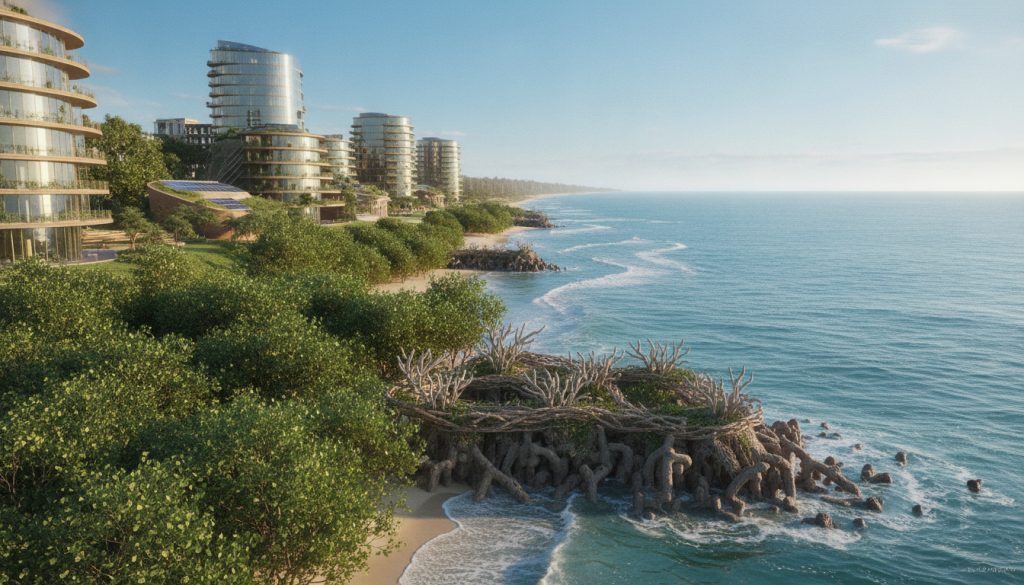
Most coastal cities use concrete and steel to fight the ocean. But Suva is doing something different. It’s working with marine life to create regenerative coastal infrastructure. This includes bio-mangrove wave barriers and coral reefs that get stronger over time.
These living coastal defense systems grow more effective each year. They don’t need to be replaced like traditional seawalls. Instead, they adapt naturally to rising seas.
This nature-based engineering is a big change for island nations. Traditional barriers can’t keep up with ocean forces. But Suva’s approach works with marine ecosystems, creating defenses that improve continuously.
Coral Reef Matrices as Regenerative Wave Attenuation Infrastructure
The offshore part of Suva’s defense uses engineered coral reef matrices. These aren’t just coral plantings. Scientists pick specific coral species for their coral wave attenuation and storm resistance.
Marine biologists grow coral polyps in underwater nurseries. Then, they transplant them onto substrates. These structures break wave energy more effectively than flat barriers.
These reefs also pull carbon dioxide from seawater. They build calcium carbonate skeletons. This makes regenerative reef infrastructure carbon-negative, fighting climate change.
The economic benefits are significant. While initial costs are higher, these reefs don’t need constant repairs. They actually get stronger each year.
Engineers use wave modeling and tidal patterns to place the reef segments. Each segment supports thousands of coral colonies. This biodiversity ensures the system’s resilience.
Bio-Mangrove Wave Barriers: Nature-Based Engineering Across Suva Harbour
Along the harbor, Suva has bio-engineered shoreline with mangrove forests. These aren’t just wild mangroves. Engineers plant specific species to maximize wave dampening.
I walked through these bio-mangrove wave barriers with a botanist. They explained the layering strategy. Taller Rhizophora species form the seaward edge, with prop roots creating initial resistance.
Behind them, Bruguiera species absorb more wave energy. Landward, Avicennia species stabilize sediments. The root networks slow water velocity during storm surge, gradually dissipating energy.
The root networks create remarkable defensive structures. Dense, interlocking roots slow water velocity during storm surge. This reduces coastal erosion while building land through sediment capture.
Beyond mangrove coastal protection, these forests provide more services. They serve as nursery habitat for fish species, supporting local food security. They filter pollutants from runoff and sequester massive amounts of carbon.
Engineers monitor growth rates and adjust plantings based on performance data. Fast-growing sections receive targeted maintenance. Areas experiencing erosion get supplemental plantings.
| Defense System | Wave Reduction | Lifespan Performance | Carbon Impact | Maintenance Cycle |
|---|---|---|---|---|
| Traditional Concrete Seawall | 40-50% initial reduction | Degrades 2-3% annually | High embodied carbon, no sequestration | Major repairs every 8-12 years |
| Engineered Coral Reef Matrices | 60-70% reduction when mature | Strengthens 3-5% annually | Carbon-negative through active sequestration | Minimal intervention after establishment |
| Bio-Mangrove Wave Barriers | 50-65% surge reduction | Improves continuously with growth | Massive carbon storage in biomass and sediment | Selective thinning and supplemental planting |
| Combined Reef-Mangrove System | 85-95% total wave energy reduction | Synergistic strengthening over time | Compound carbon sequestration effects | Ecosystem-based adaptive management |
Storm Resilience Through Biological Architecture
The true test of any coastal defense system is during extreme weather. Suva’s layered biological storm defense strategy provides redundant protection. This is something traditional infrastructure can’t match.
Offshore engineered coral reef matrices break initial wave energy. As surge moves toward shore, it encounters shallower reef sections that continue energy dissipation. By the time waves reach the mangrove barriers, their force has already been reduced by 60-70%.
The tropical storm barriers formed by mangrove forests absorb remaining surge energy. Unlike rigid structures, mangroves bend with storm forces, then recover afterward. This flexibility creates resilient coastal architecture that adapts rather than breaks.
The final layer integrates with urban infrastructure through stadium porous asphalt stormwater drainage systems. These permeable surfaces capture overflow that penetrates the biological barriers. This prevents urban flooding even during extreme rainfall events that accompany cyclones.
What makes this cyclone-resistant infrastructure revolutionary is its self-repair capability. After storms pass, coral polyps regenerate damaged sections. Mangroves sprout new growth from damaged trunks. Within months, the Suva Harbour defense system returns to full strength without human intervention or repair budgets.
Engineers monitor system performance using wave sensors and tidal gauges. This data feeds into predictive models that forecast performance under various sea-level rise scenarios. The models show that as oceans rise, the biological systems grow upward and seaward naturally, maintaining protective capacity without expensive retrofitting.
I left Suva’s waterfront convinced that this approach represents the future of coastal protection. Cities worldwide spend billions maintaining static defenses that fight losing battles against rising seas. Suva’s regenerative coastal infrastructure works with natural processes, creating protection that improves over time rather than crumbling. It’s not just smarter engineering—it’s a complete reimagining of how humans can live alongside the ocean.
Heritage Meets Nanotechnology: Preserving Suva’s Colonial Soul with Molecular Precision
I thought Suva’s old buildings would become museums or be lost to climate change. But nanotechnology is changing that story. Walking through the heritage area, I saw buildings that looked like they were stuck in time. Yet, engineers told me these buildings are now carbon-neutral.
The secret is subsurface hydrologic heritage engineering and molecular treatments. These treatments keep every architectural detail while improving performance.
This approach feels magical. You can’t see the technology, but it’s there, protecting these buildings for centuries. It’s not about demolishing the past—it’s about upgrading it at the molecular level while keeping its soul.
Molecular Shield Technology for Historic Facades
The Grand Pacific Hotel preservation project showed me what’s possible. This 1914 landmark was destined for maintenance battles against humidity and salt air. Instead, engineers applied breathable nano-coating that’s invisible but revolutionary.
I watched technicians work on the hotel’s limestone walls. The application looked like simple painting, but each brushstroke deposited billions of molecules. This breathable stone technology creates a permanent protective layer that allows moisture vapor to escape.
The results are stunning. Interior humidity regulation happens naturally, cutting cooling loads by 30% without mechanical systems. The limestone facades will outlast their original lifespan by centuries, all while looking exactly as they did in 1914.
Below ground, the transformation continues through moisture-control technology that previous generations never imagined. Engineered drainage fields capture and redirect groundwater that historically caused foundation deterioration. These subsurface systems don’t just protect—they harvest water for greywater applications, turning a maintenance problem into a resource stream.
Engineering Wind and Shade for Zero-Energy Comfort
The roofline renovations taught me that traditional design often contained genius we’ve only recently learned to measure. The Grand Pacific’s new timber-composite roofing replicates the original high-pitched colonial design perfectly, but uses engineered wood products laminated with bio-resins. These materials are lighter, stronger, and more durable than old-growth timber while remaining completely biodegradable at end-of-life.
But here’s what fascinated me most: those steep roof pitches aren’t just aesthetic choices. Engineers have calculated exact overhang depths, ridge vent placements, and soffit designs that create natural cross-ventilation patterns reducing mechanical cooling needs by up to 60%. Standing inside, I felt cool air moving through spaces in ways that seemed almost orchestrated.
The tropical climate architecture principles embedded in these retrofits draw from both traditional Fijian building wisdom and modern computational fluid dynamics. Air enters through lower vents, rises as it warms, and exits through carefully positioned ridge openings. The result? Constant air movement without a single fan running.
These passive cooling systems work around the clock, powered only by temperature differentials and prevailing breezes. I spent an afternoon in the hotel lobby during peak heat—it was genuinely comfortable, with ceiling fans turning lazily overhead more for ambiance than necessity. The building itself had become a climate control machine.
| Heritage Retrofit Element | Traditional Approach | Nano-Enhanced Solution | Performance Improvement |
|---|---|---|---|
| Exterior Stone Protection | Silicone sealers applied every 3-5 years | Breathable nano-molecular glaze (permanent bond) | 300% longer facade lifespan, 30% cooling reduction |
| Foundation Moisture Management | Surface drainage and periodic repairs | Subsurface hydrologic capture networks | Zero foundation degradation, 15,000L/month water harvest |
| Roof Ventilation Systems | Mechanical fans and air conditioning | Precision-engineered passive airflow design | 60% reduction in mechanical cooling demand |
| Roofing Materials | Old-growth timber replacement every 25 years | Bio-resin timber composites | 50-year lifespan, 100% biodegradable, 40% lighter |
What struck me most powerfully was the invisibility of transformation. Walking through these heritage buildings, you’d swear nothing had changed—the creaking floorboards, the proportions of rooms, the play of light through shuttered windows all feel authentically colonial. Yet beneath that preservation lies some of the most advanced building science on the planet.
The heritage building retrofit approach proves that sustainability doesn’t require erasing history. Instead, it can extend architectural legacies indefinitely while achieving carbon-neutral performance. Standing in the Grand Pacific’s lobby, surrounded by a century of stories and equipped with molecular-scale protection, I felt the past and future reconciled.
The Oceanic Energy Grid: Powering Suva Fiji Future 2050 with Marine Renewables
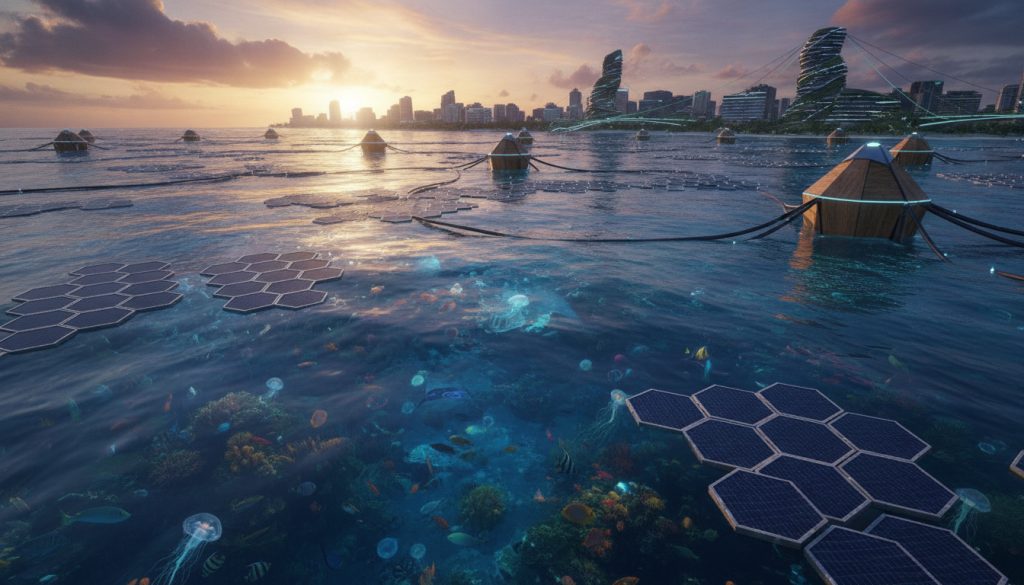
When I first saw the plans for Suva’s renewable energy, I was amazed. The harbor will soon be powered by the ocean alone. No need for fossil fuels or imported energy.
The sun and sea will work together in a smart grid. This grid will power everything from the port to ships.
This change is a big win for island nations. It solves the problem of energy security. The teams designing this system are full of enthusiasm.
They’re not just building a power plant. They’re creating a new way for coastal cities to use marine energy.
Floating Marine Solar Arrays: Harnessing Equatorial Sunlight at Sea
Large floating solar arrays will cover parts of Suva Harbour. They’re placed carefully to avoid ships and marine life. These panels are huge, like football fields, and are made for the sea.
The engineering is impressive. Each platform adjusts to the waves, keeping panels at the best angle. Suva’s location means lots of sun all year. Being on water also cools the panels, making them 10-15% more efficient.
Using the sea for solar makes sense for Suva. There’s little flat land for solar farms. By putting solar panels on water, the city saves land and gets more sun power.
Deep-Water Thermal Loops: Mining Temperature Gradients for Constant Power
Offshore, Suva is setting up a system that’s new to many. It uses the difference in water temperature between the surface and deep water. This creates a steady power source.
Surface water is warm, while deep water is cold. This temperature difference powers turbines. Cold water is then cooled and goes back down.
This system is reliable. Unlike solar and wind, it works all the time. It makes the grid very stable. This means no need for diesel generators, which are common in other island systems.
| Energy Technology | Power Output Consistency | Marine Environment Impact | Operational Lifespan |
|---|---|---|---|
| Floating Solar Arrays | Daylight dependent (12-14 hours daily) | Minimal with proper placement | 25-30 years |
| OTEC Thermal Loops | Continuous 24/7 baseload | Nutrient circulation benefits | 40+ years |
| Combined Grid System | 100% renewable stability | Habitat enhancement zones | Modular replacement cycle |
| Traditional Diesel Generators | On-demand but carbon-intensive | Pollution and spill risks | 15-20 years |
Electrified Pacific Shipping Fleet and Maritime Grid Integration
The grid is connected to the port, making things efficient. Suva makes its own green hydrogen. This is done by using extra electricity from solar and OTEC systems.
This green hydrogen powers ships and port equipment. It’s a closed-loop system. The harbor exports clean energy across the Pacific.
Shipping needs a lot of green hydrogen by 2050. It needs $2-3 trillion in new infrastructure. Without demand from shipping, and without fuel from ports, it’s a problem.
Suva solves this by controlling energy and shipping demand. China is already making green ammonia for ships. Pacific ports are becoming green hubs, with Suva leading the way.
I saw how ships get hydrogen fuel systems. The plan is to make all ships green soon. This keeps Suva’s port competitive as rules get stricter.
Walking the docks at sunset, I saw the excitement. This isn’t just tech—it’s a working model. Suva’s future runs on the ocean, turning isolation into energy wealth.
Capturing the Sky: Subsurface Hydrologic Engineering and Closed-Loop Reservoir Stormwater Harvesting
The tropical storm hit Suva with incredible force, yet the streets were dry in minutes. This was not luck, but engineering genius. I watched as a storm that would flood most cities disappeared into the pavement.
Suva gets over 3000 millimeters of rain each year, in violent downpours. But by 2050, Suva treats every drop as precious. The city turned its biggest weather threat into its most valuable resource through advanced systems.
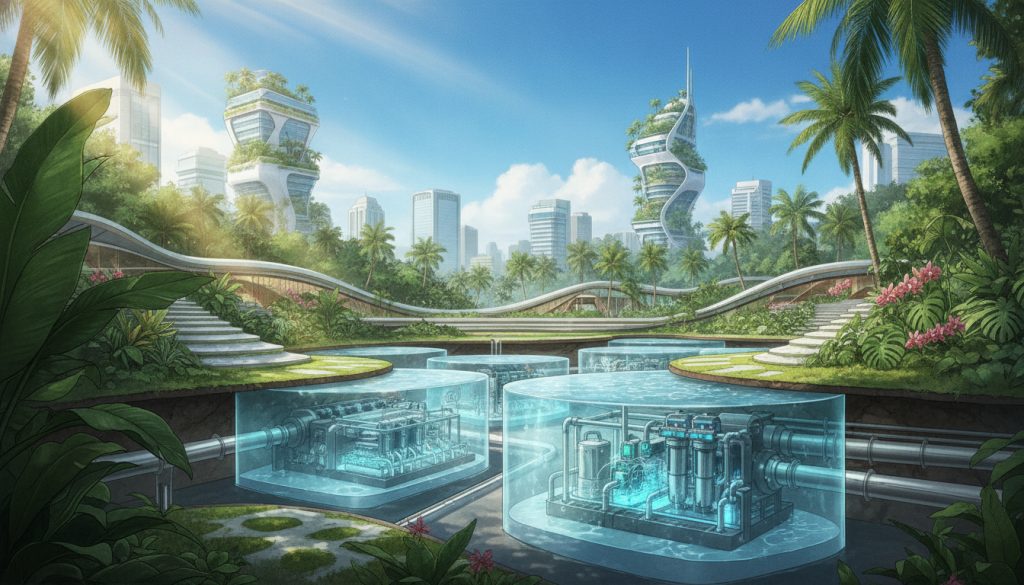
Under Suva’s streets lies a sophisticated closed loop reservoir stormwater harvesting network. It’s not just better drainage—it’s a complete reimagining of urban water cycles. This system captures, stores, filters, and repurposes 100% of seasonal rainfall.
100% Seasonal Rainfall Capture Through Subsurface Vault Networks
I went thirty feet underground to see a water cathedral. These subsurface vault networks are massive chambers under parks and roadways. They’re not simple tanks but geological formations designed with precision.
Each vault has permeable membranes for controlled soil interaction and contamination prevention. The scale is huge—some chambers are as long as football fields. During heavy rains, water enters through thousands of intake points across the city.
The system captures 100% seasonal rainfall harvesting. Every drop that falls on managed surfaces gets captured, filtered, and stored. Engineers showed me monitoring stations tracking water flow during storms, and the efficiency is remarkable.
These underground vault systems aren’t just storage—they’re active filtration and distribution hubs. They use biochar and mineral beds for natural filtration, purifying rainwater to drinking standards. The subsurface water storage capacity handles extreme weather without overflow.
Stadium Porous Asphalt Stormwater Drainage Integration
Walking on what looked like normal pavement, I saw water flowing through it at gallons per second. The stadium porous asphalt stormwater drainage systems replace traditional surfaces with high-tech alternatives.
This asphalt appears like regular pavement but allows water to flow through. Underneath lies stone beds directing flow toward vault networks. During a massive storm, water vanished within seconds.
The permeable pavement systems work across various areas. They’re impressive around the national stadium, capturing rainfall from fields and spectator areas. This integrated urban drainage eliminates flooding while recharging underground storage.
This flood prevention infrastructure has a dual purpose. During dry periods, it regulates underground temperature zones. During storms, it becomes a high-capacity intake system feeding vault networks.
Zero-Emission District Cooling from Filtered Stormwater
Here’s where Suva’s water revolution gets mind-blowing. Captured rainfall doesn’t just sit underground—it powers cooling systems without using electricity. I toured the district cooling networks that changed how Suva handles heat.
Cold seawater is pumped through filtration vaults, chilling stored rainwater. This cold water circulates through insulated pipes to buildings, absorbing heat before returning to exchange thermal energy. It’s zero-emission district cooling that slashes electricity demand by nearly 70% compared to traditional air conditioning.
The filtered stormwater systems create a continuous cycle. Rainfall flows to capture, then storage, then filtration, then cooling, then heat exchange, and discharge. Minimal losses occur, and zero energy inputs are needed beyond passive pumping.
Standing in underground vaults, I saw crystalline water flow through natural filter beds while maintaining perfect temperature zones. This is infrastructure that works with Suva’s tropical climate instead of fighting it. The integrated approach mirrors what organizations like NOAA discovered in their decarbonization efforts—systems thinking creates synergistic benefits far exceeding isolated improvements.
I met with the chief hydrologist who explained something profound: “We stopped seeing rain as a problem and started seeing it as free air conditioning delivered from the sky.” This mindset shift, combined with brilliant engineering, turned seasonal deluges from devastating floods into the power source for sustainable cooling.
The economic impact is equally impressive. Buildings connected to the zero-emission cooling network save thousands annually on electricity. The city avoided billions in flood damage infrastructure. And water security improved dramatically—those underground vaults hold enough purified water to supply the entire city for months during dry periods.
This is closed loop reservoir stormwater harvesting at its finest—capturing every raindrop, filtering it naturally, using it for cooling, and cycling it endlessly without waste. Suva proved that with creative engineering, your biggest climate challenge can become your greatest resource.
Best places to visit in Oceania.
Vertical Biophilic Architecture: Fusing Fijian Heritage with Space-Age Environmental Physics
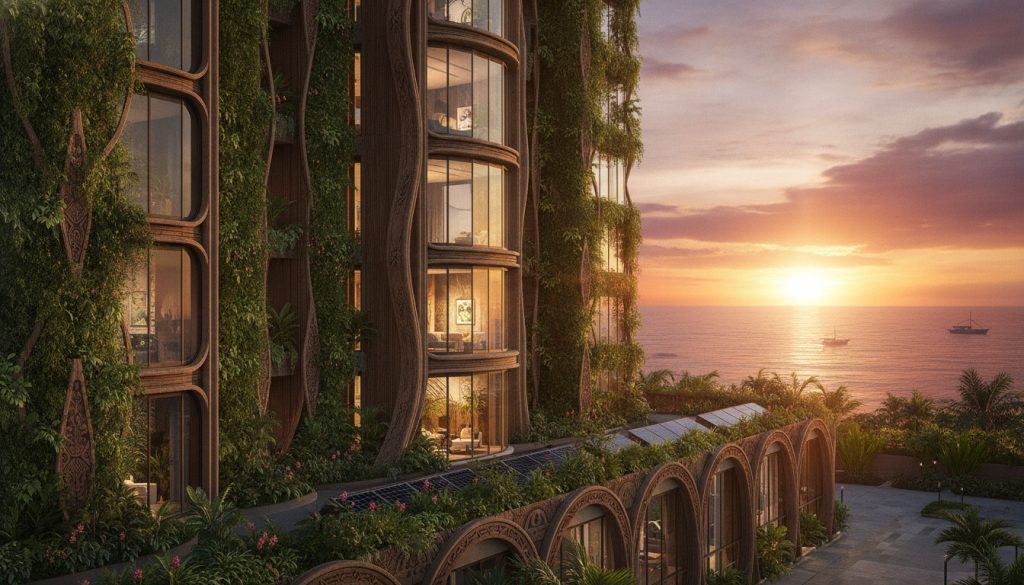
I was deeply moved when I first saw Suva’s new building facades. They look alive, breathing and adapting to their surroundings. Unlike most modern buildings, these structures are part of the environment, not just standing in it.
These buildings are vertical biophilic architecture carbon neutral and deeply rooted in Fijian culture. Walking by, it feels like walking through a vertical forest. The plants on the walls create cool spots without needing air conditioning.
Architects combined old wisdom with new tech to create something amazing. This approach is more effective than either one alone. Suva’s buildings show how this works beautifully.
Carbon Neutral Building Envelopes and Living Green Infrastructure
The building envelopes are a marvel, with carbon-neutral or even carbon-negative footprints. Every material choice is made with the environment in mind. This turns building into a positive force for the planet.
I looked closely at the materials used. The frames are made of fast-growing bamboo, which stores a lot of carbon. The walls are made from compressed waste and recycled fibers. The insulation is from coconut coir and recycled textiles.
The living green infrastructure on these buildings does many things at once. The walls are covered in plants that insulate, purify the air, and absorb rainwater. These systems also create habitats for urban wildlife and help the environment.
Bio-composite materials are key to this carbon-negative construction. These buildings regulate temperature better than traditional ones and can withstand strong winds and earthquakes. They work because they can move and adapt, not because they resist.
Inside these buildings, you see a new kind of architecture. There’s plenty of natural light and fresh air. Water features and plants add to the peaceful atmosphere.
These buildings connect you to the outdoors in every room. Research shows that this improves wellbeing and cuts energy use. They’re not just green; they’re a statement about living in harmony with nature.
Traditional Fijian Design Principles in Modern Carbon-Negative Construction
What impresses me most is how these buildings respect traditional Fijian architecture. They have open plans and minimal walls, just like ancient Fijian homes. This design lets in natural air and creates flexible spaces.
The buildings have wide eaves, just like old Fijian homes. These provide shade and rain protection while creating outdoor spaces. The Fijian heritage design isn’t just about looks; it’s about environmental wisdom passed down through generations.
The buildings are built on raised floors to cool the air and protect against floods. This is a lesson from ancient Pacific builders that modern engineering is now catching up on. The architects used traditional techniques and patterns in their designs.
The buildings use modern materials in a way that honors tradition. They are strong and flexible, thanks to tensile cables and compression members. This shows how cultural design integration can lead to better buildings.
The table below shows how traditional Fijian elements are used in modern buildings:
| Traditional Fijian Element | Modern Application | Environmental Benefit | Cultural Significance |
|---|---|---|---|
| Bure open-plan design | Minimal interior walls with flexible spaces | Natural cross-ventilation reduces cooling needs by 60% | Preserves communal gathering traditions |
| Extended thatched eaves | Deep overhangs with living green roofs | Shade lowers surface temperatures 8-12°C | Maintains traditional silhouette and gathering spaces |
| Elevated post foundations | Raised floors with airflow channels | Improves cooling while managing flood risk | Honors ancestral storm-adaptation wisdom |
| Natural fiber lashing systems | Tensile cable networks with flex joints | Cyclone resistance through movement vs. rigidity | Translates traditional engineering into modern materials |
The indigenous building wisdom in these structures is profound. Pacific islanders developed architectural solutions for tropical climates over thousands of years. Modern science confirms what traditional builders knew intuitively—that working with natural systems produces better results.
I saw construction teams using carbon-negative materials in a way that honors tradition and innovation. This process connects younger Fijians with their ancestors while showing the relevance of traditional knowledge. It’s not about nostalgia; it’s about recognizing the value of Pacific island building wisdom.
The green infrastructure systems in these buildings work on principles that Pacific islanders understood deeply. They use natural cooling, shade, and water harvesting. These aren’t new ideas; modern engineering just makes them possible on a larger scale.
Being inside these buildings, you feel the breeze and hear the plants. It’s clear that Suva’s buildings are not just trying to be “green.” They’re showing that Fijian architectural wisdom is better than conventional approaches.
This is more than just environmental performance; it’s a cultural affirmation. Suva’s buildings prove that combining traditional design with modern materials and engineering is the future of sustainable architecture. It’s not about abandoning cultural heritage but embracing and amplifying it.
Conclusion: Suva’s Ocean-Driven Blueprint for Island Capital Longevity
My research on Suva’s transformation surprised me. This Pacific capital isn’t just fighting climate change. It’s creating solutions that other coastal cities can follow.
The way Suva combines different ideas impressed me. Living seawalls get stronger every year. Heritage buildings get hidden protection. Marine energy powers areas. Rainfall cools without pollution. Each part helps the others.
I kept thinking about the young voices at the Pacific Islands Forum. They dream of thriving communities by 2050. Suva’s plan shows it’s possible with real engineering.
What gets me excited is how accessible these solutions are. You don’t need advanced tech to make them work. Ocean-driven sustainability mixes science with Pacific traditions. Ideas like floating solar arrays and coral matrices can be used anywhere.
The key is to work with the ocean, not against it. Pacific climate leadership comes from respecting nature while using its power. Cities like Manila, Lagos, and Miami face similar challenges. Suva’s approach gives them hope.
By 2050, Suva wants to show the world a different future. It’s about using creativity, cultural wisdom, and ocean respect. The future isn’t just survival. It’s about growing stronger by embracing the ocean.

Leave A Comment