

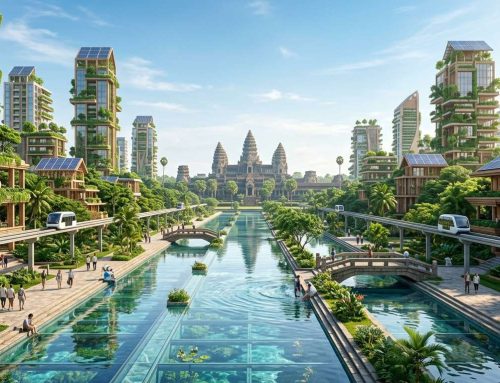
I used to doubt futuristic city plans that never came to life. But in May 2026, something changed in western District 24. 14,000 households moved into Tengah forest town Singapore. This place is special because cars go underground and nature takes over the streets.
This isn’t just another dream city. It’s a real test of what cities can be like without cars. Seeing real people moving in made me believe it’s possible.
The underground tunnels and green paths make it a productivity sanctuary. It’s like a place where you can focus and stay fit. While other cities talk about 15-minute neighborhoods, this smart eco-town has already made it a reality.
This district sees sustainability as essential, not just a nice-to-have. What I learned changed how I see the future of cities.
Key Takeaways
- 14,000 households already live in this smart district as of May 2026—not a future concept
- Cars operate exclusively in underground tunnels, freeing surface space for biophilic design
- The Jurong Region Line will connect multiple MRT stations for seamless car-free mobility
- District cooling and green infrastructure form the foundation, not optional add-ons
- The design creates an unintended productivity environment ideal for deep work and fitness
- This living laboratory demonstrates the 15-minute city model American planners claim is impossible
- Real resident experiences validate the concept beyond promotional materials
Why Tengah Forest Town Singapore Is the Urban Model America Refuses to Build
American cities grew by spreading out, while Singapore showed us a better way. It’s not about having more resources or land. It’s about choosing to make cities better for people.
I grew up in suburbs where driving was the only way to get around. Everything needed a car. But when I looked into other cities, Singapore’s approach really caught my eye.
The Suburban Sprawl Crisis and the 15-Minute City Alternative
The 15-minute city in Tengah isn’t just a dream. It’s real. Places like Parc Point show how easy it is to get what you need without driving.
This is the opposite of what we do in America. Instead of separating homes from shops by miles, Tengah puts them close together.
Residents can easily get to big shopping areas like Westgate and JEM. Future areas will have even more shops and services right in the neighborhood.
Being dependent on cars isn’t freedom. It’s a big cost in time, money, and stress, hitting the hardest those who can least afford it.
Car ownership costs American families about $10,000 a year. Tengah makes it unnecessary for daily needs. You gain hours of your life back.
Walking to get things done improves health. It makes exercise a part of daily life, not something you have to plan.
What Singapore Understood That American Planners Missed
Singapore saw that cars make things unfair. Without a car, you’re left out in America’s suburbs.
In America, people fight against mixed-use development. They worry it will take away parking. This shows a deep love for car-centric design.
But Singapore shows that designing for people first doesn’t lead to chaos. It leads to higher property values, better health, and safer communities.
American cities keep making the same mistake. We separate homes from jobs, then build highways to connect them. Then, we complain about the traffic we created.
Tengah does it differently. It mixes work, living, and fun together. This cuts down on travel time and makes life better.
| Urban Design Element | American Suburban Model | Tengah 15-Minute City |
|---|---|---|
| Daily Grocery Access | 5-15 minute drive required | 5-10 minute walk to neighborhood centers |
| School Transportation | Bus or car dependency | Safe walking routes within district |
| Recreation Access | Isolated parks requiring transport | Integrated greenways and forest corridors |
| Community Interaction | Limited due to isolation | Enhanced through walkable shared spaces |
The issue isn’t that the 15-minute city can’t work in America. It’s that we think it can’t, even though cities worldwide prove it works better.
American exceptionalism turns into isolation when we ignore successful models from abroad. Tengah isn’t a dream. It’s a real neighborhood where 14,000 people live, showing us how to make cities better.
The real question isn’t if this model could work in America. It’s why we keep choosing sprawl when better options exist and work today.
The 2026 Reality Check: Tengah’s Living Laboratory Is Already Operational

When I first heard about Tengah forest town 2050, I thought it was just another dream. Many cities promise to be green and smart but never are. Masdar City in Abu Dhabi and Saudi Arabia’s The Line are examples of this.
Tengah is different, and the proof came in May 2026.
By then, I stopped doubting and started paying attention. The numbers show that people are living in these homes.
14,000 Smart Residences Delivered and Occupied
By May 2026, 14,000 smart residences in Tengah forest town 2050 were home to real people. Not just for show, but for everyday living.
This makes Tengah stand out from other failed smart city projects. It’s a place where everything promised is being tested.
Tengah Garden Residences, by Hong Leong Group, CSC Land Group, and GuocoLand, is just one part of this change. It has 860 residential units with green spaces and lifestyle areas. But it’s more than just one project.
Urban planning experts have visited Tengah many times. They say it’s a living laboratory, not just a showplace. This is a big difference.
Demonstration projects show what could be with unlimited money. Living labs test if it works with real people. They check if district cooling works on hot days and if smart homes really save energy.
These questions are being answered with data from 14,000 occupied homes.
Parc Point and the Functional 15-Minute City Hub
I was skeptical about the 15-minute city idea at first. It sounds good in theory but is hard to achieve. American cities have tried but failed to make walkable neighborhoods.
Then I looked at Parc Point.
Parc Point is real, not just a promise. It’s a true 15-minute hub with shops, restaurants, and healthcare. People can walk to get what they need, without driving.
The Jurong Region Line won’t open until 2027. But Parc Point shows that car-free living is possible now. People are already living without cars.
This is where smart grid housing 2050 systems prove their worth. They manage energy, waste, and water in real life. The technology is part of daily life, not just a theory.
This is different from American mixed-use developments that claim to be walkable but aren’t. Tengah was designed to eliminate car use, not just reduce it. Parc Point shows this approach works.
Why This Isn’t Vaporware Like Most Smart City Promises
Many smart city announcements have failed to deliver. Dozens of them have turned into nothing. Governments promise, developers show off, and then nothing happens.
Tengah avoided this by focusing on real people, not just publicity.
The developers didn’t wait for everything to be perfect before moving people in. They started with functional neighborhoods and kept building. This approach kept the project moving forward.
Real people living in Tengah means real problems show up fast. If something doesn’t work, people complain. This leads to constant improvement, not just perfect plans.
The data from Tengah isn’t made-up. It comes from real homes facing real challenges. Urban planners can see how people use the city and how it works in practice.
Tengah is different from other smart city projects. It’s not just a promise of the future. It’s a living laboratory that proves other cities can do the same.
Western cities doubt that car-free design can work. They think district cooling is too expensive. But Tengah shows that it’s possible with 14,000 homes and working infrastructure.
The smart grid housing 2050 systems in Tengah are not just ideas. They’re working, tested, and getting better every day. This makes Tengah important for cities around the world.
It’s a real-life example of how cities can work at scale. And it’s happening every day, thanks to the people living there.
District Cooling: The Unsexy Innovation That Solves the Climate Crisis

When I first learned about Tengah’s cooling system, I nearly skipped over it. I was excited to read about the vertical farms and autonomous transport. But, chilled water infrastructure doesn’t exactly get the blood pumping. The more I researched, the more I realized this might be the single most transformative climate technology that nobody’s celebrating.
Here’s the problem we don’t talk about enough: traditional air conditioning is an environmental catastrophe hiding in plain sight. Every building runs its own cooling unit, cycling inefficiently, dumping heat into streets that then require even more cooling. It’s a death spiral that turns cities into heat islands.
Tengah’s approach flips this entire model on its head. And it’s already working.
Treating Air Conditioning as Centralized Infrastructure
I grew up thinking of air conditioning like I thought of kitchen appliances—something every household manages independently. Tengah forced me to question that assumption entirely.
What if we treated cooling the same way we treat water and electricity? Not as thousands of individual consumer choices, but as centralized infrastructure managed at utility scale. That’s exactly what the district cooling and heating system at Tengah accomplishes.
Instead of 14,000 separate air conditioning units competing for efficiency, the entire town receives chilled water from a central plant. The system distributes cooled water through underground pipes to every residence and commercial building. Individual units then use this chilled water for climate control.
The beauty of centralized residential cooling isn’t just efficiency—it’s systematic optimization. A single large-scale facility can employ technologies and processes that would never be cost-effective at individual building scale.
“District cooling systems represent a paradigm shift in how we approach thermal comfort in tropical climates, moving from fragmented individual solutions to integrated utility-scale infrastructure.”
Keppel’s Utility-Scale System and the 30% Energy Reduction
Keppel Infrastructure runs the Tengah cooling measures through a system that achieves something remarkable: 30% energy reduction compared to conventional air conditioning. That’s not a marginal improvement. That’s structural transformation.
Let me break down why this matters so much. In tropical Singapore, cooling accounts for roughly 60% of a building’s energy consumption. A 30% reduction in cooling energy means an 18% reduction in total building energy use. Scale that across 14,000 homes, and you’re talking about eliminating the equivalent of thousands of tons of carbon emissions annually.
The system achieves this through several integrated approaches:
- Centralized high-efficiency chillers that outperform individual units
- Optimized load management across the entire district
- Reduced heat rejection into the urban environment
- Smart monitoring systems that adjust output based on real-time demand
Every time I’m in an American city during summer, watching thousands of AC units humming away independently, I think about this system. We’re stuck in an outdated paradigm while Singapore has already moved to the next generation of urban climate infrastructure.
| Cooling Approach | Energy Efficiency | Urban Heat Impact | Maintenance Complexity |
|---|---|---|---|
| Traditional Individual AC Units | Baseline (100%) | High heat rejection to streets | 14,000 separate maintenance points |
| Tengah District Cooling System | 70% of baseline (30% reduction) | Centralized heat management | Single utility-managed system |
| High-Efficiency Individual Units | 85-90% of baseline | Moderate heat rejection | Distributed maintenance burden |
How Tengah’s Cooling Measures Enable True Net-Zero by 2050
Here’s what I’ve come to understand about climate goals: individual behavior changes won’t get us there. More efficient individual appliances won’t get us there. We need infrastructure-level transformations that make sustainability the default, effortless option.
Tengah’s cooling infrastructure does exactly that. Residents don’t need to research the most efficient AC unit or remember to adjust thermostats constantly. The system is designed for net-zero from the ground up.
The pathway to net-zero by 2050 requires three elements working together. First, dramatic energy reduction through centralized residential cooling efficiency. Second, integration with renewable energy sources that can power the central plant. Third, smart monitoring systems that continuously optimize performance.
Tengah has all three elements operational right now, not as future promises. The 30% energy reduction shrinks the carbon footprint immediately. The centralized system makes it economically viable to power cooling from solar and other renewables at scale. And the smart monitoring ensures performance doesn’t degrade over time.
What strikes me most is how this challenges American assumptions about freedom and choice. We’re so committed to individual control—every household choosing its own cooling system—that we’ve locked ourselves into collective inefficiency. Tengah proves there’s another way.
Climate-compatible urbanism isn’t about sacrifice or lifestyle restrictions. It’s about infrastructure design that makes the sustainable choice automatic. Nobody in Tengah needs to think about whether their AC is energy-efficient. The system handles it at utility scale.
I believe when historians look back at how humanity navigated climate adaptation in tropical cities, district cooling will be recognized as one of the quiet revolutions that actually mattered. It’s not sexy. It won’t generate viral posts. But it moves the needle in ways that individual consumer choices simply cannot.
And that’s the lesson American cities keep refusing to learn from Tengah: the most important innovations often hide underground, in infrastructure that nobody photographs but everyone depends on.
Weekend getaways from Singapore.
The Subterranean Traffic Grid: What Happens When You Eliminate Cars From the Surface

Most cities focus on more cars. Tengah, on the other hand, wondered what if streets were for people only. This led to a complete change in how they think about city planning.
This change means a big shift in what cities value. Cars still move underground, but they don’t rule our lives.
I’ve seen many American downtowns filled with parking. Tengah shows us there’s a better way.
Underground Vehicle Networks That Actually Work
The Tengah car-free town center puts all car needs underground. This includes deliveries, waste, and parking.
This isn’t just about not liking cars. Emergency vehicles and deliveries still work. But now, our streets are for people, not just cars.
American cities build underground parking all the time. We can do it. But we choose to keep streets for cars instead of people.
In Tengah, there’s no line between sidewalks and streets. This makes it safe for kids to bike and for adults to jog without breathing in exhaust.
Green Infrastructure Replaces Asphalt and Parking Lots
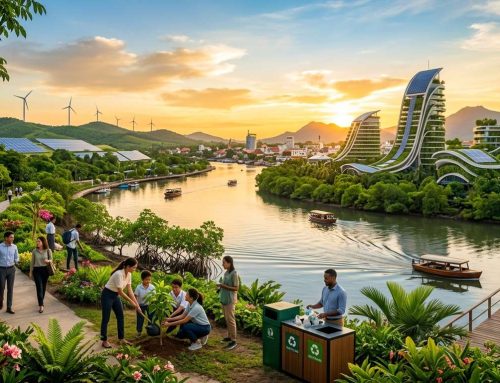
Instead of parking lots, Tengah has community gardens and forests. These areas are not just for looks.
These gardens grow food right in neighborhoods. The forests provide shade, manage water, and cool the area.
Central Park is the heart of Tengah. Forests connect it, making it easy to walk, jog, or bike.
This green network goes beyond Tengah. It connects to parks and gardens nearby, making it part of a bigger ecosystem.
I’ve seen cities in Asia and Europe do the same. It’s not about if it can be done. It’s about what we value more: cars or people.
Why American Cities Refuse This Model
The idea of people-friendly streets challenges old ways of thinking. In America, cars are seen as the main focus of city planning.
We think we have no choice but to have car-dominated streets. But Tengah shows us there’s a better way, and it works.
The main reason isn’t because it’s hard. It costs more to start, but the benefits are huge. Our streets could be places where people connect.
But American developers keep building the same way. We prioritize cars over people, then wonder why our cities feel empty.
Tengah shows what happens when we focus on people. Our streets could be beautiful paths, not just for cars.
The underground traffic system is not just about tech. It’s about what we value in our cities. Every parking lot we build shows we choose cars over community.
I’ve seen the difference in Tengah. It’s cleaner, quieter, and more welcoming than American suburbs. It shows us what we could have.
American cities have the means to do this. But we lack the will to put people first. Tengah isn’t showing us new tech. It’s showing us what we refuse to build.
Biophilic Urban Design as Performance Infrastructure

Urban planners often add a few plants to make a place “green.” But Tengah’s approach is different. It’s not just about the number of plants.
The key is continuous integration into daily life. This makes a big difference.
Tengah’s biophilic urban design is like the roads and utilities. It’s not just a nice feature. It’s a part of the city’s fabric.
Miles of Green Space You Can’t Avoid
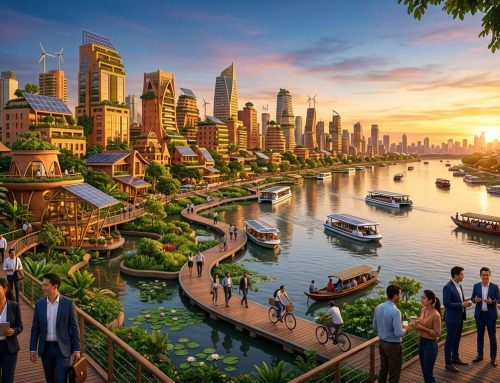
The Rainforest Walk isn’t just a park. It’s a network that connects everything. You can’t avoid it when you’re out and about.
Most cities have traffic that ruins your workout. But Tengah doesn’t. Its green corridors let you move freely without cars.
These paths are miles long and car-free. You can run, cycle, or walk without worrying about cars or pollution.
The green network goes beyond Tengah. It connects to parks and gardens outside the district. This makes outdoor activities more accessible.
Cognitive Infrastructure for Deep Focus
There’s a mental clarity aspect to Tengah’s design. It’s about creating a space for deep focus.
Walking through forests instead of sitting in traffic changes how you think. It’s not just about being green.
Studies show natural environments boost concentration. Forests, in particular, reduce stress and improve focus.
In America, getting to nature means driving on weekends. Tengah makes nature a part of daily life.
This design is a game-changer for remote workers, parents, and anyone stressed by city life. It’s not just nice; it’s a performance booster.
Training Grounds Built Into Daily Life
The greenways in Tengah are like top-notch training facilities. They’re perfect for running, cycling, and walking.
What makes them special is the lack of interruptions. No traffic lights or construction to slow you down.
These paths are the main way to get around. They’re not just for fun. They’re the backbone of the city’s movement system.
This works because the city moved its roads underground. That freed up space for nature.
- Continuous pathways without street crossings enable uninterrupted training sessions
- Forest canopy coverage reduces heat exposure during tropical midday workouts
- Community gardens and green corridors provide varied terrain for different training intensities
- Nature network connections extend training routes beyond district boundaries
For athletes, Tengah’s design is a dream come true. It’s integrated into daily life, not just for weekend runs.
The wellness corridors are more than pretty. They’re performance infrastructure that boosts health at a large scale. It’s a huge leap from the car-dependent suburbs I grew up in.
Tengah shows that biophilic urban design can be essential, not just a luxury. It prioritizes movement and mental health from the start.
Conclusion: The Tengah Standard and What It Demands From Western Cities
I spent years visiting cities across the United States. I watched planners debate car-free districts and district cooling. The Tengah plantation district just ended those debates.
This isn’t just a proposal waiting for funding. Right now, 14,000 people live in a smart infrastructure that Western cities claim is impossible. The automated waste collection system removes garbage without trucks clogging pedestrian spaces. Community clubs and neighborhood centers connect residents through integrated design rather than isolated suburban pods.
What strikes me most is how Tengah makes American infrastructure look like a choice rather than a constraint. When Singapore delivers 30% energy reduction through centralized cooling, cities choosing inefficient systems aren’t facing technical barriers. They’re revealing priorities.
The climate crisis demands net-zero pathways. Mental health research requires stress-reduced environments. Public health needs active transportation infrastructure. Tengah proves these goals work together through smart systems design.
I’m not suggesting this transformation happens overnight. Political and economic barriers in Western cities are real. But those barriers can’t hide behind uncertainty anymore. The proof exists. It’s functional. It’s housing families right now.
Western cities face a straightforward question: Why settle for inferior infrastructure when the alternative is operational? Land constraints, cultural differences, and political challenges are obstacles to navigate, not excuses to accept sprawl and energy waste.
The Tengah standard is the new baseline. Western cities need to match it or explain why they’re choosing less.




Leave A Comment