
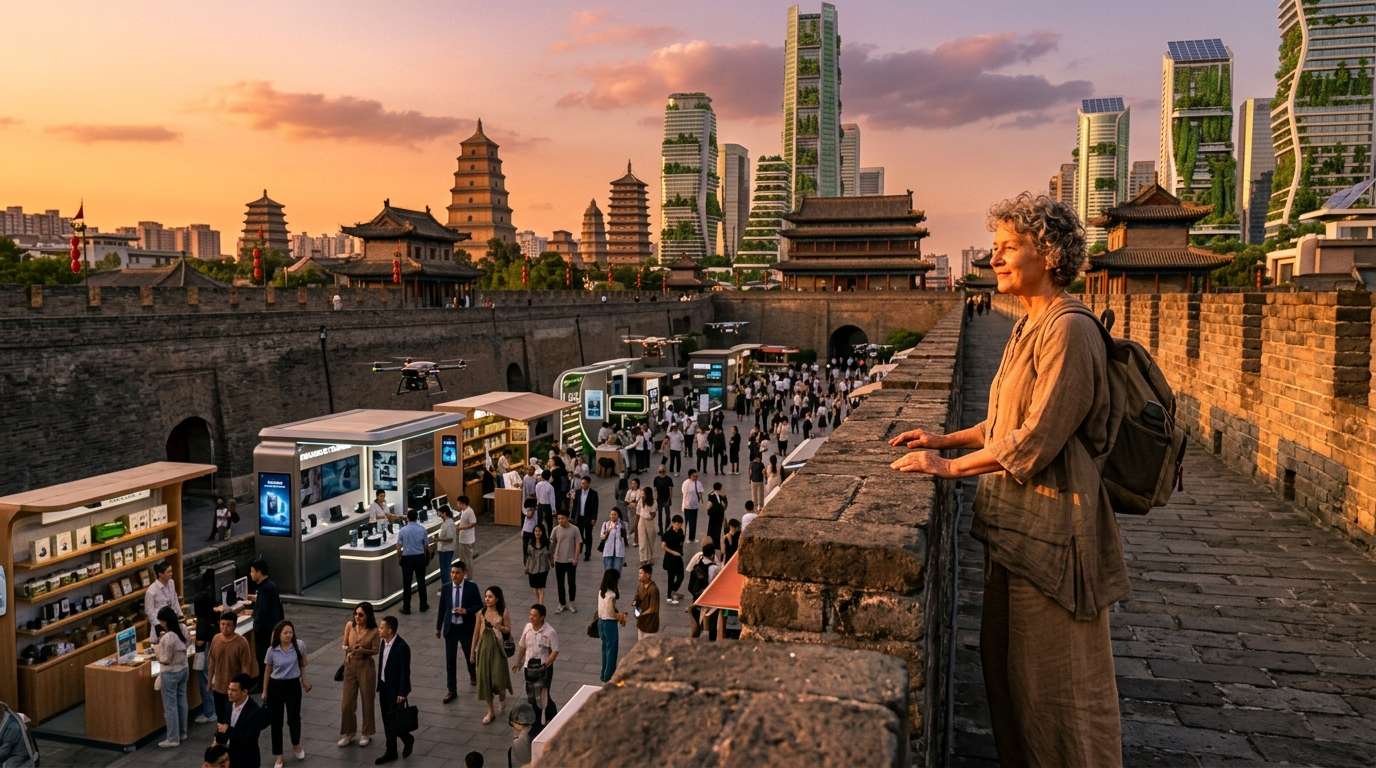
From the rampart, I looked down at a busy street and asked what this place needs to survive another 25 years. The Xian ancient city future 2050 is my pencil sketch of an answer. I was standing on bricks about 600 years old, and the traffic below felt very young.
This piece covers the wall, the water, the energy and a practical plan for a visit. It also looks at how the Tang Dynasty capital might shape daily life here, from the Wei River plain to the gates.
The 2050 parts are a vision built on real technology and real facts about the wall today. None of it exists yet. I will keep the real and the imagined clearly apart as we go.
Key Takeaways
- The 2050 vision treats the 13.7 km wall and nearby Silk Road sites as one self-powered heritage zone.
- The plan keeps old brick and patina instead of replacing them.
- Water vaults, breathable glazes and footstep power are the three main ideas.
- Global net-zero numbers show direction, not a forecast for Xi’an.
- Every clever system can fail, so simple fixes still matter.
- A trip today is easy by train: under six hours from Beijing.
Where Xi’an Stands Today Before the 2050 Picture
Xi’an is home to about 13.24 million people, 10.72 million of them urban. That is the estimate for the end of 2025. It makes Xi’an a very large city to wrap around a walled core.
The city sits on the Wei River in central China. It was a terminus of the main Silk Road trade route to the Middle East and the Mediterranean. Xi’an is also the second most popular tourist destination in China, behind only Beijing.
A city this size puts steady pressure on a historic core. Traffic, tour groups and new buildings all compete for the same few streets. Heat, dust and heavy rain add their own wear.
Much of the urban growth sits outside the old walls, so a heritage plan must protect the inner city as a living place, not only as a monument.
A casual visitor misses this. You see the wall and think the whole city looks like it. The capital of modern Shaanxi is mostly new development, and that growth shapes every decision about the old part.
To me, the crowds and the growth are the real test for any heritage plan.
What the Xian Ancient City Future 2050 Could Look Like
By 2050, I picture Xi’an as a working fortress that cleans, cools and powers itself. The 2050 vision treats the 13.7-kilometer Xi’an city wall and the Silk Road sites as one autonomous, carbon-neutral heritage biome. In this planning picture, the future keeps the old look.
The materials at risk are blue-gray kiln bricks, rammed-earth bastions and the Giant Wild Goose Pagoda. The threats are loess dust storms, spalling, mortar decay and cloudbursts. Spalling is the flaking or peeling of a brick or stone surface, usually caused by trapped water, salt and freezing.
| Piece | Today’s threat | 2050 vision | What it protects |
|---|---|---|---|
| Bricks | Spalling and mortar decay | Breathable nano-mineral glazes | Blue-gray kiln bricks and their patina |
| Water | Cloudbursts | Retention vaults under the moat and South Gate plazas | Wall foundations and museum halls |
| Power | Grid load | Piezoelectric pavers on ramparts and Grand Tang Mall | The microgrid |
| Air and dust | Loess dust storms | Sealed, breathable surfaces | Rammed-earth bastions and the Pagoda |
Here is the point a generic piece misses. This planning idea does not swap old material for new. It keeps the old look and the patina, and adds quiet protection on top.
Each row gets its own closer look below, and I start with what already stands today.
Layers of Chang’an Beneath Modern Xi’an
Xi’an has been the capital of 13 imperial dynasties across two thousand years. The urban area holds layer upon layer of that history. Any 2050 plan has to protect sites from several periods at once.
The Xi’an city wall was first built in the Tang era, from 618 to 907 C.E. The Ming dynasty expanded it from 1370 onward. The old capital, Chang’an, changed size from one era to the next.
| Era | Dates | Walled area | What to picture |
|---|---|---|---|
| Western Han Chang’an | 202 BC to 8 AD | About 36 sq km | An early imperial capital |
| Tang Chang’an | 618 to 907 | About 78 sq km | A vast walled metropolis |
| Ming Xi’an wall | From 1370 | About 14 sq km | The rampart we can walk today |
The present wall encloses far less than Tang Chang’an did. So many Tang sites, like the Pagoda, lie outside it. That matters for protection, because a plan that stops at the rampart would miss them.
A GIS map shows this best, with site density rising in layers. On a map, the Tang footprint is roughly five times the area inside today’s wall.
The 13.7-Kilometer Wall as It Stands Now
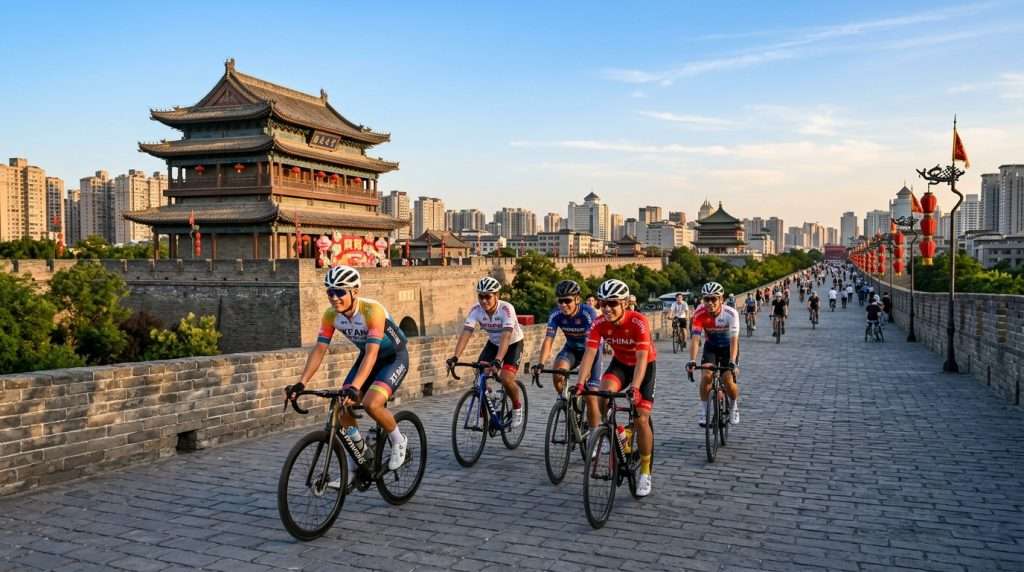
The Xi’an wall is the most complete city wall in China, and it is also among the best preserved. It has stood for centuries as a Ming dynasty rampart. It runs 13.7 kilometers around the inner city.
Here is the wall at a glance. These are real, measurable facts, and they are what the 2050 vision would protect.
- Length: 13.7 km
- Height: 12 m
- Width: 15 m
- Gates: four main gates, one per compass direction, and 14 minor gates between them
- A moat that surrounds the wall
- Bike ride along the top: about two hours
One detail many articles skip: the top is so wide that a lookout post on the wall can fit more than eight buses. You feel that width when you ride. It is more like a long, raised road than a thin ledge.
Plan two unhurried hours for the full ride, plus time to stop at each gate.
How Breathable Glazes Would Shield the Wall’s Bricks
A wall brick fails from the inside, through its pores. In the 2050 vision, a breathable glaze would slow that damage and leave the brick looking the same. This coating does not exist for this wall today. It is a projection.
The city walls of old China teach one lesson: water is the enemy, and strength alone does not save a brick. A study approach has to look at pores, salts and drying.
Why Old Bricks Fail: Moisture, Salt and Frost
Water seeps into tiny pores and carries salts with it. When the water dries, salt crystals grow and push. When it freezes, the ice pushes too, and the surface flakes off as spalling.
Durability depends on the pore network and how water moves through it, not on strength alone. An analysis of old Chinese city-wall bricks has to weigh strength, soluble salts, drying behavior and how well new material bonds to old.
What a Breathable Nano-Mineral Glaze Does
The idea is a glaze that lets water vapor out while keeping liquid water out. It would guard the mortar joints, too. The brick-mortar transition zone on the Ming Great Wall measures only 100-200 μm, and that thin band is where damage often starts.
The glaze would also keep the weathered patina. Visitors would still see the same blue-gray surface.
There is a real caution. A coating that traps moisture can speed up damage, so breathability is the key test. I would trust any such glaze only after years of trials on small test patches.
Loess Dust, Rammed Earth and the Giant Wild Goose Pagoda

The Giant Wild Goose Pagoda has stood for more than 1,300 years. It rises 65 meters (211 feet) and stands in the southeastern quadrant of Tang Chang’an, outside the present wall. Fine loess dust is hard on both earth and brick.
Loess grit is light and sharp. It settles into cracks, holds moisture and scours soft surfaces when wind drives it. Over a long period, that adds up to real wear.
Here is what the 2050 vision would need to protect:
- Blue-gray kiln bricks
- Rammed-earth bastions
- Mortar joints
- The Pagoda’s surfaces
- The natural patina that shows the age of the sites
One point readers miss: rammed earth erodes differently from brick. It crumbles by layers and soaks up water in a different way. So the bastions need their own treatment, not a copy of the brick plan.
In real conservation, dust is cleaned gently and slowly, never blasted.
Underground Retention Vaults for Wei River Cloudbursts
Xi’an sits on the Wei River, a tributary of the flood-prone Yellow River. In the 2050 vision, automated retention vaults beneath the historic moat and South Gate plazas would capture 100% of Wei River basin cloudbursts. That full capture is a vision goal, not a proven result.
The idea is simple. Rain that would flood the streets goes underground instead, and the city reuses it. The vision also treats water as a resource, not a nuisance.
Capturing the Cloudbursts
Heavy rain on a stone wall and its moat is a flood and foundation risk. Water can pool at the base and soften the ground. In a Wei River setting, that risk is real in a planning analysis of the area.
Vaults under the moat and the South Gate plazas would hold the surge. Sensors would open and close the gates between chambers. The water would drain out slowly after the storm passes.
Cooling Museum Halls and Excavation Pits
The stored water would be filtered and sent through zero-emission, closed-loop cooling loops. Those loops would cool museum halls and excavation pits. Cool, stable air is good for old objects, and the loop adds no exhaust.
A practical caution: any digging near a wall foundation needs careful archaeology first. Construction in an old capital always finds something.
A dry moat in summer would be my cue to ask where the water went.
Footstep Power on the Ramparts and at Grand Tang Mall

Every step on the wall top could be a tiny bit of power. The 2050 vision lays under-floor piezoelectric pavers across the wide ramparts and Grand Tang Mall. Footsteps and cyclists would feed clean power into a microgrid.
A piezoelectric paver contains material that makes a small electric charge when pressed. A step bends the tile a few millimeters, and wiring collects the charge. Many steps make a trickle.
The wall top and the mall suit this idea. Both have heavy foot traffic, and density of people is what makes the tiles useful. A busy street of shoppers presses the same tiles all day.
There is a sober limit. These tiles usually give small amounts of power, enough for lighting and sensors, not a whole district. As a design note, the pavers must look like old stone so they fit the wall.
I would treat footstep power as a nice extra and judge any project by its real output.
Net-Zero Targets and the Numbers Behind Them
By 2050, two thirds of the world is expected to live in cities. That growth makes clean urban development a global policy question. The figures below are global estimates, not a forecast for Xi’an.
This analysis uses the numbers at face value. They show what technology might add up to in modern urban life.
| Technology | Estimated contribution | Timeframe |
|---|---|---|
| Digital technologies | 4-10% emissions cut in energy, materials and mobility | By 2030 |
| AI | 4% cut in global emissions | By 2030 |
| E-mobility | 19% of cumulative reductions for a net-zero energy system | By 2050 |
| Renewables | 35% of cumulative reductions | By 2050 |
The city already acts as a showcase. The UNIDO Bridge for Cities 2025 event was co-hosted with Xi’an. It was the first time its main event was held outside Vienna.
Global numbers show direction, and a heritage zone has to prove its own.
Old Core Inside, Modern Ring Outside
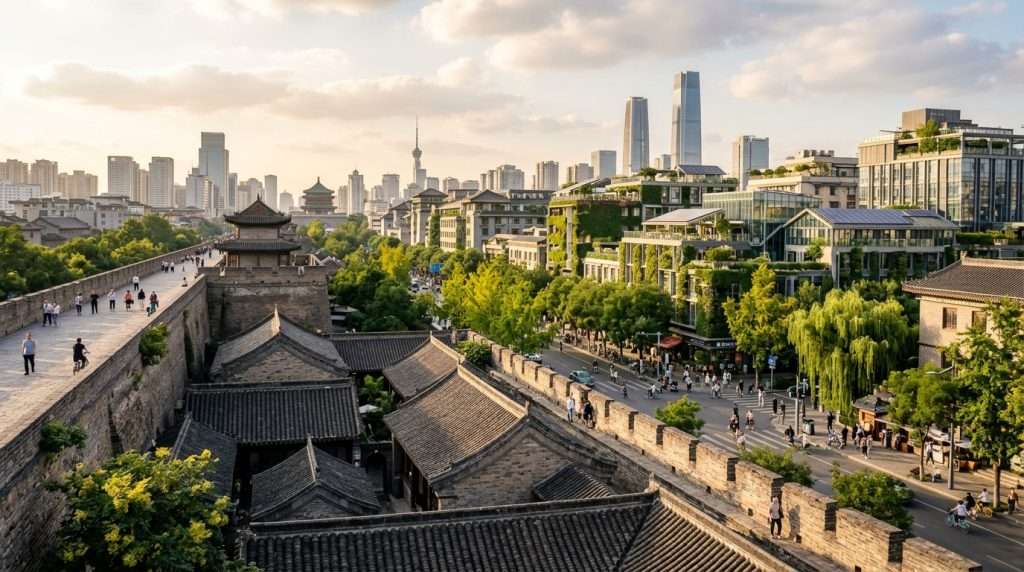
Xi’an already has 15 towers above 150 meters (500 feet), and almost none stand inside the old core. The earliest was built in 1999. Most are in the southwest quadrant near the G-30 Expressway, where the edge city has liberally spaced towers rather than a central business district.
Towers stand outside the inner city, not inside it, so the view from the wall stays historic. Readers often miss this. The skyline you see from the rampart is mostly low tile roofs.
By 2050, I project that the inner city keeps strict height limits. Eco-friendly towers and transit hubs would form a ring outside. That is a planning direction, not a rule I can point to today.
History shows the risks. Xi’an’s 2005 Tang Imperial City Renaissance Plan proposed investing 50 billion yuan to transform downtown by 2050. Research on it points to commercialization, gentrification and displacement.
When you stand on the wall, look for the line where the low roofs end and the towers begin.
Quiet Transit and Mixed-Reality Tours Along the Wall
In 2050 I would hope to cross a gate without hearing an engine. These are ideas for 2050, not current services. The core would ban combustion vehicles and move people quietly.
Here is what a visitor could see in that future:
- No combustion vehicles in the historic center
- Small silent autonomous pods rolling through the gates
- Solar-powered micro-mobility lanes on the wall top
- Walking paths along streets and the moat
- Smart-glasses overlays of Tang Chang’an near the wall and the Giant Wild Goose Pagoda
Low ground vibration matters for old foundations. Rumbling trucks shake rammed earth and loosen mortar over time. Silent pods that avoid that shock would be kinder to the location.
A caution: mixed-reality tours should add to the view, not replace looking at the real stone. Daily life in a gate town is the real show.
Take off any headset for a minute and look at the brick itself.
What Could Go Wrong With a Heritage Biome
Every clever system on this list can also fail. A heritage biome is a bold bet, and any change on a protected site usually needs careful archaeological review first. The honest risks are real, and planning must face them.
Here are the risks I worry about most:
- A coating blocks moisture and speeds damage
- Vault digging near old foundations disturbs buried layers
- Systems need constant maintenance and money
- Software fails in an autonomous district
- Crowds wear down the very surfaces being protected
There is one exception worth stating. Simple fixes like drainage and repointing often beat high tech. A clear gutter costs little and does the work every day.
A study of any heritage policy should weigh these costs over time. A vision earns trust only by naming its own weak spots.
How to Reach Xi’an From Beijing, Shanghai and Guangzhou
The train from Beijing to Xi’an takes under six hours. Flying from Beijing takes under 2.5 hours. Both put you in the center of China’s old capital region quickly.
| From | Flight time | Rail time |
|---|---|---|
| Beijing | Under 2.5 hours | Under 6 hours |
| Shanghai | About 3 hours | Under 8 hours |
| Guangzhou | About 3 hours | About 9 hours |
Xi’an-Xianyang International Airport is expanding to a capacity of over 80 million passengers a year. That growth shows how many cities now link to this one.
For overland fans, the train fits the land-based spirit. You watch the country roll by instead of clouds. It also drops you in town without airport transfers.
Book the train early in busy holiday weeks.
What to See in Xi’an Today
The Muslim Quarter starts steps from the Drum Tower. Do the walled city on foot and the mountain as its own day. That split fits a short visit.
Inside the Walled City
The Bell Tower and Drum Tower date from the Ming dynasty. They stand close together at the center of the old street grid. Their pairing once marked the hours for the whole town.
The Muslim Quarter runs along Beiyuanmen Street and is known for lamb kebab. Smoke and spice fill the lane by late afternoon. Eat standing up, like the locals.
The Xi’an Great Mosque was built in 742, during the Tang dynasty. It was expanded later under the Ming and Qing. Its courtyards feel calm after the busy street.
Beyond the Wall
Hua Shan lies about 120 km east of the city. It rises past 2,000 meters. A cable car reaches the top in about 10 minutes, which saves a very steep climb.
The sites inside the wall tell the history of a capital. The mountain tells a different story, and it needs a full day.
Go to the mountain on a weekday morning, when queues are shorter.
Photographing the Wall and Its Surroundings
My favorite frame on the wall looks down North Street toward the Bell Tower. Shoot early or late, when low light turns old brick warm. The wall top is wide and can be ridden by bike, so you can reach several viewpoints easily.
Shoot the texture of weathered brick and mortar, because that is the very thing the 2050 vision tries to keep.
Here are my other tips for a strong set of frames:
- Frame North Street toward the Bell Tower from the wall
- Use a wide lens on the long straight sections
- Look for the contrast of towers outside and tile roofs inside
- Pick a street scene with people for a sense of life
- Carry a light tripod only where it is allowed
A good example is a cyclist passing a gate tower at dusk. The design of the old stone does half the work for you.
Return at a different hour for the same corner, since the light changes the story.
Conclusion
The wall I can ride today matters more than any 2050 idea. It is real and measurable. The vision is a hopeful sketch meant to protect that real thing.
The best protection keeps the patina and the people walking on it. A city’s future should not erase its history, and daily life is part of what makes the stone worth saving. Plan a trip, bike the wall once, then look closely at the brick.
Pick a date and book a train to Xi’an.














Leave A Comment