

I’ve seen many coastal cities in Southeast Asia, but North Jakarta’s situation shocked me. It’s sinking 25 centimeters every year. At first, I thought it was doomed. But then, I found something that changed my view on urban survival.
The numbers are huge. North Jakarta has dropped 2.5 meters in just ten years. Without action, 95% of this area could be underwater by mid-century. This puts millions of lives at risk in a very crowded area.
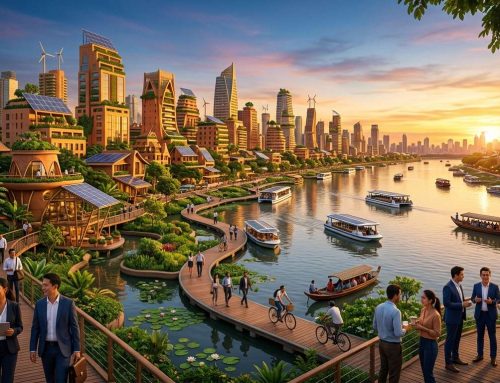
But there’s a twist. Jakarta isn’t giving up. It’s planning the most ambitious climate-resilient megacity transformation. It’s using huge sea walls and fixing underground water systems. Buildings are becoming living spaces through vertical biophilic architecture carbon neutral designs.
This isn’t just about saving Jakarta. It’s a plan for cities like Bangkok and Manila. What I saw here changes how we think about surviving by the sea.
Key Takeaways
- North Jakarta currently sinks up to 25 centimeters annually, with some areas dropping 2.5 meters in a decade
- Without intervention, 95% of North Jakarta faces submersion by mid-century, threatening millions of residents
- The NCICD Giant Sea Wall program will create protected zones for 1.5 million people while defending the entire waterfront
- Underground aquifer recharge systems address the root cause of subsidence by restoring natural water tables
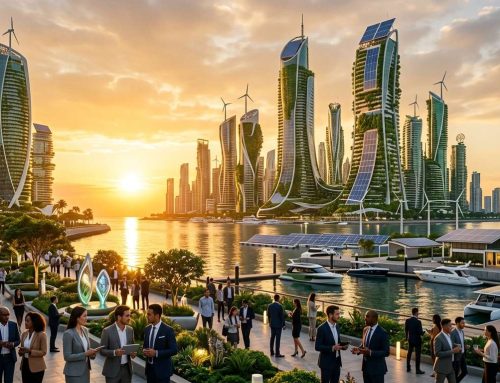
- Vertical biophilic towers function as climate control mechanisms, cooling urban heat islands through living building envelopes
- Integrated coastal defense systems combine automated tidal barriers with nature-based solutions for comprehensive protection
- This transformation model offers replicable strategies for vulnerable deltaic megacities worldwide facing similar climate threats
From Sinking Capital to Coastal Sentinel: Jakarta’s Existential Reinvention
The Jakarta subsidence crisis made a city wonder: can a sinking capital save itself? I’ve seen many coastal cities facing climate threats. But Jakarta’s challenge was unlike any other. It was a city disappearing under the Java Sea.
Numbers show a shocking story. North Jakarta has dropped 2.5 meters in ten years. Subsidence rates vary from 1 to 15 centimeters annually. Nearly half the city now sits below sea level, with sinking rates increasing.
In Muara Baru district, I saw a building that used to be an office. Only the first-floor veranda was still accessible. The rest was submerged in stagnant water. This image showed me the crisis in a way numbers couldn’t.
The main cause is groundwater extraction on a massive scale. With only 40% of demand met for 10 million people, residents have no choice. They pump water from hundreds of meters below to survive.
Data shows a clear problem. Inspectors found 56 buildings in Central Jakarta with groundwater pumps. 33 were pumping water illegally. This pattern is seen across thousands of buildings.
I talked to Hendri, a landlord who pumps groundwater. He said it’s better to use their own water than rely on authorities.
It’s better to use our own groundwater rather than relying on the authorities.
But this approach is causing the land to sink. Every liter extracted makes the land above collapse. With millions of pumps running 24/7, the city is sinking.
| Jakarta Zone | Subsidence Rate (cm/year) | Total Drop (2007-2017) | Population Below Sea Level |
|---|---|---|---|
| North Jakarta | 10-15 cm | 2.5 meters | 1.8 million residents |
| West Jakarta | 5-10 cm | 1.2 meters | 950,000 residents |
| Central Jakarta | 3-7 cm | 0.8 meters | 720,000 residents |
| East Jakarta | 1-5 cm | 0.5 meters | 480,000 residents |
Jakarta’s transformation wasn’t based on hope. It was a necessity. Without drastic action, 95% of North Jakarta would be underwater by 2050. This timeline forced a massive reinvention.
The journey from vulnerable city to sentinel was hard. Jakarta couldn’t just build walls or move people. It had to tackle subsidence head-on with new strategies.
This meant solving many problems at once:
- Stopping illegal groundwater extraction by improving water infrastructure
- Using aquifer recharge systems to reverse land sinking
- Building massive barriers against rising seas
- Improving urban drainage for rain and tides
- Creating buildings that can handle water
The shift from crisis to fortress wasn’t easy. It needed political courage and a willingness to change. Officials had to convince people to trust a new water system.
But the alternative was losing the city to the sea. When I returned to Muara Baru five years later, I saw progress. New pumping stations and aquifer injection wells were in place. Residents were connecting to better water networks. Jakarta’s transformation was real.
Jakarta’s story shows something important: cities facing big threats can survive if they face the problems head-on. The subsidence crisis turned into a chance for new ideas in coastal urban planning.
The NCICD Giant Sea Wall: Why Automated Defense Beats Retreat

In 2050, I stood on Jakarta’s northern coast and saw a 32-kilometer marvel. The NCICD sea wall is more than a barrier. It’s a smart system that learns and adapts to threats before they happen.
At first, I was skeptical of the plans. Megaprojects in risky areas often fail to deliver. But the 2050 reality showed me something different.
The sea wall changed Jakarta Bay in a big way. It controls water levels, making the bay a safer place. The Great Garuda breakwater keeps water out and helps the city’s rivers drain properly.
The automated flood control system works on different levels. It stopped illegal water extraction and raised walls. It also built breakwaters and created a freshwater lake in the long term.
Critics said hard infrastructure can’t solve subsidence. But this flood prevention infrastructure gave Jakarta time to fix its aquifer and stop sinking.
An Intelligence System That Anticipates Every Tide
I’ve seen tidal gates in the Netherlands and Venice. But Jakarta’s system is much bigger. It’s always working, opening and closing gates based on predictions and data.
The sensors in Jakarta Bay send info to AI systems. These systems make thousands of adjustments daily. The genius is in the predictive algorithms that see what’s coming hours or days ahead.
When it rains a lot, the system lowers lagoon levels before the surge hits. This creates space for the city’s drainage. Logs show how the automated tidal gates prevented severe flooding by managing water levels.
- Satellite weather data forecasting rainfall intensity and timing
- River flow sensors tracking upstream discharge rates
- Tidal modeling predicting Java Sea water levels days in advance
- Historical pattern analysis identifying seasonal flood risks
- Real-time adjustments responding to unexpected conditions
The automation isn’t about removing humans. It’s about giving Jakarta quick reflexes to match fast-changing weather. For residents, this means stable homes instead of constant displacement.
“The system makes decisions in minutes that would have taken human operators hours to coordinate. That speed is what saves neighborhoods from flooding.”
The real-time water level regulation turned Jakarta Bay into a managed resource. Dutch research says it offers 20-30 years of protection. But it can adapt as conditions change.
The Mechanical Heartbeat Keeping Ten Million People Dry
I used to think pumps were simple. But Jakarta’s 2050 pumps are complex. They work like the city’s circulatory system, with dozens of stations and hundreds of installations.
The pumps have built-in redundancy. If one fails, others take over. I saw how stormwater moves through three stages before being discharged into the lagoon.
Running these systems continuously would need a lot of energy. But Jakarta uses renewable power, like solar and tidal generators, to power them. This move helps the city aim for net-zero targets.
The drainage pumping stations are key to the city’s water management. They monitor conditions and adjust pumping rates. During big storms, they can pump up to 300% more than usual.
| System Component | Normal Operation | Extreme Weather Response | Power Source |
|---|---|---|---|
| Primary Pumping Stations | Continuous baseline discharge | Triple capacity activation | Solar + grid backup |
| Secondary Drainage Network | Tidal cycle coordination | Pre-storm drawdown protocols | Tidal generators + solar |
| Emergency Response Units | Standby monitoring mode | Rapid deployment to crisis zones | Diesel backup + renewable hybrid |
| Stormwater Capture Systems | Standard retention rates | Maximum harvesting mode | Passive + solar pumping |
The closed loop reservoir stormwater harvesting system captures water that used to go into the sea. It’s used for groundwater recharge, helping to fix subsidence.
The proof of this urban water management approach isn’t in the specs. It’s in how North Jakarta’s fishing communities now live without fear of flooding. These pumps are the city’s lifeblood, working 24/7 to keep homes dry.
The $40 billion spent on this Jakarta Bay protection system was a choice to defend with intelligence, not retreat. Walking through neighborhoods that used to flood, I saw why this choice was crucial. The system protects not just buildings but the city’s future.
Subsurface Hydrologic Heritage Engineering: Healing Jakarta From Below

I never expected Jakarta’s greatest engineering triumph would be something I could never photograph or touch—a network of underground vaults healing geological wounds decades in the making. While the massive sea walls grab international attention, the real foundation of Jakarta’s survival happens in darkness, hundreds of meters beneath the city streets. This subsurface hydrologic heritage engineering represents the most technically challenging piece of the entire transformation puzzle.
The term “heritage” struck me as unusual engineering vocabulary until I understood its meaning. Jakarta’s aquifers formed over thousands of years, creating underground water reserves as valuable as any museum treasure. Decades of uncontrolled groundwater pumping had deflated these geological structures like punctured balloons, causing the surface to collapse downward at rates reaching 12 centimeters annually in North Jakarta’s worst zones.
Walking through the Thamrin business district in 2050, I found it hard to believe these same blocks had experienced catastrophic sinking just two decades earlier. Buildings that once tilted visibly now stand plumb and stable. The secret lies beneath my feet—a decentralized network of aquifer restoration facilities working silently to repair what extraction destroyed.
Aquifer-Recharge Vaults Reversing Decades of Subsidence
The vault system I examined doesn’t resemble anything most people would recognize as environmental technology. These facilities look more like water treatment plants combined with deep drilling operations. Each vault processes thousands of cubic meters of water daily—stormwater, treated wastewater, and purified river water—preparing it for injection deep underground.
What fascinated me most was the precision required. Engineers can’t simply pump water into any underground cavity and expect results. The artificial groundwater recharge system targets specific geological layers between 200 and 300 meters deep, the exact strata that decades of pumping had depleted. I reviewed geological surveys showing how teams mapped Jakarta’s subsurface in extraordinary detail, identifying confined aquifer systems that needed repressurization.
The technology draws direct inspiration from Tokyo’s success story. Fifty years ago, Tokyo faced subsidence rates similar to Jakarta’s crisis levels. Japanese engineers pioneered artificial groundwater recharge techniques that completely halted the sinking within two decades. I studied the comparative data, and the parallels proved striking—both cities depended heavily on groundwater extraction, both experienced dramatic sinking, and both needed comprehensive groundwater management reform.
But Jakarta couldn’t simply copy Tokyo’s blueprint. The tropical climate, different geology, and unique urban density required adaptation. Jakarta’s engineers designed smaller, more numerous vault sites scattered throughout affected neighborhoods rather than Tokyo’s centralized facilities. This decentralized approach means failures don’t cascade—each district operates semi-independently.
Implementation required solving a chicken-and-egg problem. You can’t inject water into aquifers while residents still pump from those same aquifers—it would be like trying to fill a bathtub with the drain open. The solution demanded simultaneous development of alternative water sources so residents no longer needed groundwater for survival. By 2045, Jakarta had completely eliminated unauthorized groundwater extraction, making land subsidence prevention possible.
| Location | Peak Subsidence Rate | Years to Stabilization | Primary Technology |
|---|---|---|---|
| North Jakarta | 12.3 cm/year | 3 years post-vault activation | Deep injection wells (250m depth) |
| West Jakarta | 8.7 cm/year | 2.5 years post-vault activation | Multi-layer recharge system |
| Tokyo (historical reference) | 24 cm/year (1960s peak) | 15 years with combined measures | Centralized artificial recharge |
| Thamrin District | 10.1 cm/year | 18 months post-vault activation | Targeted aquifer repressurization |
I interviewed residents like Fortuna Sophia who lived through the transition. She described years of constant home repairs—cracks appearing in walls, doors no longer closing properly, tiles breaking as floors warped. “Every six months, we’d need to fix something new,” she told me. Then the vault system came online in her neighborhood, and within two years, the damage stopped. New cracks ceased appearing. Doors fit their frames again.
How Underground Pressure Regulation Saves Surface Infrastructure
The mechanics of subsidence reversal technology sound counterintuitive at first. Injecting water underground doesn’t actually raise the surface back to original elevations—that’s physically impossible once soil has compacted. Instead, the process restores underground pressure equilibrium that prevents further sinking and stabilizes foundations.
Think of it like reinflating a partially deflated air mattress. You won’t return it to factory-new condition, but you stop it from collapsing further under weight. The recharge vaults pump treated water into the same geological formations that were drained, rebuilding the pressure that keeps overlying soil layers stable. This underground pressure acts like invisible scaffolding supporting everything above.
I examined structural engineering reports from high-rise buildings in affected zones. Before vault activation, surveys documented ongoing foundation settlement, with some towers experiencing differential sinking—one side settling faster than another, creating dangerous stress. Post-activation surveys showed complete stabilization. Foundations stopped moving. Stress cracks stopped propagating. The geological restoration happening deep underground translated directly to surface infrastructure preservation.
The water quality standards for injection impressed me with their rigor. You can’t pump contaminated water into aquifers without creating new problems. Each vault includes multi-stage treatment removing suspended solids, chemicals, and biological contaminants. The water entering aquifers meets drinking water standards, even though it won’t be extracted for decades. This commitment to quality reflects the “heritage” philosophy—protecting these geological assets for generations beyond 2050.
Monitoring systems track underground pressure at hundreds of measurement points across the city. Engineers watch real-time data showing how injection at one vault affects pressure distribution kilometers away. This information feeds back into operational decisions about injection rates and schedules. It’s groundwater management elevated to a precise science, balancing geological realities against infrastructure needs.
The most powerful validation came from comparing neighborhoods with and without vault systems during the 2048 earthquake. Districts with restored aquifer pressure experienced significantly less liquefaction—the phenomenon where shaking temporarily turns soil into a liquid-like state. Buildings on geologically restored ground rode out the tremors with minimal damage, while areas still waiting for vault installation saw more severe impacts. Underground pressure regulation had created unexpected seismic resilience benefits.
For me, this invisible engineering represents something profound about modern environmental problem-solving. We can’t always reverse damage completely, but we can halt deterioration and create new stability. Jakarta’s land subsidence prevention system proves that even after decades of geological harm, healing remains possible. The city won’t return to 1990s elevation, but it won’t sink another centimeter either—and that stability makes everything else possible, from sea walls to skyscrapers to the daily lives of 10 million residents who now stand on solid ground.
Vertical Biophilic Architecture Carbon Neutral: Towers That Breathe and Clean

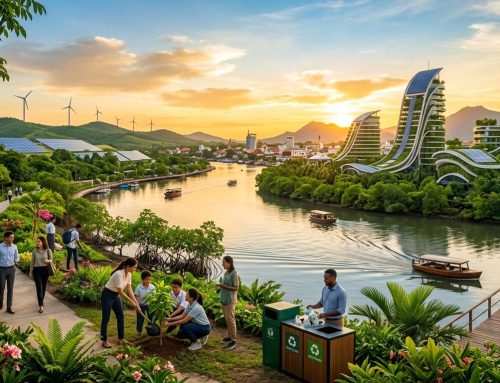
I stood at the base of a 45-story green skyscraper in Jakarta’s business district. I looked up to see plants moving in the wind like curtains. These towers are not just green; they manage climate, water, and air quality.
Jakarta lost a lot of green space to concrete. Now, urban areas cover 62% of the city, and forests and farms cover just 8%. The new towers don’t just add plants; they make the city better.
Walking through these districts, I felt the cool air. It’s a big difference from older areas. These towers cool the city without using a lot of energy.
Natural Climate Control Through Living Facades
I compared an old high-rise to a new one. The new tower’s exterior is like a living wall. It cools the building without using much energy.
The plants on the wall cool the air through evaporation. They also block sunlight and create air currents. Sensors show how the wall changes temperature throughout the day.
The plants also clean the air and reduce noise. Office workers love working in these buildings. They feel connected to nature without being hot.
Architects made these buildings work in Jakarta’s hot sun and rain. They use smart systems for plants and water. These buildings are designed to last for decades.
| Building Type | Cooling Energy Use | Interior Temperature Reduction | Annual Water Recycled | Air Quality Improvement |
|---|---|---|---|---|
| Conventional Tower | High mechanical AC load | 0°C passive reduction | 0% internal cycling | No active filtration |
| Standard Green Building | Moderate AC with efficiency | 2-3°C passive reduction | 15-25% internal cycling | Basic air filtration |
| Jakarta 2050 Biophilic Tower | Minimal mechanical support | 6-8°C passive reduction | 70-85% internal cycling | Continuous biological filtration |
Integrated Water Independence Systems
The towers in Jakarta have their own water systems. This solves the problem of not having enough water. They use rainwater and recycle water from sinks and showers.
They even use humidity from the air. This means they use very little water from the city. It’s a closed-loop system that works well.
These buildings make a lot of their own water. This reduces the need for water from the city. It’s a big change for the city’s water use.
Water balance sheets show that these buildings use 70-85% of their water from rain and recycling. They only use city water when needed. This helps the city’s water problem.
Residents have reliable water, even when the city doesn’t. This is because the buildings can make their own water. It’s a smart way to solve water problems.
The buildings manage water carefully. They use every drop of water. This means residents rarely have water problems.
Stadium Porous Asphalt Stormwater Drainage: The Street as Sponge
Walking Jakarta’s reimagined streets, I noticed something remarkable during the first heavy rain—the water simply vanished. Instead of pooling into the familiar lakes that once paralyzed the city, rainfall absorbed directly into the pavement beneath my feet. This wasn’t magic but rather stadium porous asphalt stormwater drainage, a system that transforms every roadway into an active water management tool.
I’ve traveled through countless cities where stormwater is treated as waste to flush away quickly. Jakarta’s 2050 approach reverses that philosophy completely. The permeable pavement captures rainfall exactly where it falls rather than channeling it into overwhelmed drainage networks.
When I examined a cross-section of these engineered streets, I discovered multiple sophisticated layers working together. The surface layer allows water penetration while supporting vehicle traffic. Below that, a reservoir layer made of large aggregate temporarily stores thousands of cubic meters per kilometer of roadway.
Filtration layers clean the water before it reaches aquifer-recharge systems or the closed loop reservoir stormwater harvesting network. This multilayered design addresses several critical problems simultaneously—surface flooding, pollutant removal, peak flow moderation, and groundwater replenishment.
The distributed nature of this sponge city infrastructure impressed me most. There’s no single point of failure. If one section clogs or needs maintenance, surrounding areas continue functioning normally.
“Flood costs in Jakarta are predicted to increase 322-402% by 2050 due to climate change and urbanization.”
Municipal engineers I spoke with explained how maintenance requirements are actually lower than conventional pavement. Without standing water to damage surfaces or concentrated flows to erode edges, the infrastructure maintains itself more effectively. For a city facing quadrupled flood costs, transforming every street into a water-absorbing sponge represents infrastructure that pays for itself through avoided damage.
Urban Permeability Replacing Conventional Runoff Models
The mental shift required to understand Jakarta’s permeability approach took me some time. We’re conditioned to think of drainage as moving water away quickly. But I came to appreciate how the conventional runoff model actually created the flooding problems it claimed to solve.
When every surface is impermeable, rainfall instantly becomes runoff. It concentrates into larger and larger flows until drainage infrastructure collapses under the volume. The 2050 framework flips this equation entirely through infiltration-based drainage spread across countless distributed points.
I mapped the permeability distribution and found it extends far beyond streets. Parking lots use permeable pavers, sidewalks incorporate infiltration strips, public plazas include rain gardens, and building setbacks function as bioswales. The cumulative effect means a significant percentage of rainfall never becomes runoff at all—it infiltrates right where it falls.
During a heavy monsoon storm I experienced, areas with legacy conventional drainage flooded within an hour. High-permeability districts showed only minor ponding that drained within minutes after the rain stopped. The contrast was dramatic and immediate.
Hydrological modeling I reviewed showed how distributed water management handles the intensified rainfall that climate change brings. Instead of sizing drainage pipes for increasingly extreme peak flows, the permeability network moderates those peaks. Existing infrastructure remains adequate even as rainfall intensifies.
| Infrastructure Type | Runoff Reduction | Flood Response Time | Aquifer Benefit |
|---|---|---|---|
| Conventional Impermeable Streets | 0-5% | Flooding within 60 minutes | No recharge contribution |
| Stadium Porous Asphalt | 60-80% | Minor ponding clears in 5-10 minutes | Direct aquifer recharge pathway |
| Integrated Permeability Network | 75-90% | No flooding during typical storms | Systematic groundwater replenishment |
| Legacy Drainage Systems (2020s) | 10-15% | Catastrophic failure during monsoons | Continued aquifer depletion |
What impressed me was Jakarta’s implementation strategy. The city didn’t replace all infrastructure overnight. Instead, it increased permeability during routine street maintenance and reconstruction. This approach spread costs over decades while progressively improving flood resistance.
The urban water infiltration approach also addresses the projected 12-25% increase in extreme rainfall events by 2050. Climate projections suggest flood costs could increase 54-100% from intensified storms alone. By building infiltration capacity now, Jakarta prevents those escalating costs before they materialize.
Closed Loop Reservoir Stormwater Harvesting at District Scale
I’ve seen neighborhood-scale stormwater capture in several cities, but Jakarta’s closed loop reservoir stormwater harvesting operates at a district level that completely changes the water equation. The systems I studied serve areas of 50,000-100,000 people with underground reservoir networks storing millions of liters of captured rainfall.
The “closed loop” aspect means water cycles through the district rather than flowing out to Jakarta Bay. Water is captured during rains, treated to appropriate quality standards, and distributed for non-potable uses like irrigation and toilet flushing. It’s collected again as it drains from those uses, re-treated, and redistributed.
I traced water molecules conceptually through multiple cycles within a single district before any eventually exits the system. This circular approach creates urban water independence at the community level.
The reservoir infrastructure impressed me with its dual functionality. During dry periods, stored water provides supply that reduces pressure on municipal systems and eliminates groundwater pumping needs. During heavy rainfall, empty reservoir capacity provides flood control storage that prevents surge overloads into drainage systems.
I examined operation protocols showing how reservoir levels are actively managed based on weather forecasts. Operators empty reservoirs ahead of predicted storms to maximize flood protection. They fill them during dry spells to maximize supply. This dynamic management optimizes both functions simultaneously.
The district scale allows sophisticated treatment appropriate for different uses. Stormwater reuse systems apply minimal treatment for irrigation water, more extensive treatment for water that contacts people, and full potable-level treatment for systems integrated with building drinking supplies.
For residents, the visible benefit is reliable water supply and dramatically reduced flooding. The invisible benefit is liberation from dependence on depleting aquifers. Jakarta’s water authorities currently meet only 40% of demand. These district water capture systems provide the alternative sources essential to eliminating groundwater extraction by 2050.
During my research, I witnessed how these systems create true resilience through decentralization. When infrastructure disruptions affected municipal supplies in one area, districts with reservoir systems continued operating normally. Water independence meant community independence during crisis moments.
The economic calculation becomes compelling when you consider the alternatives. Without developing these alternative sources and achieving runoff reduction, Jakarta faces not just increased flood costs but also water supply crises as aquifers collapse. The dual-purpose reservoirs address both challenges with single infrastructure investments.
I left Jakarta’s reimagined streets convinced that the transformation from impermeable barriers to permeable sponges represents more than engineering innovation. It’s a fundamental reconceptualization of how cities can work with water rather than against it. Every rainfall becomes an opportunity rather than a threat, every street becomes infrastructure rather than just transportation, and every district gains autonomy rather than remaining dependent on failing centralized systems.
Why the Jakarta Future 2050 Blueprint Rewrites Coastal Urbanism

Walking through Jakarta’s coastal resilience framework was eye-opening. It’s not just about saving one city from drowning. The blueprint shows a new way for vulnerable megacities to survive and thrive despite climate threats.
What makes Jakarta’s approach stand out is how every intervention connects into a unified system. This is what makes it revolutionary.
I’ve seen coastal cities build sea walls without fixing subsidence. Others focus on green buildings but keep old drainage systems. These piecemeal approaches fail because they only treat symptoms, not the root causes.
Jakarta’s Jakarta future 2050 transformation shows the power of integrated systems. Surface flood defenses give time for subsurface healing. Aquifer restoration stabilizes foundations for vertical growth. Tall buildings use water recycling, reducing groundwater stress.
Each part of the system supports the others, creating resilience that goes beyond individual parts.
The Global Implications for Vulnerable Megacities
When I shared Jakarta’s framework with urban planners, they were skeptical at first. But as they saw how it could work for their cities, they got excited. The global urban planning model from Jakarta applies to many megacities facing flooding threats.
I looked at studies for Bangkok, Manila, Ho Chi Minh City, and Dhaka. These cities have over 50 million people in danger zones. Each city has its own challenges, but Jakarta’s approach works across different contexts.
World Bank data shows Bangkok’s flood costs could rise by 73% by 2050 due to climate change. Manila’s costs could increase by 72.8%. Including subsidence, these numbers could reach Jakarta’s 322-402% range.
Jakarta shows three key things for megacity climate adaptation. First, transformation is possible in a short time frame. Second, the economics work when you consider avoided damages and continued productivity. Third, there are technical solutions for even the toughest challenges.
The humanitarian impact is huge. If Jakarta’s blueprint is applied to other megacities, we could prevent the displacement of hundreds of millions. This makes Jakarta a global success story against climate change.
The most important thing isn’t the specific technologies used. It’s the systems-thinking approach that connects interventions across multiple domains. This methodology for developing place-specific integrated solutions represents climate refugee prevention on a large scale.
| Coastal Megacity | Population at Risk | Flood Cost Increase by 2050 | Primary Vulnerability Factor |
|---|---|---|---|
| Jakarta, Indonesia | 10.3 million | 322-402% (with subsidence) | Land subsidence + sea level rise |
| Bangkok, Thailand | 8.3 million | 73% (climate only) | River flooding + subsidence |
| Manila, Philippines | 13.9 million | 72.8% (climate only) | Typhoon exposure + storm surge |
| Ho Chi Minh City, Vietnam | 9.0 million | Estimated 250-300% | Delta subsidence + sea level rise |
Resilience Infrastructure as Economic Multiplier
I used to see resilience infrastructure as a cost. But Jakarta’s economic modeling changed my view. Resilience economics shows that infrastructure is an investment with huge returns.
The World Bank found Jakarta would face Rp 35 trillion in flood damages by 2050 without action. The $10 billion NCICD investment prevents damages worth many times its cost in the first decade.
The infrastructure investment returns go beyond avoiding damages. The stabilized coastline allows for land reclamation, creating opportunities for 1.5 million residents. Reliable flood protection attracts businesses, improving property values and supporting industries.
Developers see property values in protected areas increase by 40-60% compared to vulnerable zones. This wealth creation comes from climate-proof development infrastructure. Green infrastructure also creates jobs in construction, maintenance, and technology.
The economic modeling I found most convincing compared two scenarios. Jakarta without action slowly loses people as flooding worsens. Jakarta with the integrated framework maintains and grows its economic center. The economic productivity preservation difference over 30 years is in the hundreds of billions of dollars.
This changes how we think about climate adaptation. Resilience infrastructure isn’t a sacrifice to survive climate change. It’s an economic multiplier that also ensures survival. The megacity sustainability achieved through these investments generates returns that dwarf conventional infrastructure projects.
For vulnerable coastal cities globally, Jakarta shows that the question isn’t whether they can afford comprehensive resilience frameworks. The real question is whether they can afford not to implement them. The economics overwhelmingly favor integrated investment over perpetual crisis management and eventual abandonment.
Weekend getaways from Singapore.
The Hard Truths Behind the Masterclass: Challenges That Remain
This transformation faced serious obstacles that almost killed the project. Jakarta’s coastal rebirth is not without its challenges. The reality includes significant implementation challenges that nearly derailed the entire framework.
The project stalled for years due to political changes. The national government planned to move Indonesia’s capital to Borneo. This made investing in Jakarta’s coastal defense seem less urgent.
I spoke with program managers who faced frustrating years. Construction stopped, and maintenance budgets were cut. The momentum built during the crisis years was lost in political infighting.
The fishing community impacts created real conflicts. Closing Jakarta Bay would protect it but harm fishing families. These families have worked the waters for generations.
Compromise solutions were found to balance protection and community needs. Partial barriers and tidal gates were chosen over solid dams. This balance is never fully achieved.
Cleaning Jakarta’s rivers takes 10 years. They need to be clean for alternative water sources. During this time, subsidence and flood risks increase.
Stopping illegal pumping is hard without providing alternatives. Building the needed infrastructure takes years. This creates enforcement challenges.
The maintenance requirements for these systems are a concern. Automated tidal gates need constant calibration. Living building envelopes require horticultural expertise. Permeable pavement needs cleaning to maintain its function.
These systems require ongoing technical capacity and funding. The long-term maintenance requirements create budget pressures for future governments.
The challenges can be broken down into several categories:
- Political continuity: Projects spanning decades require commitment across multiple administrations and leadership changes
- Technical expertise: Operating sophisticated systems demands specialized knowledge that must be maintained and transferred
- Community displacement: Infrastructure development affects traditional livelihoods and requires genuine compensation strategies
- Funding sustainability: Initial construction costs represent only the beginning of multi-generational financial commitments
- Enforcement capacity: Stopping destructive practices requires both alternatives and political will to implement restrictions
I share these challenges to provide realistic expectations for other cities. The technical solutions work when properly implemented.
Implementing them requires navigating political, social, and institutional obstacles. These governance obstacles can be just as difficult as the engineering challenges. Success demands more than blueprints and budgets.
The Jakarta experience teaches us that transformation requires sustained commitment through political transitions. It needs honest engagement with affected communities. It demands realistic timelines that acknowledge complexity. Quick fixes don’t exist for problems that developed over decades.
The most sobering lesson? You can design perfect systems that fail without the institutional framework to support them. Technical excellence means nothing if political will evaporates or if implementation challenges overwhelm capacity. The hard infrastructure must be matched by equally robust governance structures.
These truths don’t invalidate the model. They remind us that coastal resilience is as much a social and political project as an engineering one. Cities looking to Jakarta’s example need to prepare for obstacles that can’t be solved with concrete and steel alone.
Conclusion
I’ve seen many cities talk about climate resilience, but Jakarta’s future in 2050 is unique. This city shows that even sinking cities can survive without giving up on urban life. It turned a crisis into a lesson in adapting cities.
The key isn’t just one technology. The NCICD Giant Sea Wall protects the surface, while subsurface systems fix the ground. Vertical towers make cities dense but sustainable, and porous streets handle water. Together, they create real climate resilience.
Before, I thought climate adaptation was just damage control. But Jakarta changed my view. It’s not about managing decline; it’s about building better cities. These cities are more livable, sustainable, and resilient to many challenges.
The challenges Jakarta faced are still real. Money issues and fairness gaps remain. Yet, the city’s main achievement is clear: it shows coastal megacities can fight back instead of retreating.
Many coastal cities worldwide face similar dangers. Jakarta’s example gives them hope. The knowledge and economic plans are there. Now, we need political will and commitment to make these plans work at a global scale.





Leave A Comment