
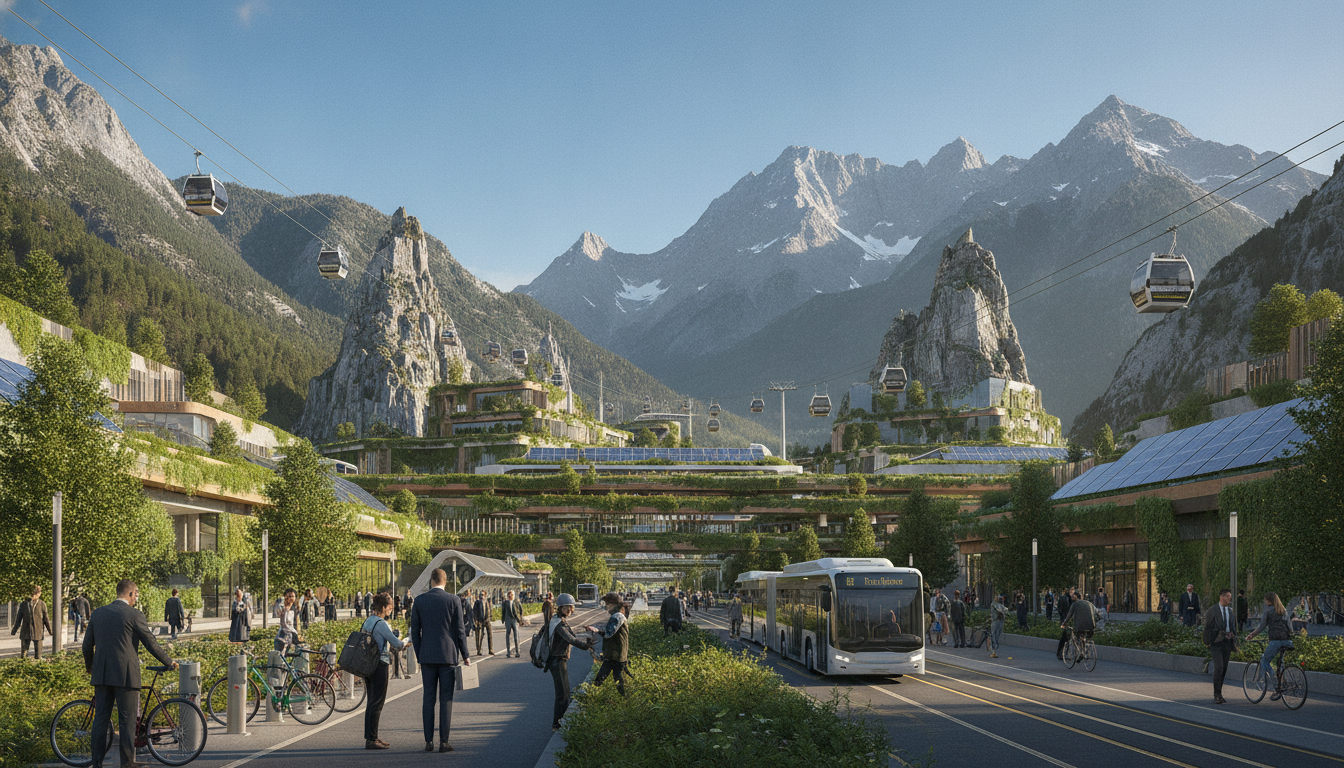
I was skeptical when I first heard about Bandung’s plan. A city of 8.5 million people with a lot of motorcycle exhaust, where most trips are in private vehicles, aiming to be carbon-negative? It seemed like science fiction.
But after looking into the plans and seeing the early Whoosh rail corridors, I saw it’s real. It’s the most ambitious urban makeover in Asia. The city’s location in a volcanic basin is key to its climate action.
Only 44% of residents use public transport now. Motorcycles are used for 75% of trips. Indonesian cities are going green, and Bandung is leading the way. By 2050, it will have a network of HSR and biophilic transit areas. This will make it a net-zero mountain city that’s both green and livable.
This is important for all high-altitude cities facing climate change.
Key Takeaways
- Bandung’s 8.5 million residents currently rely on private vehicles for 95% of trips, with motorcycles accounting for 75% of personal travel
- The city’s volcanic basin geography provides natural cooling advantages being integrated into the net-zero infrastructure plan
- Whoosh high-speed rail network forms the backbone of the 2050 carbon-negative transit transformation
- Only 44% of residents currently access public transportation, highlighting the scale of infrastructure challenge ahead
- High-altitude tropical urbanism strategies developed here will provide blueprints for mountain cities worldwide
- The 2050 vision integrates biophilic design with IoT utility systems and volcanic stone cooling loops
The Volcanic Valley That Rewrote Urban Climate Strategy
The volcanic ridges around Bandung were once seen as a problem. But they became the key to the city’s rebirth. The city spreads across 1,014 square kilometers of volcanic valley floor. This geography powers a bold tropical mountain sustainability project.
What changed wasn’t the landscape. It was how we understood it.
The city’s density is high, with 8,000 people per square kilometer. This was once seen as a nightmare. But the bandung smart city master plan saw opportunity in this challenge.
The Dismissal of High-Altitude Tropical Urbanism
I’ve seen mountain cities worldwide, facing similar challenges. Quito, Kathmandu, and Addis Ababa are cultural gems but struggle with climate issues. Experts once thought these cities were doomed.
The heat retention was a major problem. Volcanic basins trap warm air, making cooling hard. The tropical sun at high elevations adds to the challenge.
Expansion was also a hurdle. Mountain cities can’t spread out like coastal cities. Volcanic ridges force vertical growth and extreme density.
Transportation was another issue. Moving people up and down slopes requires a lot of energy. Most cities relied on cars, increasing their carbon footprint.
Infrastructure costs soared. Water had to be pumped uphill. Roads needed constant upkeep on unstable slopes. Emergency services faced challenges due to weather and altitude.
Experts thought high-altitude tropical cities were climate adaptation dead zones. They suggested limiting growth and accepting higher emissions.
But what if you could work with the volcano instead of fighting it?
Geography as Competitive Advantage: The Bandung Reversal
The breakthrough came from combining old wisdom with new science. Sundanese builders knew about volcanic basin physics long ago. They used porous volcanic stone that changed temperature with the environment.
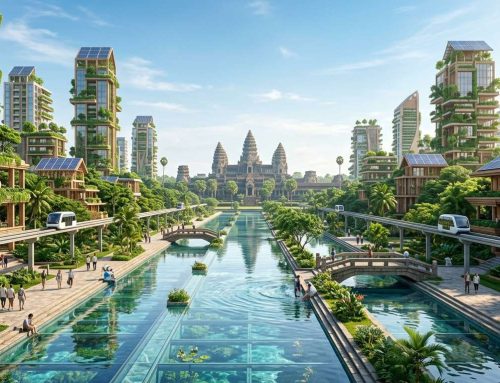
The bandung smart city master plan built on these principles. It uses vertical biophilic architecture carbon neutral systems. These systems use the volcano’s materials for cooling.
Porous volcanic stone composites regulate temperature naturally. They absorb heat during the day and release it at night. These aren’t just green walls—they’re climate technology.
The alpine breezes now cool the city. Roofs channel air flows from higher elevations. This natural ventilation reduces cooling energy by up to 70 percent.
The volcanic ridges limit sprawl but protect green belts. The basin traps heat but contains air corridors for cooler air. This approach to volcanic basin urbanism is unique.
This method flips the cost structure. Bandung uses its topography for climate control, unlike other cities. Copenhagen targets carbon neutrality with wind power and district heating. Adelaide uses solar farms on flat terrain.
| City | Primary Climate Strategy | Geographic Advantage | Target Year |
|---|---|---|---|
| Copenhagen | Wind power + district heating | Coastal wind access | 2025 |
| Adelaide | Large-scale solar arrays | Flat, sun-exposed terrain | 2025 |
| Bandung | Passive volcanic cooling + biophilic systems | Volcanic basin topography | 2050 |
| Oslo | Hydroelectric + electric transport | Mountain water resources | 2030 |
Bandung’s approach is validated by data. Over 100 cities aim for carbon neutrality by 2050. But Bandung is the first to focus on tropical mountain sustainability. It’s not just reducing emissions—it’s preventing them.
In Bandung, I saw living walls in volcanic stone facades. These aren’t just decorative. They pull carbon from the air and control humidity and temperature.
The rooflines follow ancient patterns but use modern science. Engineers design roofs to maximize ventilation during heat hours. This uses air pressure differences across the basin.
This blend of ancient wisdom and modern science is unique. It’s not just green architecture. It’s a new way of thinking about mountain cities.
This approach has many benefits. Construction costs are lower because the cooling system is made from the excavation material. Operational costs drop with passive systems. The city becomes more resilient.
Other mountain cities are taking notice. La Paz, Quito, and Kathmandu face similar challenges. The Bandung model offers a new way to embrace their geography.
This shows how constraint can become strategy. The volcanic valley that once seemed limiting now gives Bandung a competitive edge. The basin is now a source of strength.
Bandung Future 2050: The Whoosh Network as Metropolitan Skeleton
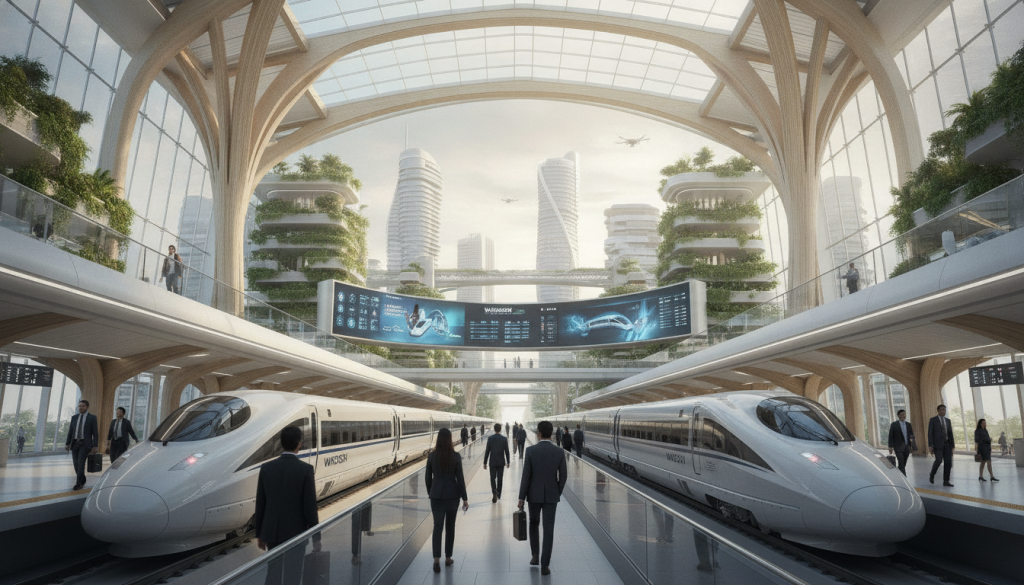
When you ride the Whoosh high-speed rail Indonesia system from central Bandung, you see a big change. My first trip to Tegalluar showed me a different view. Instead of usual suburban sprawl, I saw something new.
High-density mixed-use districts were growing around each station. These areas were planned from the start, focusing on rail access. They weren’t just added later.
This is what Bandung will look like by 2050. The rail network is the city’s backbone. Neighborhoods grow naturally from it. The bandung smart city master plan uses transit-oriented development to guide growth.
How High-Speed Rail Became the Organizing Principle of Urban Expansion
Most cities build roads first, then houses and shops. Bandung did it the other way around. This approach is changing everything.
The city is building a 23-kilometer BRT corridor Bandung system. It will cover 169 kilometers total. This isn’t just about roads; it’s the foundation for the city’s future.
Bandung is focusing growth around station nodes. This approach preserves the city’s natural beauty. It’s a big change from traditional mountain cities.
Tegalluar was once a car-dependent suburb. Now, it’s becoming a transit-oriented development hub. Private vehicles are becoming less necessary.
The district has high-density residential towers near the station. Retail shops are on the ground floor. Offices are nearby, reducing the need for long commutes. Green corridors add to the beauty of the area.
I walked the district without needing a car or motorcycle. This is rare for an Indonesian mountain city.
| Development Model | Traditional Mountain City | Bandung 2050 Transit Model |
|---|---|---|
| Primary Infrastructure | Road networks first, transit later | Rail skeleton first, development follows |
| Growth Pattern | Horizontal sprawl across topography | Vertical density around station nodes |
| Land Preservation | Natural areas filled with development | Valleys and ridges protected by design |
| Vehicle Dependency | 95% private vehicle trips required | Target: 90%+ trips via public transit |
The Death of Car-Dependent Mountain Urbanism
Bandung’s current reality shows a familiar story. The city has a lot of roads but few intersections. This is typical of car-oriented design.
Ninety-five percent of trips are by private vehicles. Motorcycles make up 75% of those. I’ve seen this firsthand, navigating through traffic on scooters.
The Whoosh high-speed rail Indonesia expansion is changing this. It’s making public transport better than cars. Reaching major districts in 15 minutes by rail is much faster than 45 minutes in traffic.
The electrification plan is also a big change. Bandung aims to make 90% of public transport electric by 2030. By 2040, it will be 100%.
These goals are not just plans. I’ve seen the charging infrastructure for electric buses. The city is preparing for electric transport ahead of time.
Talking to young families in new transit-oriented development districts was striking. Many chose not to buy cars or motorcycles. They found it didn’t make sense anymore. Their lives are centered around the transit network.
This marks a big shift from traditional mountain city urbanism. Cities like Bandung were thought to be car-dependent forever. But the Whoosh high-speed rail Indonesia network proved that wrong.
By using rail as the main structure for growth, Bandung is creating compact, walkable districts. These districts work with the mountainous landscape, not against it.
The city’s skeleton is taking shape as planned. Rail defines growth areas. Transit-oriented development focuses density around stations. Electric fleets reduce emissions. And the natural topography is preserved.
At Tegalluar station during rush hour, I saw thousands of people without private vehicles. The system is working as designed, replacing car culture.
Engineering Cool Air: Volcanic Materials and the New Climate Architecture
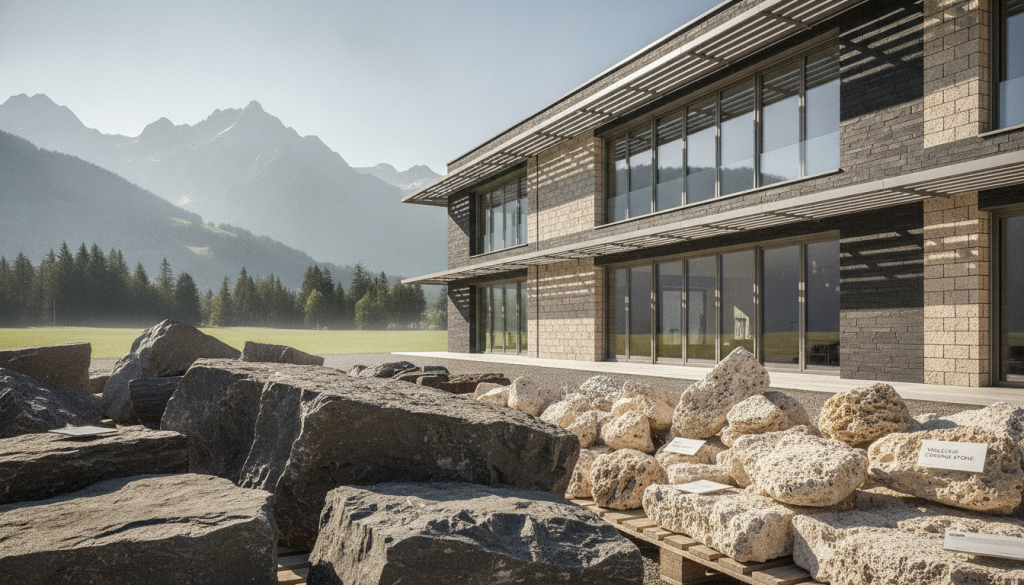
Architects in Bandung are using the building itself as a climate technology. They’ve created structures that feel light and have roofs that curve to channel wind. These designs aren’t just for looks; they help cool the air.
The city’s volcanic slopes have left behind porous rock. Local engineers are using this rock to fight climate change.
Building Blocks That Breathe
When I first touched Bandung’s volcanic stone building materials, I was surprised. They felt incredibly light. The surface was rough, with tiny holes that let water through.
This porosity is key. It helps the stone absorb and release moisture.
During rainy seasons, the stone soaks up water. When it’s dry, the water evaporates, cooling the air inside. This method can lower temperatures by 8 to 12 degrees Fahrenheit.
The idea is similar to stadium porous asphalt stormwater drainage systems. Instead of draining water, the stone holds and releases it to cool the air.
The stone also helps regulate temperature. It absorbs heat during the day and releases it at night. This keeps the inside of buildings comfortable without needing air conditioning.
Roofs That Pull Cool Air Down Mountains
In Tegalluar, the roofs of new buildings caught my eye. They’re not flat and don’t follow traditional designs. Instead, they’re tiered and angled to catch wind.
These roofs capture cool air that flows down the mountains at night. The design accelerates and directs this air into buildings. It’s a natural way to cool spaces.
Engineers studied wind patterns for 18 months to design these roofs. They work with the natural flow of air, using vertical shafts to pull cool air down through buildings.
The roofs also manage rainwater. Water filters through the surface and feeds irrigation systems. This design reduces energy use and water waste.
Living Walls as Carbon Infrastructure
Bandung’s climate architecture includes vertical gardens. These aren’t just for looks. They’re part of a carbon-neutral design.
In Margacinta, living walls cover three sides of buildings. These walls are deep and integrated into the structure. They help regulate temperature and purify the air.
The plants in these walls absorb carbon dioxide. Rooftop gardens produce food and improve air quality. This approach makes buildings carbon-neutral without relying on offsets.
This method is different from global green building standards. It’s more honest and effective. The carbon sequestration happens right where the building stands.
Building codes in Bandung now require this integrated approach. Developers must consider energy use throughout a building’s life. Volcanic stone building materials are used because they have lower embedded carbon.
| Building Component | Traditional Materials | Bandung Volcanic System | Carbon Reduction |
|---|---|---|---|
| Structural walls | Reinforced concrete (450 kg CO₂/m³) | Porous volcanic composite (180 kg CO₂/m³) | 60% lower embedded carbon |
| Cooling system | Central AC (2,500 kWh/year) | Passive evaporative + wind channeling (350 kWh/year) | 86% energy reduction |
| Carbon balance | Net positive emissions offset externally | Net neutral through on-site sequestration | Zero offset dependency |
| Water management | Separate stormwater system | Integrated porous infrastructure | Dual-function efficiency |
The city’s government checks buildings regularly. They make sure they meet standards. If not, there are fines.
This system makes passive cooling architecture the norm. It’s not just about saving energy; it’s how buildings are designed.
Technical schools and architecture students are learning about this. They study airflow and develop new materials. This knowledge is homegrown, based on local resources.
Walking through these buildings feels different. The air moves naturally, and temperatures stay comfortable. It’s a new way of thinking about architecture and climate.
The Decentralized Intelligence Doctrine: IoT, Autonomy, and Municipal Power
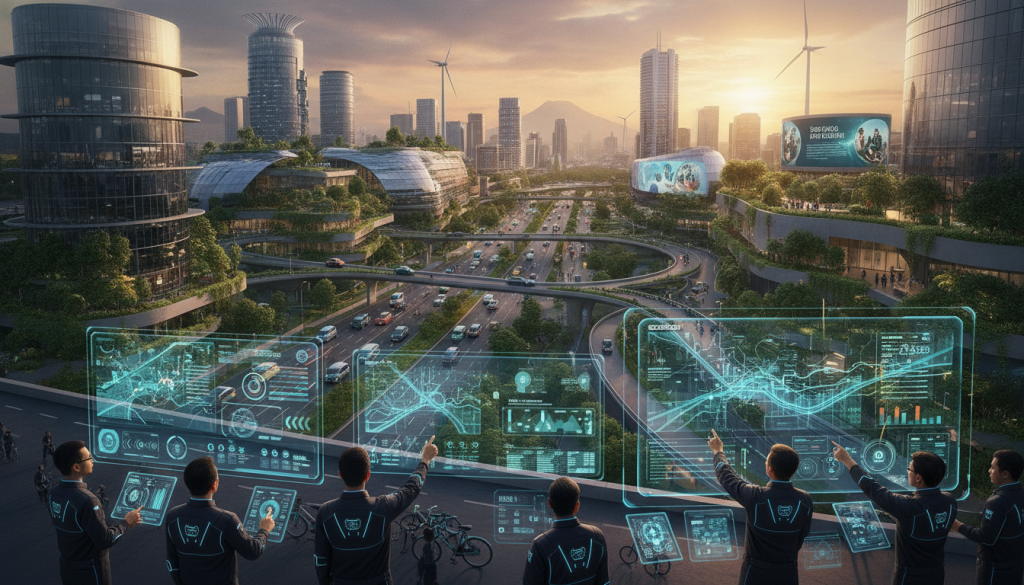
When I first heard about Bandung’s smart city plan, I expected the usual. But Bandung’s approach surprised me. It’s a system that distributes power rather than concentrating it.
The bandung smart city master plan is different from most cities. Instead of sending all data to big tech servers, Bandung lets neighborhoods control their own info and systems.
This isn’t just a choice. It’s a practical way to meet Indonesia’s big electrification goals. Cities need smart systems without losing control.
From Surveillance Framework to Community-Controlled Networks
The early bandung smart city master plan looked familiar. It was influenced by Chinese and Singapore models, focusing on central data control.
Cameras everywhere. Traffic patterns tracked by central databases. Utility use monitored by outside vendors.
But then, community pushback and municipal data sovereignty concerns changed everything. Local officials saw they were about to give control to private companies with no accountability to Bandung residents.
“We don’t want to build smart infrastructure only to discover we’ve locked ourselves into contracts that serve vendors rather than citizens.”
Between 2022 and 2025, Bandung shifted to decentralized IoT urban management. Instead of citywide surveillance, they built local systems where sensors and actuators talk to each other in neighborhood networks.
Data stays local unless needed to share. Privacy is built into the system, not added later.
How Electric Transit Runs Without Central Command
The philosophy behind Bandung’s automated electric public transit is clear. Indonesia aims for 90% public transport electrification by 2030 and full electrification by 2040. But Bandung does it differently.
Traditional systems need big central control rooms. Bandung’s system works like a nervous system, not a command center.
Here’s how it works:
- Anonymous passenger detection: Sensors track crowd density without identifying people, allowing buses to adjust to demand without surveillance
- Distributed charging networks: Electric vehicle charging is spread across district microgrids, not straining central power systems
- Adaptive routing: Bus routes change based on real-time demand detected through decentralized networks, not central algorithms
- Local utility integration: Transit systems work with neighborhood-scale water and energy loops, creating resilient infrastructure that doesn’t rely on citywide networks
I talked to a transit engineer who explained the technical beauty: “Each district manages its own transit ecosystem. The central system coordinates between districts, but it doesn’t control them.”
This approach to automated electric public transit solves a big problem. Traditional systems can fail if one point fails. Bandung’s model keeps neighborhoods running even if connections fail.
The charging system impressed me too. Instead of big charging depots, Bandung uses neighborhood microgrids. Buses charge as they go, using solar, geothermal, and local battery storage.
It’s decentralized IoT urban management tackling one of the biggest urban challenges: moving millions efficiently while cutting emissions.
Why Legacy Cities Fear This Model—And New Cities Study It
Bandung’s approach is a game-changer for cities worldwide. Urban planners from other cities are both fascinated and hesitant.
Older cities with big investments in centralized systems see Bandung as a threat to their existing investments. If you’ve spent big on surveillance and control systems, admitting a better way means your money might have been wasted.
A planner from a major Southeast Asian city said: “Our contracts with tech companies last for fifteen more years. Even if we wanted to switch to a decentralized model, the legal and financial barriers are huge.”
| System Aspect | Centralized Model | Bandung Decentralized Model | Key Advantage |
|---|---|---|---|
| Data Control | Corporate servers, proprietary access | Municipal and neighborhood management | True municipal data sovereignty |
| System Resilience | Single points of failure | Distributed networks continue if sections fail | Infrastructure reliability during crises |
| Privacy Protection | Surveillance by design, privacy added later | Anonymous sensing, privacy by architecture | Community trust and adoption |
| Vendor Dependence | Long-term contracts, lock-in | Open standards, municipal control | Cost reduction and flexibility |
Newer cities are watching Bandung closely. I’ve talked to officials from three other Indonesian cities who are designing their infrastructure with Bandung’s decentralized principles in mind.
One deputy mayor from a growing city outside Jakarta said: “Bandung showed us we don’t have to choose between efficiency and sovereignty. We can build smart infrastructure that truly serves our communities, not just tech companies.”
Building knowledge is key. Bandung didn’t just implement tech; they trained staff and community reps on how it works. Municipal data sovereignty means nothing if locals can’t use it.
Unlike most smart city examples, Bandung builds local capacity. This means the city can maintain, modify, and expand systems without needing outside help.
This is a new way of thinking about urban tech. Instead of using sensors and networks to control cities, Bandung shows how they can empower communities and strengthen democracy.
The decentralized model works better for Indonesia’s electrification goals. Local officials know neighborhood patterns and can spot issues faster than distant bureaucrats.
Visiting Bandung’s transit center was different from other cities. Instead of surveillance screens, I saw coordinators working with district managers. They work together, not from above.
This is the data doctrine that could change urban governance worldwide. It’s not about surveillance and control but about distributing power and keeping local autonomy. Whether other cities can follow depends on their willingness to resist centralized corporate solutions.
Conclusion: The Alpine Engine as Global Template or Tropical Outlier
While exploring Bandung’s vision, I kept wondering: can other cities replicate this, or is it a unique mix of volcanic geology and Indonesian innovation?
The volcanic materials in Bandung are special. Not every city sits on such porous stone. But Bandung’s transformation principles can work anywhere. The key is commitment to integration, not just Indonesian basalt.
I’ve seen many ambitious projects fail in Southeast Asia. What sets Bandung apart is its closed loop stormwater harvesting system. It links to transit corridors, building codes, and data systems. Everything is connected.
Over 100 cities worldwide aim to be carbon neutral by 2050. But most will fail because they pick technologies without a big picture. Solar panels alone won’t work in car-dependent cities.
The lesson from Bandung isn’t about volcanic stone or Sundanese roofs. It’s about organizing cities around zero-emission transit. Then, build everything else to support it.
High-altitude cities like La Paz and Kathmandu can use local resources and wisdom. The materials will vary. But the integration framework remains the same.
Bandung’s success depends on political will and action. But the blueprint is solid. Your city needs to create its own version with the same courage.




Leave A Comment