
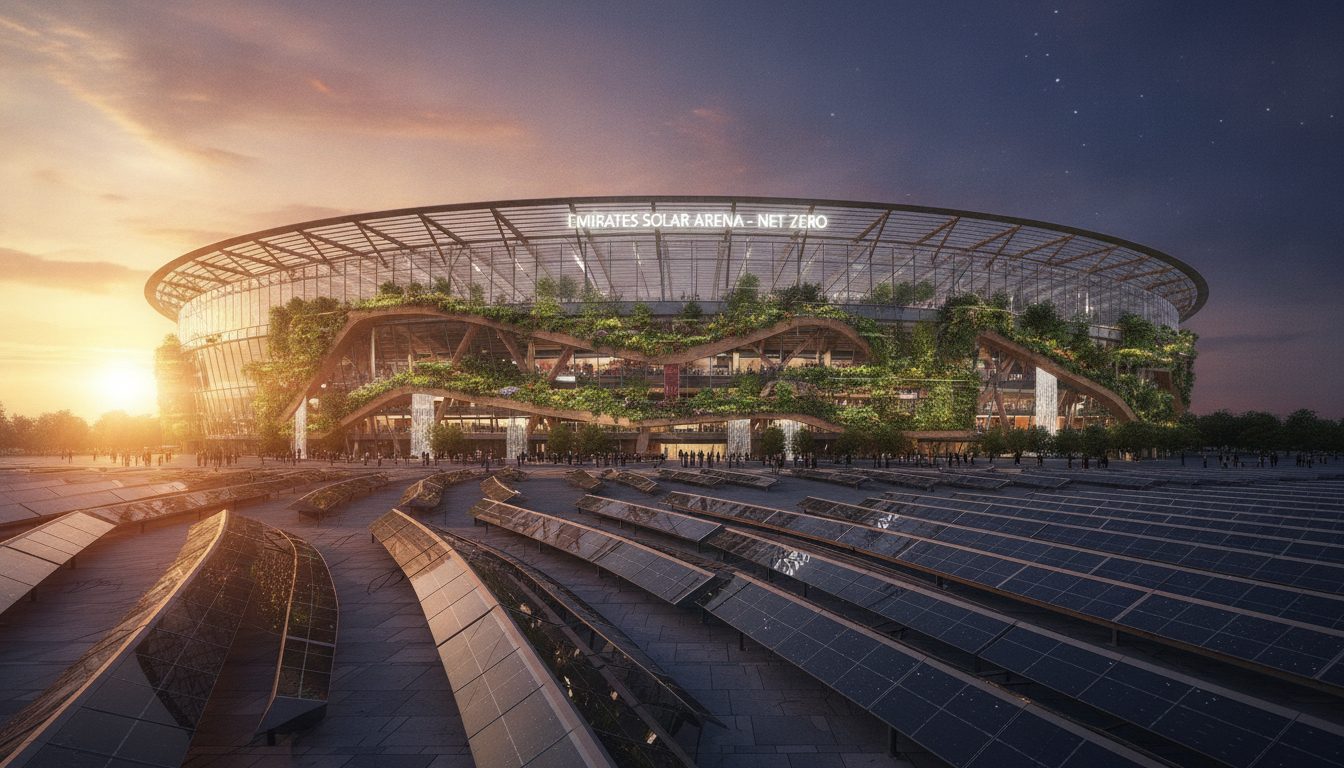
I still remember standing outside this ground and feeling Highbury’s old spirit humming beneath a brand-new skin. That feeling never really leaves you. Now imagine walking through the same gates decades from now. You’ll find North London’s most famous arena wrapped in solar-woven canopies. The floors will hum with every footstep from 60,700 fans.
This isn’t just a dream. Arsenal already started this journey. In 2018, the club signed a deal with Octopus Energy. This made it the first Premier League team to run its home on renewable power. The club has water recycling systems and an anaerobic digestion plant that turns food waste into electricity. They also use LED lighting and voltage optimization to cut energy use by up to 20 percent.
Looking ahead, these small wins will add up to something amazing. I want to show you how this stadium could become a true arsenal net zero arena. It will give back more power than it uses while keeping its Islington soul alive.
Key Takeaways
- Arsenal’s home already runs on 100% renewable energy through the club’s 2018 Octopus Energy deal.
- Existing water recycling and anaerobic digestion systems lay the groundwork for full carbon neutrality.
- Voltage optimization and LED lighting have already cut power consumption by up to 20 percent.
- By 2050, this North London ground could evolve into a fully autonomous, carbon-negative colosseum.
- Solar-woven canopy skins and kinetic rail-podium harvesting represent the next leap in stadium design.
- Closed-loop rainwater cooling networks could keep operations efficient without draining local resources.
- The transformation blends Populous architecture with cutting-edge environmental engineering.
1. Emirates Stadium Future 2050: A New Benchmark for Urban Sports Engineering
Let’s start with the story of Emirates Stadium 2050. It all began with Highbury, a beloved spot for Arsenal fans. But, the club grew too big for it.
By 2050, Islington has become a showcase for urban sports engineering. It shows that ambition and green goals can go hand in hand.
1.1 From Ashburton Grove Populous Design to a Fully Autonomous Colosseum
Arsenal left Highbury for more space and money. They needed to keep up with Europe’s top teams.
The Ashburton Grove Populous design was the answer. Populous, a top sports architecture firm, designed a stadium that could compete financially and athletically. It’s amazing how a business decision turned into a futuristic football icon.
The construction team used BIM modeling for precise steel parts. This attention to detail paid off. The project finished early, a rare achievement in stadium building. It won awards in 2007.
1.2 Scaling a 60,700-Seat Islington Home Into a Carbon-Negative Icon
By 2050, Emirates Stadium has become a symbol of environmental responsibility. It’s now a fully autonomous, carbon-negative stadium.
Every system inside works together, not relying on outside grids. It’s one of the few stadiums leading in sustainability.
The stadium’s identity has changed over the years. Let’s look at the differences in three eras.
| Feature | Highbury (1913–2006) | Emirates Stadium (2006) | Emirates Stadium 2050 |
|---|---|---|---|
| Seating Capacity | 38,419 seats | 60,700 seats | 60,700 seats retained |
| Design Philosophy | Traditional terraced bowl | Populous elliptical dish | Fully autonomous colosseum |
| Energy Model | Grid-dependent | Grid-dependent | Self-sustaining and carbon-negative |
| Recognition | Historic North London landmark | ICE Brunel Medal, 2007 | Global benchmark in urban sports engineering |
The transformation of Emirates Stadium 2050 is remarkable. It shows why it’s a key moment in engineering history.
2. The Solar-Woven Canopy Reimagining Populous’s Elliptical Dish Roof
The roof over Emirates Stadium was never just a roof. It was a calculated bet on sunlight, steel, and nerve.
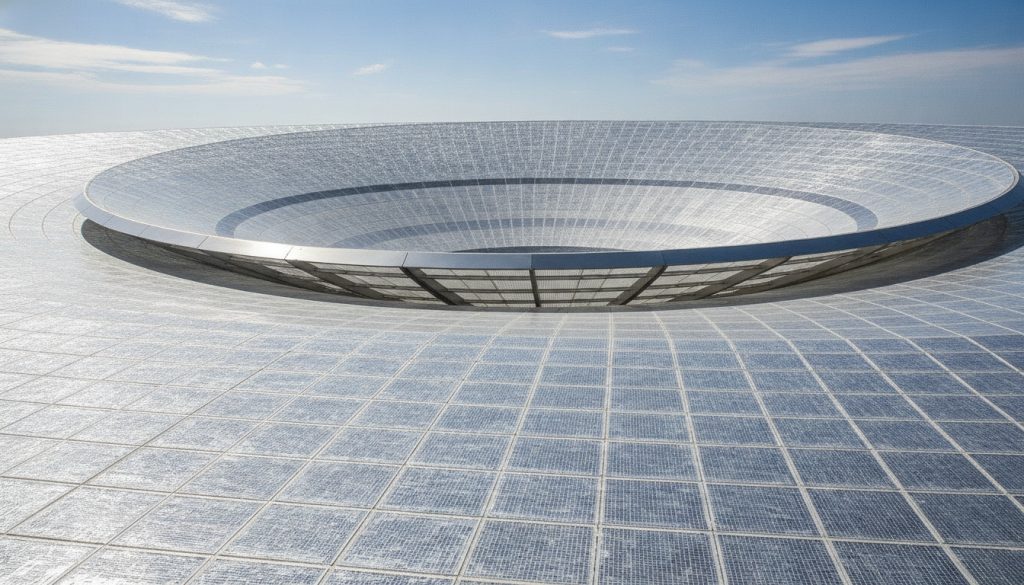
Populous engineers designed an elliptical dish canopy spanning 27,200 square meters, angled directly toward the pitch to pull in maximum natural light. Two primary tubular steel trusses, each stretching 204 meters, carried most of the load, backed by two smaller 100-meter trusses. Getting steel that size onto an Islington construction site took months of planning back in the early 2000s. I can only imagine the crews sweating over every crane lift.
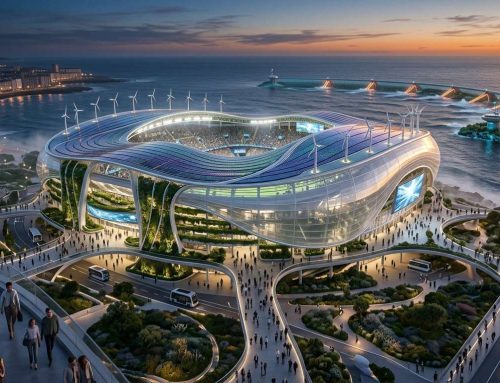
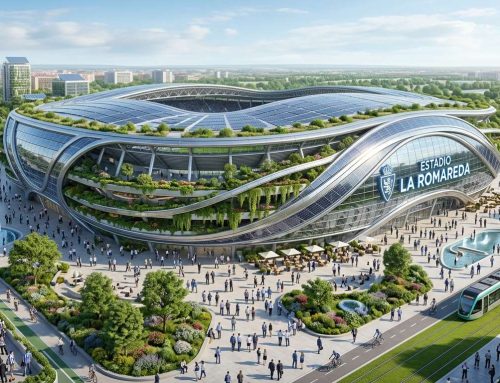
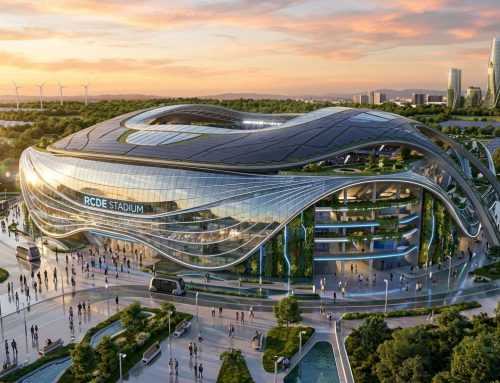
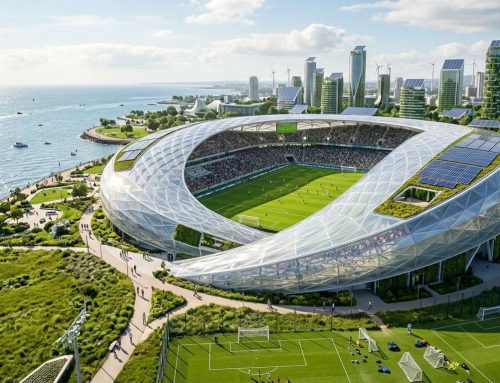
Fast forward to 2050, and that same elliptical shape carries an entirely new purpose. The dish still angles toward the pitch, but now it’s woven with a solar-active membrane that turns every match day into a small power plant. Here’s how the canopy actually works.
PTFE Membrane Solar Roof Technology Explained
PTFE, or polytetrafluoroethylene, has been a stadium roofing staple for decades. Engineers love it because it’s lightweight, weatherproof, and lets light pass through. The 2050 canopy takes that familiar material and layers thin-film photovoltaic cells directly into the membrane.
This is PTFE membrane solar roof technology at its clearest: a translucent skin that still floods the bowl with daylight while quietly converting sunlight into electricity. Because the solar layer stays thin and flexible, it adds surprisingly little extra weight to those original trusses.
Bio-Photovoltaic Skins and the Preservation of Hybrid Grass Pitch Health
Think of the canopy as a greenhouse that also charges a battery. The bio-photovoltaic skins layered over the PTFE base are tuned to filter specific light wavelengths. That lets through what the hybrid grass pitch needs to stay green, while capturing extra energy from the rest of the spectrum.
Getting that balance right matters more than most fans realize. A healthy hybrid pitch needs:
- Consistent daylight hours without heavy shading
- Steady airflow to prevent heat buildup under the canopy
- Even light distribution across every blade of grass, corner to corner
Get any of that wrong, and the grass suffers. Get it right, and the roof feeds the pitch and the grid at the same time.
Urban Sports Arena Structural Dampening in a Solar-Powered Superstructure
Adding a solar skin to a 27,200 square meter roof means adding weight, and weight changes how a structure moves in the wind. That’s where urban sports arena structural dampening comes in.
The same engineering ingenuity that raised those 204-meter trusses back in the 2000s gets repurposed here. Modern dampers and embedded sensors now absorb vibration from wind, crowd movement, and the extra mass of the solar canopy. It’s the original design logic, just working harder for a heavier, energy-generating roof.
3. Every Step Counts: Stadium Kinetic Energy Crowd Harvesting in Action
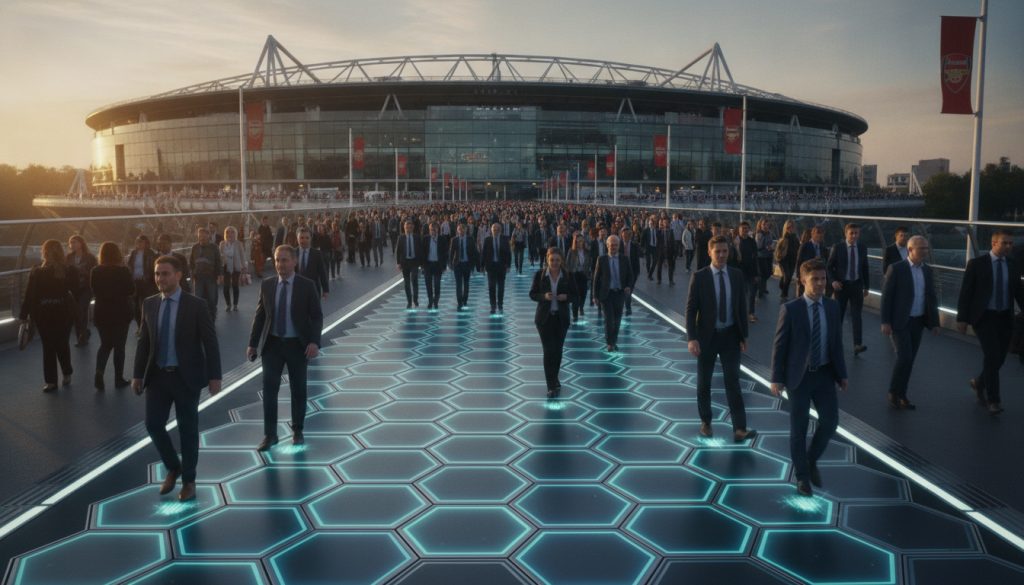
Imagine the crowd’s roar as electricity waiting to be harnessed. Emirates Stadium’s 2050 design turns this idea into reality. Every step, cheer, and celebration adds to the power.
Engineers have placed kinetic pressure plates on the stadium’s walkways. These plates are ready for the fans to move, cheer, and shake the ground.
3.1 Kinetic Pressure Plates Across Podium Bridges and Concourses
The stadium’s original access bridges are key to this innovation. The south bridge is 1,050 tonnes and 100 meters long. It was placed across a railway in one piece, a remarkable feat.
The north bridge was built in two 180-tonne sections, each 70 meters long. It was lifted into place by crane, adding a new function to the bridges.
Pressure plates on these walkways turn every step into energy. With tens of thousands of fans walking, the energy adds up quickly.
This kinetic energy harvesting is quiet but constant on matchday. The fans become a distributed power source across the stadium.
3.2 Converting Matchday Acoustic Vibrations Into Usable Electricity
Footsteps are just part of the story. Premier League crowds are always loud.
Transducers in the stadium’s frame capture sound vibrations. These vibrations are turned into electricity through piezoelectric systems.
“Every physical motion in a modern stadium carries recoverable energy. The challenge has always been capturing it efficiently at scale.”
This design solves that challenge. It combines footstep and sound energy into the stadium’s energy network. This works alongside the solar canopy above.
The power doesn’t go to waste. It’s stored, balanced, and used when the stadium needs it most. This is similar to Arsenal’s approach to trading solar power on the wholesale market.
Being in the crowd, feeling the ground hum, is amazing. The noise and steps you make power the lights above.
4. The Islington Rail Corridor Hydrologic Shield: Water as the Arena’s Lifeblood
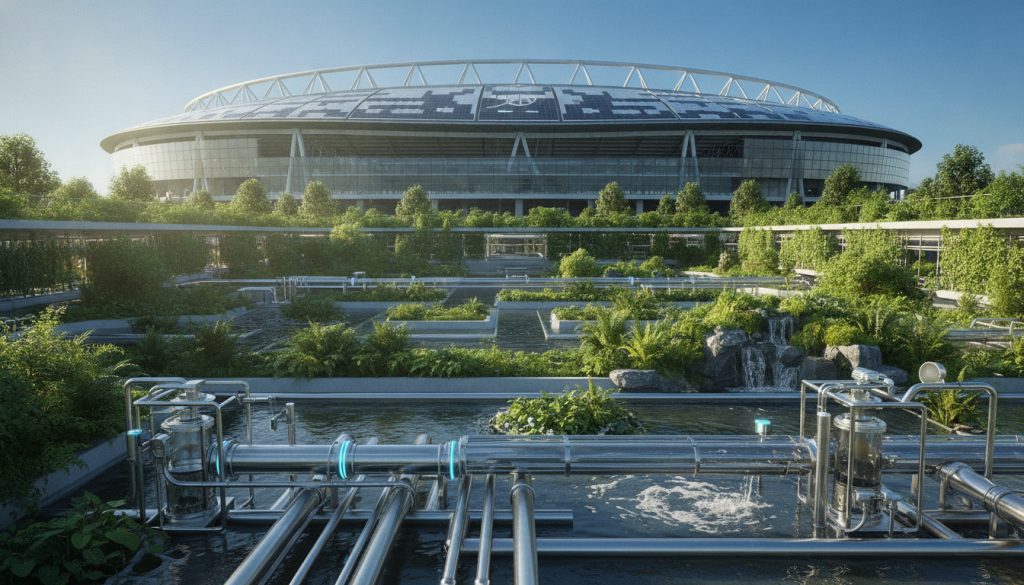
Every stadium has a heartbeat, but Emirates Stadium 2050 has something even rarer: a bloodstream. I learned this while wandering the service tunnels beneath the pitch, tracing pipes that hummed with quiet purpose. Water, not electricity, turns out to be the real force keeping this place alive.
Closed-Loop Reservoir Stormwater Harvesting Beneath North London
Arsenal built water recycling into Emirates Stadium from day one. Rainwater collection systems have quietly served the pitch irrigation and restrooms for years, a smart but modest start.
By 2050, that modest start grew into something far bigger. Engineers expanded the original setup into a full closed loop reservoir stormwater harvesting network that stretches beneath North London’s streets. Every drop that falls on the stadium roof gets pulled underground, filtered, stored, and reused instead of dumped into city drains.
A city that recycles its rain instead of wasting it is a city planning for decades, not just seasons. Islington’s version of this idea sits quietly under thousands of footsteps every matchday, unnoticed but essential.
Subsurface Vaults Capturing 100% of Rainfall and Rail-Corridor Runoff
Emirates Stadium sits right beside a working rail line. Anyone who watched construction crews slide the south bridge across those tracks knows how close the stadium and the railway really are.
That closeness became an opportunity. Subsurface vaults built into the stadium’s foundation now capture 100% of rainfall along with runoff from the nearby rail corridor. Nothing escapes the collection system, whether it falls on the stadium roof or drains off the tracks a few yards away.
This network earns its nickname, the islington rail corridor hydrologic shield, by acting like a protective barrier between the neighborhood and wasted water. Instead of flooding streets or overwhelming old Victorian sewers, every gallon gets redirected underground, filtered through layered gravel beds, then stored for later use.
Zero-Emission Capillary Cooling Loops Across Four Seating Tiers
Collecting water is only half the story. The real payoff shows up on hot matchdays, when fans across all four seating tiers stay comfortable without a single extra watt burned.
Filtered water from the underground vaults travels through capillary cooling loops woven into the stadium’s structure. These loops work like a circulatory system, moving cool water through thin channels behind seating panels and concourse walls.
The system runs on pressure differences and gravity, not electric pumps, which keeps emissions at zero. Fans might never notice the subtle drop in temperature around them, but that comfort comes straight from rain that fell days or even weeks earlier.
Standing in the upper tier during a summer fixture, I felt cool air drifting from vents I couldn’t even see. It hit me then: water really is this stadium’s lifeblood, quietly working through every level of the build.
5. Conclusion
As we wrap up, let’s step back and look at Emirates Stadium 2050. It’s a blend of three key ideas. The solar canopy captures sunlight, kinetic bridges turn footsteps into energy, and a hidden water shield keeps the pitch cool.
This doesn’t forget what made Highbury special. It also keeps Emirates Stadium feeling like home for Arsenal fans. Modern environmental tech meets a century of history, blending seamlessly.
This blend is what gets me most excited. A stadium can have both heart and green tech. The Islington skyline shows us it’s possible.
Imagine being in that crowd in 2050. You’re standing on a kinetic plate, with sunlight from a solar roof above. It’s a quiet, efficient system that keeps the lights on. This vision fills me with hope for stadium design and cities.
If this journey through Emirates Stadium’s future has piqued your interest, keep looking. The next big story in sustainable stadiums might be right around the corner.



Leave A Comment