

I still remember standing in the Porta Nuova district. I looked up at two towers covered in greenery. At first, I thought they were just a beautiful architectural experiment.
But now, I see those green towers as something much bigger. The Bosco Verticale with its 800 trees and 20,000 plants is more than just a building. It’s the start of a new way for cities to grow.
Thinking about Milan in 2050, I see a city where nature is part of the city itself. Not just in parks. Old railway lines become paths for wildlife. And climate resilience guides every decision.
Milan is trying something big. It wants to show that cities can be dense and green at the same time. Urban reforestation can happen on a big scale, not just in small projects.
The question is, is this vision possible? And what does it mean for us who love to explore cities? It’s not just about beauty. It’s about making cities better for everyone.
Key Takeaways
- The Bosco Verticale towers showed that vertical forests can thrive in cities, hosting 800 trees and over 20,000 plants
- Milan’s plan goes beyond green buildings to a big vision of urban reforestation across the city
- The city is turning old industrial sites and railway lines into biodiversity corridors that connect nature
- Climate resilience and ecological planning are now key in city planning, not just an afterthought
- This approach challenges the idea that European cities must choose between being dense or green
- For adventure travelers and urban explorers, this change offers new ways to see cities where nature and architecture merge
- Milan’s model could be a guide for other cities facing similar challenges
From Concrete Icon to Green Pioneer: The Bosco Verticale Revolution
The Bosco Verticale didn’t just add greenery to Milan. It changed how we think about density and nature in cities. When these towers opened in 2014, they showed that nature-based solutions could work at scale in a crowded city.
At first, seeing buildings with full-sized trees felt surreal. But standing under these towers, the leaves moving in the breeze was amazing.
Architect Stefano Boeri was frustrated in Dubai in 2007. He saw endless glass and metal towers that reflected heat. This made him think about buildings that cool, not just reflect, the sun.
Boeri wondered if buildings could cool their surroundings. What if futuristic Milan architecture brought forests into the sky?
The Vertical Forest as Architectural Provocation
Boeri was inspired by Italo Calvino’s “The Baron in the Trees.” This story of a boy living in trees became the idea for the Bosco Verticale.
The Bosco Verticale is not just a building. It’s precision environmental engineering disguised as art.
Each apartment has at least 2 trees, 8 shrubs, and 40 plants. This adds up to over 20,000 plants across both towers. The plants were chosen carefully to provide shade and warmth.
Residents can enjoy their balcony forests but can’t change them. Twice a year, “Flying Gardeners” clean and maintain the plants. This makes the greenery a shared space, not just decoration.
The towers have many benefits:
- Air quality improvement: The plants absorb pollutants and produce oxygen
- Temperature regulation: The plants cool the area by up to 30 degrees Celsius
- Water management: The system manages irrigation and absorbs stormwater
- Noise reduction: The plants block urban noise
- Biodiversity support: The towers provide habitat for birds and insects
Seeing the data, I realized the Bosco Verticale works. It cools the area as well as a big park. This made the concept real.
Redefining Urban Density Through Nature-Based Solutions
The Bosco Verticale is incredibly efficient. It has as much greenery as five hectares of parkland but takes up only 1,000 square meters. That’s fifty times more efficient than traditional parks.
The towers are like urban anti-sprawl devices. They provide the same benefits as single-family homes with greenery but use much less land. This is crucial for cities with limited space.
Milan can’t just clear land for parks. But it can build up, adding nature-based solutions (nbs) to the vertical space.
The Bosco Verticale is a must-see for those interested in sustainable architecture. It shows a new way to live in cities, where nature and people coexist.
The project won many awards. But its real success was changing how we think about cities.
The Ripple Effect: From Two Towers to Citywide Vision
The Bosco Verticale was more than just a building. It challenged everyone in Milan to think differently. If it’s possible here, why not everywhere?
This challenge led to Forestami, Milan’s plan to plant 3 million trees by 2030. The Bosco Verticale showed that integrating nature into cities is possible.
The Bosco Verticale’s success inspired other cities. Places like Utrecht and Nanjing have followed Milan’s lead. But Milan remains at the forefront of urban forestry innovation.
Today, the Bosco Verticale is a preview of what Milan could become. It shows how cities can be both dense and green. This change is not just about looks or awards. It’s about rethinking how we live in cities.
Milan’s journey offers hope for cities that struggle to be green. The Bosco Verticale shows that cities can be vibrant and nature-rich. We can build cities where forests thrive, not despite our density but because of it.
This shift in thinking is the real revolution started by the Bosco Verticale. And it’s just beginning.
Forestami: Milan’s Audacious 3 Million Tree Gambit

I first heard about forestami and thought it was a big deal. Three million trees sounded like a huge change. The name mixes “foresta” (forest) with “mi” (Milan’s short form), showing big ambitions.
This isn’t just about adding a few parks or planting trees for photos. It’s a big plan to change Milan.
Forestami aims to plant three million trees in Milan by 2030. This will cover about 1,200 square kilometers. It’s a big change, going beyond the city center to suburbs and farmland.
The Scale and Scope of Metropolitan Reforestation
Forestami is not just about numbers. It’s a smart plan to make Milan better. It focuses on areas that need help the most.
Milan is in the Po Valley, one of Europe’s most polluted places. The valley traps pollution and summers get very hot. The trees are not just for looks; they help the city survive.
Each tree does many things:
- It cleans the air by filtering out bad stuff and absorbing CO2.
- It helps cool the city by providing shade and cooling through evapotranspiration.
- It helps manage stormwater, reducing flooding.
- It creates a home for insects, birds, and small animals.
- It also helps people feel better by providing green spaces.
The project works because it brings everyone together. Forestami involves cities, universities, green groups, and private landowners. This teamwork makes the plan work.
Beyond Aesthetics: Climate Adaptation as Urban Survival
Milan climate adaptation through trees is more than just pretty. It’s like building infrastructure but using plants. As Milan gets hotter, these trees are key to cooling it down.
The Bosco Verticale showed how trees can help. Now, imagine that effect across the whole city. Trees can lower urban temperatures by 2-8°F, saving lives during heat waves.
Improving air quality is also crucial. The Po Valley’s pollution kills thousands each year. While trees can’t fix everything, they can make a big difference in air quality.
| Climate Challenge | Tree-Based Solution | Measurable Impact |
|---|---|---|
| Urban heat islands | Shade canopy and evapotranspiration cooling | 2-8°F temperature reduction |
| Air pollution (PM2.5) | Leaf surface absorption and filtering | 10-20% particulate reduction in tree zones |
| Stormwater flooding | Root systems and canopy interception | Up to 30% rainfall absorption per tree |
| Mental health stress | Access to green spaces | 15% reduction in anxiety and depression |
This approach to Milan climate adaptation sees green spaces as essential. They’re not just nice to have. They’re needed to keep Milan livable in the future.
Biodiversity Corridors and Ecological Connectivity
Forestami treats Milan as a living system, not just a city. The Bosco Verticale showed this works. In just one year, it attracted 1,600 birds and insects.
The United Nations recognized the Bosco Verticale as a model for urban development. This shows the power of creating habitats in cities.
Forestami aims to connect green spaces across Milan. This creates paths for wildlife to move through the city. It’s not just about planting trees; it’s about making a network.
This approach shows cities are part of nature, not separate. By connecting green areas, sustainable Milan 2050 planning helps species thrive in the city.
Soil health, pollinators, and native plants all benefit. Even temperature-sensitive species can survive hotter summers. It’s a big change for Milan’s future.
By 2050, Milan could be much cooler and greener. The trees being planted now are building a better future. It’s happening now, one tree at a time, across Milan.
The Post-2026 Olympic Legacy: Porta Romana’s Green Metamorphosis

I’ve seen many abandoned Olympic Villages around the world. They all share a sad story of missed chances and broken promises. In Athens, venues are overgrown with weeds. Beijing’s facilities are mostly unused. Rio’s buildings are falling apart, and local people are paying the price.
Milan is doing things differently for the 2026 Winter Olympics. The city is planning a lasting legacy that will change urban spaces for years to come. At the heart of this vision is Porta Romana, a huge railway yard that will become more than just temporary housing for athletes.
The Porta Romana site is 190,000 square meters of old railway space. For years, it was empty as Milan grew around it, creating a gap in the neighborhood. This is similar to what happened in the area where Bosco Verticale now stands, after the old Milano Porta Nuova station closed in 1931.
Turning Industrial Ruins Into Living Systems
Railway yards across Europe face the same issues: polluted soil, crumbling concrete, and wasted land. I’ve seen many of these sites during my travels. They often act as barriers, not bridges, between neighborhoods.
The adaptive reuse plan for Porta Romana tackles these problems head-on. Instead of building temporary structures that get torn down, Milan is creating lasting infrastructure from the start. The Olympic Village will house athletes in 2026 and then become sustainable housing and green space.
This isn’t just about making things look green. The design combines industrial heritage with modern, climate-friendly systems. Railway tracks and structures are integrated into the landscape, not erased. This approach values real transformation over demolition.
The transformation will connect to Forestami goals, creating new ecological corridors and expanding the urban forest canopy. These green spaces will provide cooling, manage stormwater, and support biodiversity long after the Olympics.
Proving Green Design Works for Everyone
Porta Romana is more than just a Vertical Forest. It includes social housing for all, not just the wealthy. Bosco Verticale shows what’s possible, but it doesn’t prove it works for everyone.
Porta Romana aims to show that climate-resilient architecture can work for affordable housing, not just luxury developments. The plan includes extensive vegetation, passive cooling, renewable energy, water recycling, and biodiversity-supporting design. These features will benefit residents of all income levels.
The challenge isn’t creating green buildings for the wealthy—it’s making sustainable architecture accessible to everyone who needs it most.
If this model works, it could be used in Milan and other cities worldwide. It would show that green architecture isn’t just for the elite. It would help communities most affected by heat waves and environmental stress.
The Living Laboratory for Future Neighborhoods
The Olympic Village will be a testbed before being applied citywide. This approach is exciting because it acknowledges uncertainty while moving forward. Not every system will work perfectly, and that’s okay—the goal is to learn.
Milan is testing ways to create carbon-neutral neighborhoods under international scrutiny. The pressure could drive innovation faster than usual. By 2050, when Milan aims to be carbon neutral, Porta Romana could prove the city’s success in turning Olympic infrastructure into climate adaptation assets.
The Milan carbon neutral 2050 vision relies on this kind of transformation. Turning brownfield sites into biodiverse green neighborhoods is key to citywide climate resilience. Each reimagined industrial site adds to the urban forest network.
For those interested in sustainable urban development, Porta Romana will be worth visiting after 2026. The real test won’t be the opening day but whether residents thrive in these spaces years later. Will the climate resilience features cool the city during summer heat waves? Will the adaptive reuse elements create real community spaces?
I plan to return and find out. The transformation from railway yard to living infrastructure shows the kind of real urban evolution worth exploring. If Milan gets it right, the post-2026 olympic legacy could change how we think about mega-events worldwide, making them a catalyst for lasting positive change.
Engineering Urban Healing: Sponge Parks and Gray-to-Green Infrastructure

Urban healing begins with changing how cities handle water. Instead of concrete, cities are turning to green systems. In many cities, rainwater is a problem, rushing into drains and polluting rivers. Milan is changing this.
Switching from gray to green is more than just making cities look better. It’s about creating ecosystems that work with nature. This approach helps with flooding and supports biodiversity.
Sponge City Principles Meet Mediterranean Climate Challenges
The sponge city idea started in China, where cities are redesigned to soak up rain. This simple idea captures, cleans, and reuses rainwater.
Milan faces unique challenges with its Mediterranean climate. It has intense storms and long droughts, made worse by climate change. Old infrastructure can’t handle these changes.
Sponge parks have many features working together. They have surfaces that let water soak into the ground. Bioswales slow down water and clean it. Rain gardens hold water and support plants that need less water.
These parks aren’t just for climate shocks. They help during storms by soaking up water. They also help during droughts by keeping plants watered.
Learn more about resilient cities and how they prepare for climate changes.
| Infrastructure Type | Water Management | Climate Benefits | Biodiversity Impact |
|---|---|---|---|
| Traditional Gray (Concrete/Asphalt) | Rapid drainage to sewers; no retention or filtration | Heat island effect; flood risk; no drought resilience | Zero habitat value; ecological desert |
| Sponge Parks (Green Infrastructure) | Absorption, filtration, storage, and gradual release | Cooling effect; flood mitigation; drought buffer | Native plant habitat; pollinator support; wildlife corridors |
| Hybrid Systems (Bioswales/Rain Gardens) | Controlled capture with overflow capacity | Temperature reduction; dual flood and drought management | Seasonal habitat; migration support; soil regeneration |
The Bosco Verticale shows advanced water management at a building scale. It uses groundwater and recycles water. Solar panels on the roof power a system that waters all floors.
This building works like a tree, using soil and sun for energy. Its drip irrigation system gives each plant the right amount of water, wasting none.
Digital Twins and Data-Driven Green Planning
Technology and nature might seem like opposites, but together they’re revolutionary. An urban digital twin lets planners test ideas before they’re built.
This method brings science to environmental restoration. Instead of guessing, planners can model different scenarios. They can see how each change affects the city.
The Bosco Verticale’s irrigation system is a glimpse of this future. Sensors track moisture and plant health in real-time. The system adjusts water automatically, responding to needs.
Digital twin technology optimizes green space for climate adaptation while saving resources.
Using digital twins city-wide transforms Milan’s planning for 2050. Planners can find the best places for trees and parks. They can design irrigation for 3 million trees without wasting water.
This planning also adapts to changing climates. The digital twin can suggest new infrastructure as needed. It’s a living, evolving plan for the city.
Transforming Streets into Biodiverse Corridors
Streets are often neglected spaces in cities. They’re hot, polluted, and have no wildlife. Milan is turning them into green paths.
Street trees and green medians provide shade and cool the city. Green parking lanes replace solid asphalt with plants. These changes make streets better for everyone.
These corridors are key for wildlife and pollinators. They connect parks and natural areas. They also cool the city during hot summers.
For Milan’s green future, changing streets is crucial. Streets cover a lot of city area. Making them green boosts the impact of parks and forests.
The idea comes from Forestami’s work on biodiversity corridors. Milan is creating a network of green spaces. This lets birds and other wildlife move freely through the city.
This vision tackles many challenges at once. It manages water, reduces heat, supports wildlife, and improves air. It’s a smart way to make cities better.
By 2050, Milan’s sponge city could handle millions of gallons of water. The digital twin will make sure every part works best. And the green streets will connect it all into a living city.
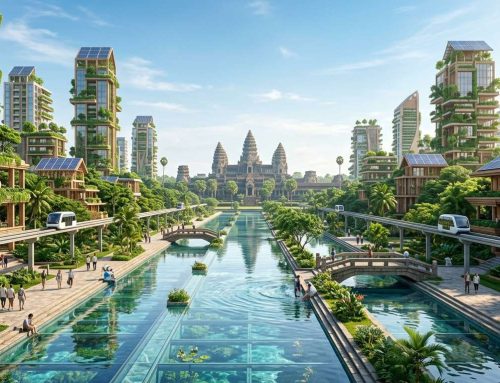
Tengah Forest Town in Singapore 2050.
Milan in 2050: Where the 15-Minute City Meets Italian Luxury

When I think of Milan in 2050, I see a city that values people over cars. It’s a place where Bosco Verticale, Forestami, Porta Romana, and sponge infrastructure come together. They change how people live their daily lives.
The 15-minute city idea is at the heart of this vision. Imagine being able to walk or bike to work, shops, schools, and parks in 15 minutes. This makes cars unnecessary.
This isn’t a new idea. Italian cities were designed for walking before cars came. Milan in 2050 will bring back that old charm with modern green features.
Pedestrianization and the Demise of Car-Centric Urbanism
I picture Milan’s future with fewer cars and more walking and biking. Streets will have wider sidewalks, bike lanes, and trees for shade. Cafes will take over old parking spots, becoming community hubs.
The Bosco Verticale shows this vision is possible. It’s close to the city center and connected to the metro. People don’t need cars to get around.
Milan’s future will focus on people, not cars. It will have better public transport, bike paths, and walking areas. Digital tools will make cars less necessary.
The city’s green spaces will make walking and biking cool, even in summer. Bosco Verticale already shows how green spaces can cool buildings. Imagine that across the city.
By 2050, Milan will be quieter. No more car noises, just people and nature sounds.
Carbon-Neutral Neighborhoods as the New Status Symbol
I’m excited to see how Milan might make green living a status symbol. This could make sustainable neighborhoods the ultimate luxury.
Milan is known for its fashion and design. If it can make green living the new luxury, it could lead the way. This could make people want to live in green neighborhoods.
In Milan in 2050, living in a green neighborhood will show you’re cultured and care about the planet. It’s like designer clothes today.
| Neighborhood Feature | Traditional Luxury (2020s) | Sustainable Luxury (2050) |
|---|---|---|
| Transportation Access | Private parking garage, car ownership | Metro connectivity, bike-share integration, pedestrian priority |
| Green Space | Manicured private gardens, minimal biodiversity | Vertical forests, biodiverse corridors, public forest access |
| Energy Systems | Conventional HVAC, grid dependence | Passive cooling, renewable integration, net-zero consumption |
| Status Indicator | Square footage, premium materials | Carbon footprint reduction, environmental performance certification |
The Bosco Verticale shows sustainable living can be luxurious. It’s a model for the future.
Fashion Capital Reimagined: Ethical Luxury and Sustainable Living
Milan already sets trends in design and fashion. If it makes sustainable living appealing, others will follow. It needs to keep its quality of life while cutting carbon.
Milan’s fashion scene could focus on ethical luxury and sustainable living. This would be a big statement worldwide. It would change how people dress and live in the city.
Digital transformation Milan 2050 will make this vision real. It will use smart buildings, better transport, and apps for local services. Imagine apps for bike-share, route choices, and air quality.
The digital twin could track the city’s carbon footprint. It could make reducing carbon a fun competition between neighborhoods.
Here’s what digital transformation Milan 2050 might include for residents:
- Integrated mobility platforms showing real-time transit, bike-share, and pedestrian route options
- Neighborhood carbon dashboards displaying collective environmental impact
- Local service directories promoting businesses within your 15-minute radius
- Environmental quality sensors providing air quality, temperature, and biodiversity data
- Community engagement tools connecting residents to urban forest maintenance and local initiatives
Private cars will become less important in Milan’s future. Walking and biking will be faster, cheaper, and healthier.
The mix of pedestrian-friendly design, green living, and digital tools will create better neighborhoods. These neighborhoods will be more livable, sustainable, and luxurious than before.
This vision isn’t far-fetched. Milan already has the building blocks for it. The question is whether it can scale these ideas fast enough and make them desirable.
Conclusion: Can the Jungle City Model Be Exported Beyond Milan?
I’ve seen cities all over the world facing climate issues. Milan’s approach, with vertical forests and three million trees, makes me wonder: can this work elsewhere?
The Bosco Verticale shows the concept can travel. Stefano Boeri designed the Trudo Vertical Forest in Eindhoven, finished in 2021. The Easyhome Huanggang Vertical Forest City Complex opened in Huanggang in 2022. The UNFCCC picked the original towers as a model for “virtuous and exportable urban development.”
Future Milan’s urban development can be adapted to other places. A jungle city in Stockholm will be different from one in Singapore. The trees and how they’re watered will change. But the main ideas stay the same—using nature as infrastructure, seeing plants as climate tech, and creating biodiversity corridors and water capture systems.
Milan shows us something important for cities everywhere. You can keep your economy strong while aiming for big environmental goals. Milan is still a top fashion city but is also becoming a forested metropolis.
The big challenge is to copy Milan’s political will, funding, and teamwork. Not every city can do this. Some might not want to try.
For travelers like me, these new jungle cities are exciting places to visit. I’m looking forward to going back to Milan over the next few decades to see how it changes. These cities let you see the future being built, where buildings and nature come together in a new way.
Milan might start a global movement. Or it might be a unique example. Either way, it’s worth watching.



Leave A Comment