
I still remember tracing a map covered in tiny green dots — 900 scattered islands making up one remarkable Pacific nation. That image stuck with me long after I closed the atlas.
It raised a bigger question. What happens when a country this spread out decides to outpace climate change instead of just surviving it?
This nation already sits net negative in emissions. Forests blanket roughly 87% of its land area, giving it a head start most countries can only dream about.
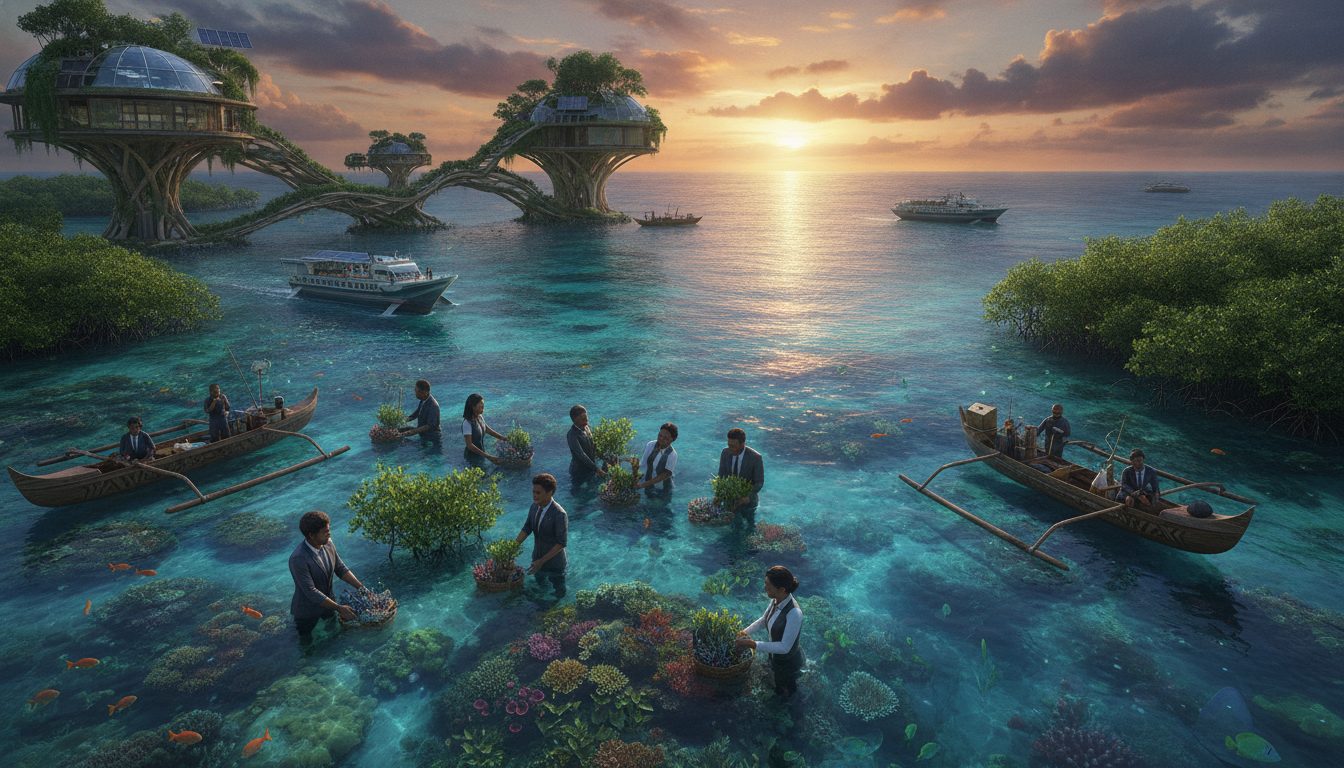
That foundation now supports something far bigger. Picture a fully carbon-negative ocean state built on living reef barriers, floating microgrids, and zero-emission ferries gliding between villages.
I want to walk you through this transformation, framed through Melanesian blue economy resilience — where centuries-old reef stewardship meets genuinely futuristic marine engineering.
It’s the kind of story that makes you stop and say, “wait, tell me more.”
Key Takeaways
- A 900-island Pacific nation is already net negative in emissions, powered largely by forests covering 87% of its land.
- Long-term climate strategy pairs living reef barriers with offshore renewable microgrids for lasting coastal protection.
- Zero-emission hydrofoil transit connects remote communities without adding carbon to the equation.
- Melanesian blue economy resilience blends ancestral reef stewardship with cutting-edge marine physics.
- Ocean Thermal Energy Conversion offers a steady, homegrown power source drawn straight from the sea.
- Community-led kastom practices remain central to how coastal resources get managed and protected.
1. Why Solomon Islands Future 2050 Signals a Turning Point for Climate-Vulnerable Nations
Forget the old story of island nations being helpless against climate change. The Solomon Islands is changing that narrative, and it’s a big deal for the Pacific.
This isn’t just a hopeful story. It’s based on real data, community agreement, and a clear understanding of the risks for island residents.
From Climate Victim to Climate Vanguard
The Solomon Islands is surprisingly net negative in emissions. Its forests take in more carbon than the country emits. This could mean they’re off the hook.
But they’re not off the hook.
The country’s leaders, businesses, and people all agree: keep cutting emissions. This unity is rare, even among wealthier nations still debating targets.
Why keep going when you’re ahead? The answer is simple. Being carbon negative doesn’t protect against storms or droughts. The Solomon Islands is fighting for survival, not just numbers.
The Stakes for 900 Islands and Their People
The National Adaptation Programme of Action highlights the dangers. Agriculture, settlements, water, and health are all at risk. These aren’t just abstract threats; they affect almost everyone.
About 84% of the population lives rurally, relying on traditional food systems. Fishing, gardening, and farming are not just hobbies; they’re how families survive.
On Ontong Java and Sikaiana, freshwater shortages and failing taro crops are real issues. Saltwater is getting into the soil, affecting food security. These problems are happening now, to real families.
Sea level rise and saltwater intrusion have already begun disrupting food and water security in some of the most remote Solomon Island communities.
To understand why this matters for engineering solutions, it helps to see how these pressures affect the islands.
| Vulnerable Sector | Primary Risk | Communities Affected |
|---|---|---|
| Agriculture | Saltwater intrusion, failing taro and staple crops | Ontong Java, Sikaiana, low-lying atolls |
| Water & Sanitation | Freshwater lens contamination, well shortages | Rural atoll communities nationwide |
| Human Settlements | Coastal erosion, storm surge exposure | Coastal villages across Western and Malaita Provinces |
| Human Health | Waterborne illness, food insecurity | Rural populations, roughly 84% of citizens |
Every row in that table represents a community deciding whether to stay or leave. The phrase Solomon Islands future 2050 isn’t just a slogan. It’s a deadline set by rising water, making the engineering work urgent.
Solomon Islands tourist attractions.
2. The Marovo Lagoon Bio Barrier: Reef Engineering as the First Line of Defense
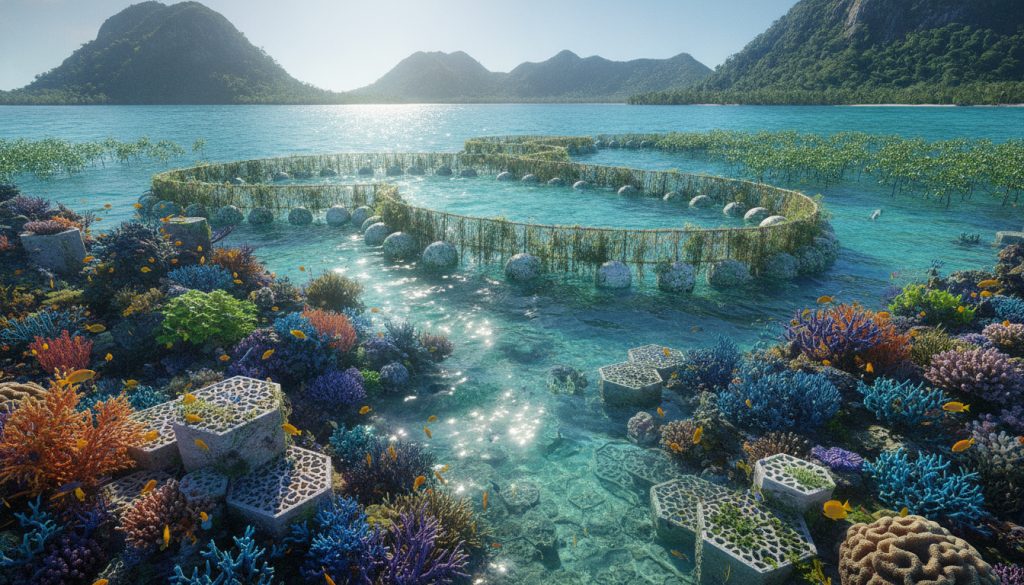
The idea of a lagoon protecting a nation is almost like a movie. Marovo Lagoon is one of the largest saltwater lagoons on Earth. It’s along the coast of the Western Province, surrounded by rainforest and island villages.
By 2050, it will be the country’s first line of coastal defense. This idea is amazing because it combines nature and engineering. The result is the Marovo Lagoon bio barrier, a living system to protect atolls from rising seas.
Electro-Crystallized Coral Matrices Explained
Let’s talk about it simply. Electro-crystallized coral matrices are coral grown with a low electrical current. This current makes minerals build up faster.
Coral larvae attach to metal frames and grow into walls. These walls act as a natural seawall around Marovo Lagoon.
This idea isn’t new worldwide, but using it on this scale is bold. The Marovo Lagoon bio barrier uses living coral that keeps growing and adapting.
Self-Healing Barriers and Cyclone Storm Surge Dissipation
These reef structures are self-healing. When a cyclone hits and breaks coral, the current keeps working. New growth fills in the damage over months, not decades.
Storm surges are a big threat to Pacific coastlines. A coral wall can absorb wave energy before it hits shore. This protects homes and farmland.
Coastal zone management remains one of the most urgent adaptation priorities for small island nations facing sea level rise.
This idea matches urgent climate adaptation reports. Protecting the coastline is not optional for island nations. It’s survival planning.
Outer Reef Systems and Long-Term Marine Resilience
This isn’t just a lagoon fix. The same technology is planned for outer reef systems around 900 islands.
This means the bio barrier concept scales up nationwide. Fish populations get better reef habitat. Coastal villages get storm protection. Fishing communities gain a buffer that grows stronger with time.
I didn’t expect a reef restoration project to be a national security strategy. But the Marovo Lagoon bio barrier is exactly that. It’s a defense system built from coral, current, and time.
3. Powering a Nation Without Carbon: The Pacific OTEC Grid and Beyond
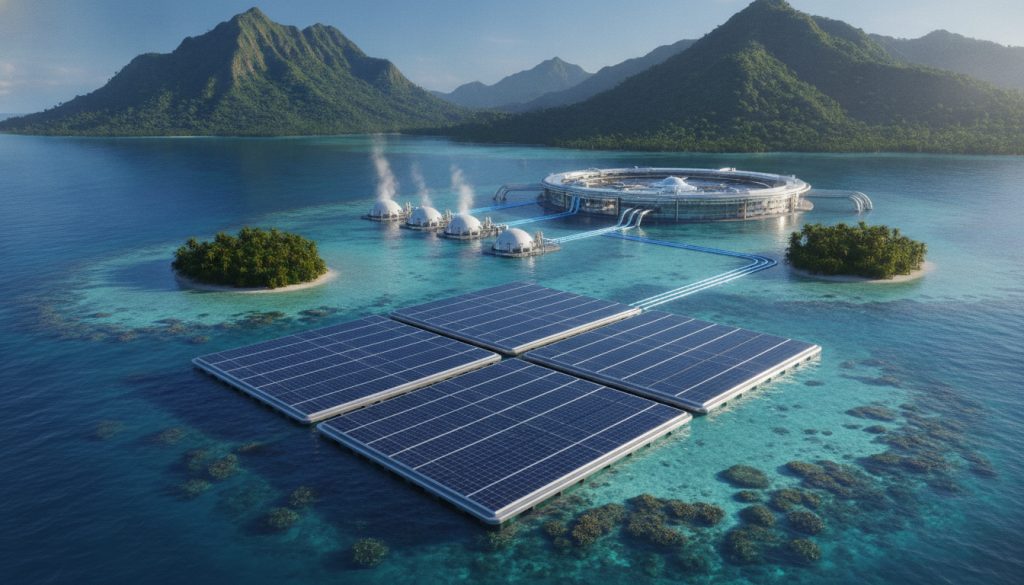
Every island nation faces a big question: how to keep the lights on without fuel imports? The Solomon Islands found an answer by looking into their ocean. They’re building a Pacific OTEC grid to harness electricity from the sea.
It sounds like magic when you first hear it. Warm surface water meets icy deep water, and power gets born. No smoke, no fuel barges, no midnight generator failures.
Ocean Thermal Energy Conversion in New Georgia Sound
New Georgia Sound is where this idea is being tested. Engineers use warm water near the surface and cold water from deep down.
The temperature difference drives a turbine, making electricity. This method doesn’t need sunlight or wind, unlike solar or wind power.
The ocean’s warmth and coldness are constant. This means power is always available, day or night. For a country of 900 islands, this steady power is a game-changer.
Geothermal Power and Floating Lagoon Solar Arrays
OTEC isn’t enough for the whole archipelago. So, planners added two more sources. Volcanic islands offer geothermal heat close to the surface.
Also, floating solar arrays sit on calm lagoon water. This is smart use of space in a country with little flat land.
The LEDS pathway aims for 87 MW of new solar capacity and 92 MW of hydropower by 2050. The Tina River Hydropower Project is a big part of this goal, expected to finish in 2028 for USD 500 million.
“Achieving universal electricity access by 2050 requires diversified renewable investment across solar, hydropower, and community-scale microgrids.”
Uniting the Grid: One Oceanic Microgrid for 900 Islands
The plan is to connect all islands into one microgrid. This is a big step.
OTEC from New Georgia Sound, geothermal wells, and floating solar arrays all feed into this network. Undersea cables link islands, replacing old diesel generators.
The total cost is USD 1.5 billion, plus USD 500 million for Tina River. It’s a big investment for a small nation, but it means energy independence.
| Energy Source | Capacity Target | Investment | Milestone |
|---|---|---|---|
| OTEC (New Georgia Sound) | Continuous baseload power | Part of USD 1.5 billion pathway | Active pilot phase |
| Floating Solar Arrays | 87 MW | Included in USD 1.5 billion | 2050 target |
| Tina River Hydropower | 92 MW | USD 500 million | 2028 completion |
| Geothermal | Supplemental island supply | Included in USD 1.5 billion | 2050 target |
Watching floating panels shimmer in a lagoon, it’s hard not to feel hopeful. A Pacific OTEC grid with geothermal and solar isn’t just a dream. It’s a real plan for small island nations to break free from diesel.
4. Zero-Emission Mobility Across Guadalcanal, Malaita, and Western Province
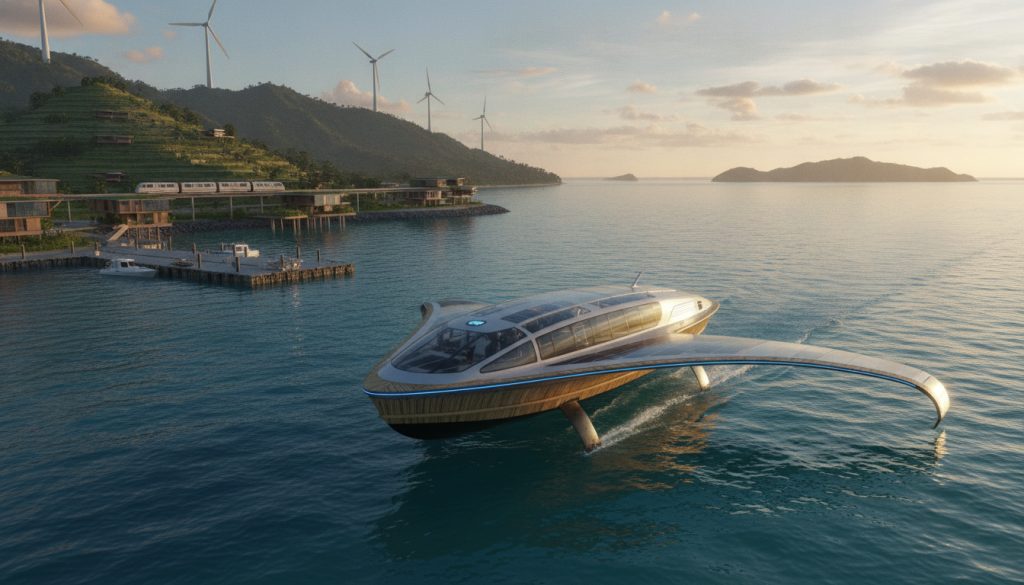
Imagine traveling through Solomon Islands in the future. You’ll see silent hydrofoils gliding on the water, without any diesel. Island-hopping is a big part of the charm here. Boats link families, markets, and economies across Guadalcanal, Malaita, and Western Province.
This daily life won’t change in Solomon Islands’ future. It will just be cleaner. Experts say smarter vehicles and electric boats could cut emissions by 253,000 tonnes of CO2-equivalent by 2050.
Hydrogen Hydrofoils Redefining Inter-Island Transit
Imagine a boat that lifts above the waves, cutting travel time without fuel. That’s what hydrogen hydrofoils promise. They use hydrogen from seawater, powered by the ocean and sun.
This new way of traveling is quiet, unlike today’s diesel ferries. There’s no exhaust or fuel smell. Just a smooth ride between islands.
This isn’t just a dream. Pacific nations have tested hydrofoil prototypes. They work well in tropical waters. Now, it’s time to use them across hundreds of islands.
Solar Cargo Liners and the Future of Pacific Shipping
Cargo is key to keeping the islands supplied. That’s where solar cargo liners come in. They use solar panels and batteries to move goods.
There’s already action on the world stage. Solomon Islands, along with the Marshall Islands and Kiribati, pushed for net zero shipping by 2050. They also suggested a $100 levy on shipping emissions to help vulnerable countries.
“The revised IMO GHG Strategy sets our sector on a course for continued progress in the fight against climate change.”
Small island nations’ efforts are making a difference. They’re shaping global shipping rules today. Solomon Islands’ future 2050 is more than a dream.
| Transport Mode | Fuel Source | Emissions Profile | Primary Route Type |
|---|---|---|---|
| Diesel Ferry (Current) | Marine diesel | High CO2 output | Inter-island passenger routes |
| Hydrogen Hydrofoil | Green hydrogen (electrolysis) | Zero direct emissions | Guadalcanal, Malaita, Western Province transit |
| Solar Cargo Liner | Onboard solar + battery storage | Zero direct emissions | Freight and provincial supply routes |
Standing on a dock in Honiara today, you hear diesel engines and smell fuel. But that’s changing. Hydrogen hydrofoils and solar cargo liners are making travel cleaner for the next generation.
5. Vertical Biophilic Architecture and Subsurface Hydrologic Heritage Engineering
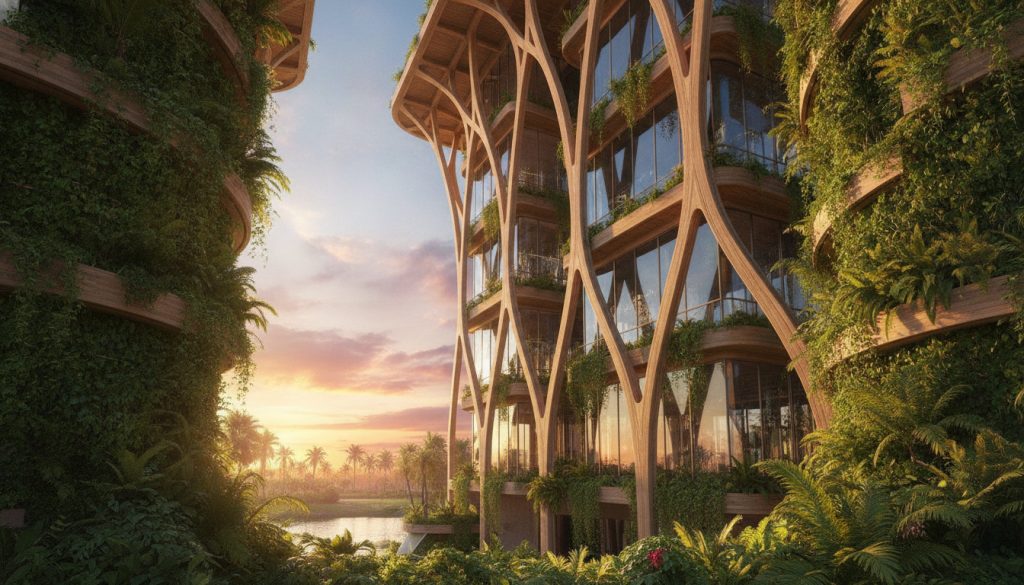
One thing that really gets me excited is what happens when you step off the boats. Solomon Islands 2050 has a vision for villages and towns. They’re built with vertical biophilic architecture carbon neutral in mind, blending old wisdom with new tech.
Buildings are designed to breathe, and water is reused. Almost nothing is wasted. It’s a future where sustainability meets beauty.
Timber-Composite Kastom Structures and Natural Cross-Ventilation
Traditional Melanesian kastom houses are great at handling heat. They have steep roofs, raised floors, and open walls. This lets air move freely.
Future architects might use engineered composite panels instead of timber. These panels can withstand cyclone winds and salt air. The buildings will rise several stories in coastal towns, stacking homes and shops without needing air conditioning.
Natural cross-ventilation channels sea breezes through open corridors and shaded courtyards. It’s a quiet kind of innovation. It respects ancestral design instead of replacing it with glass towers.
Closed-Loop Hydrologic Vaults and Reservoir Stormwater Harvesting
Underneath these buildings, there’s something even more fascinating: subsurface hydrologic heritage engineering. Closed-loop hydrologic vaults capture rainwater during the wet season. They store it below ground, away from evaporation and contamination.
This water is then cycled back up to cool interior spaces during hot afternoons. It then flows out to irrigate community gardens and taro patches. This closed loop reservoir stormwater harvesting turns seasonal flooding into a dependable resource. It addresses water security gaps that national climate assessments have highlighted for years.
Stadium Porous Asphalt Drainage as a Design Model
Parking lots might not sound inspiring, but they are. Some of the world’s biggest stadiums use porous asphalt to drain stormwater without runoff. This principle scales down beautifully for island infrastructure.
Stadium porous asphalt stormwater drainage systems let rain soak through pavement instead of pooling or rushing into the sea. This reduces sediment and debris. Applied across an entire nation, it means healthier lagoons, fewer flash floods, and calmer mornings for everyone living along the coast.
Conclusion
Looking back at the Solomon Islands’ journey to 2050, a simple truth stands out. This nation isn’t following someone else’s plan. It’s creating its own.
The reef barriers in Marovo Lagoon and the ocean-powered grid in New Georgia Sound are just the start. Hydrogen hydrofoils and buildings that work with the wind are part of it too. But it’s the people who’ve lived here for thousands of years that make it special.
This story is unique because it combines old traditions with cutting-edge science. The Solomon Islands respect their reefs and tides. They build with what nature gives them. This is the base of their strength.
This approach changes what it means to be an island nation. It’s not about waiting for help or accepting outside solutions. It’s about leading with their own knowledge and vision.
I’ll be keeping an eye on how this story unfolds. I encourage others to do the same. The Solomon Islands might show the way for other island nations.

Leave A Comment