
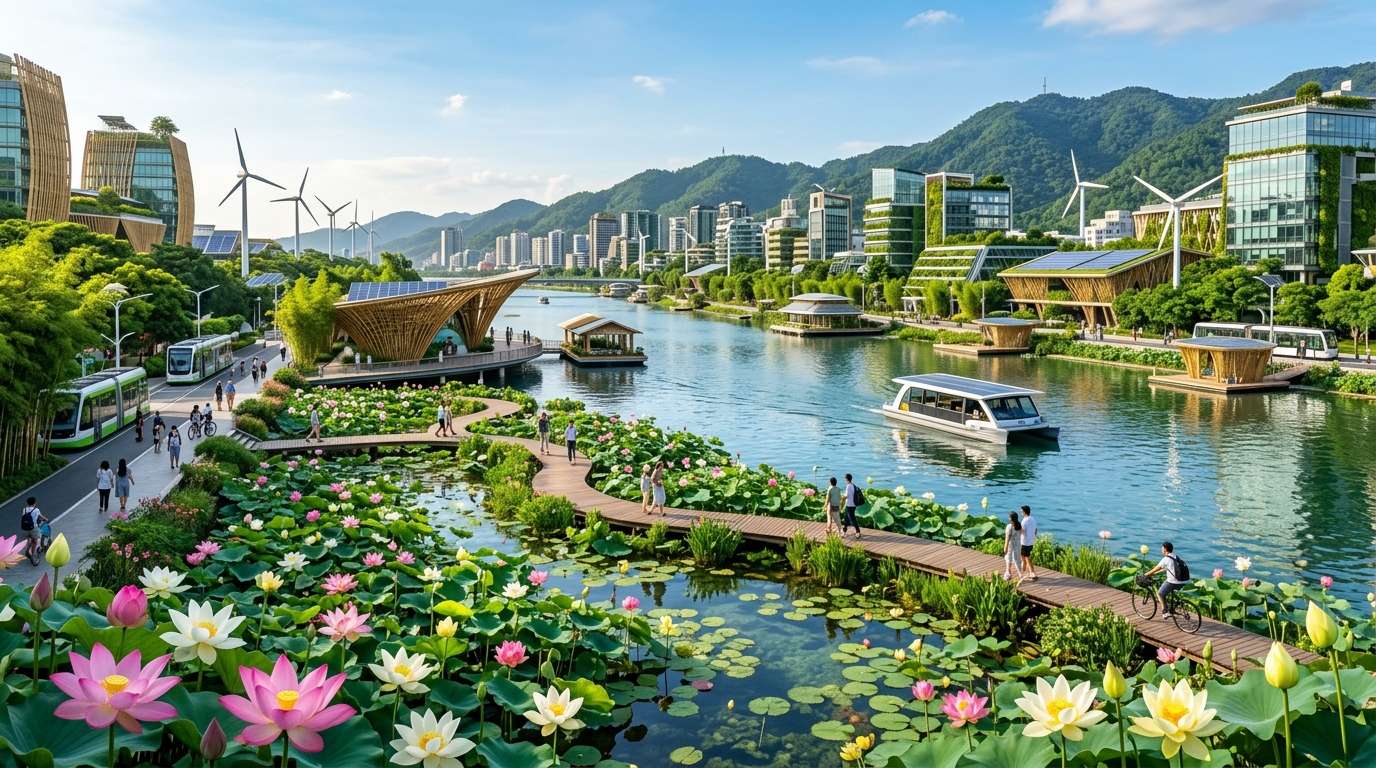
I stood on the muddy banks of the Mun River last monsoon season. Water climbed higher than I had ever seen. Fishermen pulled their boats up early.
Monks at a nearby temple swept flood debris from the stone steps. It felt urgent, almost fragile.
Then I closed my eyes and pictured that same spot decades from now. I imagined the Ubon Ratchathani future 2050 as a city that turned flooding into strength. I call it the Lotus Engine.
It would link flood vaults, heat-resistant temple materials, and public plazas that generate power with every footstep.
This is not pure fantasy. The Bangkok Post has reported on the world’s largest hydro-floating solar farm at Sirindhorn Dam in this province. It connects to Thailand’s carbon-neutral pledge, announced by Prime Minister Prayut Chan-o-cha at COP26.
That pledge gives this riverside capital a real chance to become extraordinary. I map the Ubon Ratchathani future 2050 as a travel story and a blueprint for a resilient sanctuary.
Key Takeaways
- The region already hosts the world’s largest hydro-floating solar farm, anchored at Sirindhorn Dam in Thailand’s Isan heartland.
- Thailand’s carbon-neutral pledge, announced at COP26, gives this area real momentum toward sustainable growth.
- The “Lotus Engine” concept blends flood management, heritage preservation, and renewable energy into one connected system.
- Seasonal Mun River flooding could become a resource for hydrologic retention and clean power generation.
- Historic temple sites may adopt breathable, climate-resistant materials without losing their cultural character.
- Public spaces like Thung Si Mueang could generate energy through everyday foot traffic.
1. A Lower Isan Capital Reimagined as a Carbon-Neutral Sanctuary
The first time someone told me Ubon Ratchathani would be carbon-neutral by 2050, I almost laughed. Then I investigated why.
Thailand committed to a nationwide carbon-neutral target by 2050, a pledge the Bangkok Post reported as a defining policy shift. By then, Ubon Ratchathani aims to become a global masterclass in river-basin heritage resilience. It will scale Lower Isan’s spiritual capital into a true carbon-neutral sanctuary.
Its temples have shaped daily rhythms for centuries. Its farmers have followed the Mun River’s seasonal pulse just as long. That connection between water, land, and faith runs deeper than most outsiders realize.
I learned about farmers like Banjong Panin, part of the Sustainable Rice Platform working across Ubon Ratchathani’s paddies. His methods cut water use nearly in half through smarter irrigation timing. That’s not a government mandate. It is farming wisdom meeting modern technique, the thinking behind this Isan Buddhist net-zero heritage story.
2. Guarding Wat Phra That Nong Bua’s Sacred Silhouette
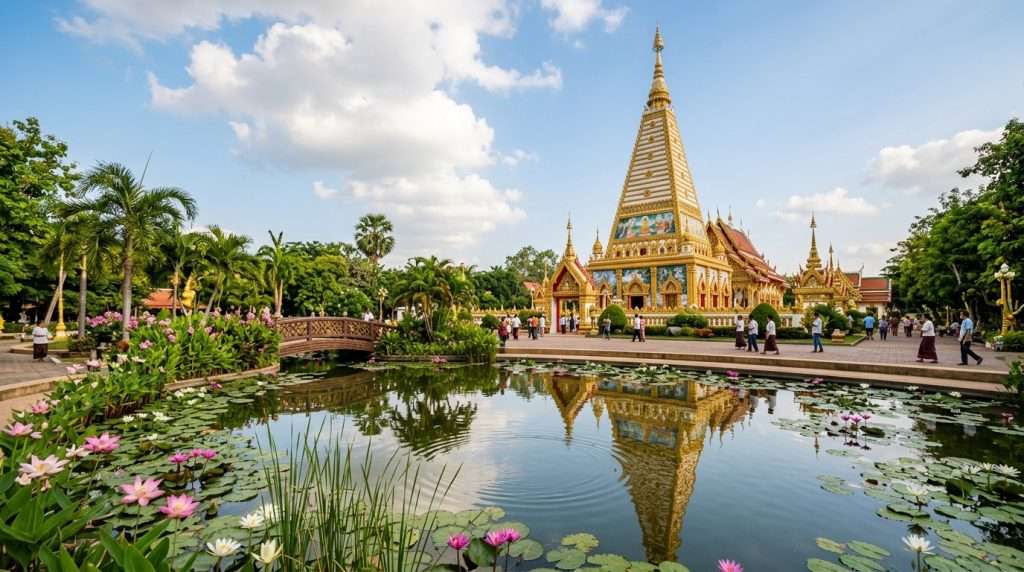
Walking toward the sacred chedi at Wat Phra That Nong Bua, I noticed years of quiet engineering work. The 56-meter spire rises above the temple grounds like a beacon, modeled after India’s famous Bodh Gaya structure. Keeping its silhouette crisp against the Isan sky takes serious science, not prayer alone.
Protecting the 56-Meter Bodh Gaya-Style Chedi from Tropical Weathering
Isan’s climate is brutal on old stone. Monsoon moisture enters every crack, and following heat breeds mold almost overnight. I learned that stucco spalling, when the outer surface flakes and crumbles, threatens the chedi most.
Conservation teams watch for three warning signs constantly:
- Hairline cracks that trap humidity
- Dark mold blooms on shaded surfaces
- Surface flaking after heavy rains
Each issue worsens the next. Catching them early is everything.
Non-Invasive Mineral Masonry Glazes and the Science of Breathable Stone
Here’s where it gets interesting. Instead of sealing the chedi with modern waterproof coatings, conservators apply non invasive mineral masonry glazes. These nano-thin layers let stone breathe while blocking moisture intrusion.
Traditional sealants trap water vapor inside, speeding decay. Breathable glazes work differently:
- They repel surface water without blocking vapor exchange
- They bond mineralogically with the original stucco
- They require no demolition or resurfacing
I found this approach refreshingly humble. It respects what’s already there instead of covering it up.
Preserving the Jataka Reliefs’ White-and-Gold Narrative
The reliefs circling the chedi base tell the Jataka tales, stories of the Buddha’s past lives carved in white-and-gold detail. Standing close, I could trace individual figures that stayed crisp after decades of exposure.
That clarity does not happen by accident. Preservation teams treat each relief as an artifact and storybook, protecting pigment layers as carefully as the stone beneath.
This careful balance between science and storytelling explains why wat phra that nong bua preservation efforts matter so much. If you lose the texture, you lose the narrative too.
3. Mun River Flood Defense Beneath the Riverfront
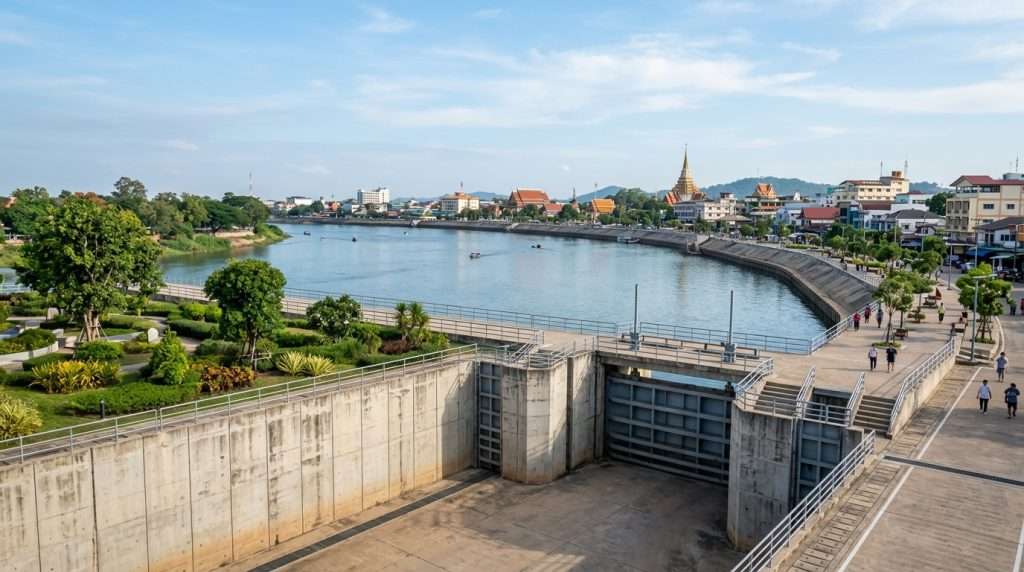
I’ve walked along riverfronts worldwide, but none hides a secret like this one. In 2050, families stroll, vendors sell grilled fish, and kids chase pigeons. Nothing about the scene reveals an engineering marvel.
Beneath this peaceful pavement lies Southeast Asia’s advanced mun river flood defense system. It works quietly, so the old town no longer faces disaster.
Automated Subterranean Retention Vaults Capturing 100% of Monsoon Deluges
Each monsoon season, the Mun River once rose without warning. Old photos of Ubon Ratchathani show flooded streets, shops, and temple grounds.
The vault network changed that story. Automated chambers lie below the riverfront, guided by rainfall sensors and real-time river monitors.
When heavy monsoon rain arrives, gates open automatically. Floodwater enters the vaults instead of flowing through the city. The system claims to capture 100 percent of seasonal deluges, once an impossible result for longtime residents.
Subsurface Hydrologic Heritage Engineering: From Floodwater to Filtered Resource
This system differs from a typical flood barrier. The water does not simply wait underground for someone to pump it away.
This is subsurface hydrologic heritage engineering in action. Filters clean the captured water, changing a seasonal threat into a useful resource.
Research from the Sustainable Rice Platform found that alternate wetting-and-drying irrigation cut water use by half for Ubon Ratchathani rice growers. That approach now guides the city’s foundation.
| Water Management Approach | Water Loss | Resource Recovery |
|---|---|---|
| Traditional flood drainage | High runoff waste | None |
| Alternate wetting-drying irrigation | 50% reduction | Partial reuse |
| Subsurface retention vaults | Near-zero waste | Full filtration and reuse |
Zero-Emission Capillary Cooling Loops Safeguarding the Wooden Ho Trai
The filtered water leaves storage and moves through zero-emission capillary cooling loops. These loops connect to the wooden Ho Trai at Wat Thung Si Mueang.
This manuscript hall holds centuries-old palm-leaf scriptures. Heat and humidity can destroy these fragile pages within years.
The cooling loops control temperature and moisture around the structure without fossil fuel. Floodwater once threatened the old town but now protects its oldest written treasures. This careful cycle makes the riverfront feel like a promise kept.
4. Thung Si Mueang Park and the Candle Festival’s Hidden Power Grid
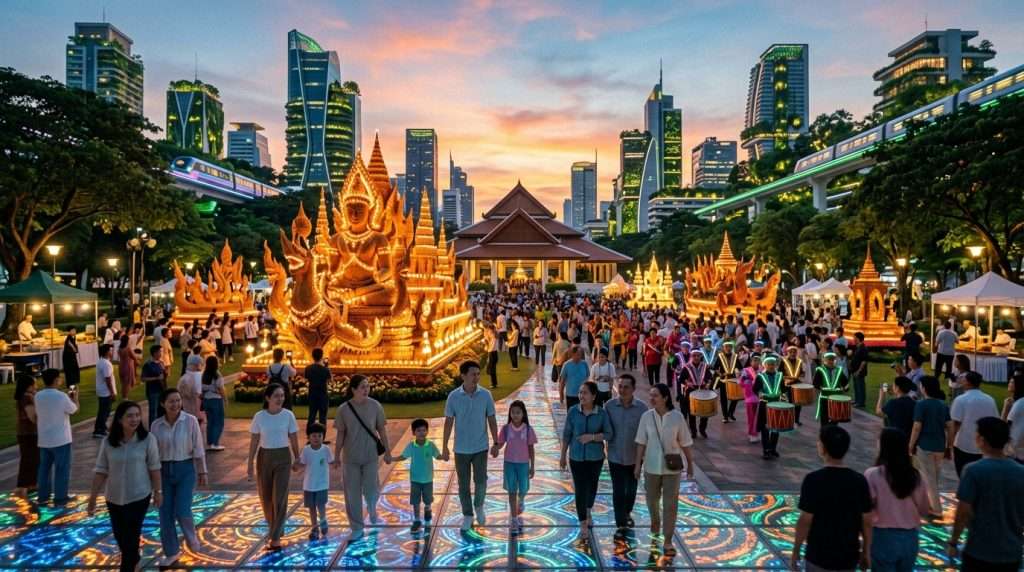
During the Candle Festival, walk through Thung Si Mueang Park. Wax sculptures taller than tuk-tuks glow beneath lantern strings. Crowds move past food stalls. Drums echo through the humid night. Nobody looks at the ground, and that is the point.
Ubon Ratchathani future 2050 plans hide a quiet energy system beneath those thousands of footsteps. It turns the festival into a power source without interrupting anyone’s stride.
4.1 Piezoelectric Pavers Turning Festival Footsteps into Energy
Piezoelectric pavers sound complex, but the idea is simple. Certain materials create a small electrical charge when pressed. Engineers place them inside strong paving tiles along the park’s busiest paths.
One footstep creates almost no power. Yet the Candle Festival attracts hundreds of thousands of visitors over several days each July. Every step, dance move, and photo stop near the wax floats adds to the total.
The pavers feel no different underfoot. Festival-goers never notice a thing. They keep walking and light the night with every stride.
4.2 Powering a Clean Microgrid Along Candle Festival Avenues
Captured footstep energy feeds a local microgrid. It powers string lights, sound systems, and food stalls along the main festival avenues.
This reflects a wider shift across Thailand. According to Bangkok Post coverage of its expansion plans, EGAT has pushed toward decentralized renewable power. Ubon Ratchathani’s festival grid follows that logic on a smaller, more playful scale.
No diesel generators rumble nearby. No extension cables cross the grass toward the main grid. The energy comes from the celebration itself, and it stays clean from footstep to lightbulb.
| Power Method | Emissions | Grid Dependence | Festival Suitability |
|---|---|---|---|
| Diesel Generators | High, constant exhaust | None, fully standalone | Noisy, disrupts festival atmosphere |
| Extended Grid Cables | Low, grid-sourced | High, strains local grid | Limited by cable length and capacity |
| Piezoelectric Pavers with Solar | Zero on-site emissions | Low, self-sustaining microgrid | Blends seamlessly into festival crowds |
5. Expanding Hydrologic Heritage Engineering Citywide
I never expected a sports stadium to teach me about flood control, but Ubon Ratchathani proved me wrong. The city’s 2050 roadmap reaches beyond temple walls and riverside vaults. It covers parking lots, public parks, and reservoirs across the Mun River basin. Ubon Ratchathani redefines Isan citadel longevity by treating every city surface as one connected water system, not only the historic core.
5.1 Stadium Porous Asphalt Stormwater Drainage Networks
Ubon Ratchathani’s municipal stadium flooded every rainy season. Its flat, hard-packed grounds absorbed very little water. Engineers repaved the parking lots and nearby fields with porous asphalt, which lets rain sink through instead of pooling.
That change turned thousands of square meters of dead pavement into working drainage infrastructure. Rain no longer races toward storm drains or overwhelms the Mun River during heavy downpours. Instead, it seeps underground, recharging soil and reducing street floods.
The stadium’s porous asphalt stormwater drainage network protects neighborhoods and historic lanes from flash floods that once disrupted daily life.
5.2 Closed-Loop Reservoir Stormwater Harvesting Across the Basin
Beyond pavement, Ubon Ratchathani follows Thailand’s national energy playbook. The plan captures stormwater in reservoirs and filters it. It cycles water back for irrigation, drinking supplies, or power generation instead of letting it wash downstream.
This is not a futuristic guess. Bangkok Post has reported on EGAT’s rollout of 16 hydro-floating solar and reservoir hybrid projects nationwide, totaling 2.7 gigawatts. Srinagarind Dam in Kanchanaburi already runs this renewable-reservoir model, proving it works at scale.
Across the Mun basin, closed-loop reservoir stormwater harvesting means each monsoon season adds to water and energy reserves. The water would otherwise drain away unused. Groups like the Food Planet Prize have highlighted this approach in Thailand’s wider sustainable food and water movement.
6. Ubon Ratchathani Future 2050: A Blueprint for Isan Buddhist Net-Zero Heritage
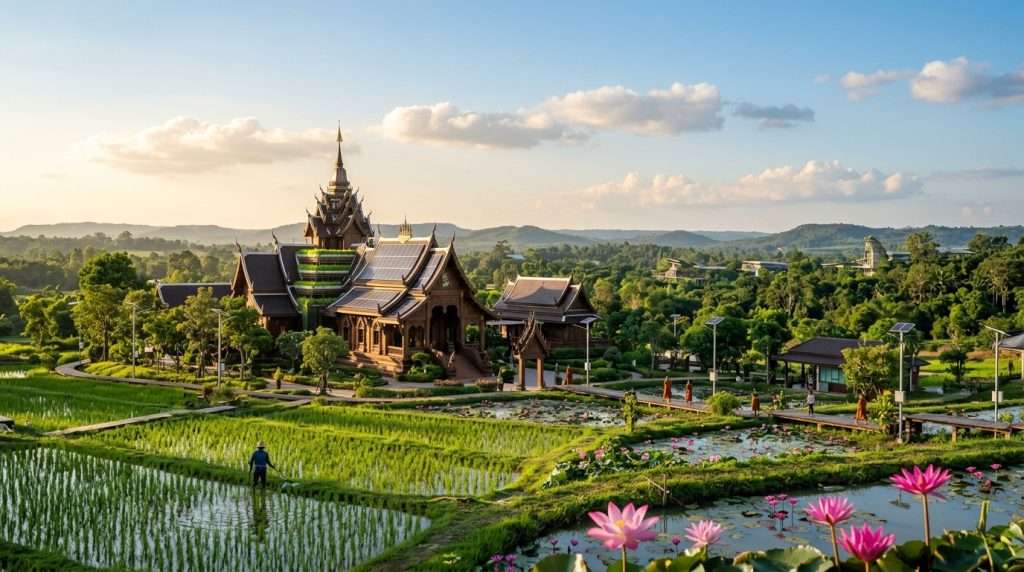
By 2050, I believe Ubon Ratchathani will become a global masterclass in river basin heritage resilience. This is not a distant planning dream. It is a working model built on engineering, policy, and respect for sacred ground.
Lower Isan’s Spiritual Capital Scaled to Global Standards
I once saw Ubon Ratchathani as a quiet stop near Laos, not a city people would study. That view did not last.
Thailand’s national pledge set a 2050 deadline for carbon neutrality. This province already had proof through local rice farmers using the Sustainable Rice Platform, an international standard for low-emission, water-efficient farming.
That is certified proof, not a marketing slogan. It resembles the evidence behind Copenhagen’s cycling reputation and Singapore’s green building leadership.
Add river basin resilience and sacred-site preservation, and you get an isan buddhist net zero heritage model other cities want to copy.
Why Wat Phra That Nong Bua Preservation Sets the Benchmark
Conservators from outside Thailand now study wat phra that nong bua preservation, much like students study famous European restorations. Researchers have flown in to examine the mineral glazing and moisture-control systems protecting the 56-meter chedi.
This case proves heritage protection and net-zero engineering can share resources. Breathable stone treatments shield the Jataka reliefs from tropical humidity and reduce energy use for climate control.
“You don’t usually see a temple’s survival strategy double as a city’s water infrastructure. That overlap is what makes this site worth studying.”
Ubon Ratchathani redefines Isan citadel longevity by showing that durability and sustainability can share one blueprint.
| City | Signature Sustainability Focus | Global Recognition | Heritage Integration |
|---|---|---|---|
| Ubon Ratchathani | River basin flood defense, carbon-neutral temple engineering | Sustainable Rice Platform certification, national 2050 carbon-neutral pledge | Wat Phra That Nong Bua techniques studied worldwide |
| Copenhagen | Cycling infrastructure, carbon-neutral transit | UN-recognized carbon-neutral capital goal | Minimal integration with pre-modern sacred sites |
| Singapore | Green building certification, vertical greenery | BCA Green Mark global benchmark | Modern heritage districts, few ancient religious landmarks |
7. The Tension Between Sacred Authenticity and Engineering Intervention
I won’t pretend this vision feels settled in my mind. Protecting a 700-year-old chedi with nano-glazes and underground vaults sounds smart on paper. But does it protect what makes the place sacred?
Can Technology Preserve Spirit as Well as Structure?
A breathable glaze can shield limestone from acid rain. A buried vault can hold back a monsoon before it reaches a wooden library. Neither can capture the feeling of standing before Wat Phra That Nong Bua at sunrise.
I think about Banjong Panin, a rice farmer who worked with the Sustainable Rice Platform. She doubted new farming methods her family had used for generations. She trusted them only after seeing healthier yields and less wasted water herself.
Communities near this temple might share that hesitation. Change earns trust slowly, through visible results, not blueprints alone.
Lessons for Other River-Basin Heritage Cities Worldwide
Ubon Ratchathani isn’t alone in this struggle. Cities along the Ganges, the Nile, and the Mekong face similar flood risks. They also fear losing something intangible while fixing something physical.
Research on climate risks across the Mekong region shows that water management decisions ripple beyond city limits, affecting culture, farming, and faith.
What makes Ubon’s approach worth copying is not the technology itself. Tools arrive slowly and carefully, with the community leading the way. That process wins over one skeptic at a time.
8. Conclusion
I came to Ubon Ratchathani for the golden chedi, river light, and candle carvings. I found something larger than any single temple visit.
Imagining Ubon Ratchathani future 2050 means more than underground vaults or piezoelectric pavers. Those details still matter.
It means a city can honor its past while creating a livable future. Monks still chant at Wat Phra That Nong Bua. The Mun River still rises every monsoon season.
The candle festival still draws crowds every year. These traditions do not disappear under the plan. The plan protects them.
Net-zero living and sacred tradition can share the same ground. They can support each other, like lotus stems growing in muddy water.
If you plan a route through Isan, keep this city on your radar. This quiet corner of Thailand may teach the world how to build cities that last.
Watch Ubon Ratchathani future 2050 unfold over the next few years.







Leave A Comment