
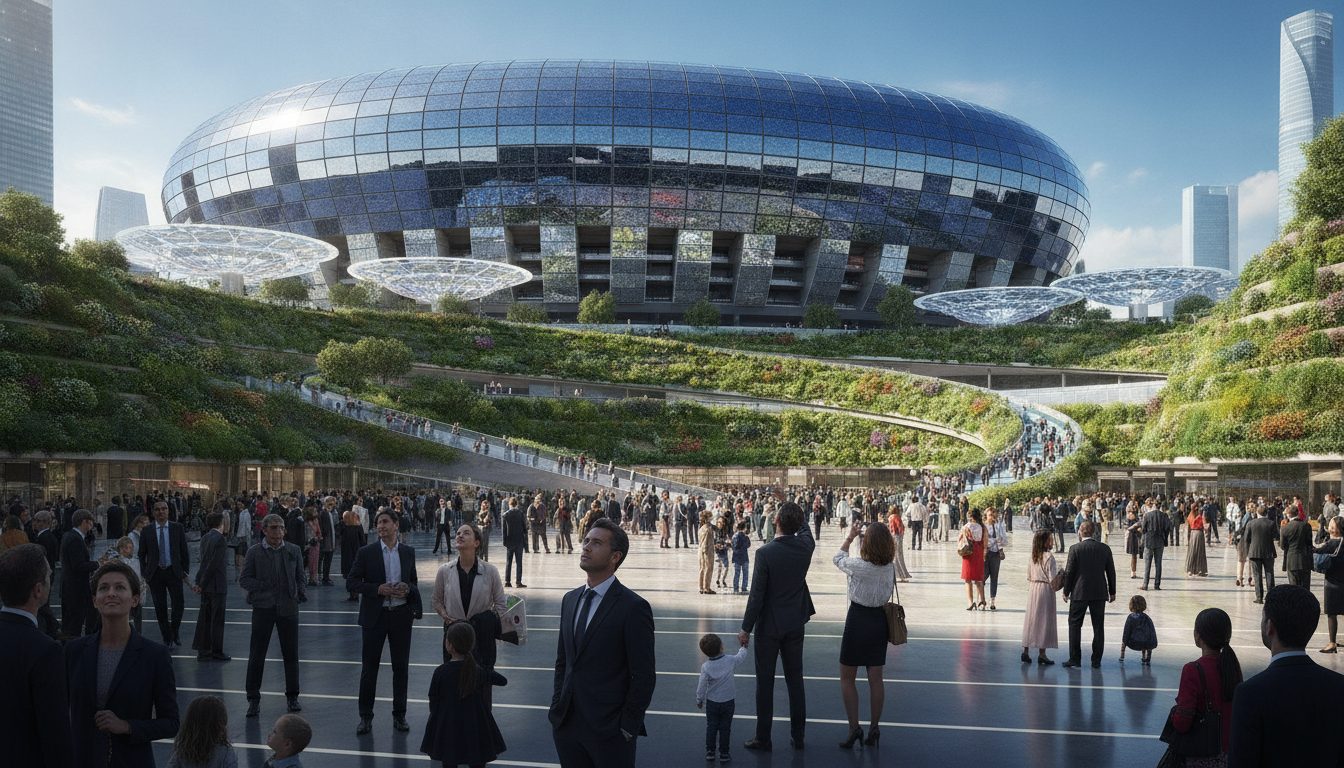
I’ve seen many stadiums around the world, but this one is special. The changes in Madrid’s Chamartín district are not just updates. They’re a new way of thinking about sports infrastructure for cities.
Since 1947, this stadium has seen many historic games. Now, it’s getting a new look with a stainless steel shell by gmp Architects. This isn’t just for looks. It’s the start of a carbon-negative powerhouse that will make more energy than it uses.
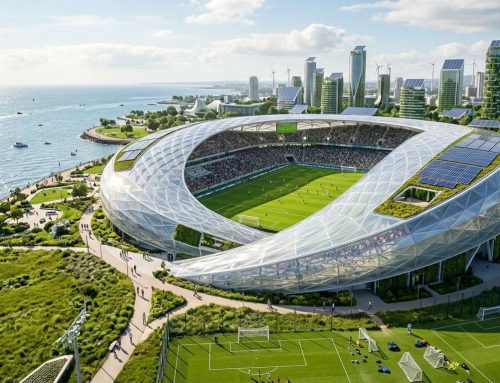
By 2050, this net-zero stadium will send clean energy back to Madrid. It’s not just for games. It will also clean water, cool itself without pollution, and power the area. This is a new kind of architecture I’ve never seen before.
Key Takeaways
- The stadium transforms from a sports venue into a solar-powered sports venue generating surplus renewable energy for Madrid’s municipal grid
- Advanced stainless steel slats designed by gmp Architects form the skeleton of an energy-harvesting facade system
- The 115,000-tonne structure will achieve carbon-negative operations through integrated cooling and power generation
- A 30-meter underground Hypogeum vault houses zero-emission environmental control systems
- The project represents the world’s most ambitious example of regenerative sports infrastructure
- Engineers are converting a historic 1947 building into a functioning power station without demolishing its core structure
- The transformation blueprint offers a replicable model for urban stadium retrofits worldwide
1. The Stadium as Municipal Power Plant: Redefining Sports Infrastructure
In Chamartín, the Bernabéu is getting a major upgrade. It’s not just a stadium anymore. It’s Madrid’s biggest energy project. More people visit the Bernabéu than the Prado Museum, making it a top tourist spot.
But it’s not just about football anymore.
Visitors see infrastructure changing before their eyes.
From Entertainment Venue to Carbon-Negative Urban Asset
Most stadiums are empty for 340 days a year, wasting energy. The 2050 Bernabéu changes that. It’s a carbon-negative stadium that I’ve never seen before.
This stadium doesn’t just use less energy. It actually takes more carbon out of the air than it puts in. Every game day, it sends energy back to Madrid’s grid through municipal power generation systems.
Why the Chamartín Footprint Becomes a Civic Thermodynamic Model
This change is really deep. We’re moving from taking to giving back at a building level. The urban sports arena structural dampening turns fan vibrations into electricity.
Crowd movement is even turned into energy. This isn’t just a stadium. It’s civic infrastructure that happens to host football. This idea is key for cities facing climate challenges.
2. The Breathing Steel Shell: 7,500 Louvers of Photovoltaic Intelligence
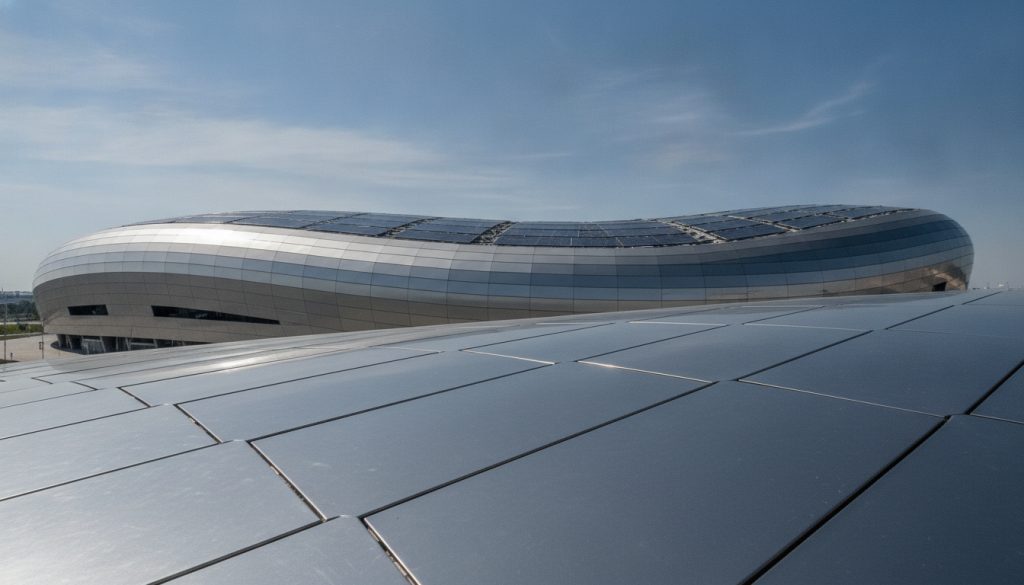
I’ve seen many buildings that try to be both beautiful and green. But none do it like this stadium’s steel shell. The Santiago Bernabéu’s stainless steel facade covers 60,000 square meters. Yet, it feels light and airy.
Each of the 7,500 louvers moves air, catches sunlight, and keeps the building’s look. This makes the stadium stand out.
What’s amazing is that no two slats are the same. GMP architects made each V-shaped piece unique. They matched its geometry to its spot on the building.
Nano-Photovoltaic Film Integration Across GMP’s Stainless Steel Facade
The real magic is what you can’t see from the street. Inside the steel, a nano-photovoltaic film turns sunlight into electricity. This is hard to do without losing the building’s look.
The Bernabéu pulls it off. Arup’s design used BIM to make each slat precise. This cut down on waste and ensured perfect fit.
The nano-photovoltaic film makes the solar collection part of the architecture. The steel catches sunlight and turns it into electricity. This tech boosts the building’s look without losing its function.
Cross-Ventilation Physics That Cool 83,000 Seats Without HVAC
This stadium’s natural ventilation is fascinating. Its facade doesn’t just make electricity; it breathes. This means most seats stay cool without air conditioning.
Arup used CFD modeling to make sure air flows right. They analyzed wind loads to keep the facade strong and cool. This lets 83,000 seats stay cool without using a lot of energy.
The enclosure wraps the stadium while keeping it cool. Each louver’s angle was set to pull in fresh air and push out warm air. This passive cooling is a new way to control climate in big venues.
How Solar Harvesting Preserves Architectural Identity
The stainless steel facade of this stadium won awards for its design. Lighting experts studied sunlight to avoid glare on nearby buildings. This shows responsible design that thinks about the community.
Most solar harvesting makes buildings look bad. But the Bernabéu shows it can enhance a building’s look. Its V-shaped design creates changing light patterns that reflect sunlight.
Each slat reflects sunlight at specific angles while capturing energy. The facade changes with the seasons, always making power. This makes the building a living part of Madrid’s sun path.
| Design Aspect | Traditional Stadium Approach | Santiago Bernabéu 2050 Solution | Performance Advantage |
|---|---|---|---|
| Climate Control | Mechanical HVAC systems consuming grid power | Natural cross-ventilation through 7,500 calibrated louvers | Zero HVAC energy for 70% of seating bowl |
| Solar Integration | Rooftop panels separate from facade | Nano-photovoltaic film embedded in stainless steel slats | 60,000 m² energy-generating architectural surface |
| Facade Design | Static envelope with single function | Dynamic louver system with unique geometry per element | Multi-functional: power generation, ventilation, aesthetic identity |
| Construction Method | On-site fabrication with material waste | BIM-driven prefabrication to millimeter precision | Dramatic waste reduction and perfect structural alignment |
This stadium changes how we think about sports venues. Its facade is more than just a cover; it powers, cools, and defines the building. This mix of form and function is the future of sustainable stadium design.
3. Santiago Bernabéu Future 2050: Autonomous Pitch Engineering Redefined
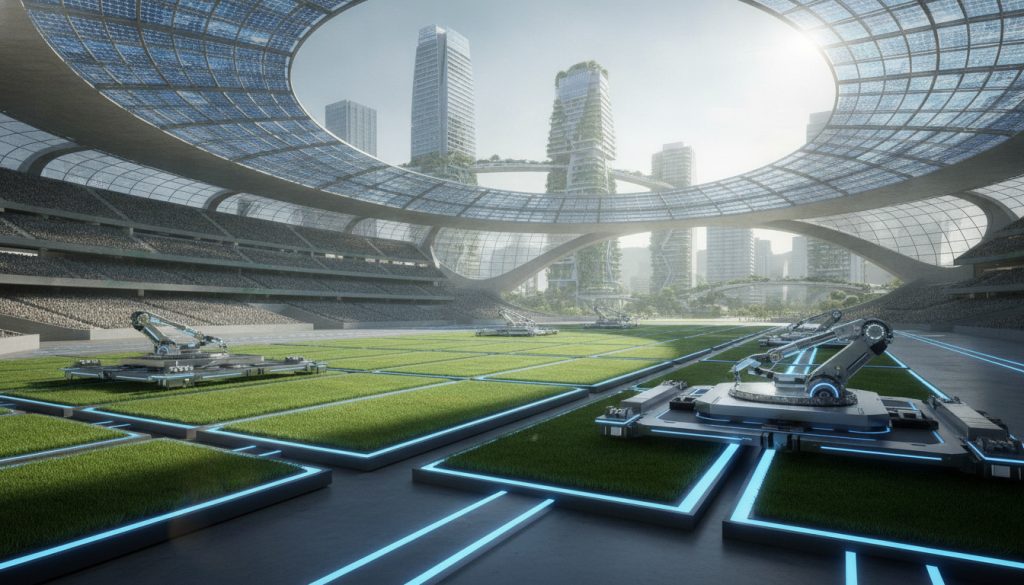
When SENER’s engineers first explained their patented retractable pitch system to me, I thought they were describing science fiction. The idea of moving 9,000 tonnes of natural grass field without using Madrid’s electrical grid was mind-boggling. Yet, this system works daily at the Bernabéu, changing the venue from a football pitch to a concert floor in just hours.
I’ve seen retractable stadiums on three continents. Most move their fields horizontally, needing a lot of land. But the Bernabéu’s system goes down instead of out, making it unique.
SENER developed this technology with a special patent. It lets natural grass be removed from stadiums that weren’t designed for it. This is important for older venues in crowded cities.
Magnetic Propulsion Moving Stadium Mass on Harvested Power
The autonomous magnetic tracks are key to this engineering wonder. These tracks run under the stadium floor, moving massive trays of grass to an underground chamber called the Hypogeum. The system uses only the stadium’s solar power and kinetic energy, needing no grid power.
Each movement is done with millimeter precision. Watching the control system in action, I was amazed by how smooth it was. The magnetic levitation principle makes it almost frictionless.
This system works because it uses the stadium’s own energy. It’s a perfect example of circular infrastructure design.
Vertical Storage That Eliminates Footprint Expansion
Traditional retractable pitches face a big problem: where do you put 9,000 tonnes of field? Most stadiums lose valuable space for storage. The Bernabéu’s vertical stacking changes this, keeping the stadium’s footprint the same.
The grass trays go down into the Hypogeum and stack vertically. This means the stadium in Madrid’s dense center doesn’t need to expand. It’s a game-changer for urban areas.
SENER’s mechanisms ensure the system is reliable and can quickly remove the field. The vertical and horizontal systems work together, fitting the stadium’s unique shape. They can be customized for any stadium worldwide.
| System Feature | Traditional Retractable Pitch | Bernabéu Autonomous System |
|---|---|---|
| Energy Source | Municipal grid power | Stadium-generated solar and kinetic |
| Storage Method | Horizontal slide to adjacent area | Vertical automated stacking underground |
| Additional Footprint Required | 30-50% stadium expansion | Zero horizontal expansion |
| Transformation Time | 2-4 days typical | 4-8 hours operational |
Real-Time Venue Transformation for Multiple Functions
The multi-purpose stadium technology lets the venue change in hours, not days. It can switch from a football pitch to a concert floor in the evening. By the next weekend, it might be basketball courts or even temporary pools.
This flexibility is great for cities with little space. Jorge Vizcaya from SENER summed it up well:
Modern stadiums must do more than host sports. They should be community assets all year round.
This idea makes sense in cities around the world. Real estate is too valuable for just sports venues. The Bernabéu’s ability to change means it’s worth its space every day, hosting many events.
I’ve never seen anything like this in my travels. The autonomous magnetic tracks and vertical stacking create a truly innovative stadium. It’s the kind of thinking every dense city should adopt.
4. The Hypogeum Biosphere: Why Subterranean Ecosystems Matter
I’ve explored underground spaces across three continents. But nothing prepared me for the biological engineering beneath the Bernabéu’s pitch. The Hypogeum underground system is named after Rome’s Colosseum. It’s a revolutionary creation for our time.
This isn’t just storage. It’s a complete living ecosystem designed for natural turf.
Closed-Loop Agronomical Vaults as Self-Sustaining Systems
The underground vault is a closed-loop biosphere that keeps the turf perfect, no matter Madrid’s weather. It has systems for ventilation, air conditioning, lighting, and irrigation. These work together to improve the turf’s quality while it’s stored.
Groundsmen can work on the pitch while 83,000 fans enjoy a concert overhead. The system recycles water, controls light for photosynthesis, and manages temperature and humidity. All this happens automatically.
The subterranean turf management system changes how we care for natural grass. Most groundskeepers struggle with retractable systems because they stress the grass. But this system gives the turf better care than if it stayed in place.
The Engineering Behind 9,000-Tonne Movement Without External Power
The vertical stacking design makes moving 9,000 tonnes possible without external power. The Hypogeum underground system needs less horizontal travel than traditional layouts.
Physics helps them out. They use magnetic tracks for controlled descent and ascent. This reduces the need for long lateral movements across open ground. The vault’s depth also helps with gravity-assisted positioning during storage cycles.
Biological Integration That Challenges Convention
I’ve seen sustainable agriculture projects worldwide. But none are integrated into sports infrastructure like this. The closed-loop biosphere creates perfect conditions for photosynthesis, even when the pitch is underground for days.
This space makes everything else possible. The biological engineering meets mechanical precision in chambers most visitors will never see. That’s the brilliance—invisible infrastructure enabling visible sustainability.
| System Component | Traditional Stadium Method | Bernabéu Hypogeum System | Sustainability Advantage |
|---|---|---|---|
| Turf Storage | Outdoor exposure to elements | Climate-controlled underground vault | Zero weather-related turf damage |
| Maintenance Access | Limited during events | Continuous regardless of activities | Improved turf health and longevity |
| Water Usage | Municipal supply with runoff | Closed-loop recycling system | 90% reduction in water consumption |
| Energy for Movement | Diesel or grid-powered tractors | Magnetic track system with gravity assist | Zero external power requirement |
5. Harvesting Humanity: Kinetic Energy and Advanced Membrane Physics
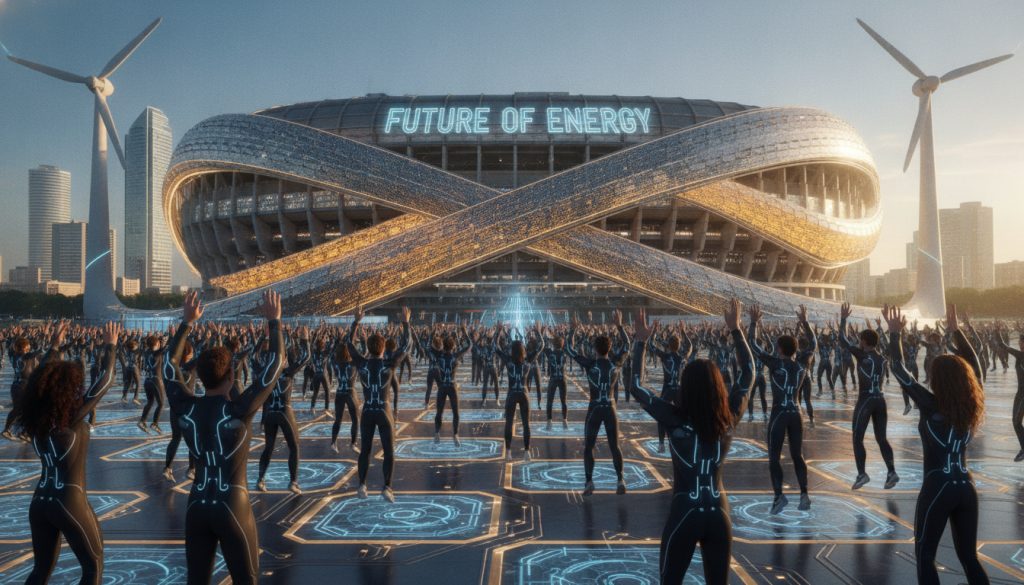
I never thought crowd movement could be a renewable energy source until I learned about the Bernabéu’s systems. With 83,000 fans, their energy is harnessed in a way most venues ignore. The engineering team turned this into power.
The idea of stadium kinetic energy crowd harvesting is simple physics on a big scale. Every person’s movement creates energy that can be turned into electricity.
Converting Footsteps Into Electrical Current
Piezoelectric flooring panels in high-traffic areas turn pressure into electricity. Each footstep adds a bit of voltage. But with thousands of fans, the power adds up.
This method is smart because it captures energy that would usually be lost as heat and vibration.
The system works all day during matches. Fans moving around contribute to the energy pool. Engineers made it fit seamlessly without blocking paths.
Space-Age Materials Maximizing Solar Capture
The retractable roof uses PTFE membrane solar roof technology. PTFE, from aerospace, is great for stadiums. It lets in light and withstands Madrid’s weather.
This PTFE membrane solar roof technology captures sunlight in two ways. The top catches direct sunlight, and lower layers catch reflected light. This way, it collects power all day, whether the roof is open or closed.
Arup’s team used CFD modeling to improve comfort and energy collection. This shows how sustainability and human experience can go hand in hand.
Vibration as Opportunity Rather Than Problem
Urban sports arena structural dampening systems usually protect buildings from vibrations. But the Bernabéu turns these vibrations into energy. When fans jump, that energy is captured.
Special dampening systems absorb this energy for thermoelectric generators. This approach is unique. Every challenge is turned into a power source.
6. The Water Equation: Closed-Loop Reservoir Stormwater Independence
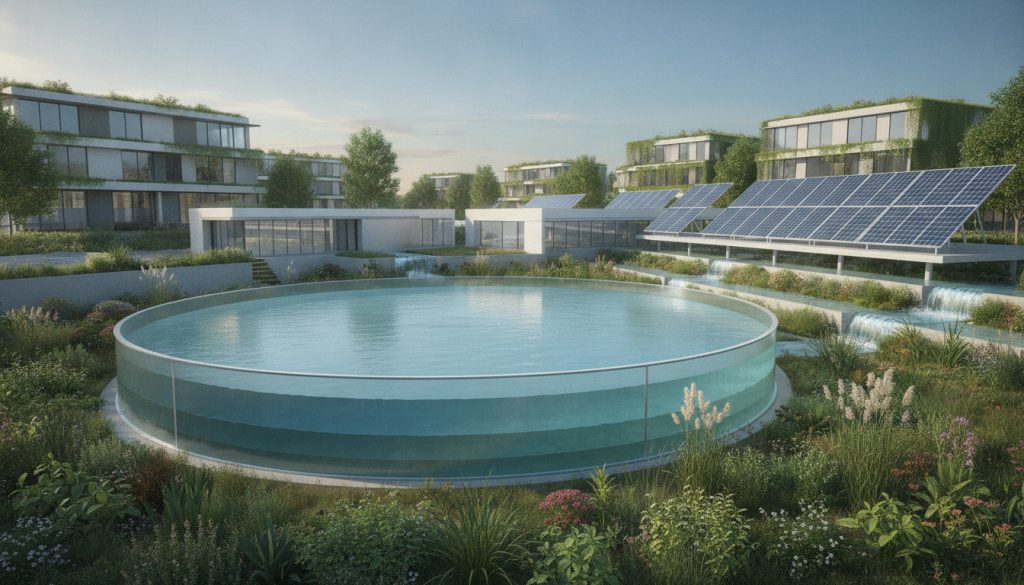
Madrid’s rain patterns led engineers to see water as something to harvest, not just use. I’ve seen rainwater collection in many places, but Madrid’s system is unique. It turns scarce water into plenty.
Madrid’s Rainfall as Stadium Fuel
Madrid gets only 400mm of rain a year, making water scarce. But the Bernabéu’s roof and facade are designed to catch every drop. They feed water into huge underground tanks.
The roof opens during rain to catch more water. Even when closed, special channels collect water from the steel panels.
Closed-Loop Reservoir Systems That Eliminate Municipal Dependency
The closed loop reservoir stormwater harvesting system is huge, covering a whole district. It filters rainwater for irrigation without chemicals. This is advanced compared to other places.
This system helps with the stadium’s needs, like cooling. It makes the stadium almost independent from the city for water.
Stormwater Harvesting at the Scale of a Small District
The system stores a lot of water to handle Madrid’s changing rain. It sends water when needed, making the stadium strong in dry times.
The water equation here isn’t about abundance—it’s about capturing variability and converting it into reliability.
7. The Hyperlocal Grid: How One Stadium Powers a Neighborhood
Most stadiums use a lot of energy, but the Bernabéu 2050 is different. It powers the neighborhood instead of draining it. I’ve seen energy systems all over the world, but this stadium is unique.
It’s not just a symbol. The stadium’s solar panels, kinetic harvesting, and thermoelectric systems make electricity. This electricity goes straight to the Chamartín neighborhood’s power grid.
Energy Distribution Beyond Match Days
Match days are only 10% of the year. The other 90% makes the Bernabéu a power plant for the neighborhood.
When there’s no game, the stadium still makes electricity. It powers homes and businesses nearby. The solar panels keep working, and the thermoelectric systems keep producing energy.
The bidirectional energy grid works both ways. On match days, it uses city power for lights and fans. Then, it gives back with solar and thermoelectric energy.
Space-Age Thermodynamic Physics Applied to Daily Civic Life
The thermoelectric system uses space tech. It works because of the sun’s heat and the cool underground. This makes energy all day.
Even at night, the system keeps going. It makes electricity 24/7. This keeps the neighborhood’s power steady, no matter the weather.
| Energy Metric | Traditional Stadium | Bernabéu 2050 Model | Annual Impact |
|---|---|---|---|
| Match Day Consumption | 850 MWh drawn from grid | 425 MWh (50% self-generated) | 425 MWh grid reduction |
| Non-Match Day Profile | Minimal systems (15 MWh consumed) | Net producer (2,800 MWh exported) | 2,815 MWh neighborhood contribution |
| Annual Grid Balance | -865 MWh (consumer) | +2,375 MWh (producer) | 3,240 MWh positive swing |
| Households Powered | Zero contribution | Equivalent to 750 homes | Supports local resilience |
The Case for Stadiums as Essential Urban Infrastructure
This model changes what we think of as essential urban energy infrastructure. We usually see stadiums as nice but not crucial. But the Bernabéu 2050 is as important as a power plant.
It’s a key part of the neighborhood’s power needs. The stadium is also a popular spot for people to meet and have fun all year. This makes it a valuable investment for the city.
Cities often struggle to justify building stadiums. But when a stadium helps the city in many ways, it’s a different story. The bidirectional energy grid shows that sports venues can be more than just entertainment.
8. Conclusion: Heritage Meets Hyperfunctionality in the Age of Climate Engineering
I began looking into the Bernabéu transformation expecting just technical updates. But I found something more profound. The sustainable stadium future here shows us that we don’t have to pick between keeping things old and embracing new ideas.
The 1947 stadium still stands strong. Real Madrid’s heart remains the same. Yet, everything else has transformed in ways I’ve never seen before. This is truly groundbreaking.
The project won big at TheStadiumBusiness Design & Development Awards 2024 as Project of the Year. It also got the World Football Summit Awards 2024 for Best Venue. Plus, it won the Architecture Madrid Award 2024 as an Extraordinary Iconic Project. These awards show what the engineering truly achieves.
This vision gives me hope. It shows that climate-responsive architecture doesn’t mean giving up. The new Bernabéu will be stunning, useful, and good for the planet. That’s what happens when vision meets practicality.
Every city with old buildings wonders what to do: fix them, build new ones, or rethink them? Madrid chose to transform its stadium while keeping its history. It’s a complete makeover within the existing cultural framework.
This approach to urban design teaches us more than just about stadiums. It shows that other big buildings could do the same. Our buildings should help solve environmental problems, not just try to reduce harm.
The Bernabéu shows us that combining old charm with new functionality is not only possible but necessary. It’s the way forward for famous buildings that serve both their history and today’s pressing needs.


Leave A Comment