

I’ll admit it: Battambang caught me off guard.
I came for colonial shophouses and a rickety bamboo train ride, not a lesson in city planning.
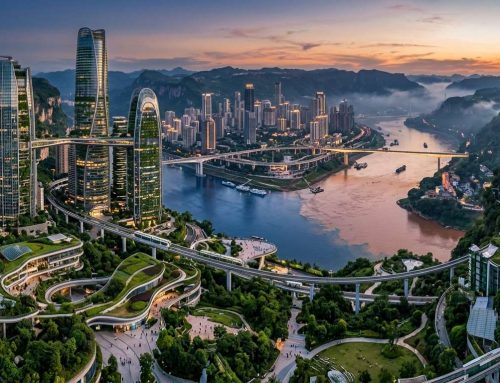
Between the ochre facades and quiet civic life near the riverbank, I saw something larger taking shape. This sleepy province, known for rice fields and fading French-era buildings, now studies big-data plans from Guizhou, China.
Local leaders traveled east to study smart farming and smart-city management through a South-South cooperation framework built on digital transformation. That trip reveals where this river town may be headed.
Can a heritage town become carbon-neutral by 2050 without losing its charm? I think the Battambang future 2050 vision may already offer an answer.
Key Takeaways
- Battambang is positioning itself as a heritage-driven model for carbon-neutral urban growth.
- Local leaders studied smart farming and city management practices in Guizhou, China.
- The province is exploring big-data tools under a South-South cooperation framework.
- Colonial-era architecture and river ecosystems play a central role in future planning.
- The goal is sustainability that preserves cultural identity rather than erasing it.
1. Why Battambang Future 2050 Signals a New Era for Provincial Heritage Cities
Provincial towns rarely script their future, but Battambang has since 2011. I have crossed dozens of overland routes through Southeast Asia’s forgotten river towns, most trapped between decay and rushed modernization. Battambang felt different when I read its planning paperwork instead of admiring its postcards.
The groundwork traces back to the ADB-funded Greater Mekong Subregion Southern Economic Corridor Towns Development, known locally as GMS1-SECTDP. Its Strategic Local Economic Development Plan was first drafted in 2011 and revised in November 2023. That marks over a decade of steady planning before anyone coined “Battambang 2050.”
The province’s official roadmap, MLMUPC’s 2019 Master Plan for Land Use, states this ambition plainly.
“A city that is environmentally friendly, socially responsible, and economically successful and at the same maintain its uniqueness.”
The vision has six pillars: good governance, a green, healthy city, heritage-culture-tourism development, commerce, agriculture, and regional trade connectivity. Together, they turn Battambang colonial architecture preservation from a nostalgic hobby into a load-bearing pillar of civic policy.
I find that remarkable. Most provincial capitals treat old buildings as liabilities to bulldoze or props for selfies. Battambang treats its ochre shophouses and sandstone temples as infrastructure worth engineering around. That is why the technical story matters.
2. Guarding the Ochre Soul: Non-Invasive Mineral Masonry Glazes Save Colonial and Khmer Heritage
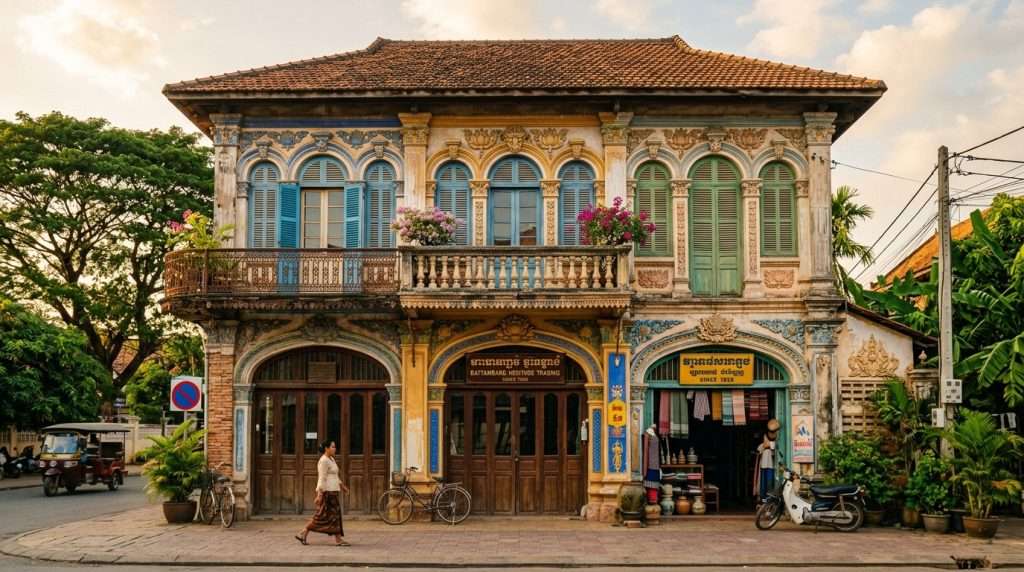
Watching a century-old wall flake apart in monsoon heat broke my heart on Battambang’s riverside streets.
I carried my camera as I watched a century-old wall flake apart in the monsoon heat.
Plaster dust fell onto my shoes like dry confetti from facades that survived typhoons, wars, and a hundred rainy seasons.
Then I learned about non-invasive mineral masonry glazes, which let old walls breathe instead of trapping moisture.
Battambang 2050 isn’t creating this idea from scratch. The Asian Development Bank’s technical assistance, TA 8556-REG, named heritage conservation a core provincial investment priority.
It placed that priority beside water supply and transport upgrades.
2.1 Shielding 800 French-Colonial Shophouses from Tropical Rot
Battambang’s ochre glow comes from roughly 800 French-colonial shophouses near the Sangkae River.
While photographing shutters and balconies, I saw that lower plaster looked worse than plaster above it.
Rising damp causes the damage. Monsoon humidity enters brick and old lime mortar, then modern paint traps it inside.
Over time, the trapped moisture cracks plaster from the inside out.
Non-invasive mineral masonry glazes solve this without removing a building’s character. Crews apply a thin mineral coating that bonds with existing plaster.
Breathable channels let moisture escape as vapor while the ochre patina remains untouched.
2.2 Protecting Wat Ek Phnom’s 11th-Century Sandstone Carvings
A short ride outside town stands Wat Ek Phnom, an 11th-century Khmer temple with sandstone carvings.
Those carvings survived a thousand monsoons. I traced a worn apsara relief, expecting the surface to crumble.
Sandstone faces the same threat as plaster: trapped water expands and flakes the surface apart.
Conservators use breathable mineral chemistry on the carvings, scaled down for porous stone.
The glaze does not hide centuries of weathering. It protects the carving from further erosion while leaving every crack and worn edge unchanged.
That preserves the authenticity travelers come here to see.
2.3 The Chemistry of Breathable Nano-Mineral Glazes
Here is the fascinating part, explained as I would describe it to a travel buddy over dinner.
These non invasive mineral masonry glazes use nano-sized particles, often silica or calcium-based compounds.
They bond with stone or plaster at the molecular level. The bond stays strong, but the structure remains porous.
Water vapor moves out, while liquid rain cannot push back in.
That one-way breathability prevents tropical humidity from cracking stone and lime plaster.
| Treatment Type | Breathability | Visual Impact | Typical Lifespan |
|---|---|---|---|
| Cement render | Low | Hides original texture | 5-10 years before cracking |
| Synthetic sealant | Very low | Glossy, unnatural sheen | 3-7 years before peeling |
| Non-invasive mineral glaze | High | Preserves natural patina | 15-20 years, re-applicable |
Leaving the shophouses and temple, I kept thinking that the best conservation work goes unnoticed.
Visitors will not see a coating. They will see a city that aged gracefully instead of falling apart.
3. Subsurface Hydrologic Heritage Engineering: Battambang’s Answer to Monsoon Flooding
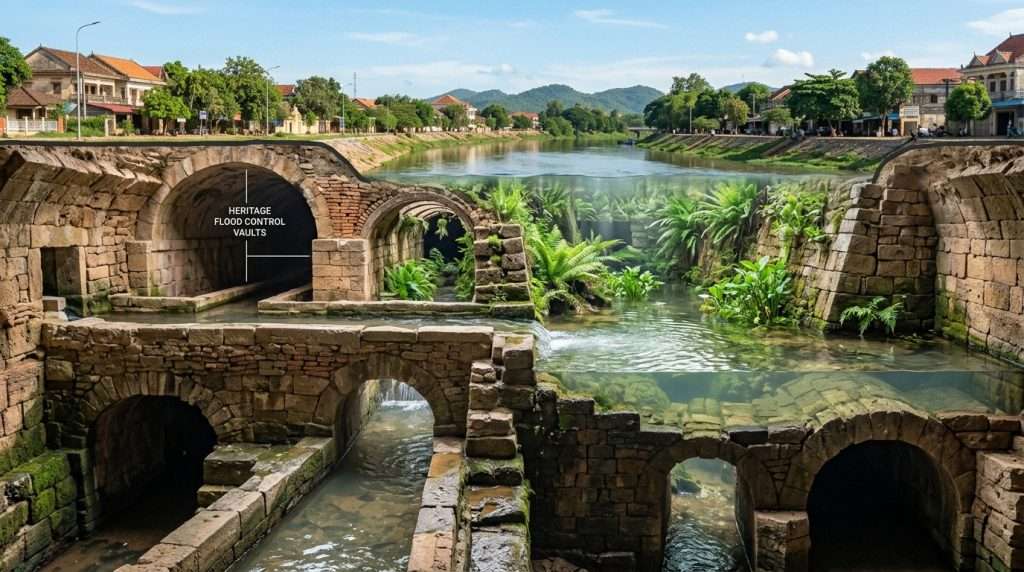
A downpour at Psar Nath market taught me something heritage guides never mention: water ignores history. It pools around French-colonial doorways and soaks sandstone foundations, just as it floods a parking lot.
Battambang’s planners found a clever solution. Instead of fighting water at street level, they buried the system to protect the historic district. This approach, subsurface hydrologic heritage engineering, hides modern flood control underground, leaving the ochre shophouses above unchanged for travelers.
The idea rests on earlier research. The Asian Development Bank’s technical assistance programs included TA 8556-REG and later TA 9203-CAM. They identified drainage and flood management as urgent gaps for the Tonle Sap Basin region. Battambang’s current design turns that research into something visitors will never notice, which is exactly the point.
3.1 Automated Retention Vaults Beneath the Sangkae River Waterfront and Psar Nath Market
Beneath the riverfront and market stalls sits a network of automated vaults. Sensors track rainfall and river levels in real time, then open or close chambers. This redirects surging water before it reaches the surface.
This Sangkae River flood defense system acts like a pressure valve for the whole town. During heavy monsoon rains, the vaults quietly absorb the surge. Vendors stay dry, while tourists take photos instead of wading through puddles.
3.2 Closed-Loop Reservoir Stormwater Harvesting for 100% Flood Capture
Here’s the part that genuinely impressed me. The system does not just move water away; it keeps it. The Closed loop reservoir stormwater harvesting system captures essentially 100 percent of seasonal runoff. It prevents useless river discharge and flooding on low-lying streets.
That stored water does not sit idle. It feeds zero-emission cooling loops that regulate temperatures across civic buildings. This turns a flood risk into a year-round resource.
- Captures nearly all monsoon rainfall before it reaches street level
- Recycles filtered water into civic cooling systems
- Reduces dependence on external water supply during dry months
3.3 Stadium-Style Porous Asphalt Drainage Across Civic Streets
Above ground, the streets quietly help, too. Engineers borrowed stadium porous asphalt stormwater drainage tech, usually hidden under sports venues, and laid it across Battambang’s civic roads.
The asphalt looks ordinary, but tiny channels pull water downward instead of letting it pool. Boots stay dry, scooters avoid skids, and the system feeds into the reservoir network below.
| System | Location | Primary Function |
|---|---|---|
| Retention Vaults | Sangkae River waterfront, Psar Nath market | Automated surge diversion |
| Closed-Loop Reservoirs | Citywide subsurface network | 100% stormwater capture and reuse |
| Porous Asphalt | Civic streets and plazas | Surface-level drainage |
Together, these three layers turn Battambang’s biggest seasonal threat into an invisible, well-managed system. There are no sandbags or soaked shoes. This heritage town finally learned to work with water instead of against it.
4. Powering a Net-Zero City with Water and Footsteps
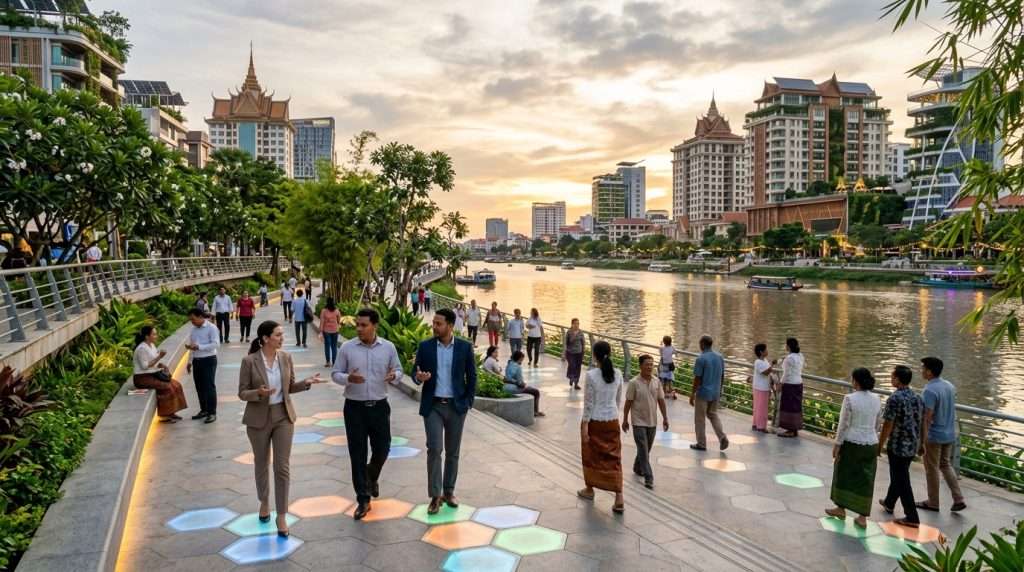
Floodwater does more than fill retention vaults. It keeps moving and finds new work across Battambang.
City planners drew real ideas from a study trip to Guizhou, China. There, smart-city management made decentralized power generation part of everyday infrastructure. That mindset guides the Battambang future 2050 blueprint: low-footprint systems blend into daily life rather than stand apart.
4.1 Zero-Emission Capillary Cooling Loops for Civic Districts
After underground vaults filter stormwater, engineers route it into capillary cooling loops. These loops snake through civic buildings and quietly pull heat from the air.
Battambang gets brutally hot most months of the year. These loops reduce energy-hungry air conditioning in government offices, schools, and market pavilions near Psar Nath.
It’s a simple trick. Water absorbs heat as it circulates, then releases it elsewhere. The whole process runs without burning a drop of fuel.
4.2 Piezoelectric Pavers Along Riverside Esplanades and Bamboo Rail Corridors
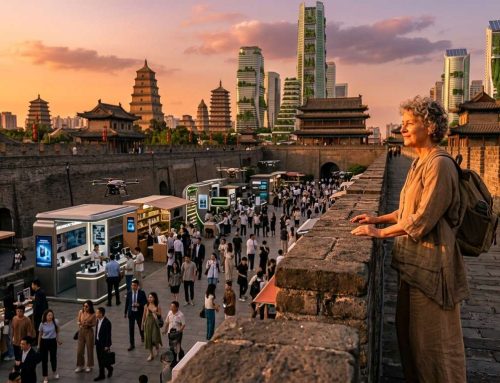
At sunset, the riverside esplanade fills with vendors, joggers, and families taking evening walks. Under their feet, piezoelectric pavers quietly turn each footstep into usable electricity.
The same technology runs along the restored bamboo rail corridor. It follows the bouncy, rickety train route that has long been one of Battambang’s biggest tourist draws. Every traveler who hops aboard adds a tiny charge to the local microgrid.
Residents and visitors need not sacrifice anything. The city works with existing rhythms, turning ordinary movement into clean, decentralized power.
| System | Energy Source | Primary Location | Key Benefit |
|---|---|---|---|
| Capillary Cooling Loops | Filtered reclaimed stormwater | Civic buildings near Psar Nath Market | Reduces air conditioning demand |
| Piezoelectric Pavers | Pedestrian footstep pressure | Riverside esplanade and bamboo rail corridor | Feeds clean power into local microgrid |
| Smart Grid Monitoring | Guizhou-inspired data analytics | City-wide civic network | Balances real-time energy loads |
5. A Blueprint for Cambodia’s Rice Bowl: Lessons for Global Colonial Cities

Walking through Battambang, I saw that the city’s greatest achievement reaches beyond its own transformation. Its roadmap can guide every river town facing the same battles.
Battambang sits within Cambodia’s Southern Economic Corridor, alongside Bavet, Neak Leung, and Poipet. All are ADB corridor towns undergoing similar infrastructure upgrades.
That matters because Battambang is not an isolated experiment. It offers a working model that neighboring towns can copy block by block, canal by canal.
5.1 Balancing Heritage Tourism with Carbon-Neutral Infrastructure
The challenge is clear: tourists visit Battambang for ochre shophouses, quiet temples, and the bamboo train.
Nobody books a flight to see a stormwater vault. Carbon-neutral systems must stay hidden beneath streets while the surface keeps its old-world charm.
That balance makes Cambodia’s rice bowl approach especially smart. Heritage stays visible. Net-zero infrastructure stays hidden, so nothing competes for travelers’ attention.
A city doesn’t need to choose between its past and its future. It just needs the discipline to keep them from colliding.
5.2 What Aging Colonial Ports and River Towns Can Borrow from Battambang
I kept thinking about other places I’ve traveled through that share Battambang’s problems. They share French-era plaster, seasonal flooding, and tourism economies that cannot afford reckless modernization.
Hoi An in Vietnam, Galle in Sri Lanka, and stretches of the Mekong farther into Laos face similar risks. Each has colonial bones and monsoon threats, leaving them on borrowed time.
| River or Port Town | Country | Shared Vulnerability | Battambang Lesson |
|---|---|---|---|
| Hoi An | Vietnam | French masonry, annual flooding | Breathable mineral glazes over heritage walls |
| Galle | Sri Lanka | Colonial fort erosion, coastal flooding | Subsurface retention vaults near waterfronts |
| Luang Prabang | Laos | Riverside heritage, seasonal surges | Closed-loop stormwater harvesting |
| Bavet, Neak Leung, Poipet | Cambodia | Corridor growth, aging drainage | Direct transfer of Battambang’s engineering model |
The Cambodia rice bowl is becoming an unexpected net-zero case study for other nations. Battambang can protect its colonial soul while running on water and footsteps. Towns with bigger budgets have no excuse to fall behind.
6. Conclusion
I still remember my first view of the ochre shophouses beside the Sangkae River. Sun-warmed and quietly strong, they seemed to resist time. Here, mineral glazes protect century-old sandstone, while hidden flood vaults lie beneath Psar Nath.
Piezoelectric pavers turn footsteps into power. These projects show that Battambang future 2050 is neither a tourism slogan nor a tech showcase. It is a working plan by people who love their city enough to change how it works without changing its feel.
Travelers should consider this: Battambang is not modernizing despite its colonial facades and riverside markets. It is modernizing because those places matter too much to lose. For anyone who values honest, real overland travel, that matters.
I think this quiet provincial capital may teach bigger, louder cities something important. Preservation does not have to mean standing still. Sometimes authentic places rebuild their foundations while keeping their soul where it has always been.













Leave A Comment