
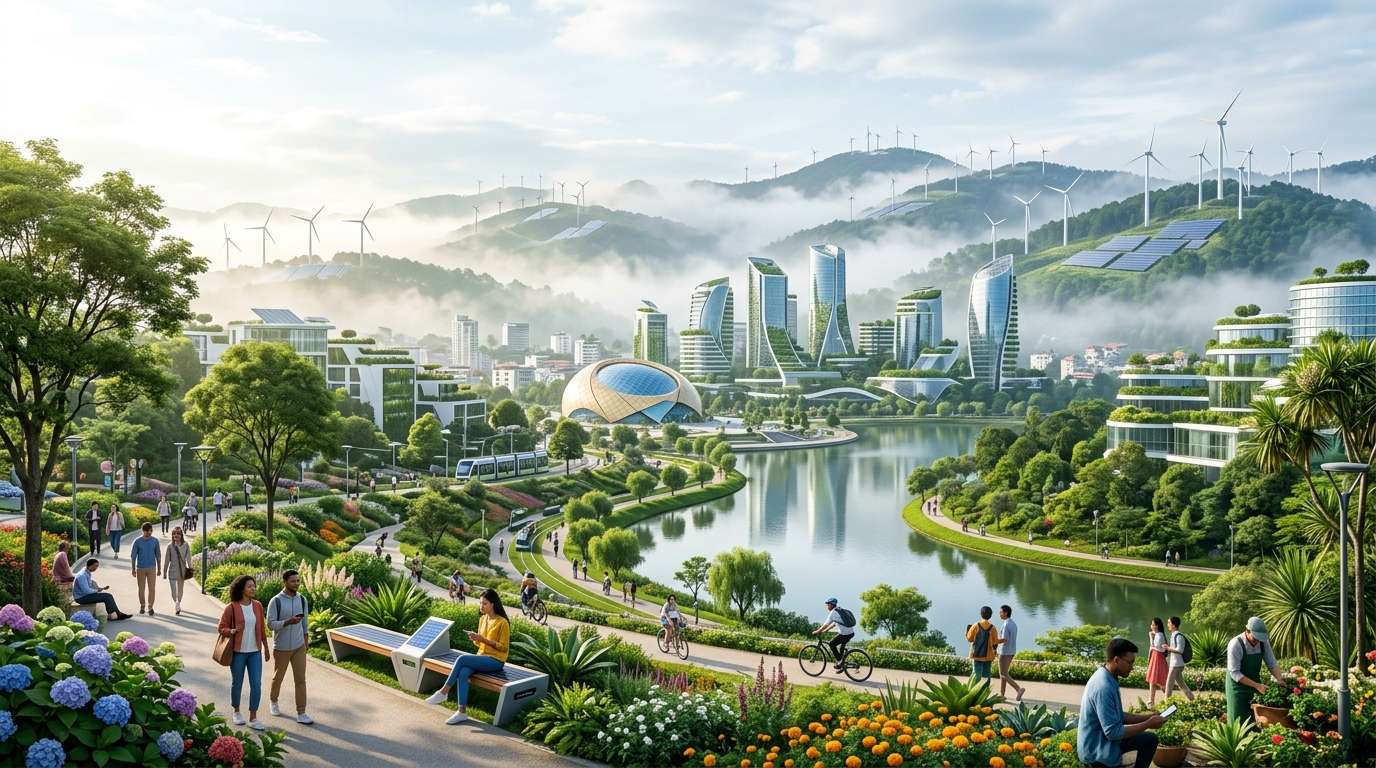
I remember standing at the edge of Đà Lạt, watching pine ridges fade into lake mist. That moment stayed with me. It felt like seeing a secret the world had not noticed.
This small highland town sits 1,500 meters above sea level. The Da Lat future 2050 is one of the most compelling climate stories I have found. I call it the mist engine, a simple name for blending old-world charm with invisible, next-generation engineering.
Picture colonial villas and a century-old cog railway beside breathable nano-mineral coatings and smart lake systems. That contrast is the whole point. Nothing here feels erased or replaced; it feels protected.
I am not claiming Đà Lạt has become a flawless, finished utopia by 2050. Instead, I found something more honest: a town learning to breathe cleaner while keeping its roots. The Da Lat future 2050 is a story worth sharing.
Key Takeaways
- Đà Lạt sits at 1,500 meters and serves as a working model for alpine climate resilience.
- The city blends French colonial architecture with modern, low-impact engineering solutions.
- Nano-mineral glazes help structures stay cool while reducing energy demand.
- Xuân Hương Lake supports smart water retention systems built into daily city life.
- Pedestrian pathways capture footstep energy, turning foot traffic into usable power.
- Heritage preservation and sustainability goals work together, not against each other.
1. Da Lat Future 2050: A Global Masterclass in Highland Garden Resilience
I still feel a strange thrill when I imagine Đà Lạt in 2050. Flower terraces hum beside carbon-neutral towers, joining its past and future.
Vietnam’s “City of Eternal Spring” sits at 1,500 meters above sea level. That altitude gave Đà Lạt a head start, helping it avoid the worst lowland heat reshaping many Southeast Asian cities. By 2050, planners kept this natural advantage and built around it.
My research showed how quietly this transformation happened. There were no flashy announcements or bulldozed neighborhoods. Instead, patient, layered engineering joined a town that still smells like pine needles and wet soil after rain.
The Da Lat future 2050 story isn’t about replacing the past. It is about reinforcing it.
Colonial villas still stand, and Xuân Hương Lake still reflects the morning fog. The real difference lies underground and overhead, in systems most visitors never notice.
This Da Lat future 2050 snapshot shows what changed and what stayed the same as this highland retreat moved toward net-zero:
| Feature | Đà Lạt Today | Đà Lạt 2050 |
|---|---|---|
| Energy Source | Grid-dependent, coal-blended power | Piezoelectric microgrids along lake and rail |
| Heritage Buildings | Weathered plaster, visible moss damage | Nano-mineral glazed, breathable facades |
| Water Management | Surface drainage, seasonal flood risk | Subsurface retention vaults, closed-loop harvesting |
| Urban Identity | Garden city with aging infrastructure | Carbon-neutral highland sanctuary |
For other highland cities facing climate pressure, Đà Lạt offers rare proof: resilience and character don’t have to compete. That is the part that keeps pulling me back.
2. Guarding the Past: Non-Invasive Mineral Masonry Glazes for Colonial Heritage
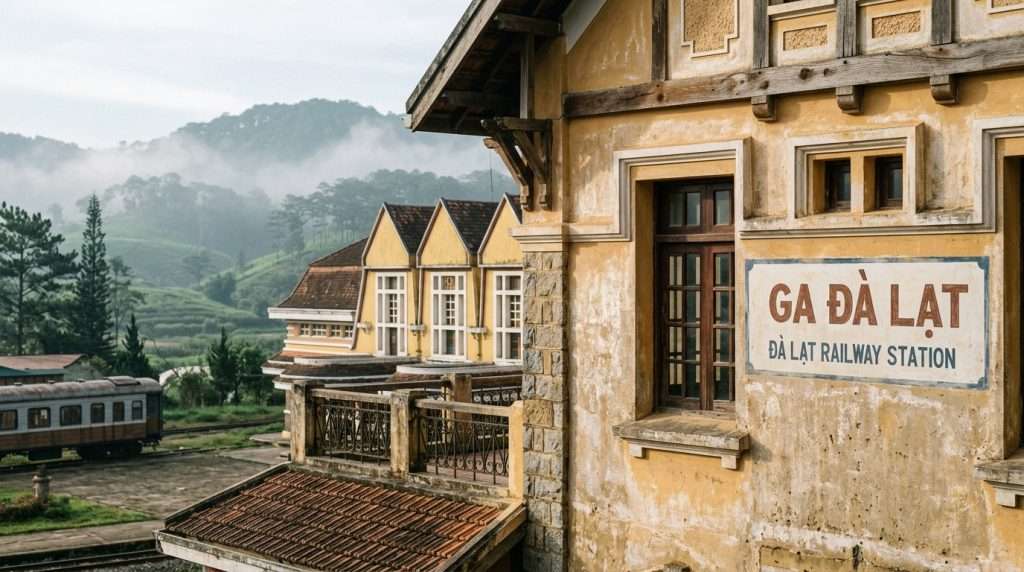
Quiet magic appears on the walls of Đà Lạt’s oldest buildings, but it is not paint. I first noticed it at the railway station, then at hillside villas behind pine trees. These surfaces looked untouched, yet something unseen clearly protected them.
That protection comes from a new generation of non invasive mineral masonry glazes. These coatings soak into stone and plaster instead of sitting on top like traditional paint. They let old walls breathe while blocking mountain damp, which causes slow destruction.
2.1 Da Lat Railway Station Preservation Through Breathable Nano-Mineral Shielding
The 1938 Art Deco railway station is one of my favorite buildings in Vietnam. Its stepped roofline and warm ochre walls look like a French travel poster.
Mountain humidity constantly works against it. Moisture enters stone and stucco, then becomes trapped and slowly rots the structure inside.
Engineers solved this without changing the building’s character. They applied a breathable nano-mineral shield that releases vapor while blocking liquid water.
This approach makes da lat railway station preservation possible without scaffolding, demolition, or one altered brick. The original ochre tone remains unchanged, just as travelers have seen it for decades.
Even the stained-glass windows remain untouched; the glaze treats only surrounding masonry. It’s preservation that disappears into the background, which is exactly the point.
2.2 French-Colonial Villas: Arresting Moss, Plaster Spalling, and Timber Rot
French-colonial villas scattered across Đà Lạt’s hillsides face a tougher fight. Thick fog arrives most mornings, giving moss an easy foothold on old plaster.
Untreated moss traps moisture against the wall. Plaster begins spalling, while timber window frames quietly rot beneath their paint.
The railway station’s glazing technology now protects dozens of these villas. It stops moss from taking hold and keeps plaster bonded to the wall behind it.
Timber elements receive similar treatment through breathable formulas that resist rot without sealing wood shut. Non invasive mineral masonry glazes work as well on a century-old windowsill as on a landmark station facade.
What strikes me most is the lack of visible intervention. The villas’ cracks and weathered tones remain exactly where history left them.
| Preservation Method | Moisture Handling | Impact on Original Texture | Maintenance Frequency |
|---|---|---|---|
| Traditional cement render | Traps moisture inside walls | Covers original surface details | Every 3-5 years |
| Standard exterior paint | Seals surface, blocks breathability | Alters color and texture over time | Every 2-4 years |
| Non-invasive mineral masonry glazes | Allows vapor to escape, blocks liquid water | Preserves original tone and texture | Every 10-15 years |
3. Subsurface Hydrologic Heritage Engineering Beneath Xuân Hương Lake
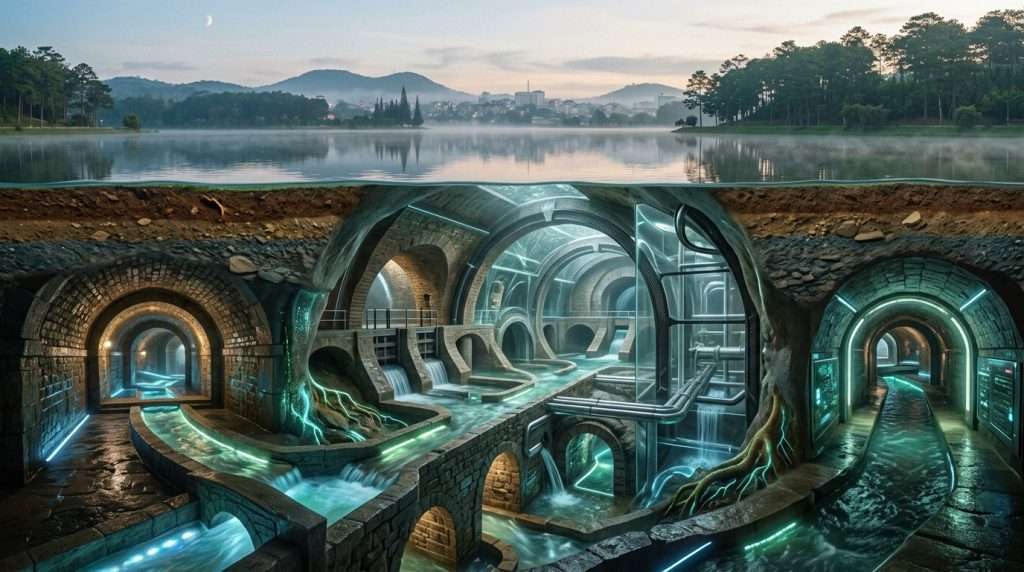
Picture this: a monsoon downpour hits Đà Lạt, yet water disappears underground instead of flooding the streets. This is not magic. It is subsurface hydrologic heritage engineering protecting the city I loved on my first overland trip through Vietnam’s Central Highlands.
Beneath Xuân Hương Lake’s postcard-perfect surface, hidden tunnels and vaults do work most visitors never notice. I wanted to understand how they work, not simply admire their existence.
Automated Retention Vaults and the Cam Ly Stream Basin
I see the Cam Ly stream basin as the city’s hidden safety net. Automated retention vaults lie beneath the lakebed and intercept monsoon runoff before flash floods reach downtown.
Sensors track rainfall intensity in real time, and floodgates open automatically when storms intensify. The gates send water into chambers that hold enormous volumes without disturbing the historic shoreline above. The vaults capture nearly all monsoon cloudburst runoff before it reaches streets, making a seasonal hazard a non-event.
- Real-time rainfall sensors trigger automatic floodgate response
- Underground chambers store runoff without surface disruption
- Historic lakeside architecture stays untouched during peak storms
From street level, the system feels almost invisible. You walk the lake path, snap photos, and have no idea that engineers work a few meters below. They have essentially eliminated the flood risk that once plagued this valley each rainy season.
Closed-Loop Reservoir Stormwater Harvesting for Zero-Emission Climate Control
Captured water does not simply sit in storage. It is filtered, then cycled through a closed loop reservoir stormwater harvesting system. This system feeds zero-emission capillary heating and cooling networks in buildings around the lake.
The clever part is that rainwater once threatening basements now controls indoor temperatures without burning a single drop of fossil fuel. Pipes run beneath heritage buildings and carry cooled or warmed water by season.
I find this engineering genuinely smart. It turns flood risk into a climate-control resource, so nothing is wasted. You could miss this quiet innovation unless someone pointed it out.
Xuân Hương Lake Hydrologic Cooling and the Highland Microclimate
All this underground work serves one human goal: keeping Đà Lạt’s famous mist alive. Xuân Hương lake hydrologic cooling pulls heat from surrounding air. This helps maintain the cool, misty microclimate that makes this highland city unlike tropical Vietnam.
Without this subsurface cooling, rising regional temperatures could erode the fog and chill that define a morning walk around the lake. With it, the experience remains intact for generations of travelers and locals.
I walked the lake path early one morning as mist curled over the water. Then I realized this feeling exists because of engineering most people never see.
4. Powering the Streets: Piezoelectric Microgrids Along Lake and Rail
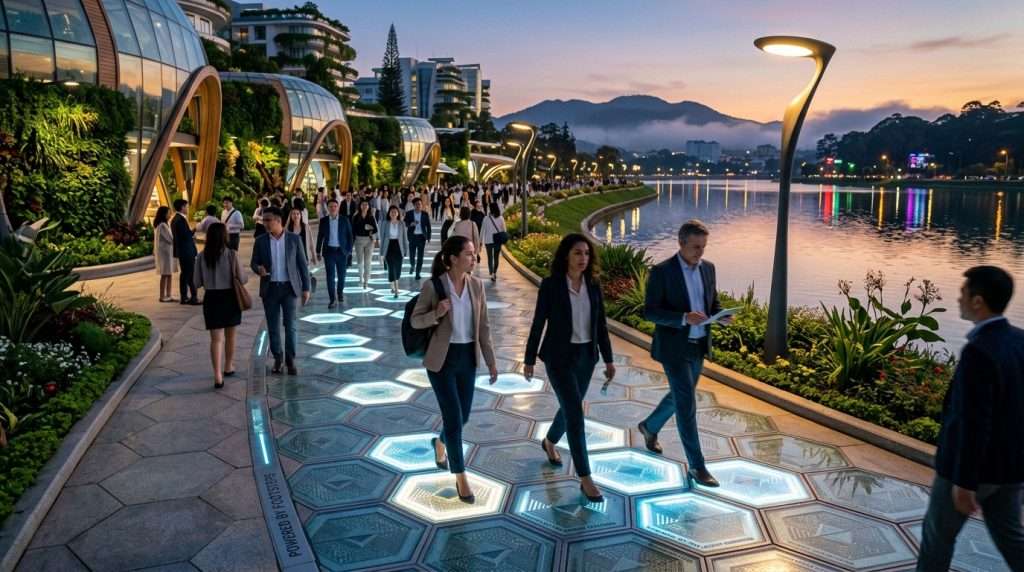
Along Xuân Hương Lake, each footstep does more than move you forward. Under the gravel and stone, a quiet system turns that motion into electricity. It is one of the smallest ideas in the Da Lat future 2050 plan, yet it stayed with me most.
No one mentioned it at first. I noticed streetlights flickering differently near the water, almost matching foot traffic. Then I learned about piezoelectric pavers buried beneath the promenade.
4.1 The Perimeter Lake Promenade as a Living Power Grid
Walking the full loop around Xuân Hương Lake takes about forty minutes without photo stops. I stopped often because the view never gets old. I did not expect the pavement to be working too.
Sub-surface piezoelectric pavers line parts of the promenade, capturing pressure from thousands of daily footsteps. That energy feeds a small microgrid for nearby streetlights, public benches, and vendor stalls selling artichoke tea and roasted corn.
Nothing about the walk feels mechanical or obviously futuristic. It still looks like a lakeside stroll. The technology stays hidden, doing its job without asking for attention.
“The best infrastructure is the kind you never notice working.”
4.2 Historic Cog-Railway Lines Reimagined as Clean Energy Corridors
From the lake, I followed the old cog-railway route that carried coffee beans and curious travelers up the mountain. The tracks remain, polished smooth by a century of use.
Now, they also serve as energy corridors. Pressure-sensitive flooring beside restored rail segments turns foot and light rail traffic into power for platforms and heritage lighting.
It feels like a strange, satisfying kind of time travel. You stand on rails built for steam-era tourism while they quietly charge a 21st-century microgrid. That blend of old and new best captures the Da Lat future 2050 I have seen so far.
| Energy Corridor | Primary Function | Power Output Used For | Heritage Element Preserved |
|---|---|---|---|
| Xuân Hương Lake Promenade | Pedestrian foot-traffic capture | Streetlights, benches, vendor stalls | Original lakeside walking path |
| Cog-Railway Corridor | Rail and platform foot-traffic capture | Platform lighting, signal systems | Historic rail tracks and station platforms |
| Combined Microgrid Network | City-wide clean energy distribution | Shared streetlight and public amenity grid | Integrated colonial-era urban layout |
5. Scaling Resilience Across the Langbiang Net-Zero Plateau
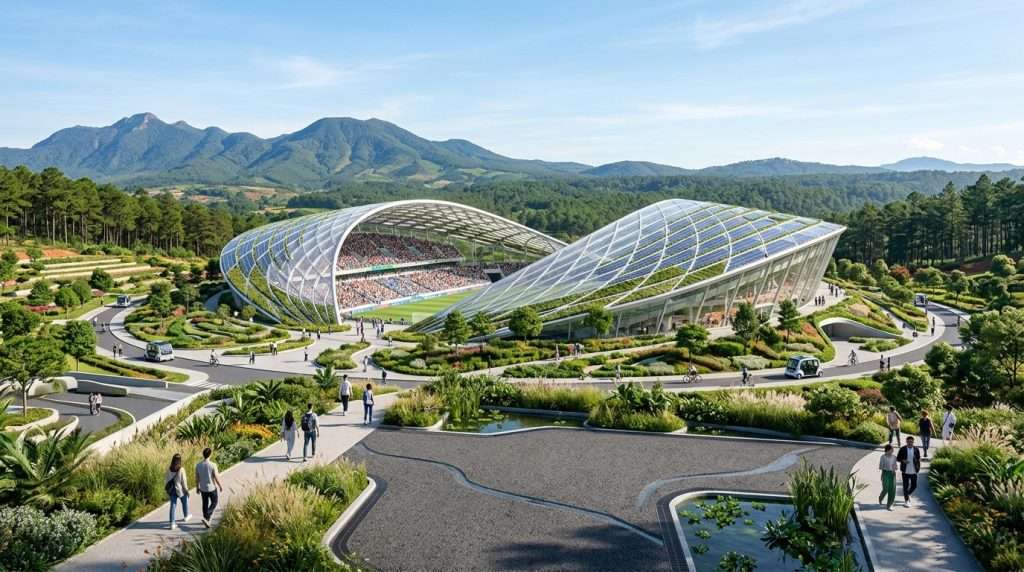
The real magic of Đà Lạt’s transformation lies beyond downtown. Its ideas ripple across the Langbiang net zero plateau.
Locals often described the same pattern. A small fix near the lake was tested, improved, and copied elsewhere. That is how resilience spreads: one neighborhood at a time.
This practical approach impressed me. No one chased a flashy master plan. They solved one problem, then used the fix in the next valley.
5.1 Stadium Porous Asphalt Stormwater Drainage as a Citywide Blueprint
It began at the city stadium, of all places. Engineers tested stadium porous asphalt stormwater drainage on parking lots and nearby pavement. They hoped to manage sudden highland downpours without flooding nearby streets.
Water passed through the surface instead of pooling. Runoff fell sharply during peak monsoon storms.
Within a few years, the same porous asphalt mix appeared on roads, plazas, and parking areas across the plateau. What began as a stadium experiment became the drainage standard for an entire alpine city.
I find that kind of scaling inspiring. One parking lot taught an entire region how to breathe through heavy rain.
5.2 Weaving Heritage Districts into the Alpine Carbon-Neutral Network
Heritage sites could have remained separate, like fragile museum pieces behind glass. Instead, planners connected them to the carbon-neutral network.
Old colonial quarters now share drainage lines, microgrids, and cooling systems with newer neighborhoods. Nothing remains isolated.
I walked through districts where century-old villas stood beside quietly humming energy nodes. The pairing felt natural, like one continuous system joining history and innovation across the plateau.
“We didn’t want heritage to be a separate chapter,” one planner told me. “We wanted it to be part of the same sentence as the future.”
Đà Lạt redefines alpine city longevity through a quiet habit: connecting every corner of the plateau into one resilient, breathing system.
6. Conclusion
At sunset, Xuân Hương Lake shows how mist from its water cools the whole valley. This quiet design is the real magic of Da Lat future 2050. The railway station still looks decades old, but its walls now breathe and resist humid decay.
Along the lake promenade, each footstep seemed to move me forward and feed power back into an unseen grid. That pattern shapes Da Lat future 2050: old villas, cog-railway tracks, and stadium grounds join one quiet carbon-neutral system. It works quietly, without asking visitors to notice.
Da Lat redefines alpine city longevity by showing progress need not erase the past. Progress means listening closely to what already worked and giving it room to work another hundred years.
Planning a highland route through Vietnam? Put this city on your list: walk the lake, ride the old rail line, and sit in a French-era café. See a villa wall protected without losing character, and feel Da Lat future 2050 move forward while staying itself.








Leave A Comment