

I stood at the edge of the Kok River valley last week. Light hit Wat Rong Khun’s spires as it always has. Yet the Chiang Rai future 2050 felt different: the air was clear, and quiet machines hummed through the hills.
This valley once flooded every rainy season and filled with wildfire smoke every dry one. Now it operates as one of the boldest climate experiments I have ever walked through.
Thailand pledged a new Net Zero target at COP30 in November 2025. It moved its deadline forward by fifteen years and plans to cut emissions 47% by 2035.
Watching that promise take physical shape here felt surreal. I never expected a river valley to feel this alive.
My postcard shows the Chiang Rai future 2050: a flood-prone tourist stop transformed into a global climate blueprint. Here, ancient plaster meets nano-mineral glazes, and Lanna craftsmanship anchors serious, real engineering.
Key Takeaways
- Thailand moved its Net Zero deadline up fifteen years, targeting 2050 instead of 2065.
- The country aims to cut net greenhouse gas emissions 47% by 2035 compared to 2019 levels.
- Wat Rong Khun’s iconic plaster design now pairs with modern nano-mineral glaze technology for durability.
- Kok River flood control uses hydrologic retention vaults to manage seasonal flash floods.
- Smoke-deflection systems help the valley manage seasonal haze from wildfires and agricultural burning.
- The region blends traditional Lanna architecture with advanced civil engineering solutions.
1. Chiang Rai Future 2050: Why This Valley Became a Global Case Study
I arrived in Chiang Rai expecting temples and mountain views, but found the Chiang Rai future 2050 project. It was one of the world’s boldest climate experiments. Locals discussed flood seasons, smoke seasons, and rebuilding plans like weekend errands.
Then I understood that the valley was not chasing a futuristic fantasy. It was solving real problems, one riverside block at a time. The Chiang Rai future 2050 story is not about flashy towers or science-fiction gadgets; it is about an old town. It turned seasonal flooding, its biggest weakness, into a working blueprint that other cities study closely.
Thailand made global headlines at COP30 by adding Chiang Rai’s approach to its national Net Zero 2050 target. The updated climate plan, called NDC 3.0, aims to cut net greenhouse gas emissions 47% by 2035 from 2019 levels. This is not a distant promise; I saw parts of it in town streets and canals.
The numbers behind this shift are hard to ignore. Renewable electricity should reach 68% of the national grid by 2040, then 74% by 2050. These targets shape Chiang Rai’s transformation:
| Metric | Target | Timeline |
|---|---|---|
| Net GHG Emissions Reduction | 47% below 2019 levels | By 2035 |
| Renewable Electricity Share | 68% | By 2040 |
| Renewable Electricity Share | 74% | By 2050 |
| Thailand Climate Risk Index Rank | Jump from 72nd to 17th | 2022 to 2026 |
That last row stopped me. Thailand’s Climate Risk Index ranking is expected to rise from 72nd place in 2022 to 17th by 2026. This sharp climb shows serious vulnerability: floods, storms, and extreme heat arrive faster and harder than predicted a decade ago.
Chiang Rai felt that pressure early. Instead of waiting for disaster funding or slow policy fixes, the city used its geography. The river wasn’t the enemy anymore, it became the solution.
“Thailand’s updated NDC reflects an urgent recalibration, one that treats climate adaptation not as a future obligation but as a present necessity.”
Walking through Chiang Rai today, you can feel that urgency turned into action. Old drainage canals now serve as flood buffers, and public buildings capture monsoon rain instead of fighting it. Nothing looked like a laboratory; it looked like a town that refused to lose.
That is why the Chiang Rai future 2050 model appears in climate discussions far beyond Thailand. It shows that a mid-sized valley with limited resources and real flood risk can lead the way. Sometimes the best blueprint grows from necessity along a riverbank, rather than being built from scratch.
2. Wat Rong Khun Seismic Preservation: Guarding the White Temple’s Soul
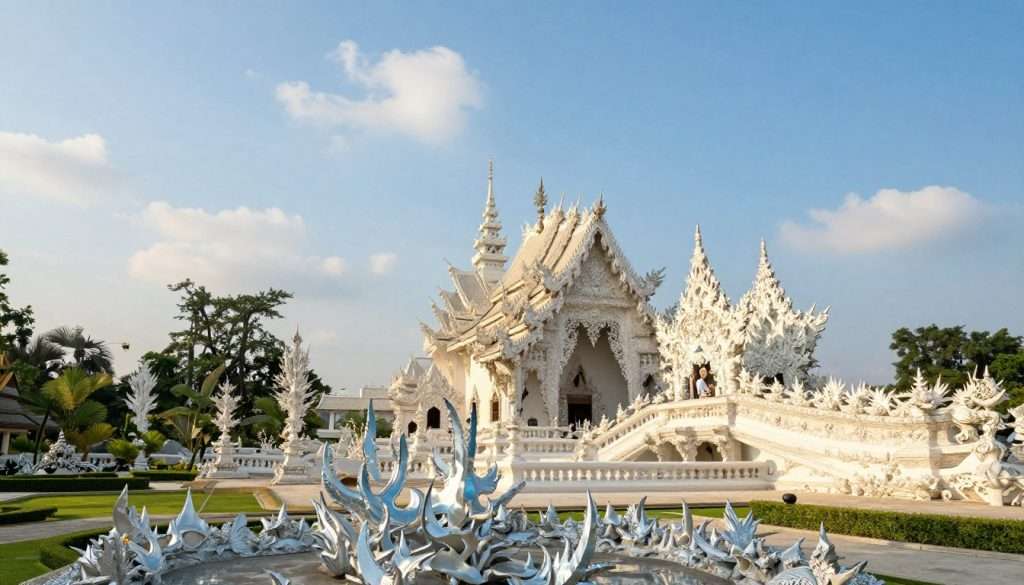
When I first saw Wat Rong Khun, I felt I had entered a photograph viewed online many times. Mirrored glass in the white plaster caught afternoon sun and scattered tiny flashes across the courtyard. I had studied this scene in old travel blogs, but its delicate structure surprised me up close.
That fragility explains why wat rong khun seismic preservation is closely watched across Southeast Asia. The temple’s flame-shaped spires and hand-carved plaster were not built for modern seismic activity. Engineers behind Chiang Rai’s 2050 vision knew one strong tremor could crack decades of painstaking artistry.
So they chose a coating system that protects every detail without changing what lies beneath.
Non-Invasive Mineral Masonry Glazes for Fragile Flame Spires
I think of non invasive mineral masonry glazes as an invisible raincoat for the temple. The glaze rests on original lime plaster without soaking in, bonding, or reacting with it. It flexes during ground movement, absorbing seismic stress before it reaches the fragile spires.
Conservators apply the glaze in microscopic layers and check that mirrored glass inlays remain untouched. The goal is protection without disguise It keeps every carved flame and naga scale as artist Chalermchai Kositpipat intended.
| Feature | Traditional Plaster Repair | Non-Invasive Mineral Glaze |
|---|---|---|
| Contact with original surface | Direct bonding, often irreversible | Zero chemical bonding |
| Seismic flexibility | Rigid, prone to cracking | Flexes with minor ground shifts |
| Reversibility | Difficult to remove | Fully reversible |
| Visual impact | Can dull white finish | Preserves original shine |
Breathable Nano-Mineral Consolidants vs. Tropical Mold and Luminescence Loss
Chiang Rai’s humidity is relentless, and mold loves lime plaster almost as much as tourists love photographing it. Breathable nano-mineral consolidants help protect the surface.
These consolidants strengthen plaster from within while letting moisture pass through naturally. Trapped humidity often destroys historic plaster faster than mold itself Breathability matters as much as raw strength.
“A conservation material that cannot breathe will eventually destroy the very surface it was meant to save.”
A local guide told me the temple once needed repainting every few years to fight discoloration. Working beneath the surface, nano-mineral consolidants help the flame spires keep their glow longer. They do so without changing a single line of Kositpipat’s original vision.
3. Subsurface Hydrologic Heritage Engineering Along the Kok River
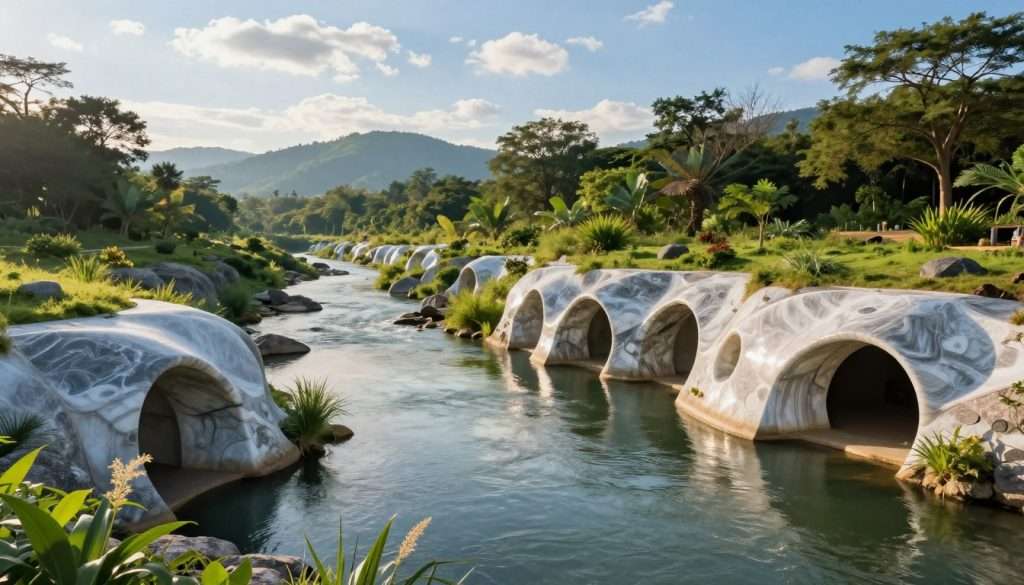
On my first trip through northern Thailand, I watched the Kok River become a real threat overnight. Monsoon rains raised the water fast, and locals piled sandbags near the old town. That memory stayed with me for years.
Walking that riverfront now feels almost unreal. The river still rises each rainy season, but the historic district stays dry. The answer lies below the ground in a system engineers call subsurface hydrologic heritage engineering.
The term sounds technical, but the idea is simple. Hidden vaults run beneath streets near old temples and shophouses. They catch floodwater before it reaches walls, doorways, or centuries-old foundations.
Kok River Flood Sponge: Capturing 100% of Monsoon Runoff
Locals nicknamed the network the Kok River Flood Sponge, and the name fits. It captures 100% of seasonal monsoon runoff before it reaches the historic core.
It works like stadium porous asphalt stormwater drainage systems I have seen back in the States. Water soaks through the surface instead of pooling. Chiang Rai applied that logic underground across an entire river corridor.
Rainwater filters through porous layers and enters retention chambers. It waits there until engineers release it safely downstream. The system absorbs the year’s heaviest storms without overflow or flash flooding through the old streets.
Closed-Loop Reservoir Stormwater Harvesting for the Clock Tower District
What happened to that stored water surprised me most. Near the Clock Tower district, engineers built a closed-loop reservoir stormwater harvesting system. It reuses every drop instead of letting the water drain away.
Captured rain is filtered, stored, and pumped out for irrigation, street cleaning, and neighborhood cooling systems. Nothing is wasted, and the loop keeps the same water working after the storm.
At the base of the old clock tower today, it is easy to forget floods were once a threat. The engineering stays hidden beneath cobblestones and garden beds. That is probably the point.
Heritage preservation once meant fighting nature. Here, it means working with nature, one hidden vault at a time.
4. Zero-Emission Capillary Cooling: Turning Floodwater into Comfort

I still remember when my sandals told me something was wrong—in the best possible way. I stood in the Clock Tower district at noon, ready for the usual furnace blast of a Thai afternoon. Then strange coolness rose from the pavement.
That coolness wasn’t magic; it was engineering linked to the flood sponge system nearby. Every drop of monsoon runoff captured underground gets a second job in Chiang Rai future 2050 planning: keeping people comfortable without burning a single watt of fossil fuel.
How Filtered Runoff Powers the Clock Tower District
The system uses thin capillary tubes buried just beneath the street surface. Filtered floodwater moves slowly through these channels and absorbs heat from the pavement above.
As the water warms, it slowly evaporates through porous stone tiles, pulling heat from the ground. No pumps fight gravity, and no compressors hum in the background. The loop runs on zero-emission pressure differences created by the upstream reservoir system’s elevation.
Engineers call this “passive thermal exchange,” but I call it a sidewalk that doesn’t burn my feet. This small detail changes how the district feels at 1 p.m. in April, historically the hottest stretch of the year.
Rethinking Public Space Without Fossil-Fueled Air Conditioning
Without air conditioning, public spaces start to look different. Market vendors no longer huddle under noisy portable units. Plaza benches stay outdoors instead of moving indoors behind glass and compressors.
I watched families linger at outdoor tables well past noon, something I never saw during earlier visits to northern Thailand. That alone felt like proof the model works.
This shift matters far beyond comfort. Every fossil-fueled AC unit removed from a city block cuts emissions, noise, and electrical strain during peak demand hours. For Chiang Rai future 2050 ideas, this sends a quiet but powerful message: comfort and sustainability can work together.
Cities across Southeast Asia face the same brutal heat, and most rely on air conditioning as the only fix. Chiang Rai shows another path, where floodwater that once threatened the valley now keeps its streets livable.
5. Chiang Rai Valley Haze Mitigation Through Atmospheric Ionization
During my first visit to Chiang Rai in burning season, I could not see past the street’s end. Smoke from crop burning and forest fires settled in the bowl-shaped valley each spring, trapped by surrounding hills. Locals wore masks when they walked to the market.
Doctors reported spikes in respiratory illness every March. Tourists canceled trips or left early, disappointed by views that never appeared. I shared that disappointment, standing where postcards promised mountain views but seeing only gray.
When I returned years later, everything had changed. From a bridge over the Kok River, I saw blue sky reach the peaks. The change came from a bold approach to chiang rai valley haze mitigation.
Atmospheric Ionization Towers and the Fight Against Seasonal Smoke
Imagine giant air purifiers built for an entire valley, not one room. Each structure releases a steady stream of charged ions into surrounding air. Smoke particles pick up that charge and form heavier clusters.
When these clusters become heavy enough, they fall from the sky instead of drifting for miles. Chiang Rai placed dozens of these towers along ridgelines and near known burning zones outside the city. Engineers designed most to run on solar power, so they work around the clock during peak burning months.
A local engineer overseeing part of the network explained it to me plainly during that visit.
“We’re not trying to stop people from burning fields. We’re trying to make sure that smoke never reaches the point where it becomes dangerous to breathe.”
That distinction matters. The towers do not challenge tradition. They clean up afterward quietly and continuously, letting families in the valley open windows in March without covering their faces.
- Passive operation: towers run on solar power with no fuel or emissions involved.
- Wide coverage: placement along ridgelines targets smoke before it spreads across the valley floor.
- Low maintenance: minimal moving parts keep the system running through the entire burning season.
A Model for Smog-Choked Valleys Beyond Thailand
Chiang Rai is not the only bowl-shaped place that traps smoke. Chiang Mai, a few hours south, faces the same seasonal haze each year. Northern Indian valley cities face this struggle: farmers burn stubble in fall and winter, and smog covers regions for weeks.
What makes this valley haze mitigation model appealing is its simplicity. It does not demand that farmers abandon centuries-old practices overnight. Instead, it works with smoke already in the air and clears it before it reaches people’s lungs.
Officials from other provinces have toured the tower network to study its operation. If the technology scales as engineers hope, this quiet valley could teach smog-choked regions worldwide to breathe more easily. It could do so one ionized tower at a time.
6. An Autonomous Solar-Electric Tram Grid for a Cultural Corridor

The last stop on my imagined tour of Chiang Rai future 2050 is one I’d actually want to ride myself.
Instead of another rental scooter or a cramped tuk-tuk, I step onto a driverless tram. It uses solar power and glides along quiet tracks, linking the old town with temples once requiring full-day trips.
No exhaust. No haggling over fares. Just smooth movement through a valley built for people, not engines.
Linking Historic Quarters with Outlying Art Temples
When I first explored northern Thailand, I rented wheels to reach these sites. Wat Rong Suea Ten, the Blue Temple, and Baan Dam, the Black House, meant navigating unfamiliar roads alone.
The new tram grid changes that completely. It threads through the historic quarter, past the clock tower, and toward these outlying art temples. Scattered sites now feel like one connected cultural corridor.
Solar canopies above each platform generate the power these trams need. The whole system runs without pulling extra load from the valley’s main grid. This matters greatly for a region working toward net-zero status.
Riders can hop between stops in minutes instead of hours. A trip that once filled an entire itinerary now fits into one afternoon.
Mobility as an Act of Preservation, Not Just Convenience
Here’s what struck me most: this isn’t only about getting around faster. It’s about protecting what’s fragile.
Constant vehicle traffic near old temple foundations creates vibration damage over time. Diesel exhaust speeds decay on delicate stonework and wood carvings. Each removed car trip means less long-term wear near these sites.
“Preservation isn’t only about materials and craftsmanship. It’s also about how people move through sacred space.”
That idea sticks with me. Mobility becomes a form of respect, not just a way to save time.
For budget travelers like me, who’d rather skip the rental car altogether, this system opens the whole region. There’s no deposit to worry about, no unfamiliar traffic laws to learn, and no getting lost after dark.
My earlier overland trips through the north required planning and caused some stress. Now, this feels like an entirely different way to travel. Chiang Rai future 2050 isn’t just cleaner or greener. It’s simply easier to explore.
7. Conclusion
At sunset, I watched the tram glide past rice fields toward the White Temple from the riverbank. I understood what Chiang Rai had been building all along. The flood sponge, capillary cooling, haze towers, and seismic-safe glazes on the flame spires cannot work alone. Together, they answer one question: how do you protect something sacred when climate itself becomes the threat?
Thailand moved its net-zero target 15 years earlier, from 2065 to 2050, pushing every sector toward faster, cleaner change. Chiang Rai turned that mandate into something people can walk through, not merely read in a policy paper. That is rare. Most climate plans stay abstract, but this valley made its plan tangible.
I’ve traveled through many places, chasing good light and good stories. Few made me rethink what “sustainable” means. Chiang Rai future 2050 isn’t a slogan here. It means drainage channels, ion towers, and solar trams working together. A 700-year-old temple can still catch morning light a century from now.
That is the real lesson I carried away with my camera gear. Chiang Rai redefines artistic heritage longevity, proving a place can fight for its climate future and soul at the same time. It can emerge more beautiful for that.





Leave A Comment